
How to Choose the Right Trademark Class for My Business in India (2026 Guide)
India recorded over 4.7 lakh trademark filings in FY 2024-25, ranking it as the world’s fifth-largest jurisdiction for brand protection. While this growth is exciting, it also means the Trademark Registry is more crowded than ever before. You’ve worked hard to build your brand, so it’s natural to feel anxious about technical errors or choosing the wrong category. Many founders struggle with how to choose the right trademark class for my business because one wrong click can lead to an expensive legal objection or a total loss of your brand’s protection.
It’s frustrating to feel like you’re guessing with your company’s future, especially when government fees and strict deadlines are involved. We’re here to replace that confusion with absolute clarity. This guide simplifies the NICE classification system so you can pick your classes with precision. We’ll explain the difference between goods and services, highlight the 2026 fee updates for startups and companies, and show you how to protect your vision without overspending. By the end, you’ll have a clear roadmap to secure your brand name for the next ten years.
Key Takeaways
- Understand how India utilizes the international NICE Classification system to categorize brands into 45 distinct classes under the Trade Marks Act, 1999.
- Differentiate between Classes 1 to 34 for tangible goods and Classes 35 to 45 for services to ensure your brand has comprehensive legal coverage.
- Master the 5-step strategy for how to choose the right trademark class for my business by aligning your application with current activities and future growth.
- Learn how to leverage Form TM-A for multi-class applications and benefit from lower government fees of INR 4,500 for startups and small enterprises.
- Gain the clarity needed to avoid common Registry objections and secure your brand’s legacy for its 10 year validity period.
What Are Trademark Classes and Why Do They Matter in India?
In the Indian market, a trademark isn’t a universal shield that covers every possible product or service. Instead, brand protection is compartmentalized into specific categories. These categories ensure that the Trademark Registry remains organized and that businesses don’t unfairly monopolize a name across unrelated industries. Understanding how to choose the right trademark class for my business is the first step toward building a legally sound brand identity under the Trade Marks Act, 1999.
This system allows different companies to coexist with identical names, provided they operate in entirely different sectors. For instance, a company named “Eagle” might sell high-end leather boots under Class 25, while another “Eagle” provides cloud-based accounting software under Class 42. Because their customers and markets don’t overlap, the law permits both. However, your protection only extends to the classes you’ve officially registered. If you register your brand for clothing but later start selling perfume without updating your classes, your name remains vulnerable in the fragrance market.
The NICE Classification System in the Indian Context
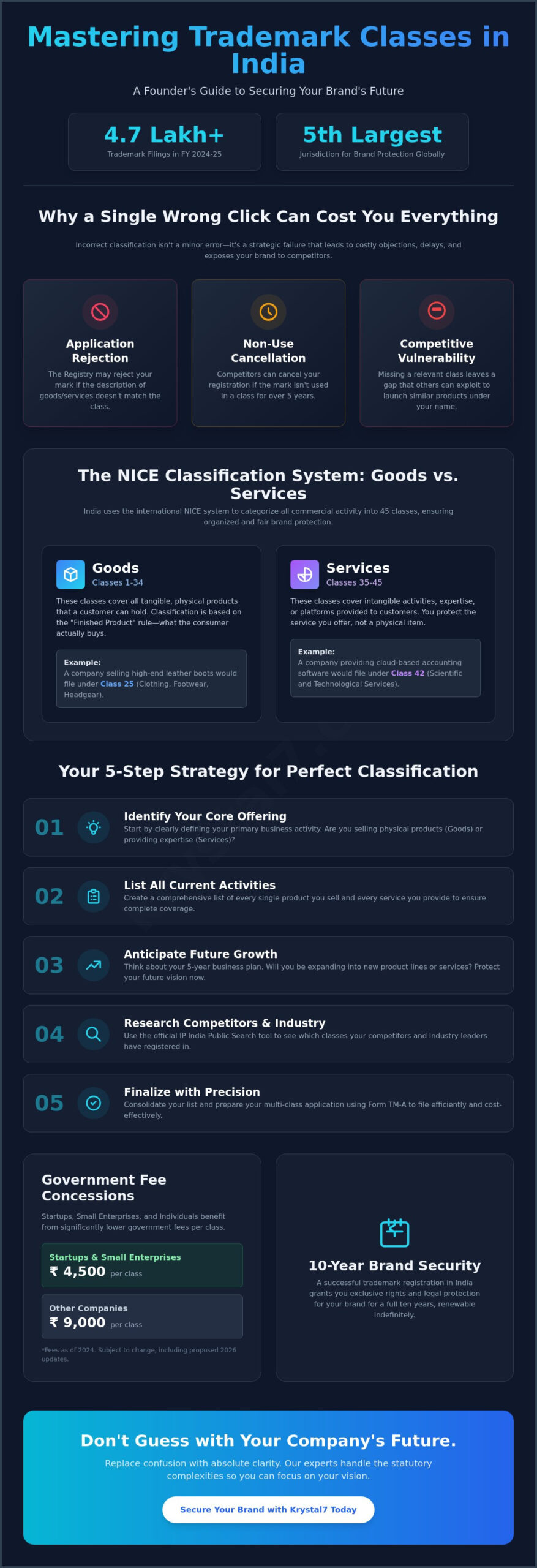
India follows the International (Nice) Classification of Goods and Services to maintain global standards in intellectual property. The NICE Classification is the international standard adopted under the Fourth Schedule to the Trade Marks Rules, 2017. It divides all commercial activities into 45 distinct classes. Classes 1 to 34 cover tangible goods, ranging from chemicals and paints to jewelry and furniture. Classes 35 to 45 are dedicated to services, including advertising, education, and financial advisory.
The Indian Trademark Registry uses this structure to manage its massive public database. When you file an application, the Registrar checks for “confusingly similar” marks within your chosen class. This methodical approach brings crystal clarity to the registration process, ensuring your brand stands on its own merit without infringing on others.
The Legal Risks of Incorrect Classification
Picking the wrong class isn’t just a minor paperwork error; it’s a strategic failure that can halt your business growth. If your application lists an incorrect class, the Registry will likely issue an “Objected” status in your Trademark Examination Report. Resolving these objections requires filing formal replies and potentially attending hearings, which increases your legal costs and delays your registration by months.
- Application Rejection: The Registry may reject your mark if the goods description doesn’t match the class.
- Non-use Cancellation: Under Indian law, if you register in a class but don’t actually use the mark for five years, a competitor can apply to cancel your registration.
- Vulnerability: Missing a relevant class leaves a “gap” that competitors can exploit to launch similar products under your name.
Learning how to choose the right trademark class for my business prevents these expensive hurdles. It ensures your brand is protected exactly where it operates, giving you the freedom to focus on your vision while our experts handle the statutory complexities.
Goods vs. Services: Navigating Classes 1 to 45
The divide between goods and services is the foundation of your filing strategy. Under the NICE classification system, classes 1 to 34 are reserved for tangible products, while classes 35 to 45 cover intangible services. If you sell a physical item that a customer can hold, it’s a good. If you provide expertise, labor, or a platform, it’s a service. Identifying your primary source of revenue helps you decide where to file first to manage your costs effectively.
To get crystal-clear insights, you should visit the official Intellectual Property India portal. Their Public Search tool allows you to see exactly which classes your competitors have chosen. This research is vital when figuring out how to choose the right trademark class for my business because it reveals industry standards you might have missed. Many Indian startups operate as hybrid businesses, meaning they might need protection in both product and service categories to be fully secure.
Classes 1-34: Protecting Your Physical Products
Classes 1 to 34 protect physical products using the “Finished Product” rule. This means you classify based on what the consumer actually buys from you. For example, if you manufacture and sell shirts, you belong in Class 25. If you sell skin creams or perfumes, your home is Class 3. Pharmaceuticals and supplements fall under Class 5.
A common point of confusion for tech founders involves software. If you sell a recorded software product or a downloadable mobile app, it often falls under Class 9 as a “recorded” good. However, the distinction between a product and a service is shifting. Understanding these nuances is a critical part of how to choose the right trademark class for my business.
Classes 35-45: Protecting Your Service Offerings
Classes 35 to 45 cover intangible offerings and professional activities. Class 35 is a popular “catch-all” in India because it covers retail stores, e-commerce marketplaces, and business management. If you’re a professional consultant in Gurgaon, you’ll likely find your home in Class 35 for business advisory or Class 45 for specialized legal and compliance services.
Technology-driven startups often look toward Class 42. This class covers IT services, software development, and Software as a Service (SaaS) models. For those in the education or training sector, Class 41 provides the necessary protection for your brand. If your business model feels like a hybrid, getting a professional trademark search can save you from filing in unnecessary classes while ensuring your core vision is protected.
How to Choose the Right Trademark Class: A 5-Step Process
Selecting the correct category for your brand requires more than a quick glance at a list. It’s a methodical exercise that aligns your legal protection with your commercial reality. When entrepreneurs ask how to choose the right class, they’re often looking for a way to maximize protection while minimizing government fees. Following a structured 5-step process ensures you don’t leave your brand vulnerable to competitors.
- Step 1: Audit your current offerings. Create an exhaustive list of every product you manufacture or service you provide. Don’t leave out secondary activities like maintenance or consulting.
- Step 2: Look into the future. Identify your expansion plans for the next 24 to 36 months. If you’re a Gurgaon-based startup currently offering digital marketing but plan to launch a proprietary software tool, you’ll need to consider multiple classes from the start.
- Step 3: Search the official database. Use the IP India Class Search portal to find where your specific activities land. This helps you understand how to choose the right trademark class for my business by matching your operations to the Registry’s vocabulary.
- Step 4: Analyze revenue drivers. If budget is a constraint, prioritize the classes that generate the majority of your billing. Focus on your primary source of revenue for your initial filing.
- Step 5: Seek expert validation. Finalize your list with a Chartered Accountant or Trademark Attorney. They’ll ensure your descriptions are legally robust and help you avoid common filing pitfalls.
Using the IP India Classification Portal
The Classification of Goods and Services portal is your most valuable research tool. It allows you to search by keyword to find pre-approved descriptions that the Registry already accepts. Using these standardized terms can significantly speed up the examination process. Avoid vague descriptions like “general business activities” at all costs. Such language often triggers formal objections from the Registrar, leading to unnecessary delays and additional professional fees.
The “Future-Proofing” Strategy for Startups
Startups must balance their current budget with their long-term vision. It’s often wise to register for classes you intend to enter within the next 12 months. In your application, you can mark these as “Proposed to be Used” if you haven’t launched them yet. This secures your priority date before a competitor can jump in. Remember that intellectual property is a core business asset. It’s helpful to include an IP audit as part of your annual compliance for Private Limited Company to ensure your filings stay updated as you grow.
Getting these steps right today gives you the freedom to focus on scaling your venture tomorrow. If you’re feeling overwhelmed by the technical jargon, our legal strategists can help you identify exactly how to choose the right trademark class for my business with crystal-clear precision.
Multi-Class Applications and Fee Concessions in India
Protecting your brand across different sectors doesn’t have to be a financial burden. The Indian Trademark Registry offers significant fee concessions that make comprehensive protection accessible for early-stage ventures. When planning how to choose the right trademark class for my business, you must consider the legal entity type you’re using for the filing. Individual founders often pay 50% less in government fees than large corporate entities during the initial phase of their journey.
The standard process involves filing Form TM-A through the comprehensive e-filing portal. For large companies and LLPs, the government fee for online filing is INR 9,000 per class. If you’re an individual, a registered startup, or a small enterprise, this fee drops to INR 4,500 per class. These savings allow you to secure multiple classes without overstretching your initial capital. It’s a methodical way to build a robust legal perimeter around your brand name from day one.
MSME and Startup India Benefits
Claiming your 50% fee reduction is straightforward if you have the right documentation. You’ll need to provide your Udyam Registration Certificate to prove your status as a small enterprise. If your venture is recognized by the DPIIT under the Startup India scheme, you can also benefit from fast-track examination and lower professional costs. If you’re still in the early stages of setup, you can follow our guide on how to register business in India to secure your MSME status before filing your trademark.
When to File Multiple Applications vs. One Multi-Class App
Form TM-A allows you to include several classes in a single application. This multi-class approach is efficient and keeps your trademark portfolio organized. However, it carries a specific risk that many entrepreneurs overlook. While multi-class apps are convenient, an objection in one class can sometimes stall the entire registration. If one category faces a hurdle, the Registry may hold back the certificates for all other classes in that application.
- Single Class Apps: Offer faster resolution. If one class is contested, the others can proceed to registration independently.
- Multi-Class Apps: Save on professional filing fees and administrative paperwork. They’re ideal when your classes are closely related and unlikely to face conflict.
Deciding between these two paths is a critical part of how to choose the right trademark class for my business. Our expert trademark consultants can analyze your specific industry risks to recommend the safest filing strategy for your brand.
Securing Your Brand with Krystal7: Expert Trademark Advisory
Building a brand is a visionary act. Protecting it requires a methodical and defensive strategy. While this guide explains how to choose the right trademark class for my business, the actual filing involves navigating the complex Trade Marks Rules, 2017. Krystal7 brings crystal clarity to this process, ensuring your application is robust from the moment it hits the Registry’s database.
Our end-to-end service begins with a comprehensive search report. We don’t just look for identical names; we analyze the IP India database for phonetically similar marks that could trigger a rejection. This strategic foresight is often paired with our expertise in Company Registration in India. By aligning your corporate structure with your intellectual property strategy, we give you the freedom to focus on scaling your venture while we handle the red tape.
Expert Guidance on How to Choose the Right Trademark Class for My Business
The journey doesn’t end once you submit your application. The Trademark Registry often issues examination reports that might flag your mark as “Objected.” Our team of Chartered Accountants and legal strategists specializes in drafting precise, law-based replies to these reports. We provide professional hearing representation before the Registrar to defend your brand’s uniqueness. We actively monitor your application status on the IP India portal so you never miss a critical four-month opposition window.
Intellectual property is a valuable intangible asset that adds significant value to your company’s valuation. We ensure your trademarks are correctly documented and reflected during your Annual Compliance for a Private Limited Company. This integrated approach ensures that your legal protection, statutory filings, and financial reporting remain in perfect sync as your business grows.
Get Started with Krystal7 Today
We believe in transparency as a core brand pillar. You’ll receive clear, upfront pricing with no hidden costs for your trademark filings or search reports. You gain direct access to elite experts who understand the Indian regulatory landscape inside out. We handle the complexity of the NICE classification system so you can pursue your passion with total peace of mind.
Mastering how to choose the right trademark class for my business is easier with a partner who cares about your long-term legacy. Don’t leave your brand’s future to guesswork or technical errors. Contact Krystal7 Consultants today at business@krystal7.com or visit krystal7.com to secure your brand with absolute clarity and professional expertise.
Secure Your Brand’s Legacy with Absolute Clarity
Your brand name is one of your most valuable commercial assets. Mastering how to choose the right trademark class for my business ensures your intellectual property remains a shield against competition rather than a liability in the Registry. By leveraging MSME fee concessions and using standardized NICE descriptions, you build a robust legal foundation while keeping your costs low. It’s about protecting your current revenue and your future vision simultaneously.
Krystal7 Consultants has earned the trust of 500+ Indian entrepreneurs through our chartered expertise in Indian IP Law. We provide transparent, upfront pricing so you can scale your venture without the fear of hidden legal costs. Our team handles the meticulous details of classification and Registry monitoring, giving you the freedom to focus on your growth.
Ready to protect your brand? Contact Krystal7 Consultants for expert Trademark Registration. Your business dream deserves crystal-clear protection, and we’re here to help you thrive.
Frequently Asked Questions
What happens if I choose the wrong trademark class for my business in India?
Choosing the wrong class results in a Trademark Examination Report with an “Objected” status. You can’t change the class after the application is submitted, so you’ll have to file a fresh application and pay the government fees again. This error leaves your actual business activities unprotected while wasting time and capital on an incorrect category that won’t hold up in court.
Can I add more classes to my existing trademark application later?
No, you cannot add additional classes to an application once it’s filed with the Registry. You must submit a completely new application for any new classes you want to cover. This is why learning how to choose the right trademark class for my business during the planning phase is so important. It prevents the need for multiple filings and extra government fees of INR 4,500 or INR 9,000 per class.
How many trademark classes should a typical Indian startup register in?
Most Indian startups find adequate protection by registering in one to three classes. For instance, a fintech venture might choose Class 36 for financial services and Class 42 for its software platform. When you’re deciding how to choose the right trademark class for my business, focus on your primary revenue drivers first. Registering in too many classes increases costs without adding meaningful protection if you don’t actually operate in those sectors.
Is the government fee for trademark registration the same for all classes?
Yes, the government fee is uniform across all 45 classes, but the Registry charges it on a per-class basis. For online filings in 2026, individuals, startups, and small enterprises pay INR 4,500 per class. Large companies and LLPs pay INR 9,000 per class. If a startup files for three classes, the total government fee will be INR 13,500.
What is the difference between Class 35 and Class 42 for a software company?
Class 35 covers business activities like retail, advertising, and e-commerce marketplaces, while Class 42 is for technical services like software development and SaaS. A software company selling a product via its own platform often needs both. Class 42 protects the core technology, and Class 35 protects the commercial retail aspect of the brand.
Do I need a separate trademark for my logo and my brand name?
You can file a single “Device Mark” to protect the logo and name together, but filing a “Word Mark” for the name alone offers broader protection. A Word Mark protects the brand name regardless of its design or font. Many founders choose the Word Mark first because it allows them to update their logo design later without needing a new trademark registration.
How long does a trademark registration last in India before renewal?
Trademark registration in India remains valid for 10 years from the date you file the application. You can renew it indefinitely every 10 years by paying the renewal fees. For online renewals in 2026, the fee is INR 9,000 for large companies and INR 4,500 for individuals or small entities per class. Missing the renewal deadline can lead to the removal of your mark from the Registry.
Can I register a trademark in all 45 classes to be fully protected?
Technically you can, but it’s highly discouraged because Indian law requires a genuine “intent to use” the mark in every registered class. If you register in classes where you don’t operate, competitors can file a “Non-use” cancellation petition after five years to remove your mark. It’s also very expensive, costing a small enterprise over INR 2,00,000 in government fees alone to cover the entire NICE system.

Article by
Nihal Srivastava
Nihal Srivastava is the Co-Founder of Krystal7 Consultants, helping Indian entrepreneurs and startups navigate company registration, compliance, trademark protection, and regulatory requirements with clarity and confidence. With 6+ years of hands-on expertise in MCA filings, GST compliance, and corporate structuring, Nihal has guided 1000+ businesses across India through their legal and compliance journeys. He believes every business dream deserves crystal clear foundations, and that no founder should be held back by paperwork or red tape.