

Justifying the Cost of a Business Consultant: A Guide to ROI
The price tag on an expert business consultant can feel more like a roadblock than a runway for growth. It’s a number that immediately sparks doubt: “Is this worth it?” “Can’t my team handle this?” “What if the advice doesn’t work?” This uncertainty makes justifying the cost of a business consultant one of the toughest decisions a leader can face. The fear of a costly mistake often leads to inaction, leaving valuable opportunities untapped and persistent problems unsolved.
This guide is designed to replace that guesswork with Krystal-Clear confidence. We will provide a straightforward framework to help you shift your perspective from a daunting expense to a powerful strategic investment. You will learn exactly how to calculate the tangible return on investment (ROI) a consultant can deliver, empowering you to know when hiring an expert is not just a valid expense, but the most profitable decision you can make for your company’s future.
Key Takeaways
- Shift your perspective from viewing a consultant as a business expense to seeing them as a strategic investment catalyst for sustainable growth.
- Discover a clear framework to calculate both the tangible financial returns and the invaluable strategic benefits of expert business advisory.
- The key to justifying the cost of a business consultant lies in identifying specific operational or financial areas where their expertise will generate a measurable return.
- Learn actionable criteria for vetting and selecting the right consultant, ensuring they are aligned with your vision and equipped to deliver a positive impact.
Shifting Your Mindset: From a Cost Center to an Investment Catalyst
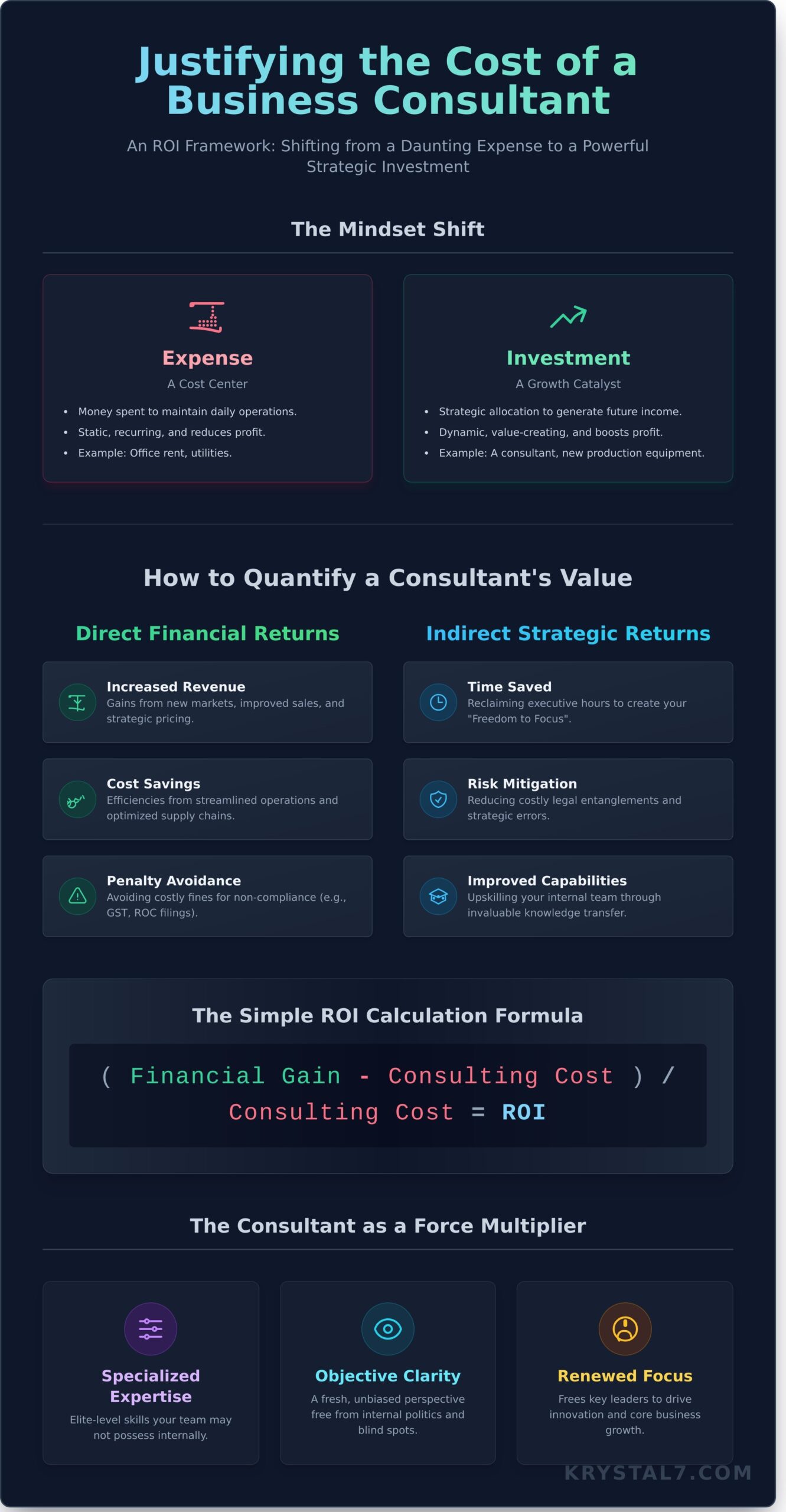
Let’s address the primary hurdle for any business leader considering external help: the price tag. It’s easy to view a consultant’s fee as a significant, and perhaps prohibitive, expense. However, this perspective overlooks a fundamental truth. The most crucial step in justifying the cost of a business consultant is to shift your mindset entirely-from seeing them as a cost center to understanding their role as an investment catalyst. The right consultant doesn’t cost you money; they create a clear path to make you more.
The Critical Difference Between an Expense and an Investment
An expense, like office rent or utilities, is money spent to maintain your daily operations. An investment, on the other hand, is a strategic allocation of resources designed to generate future income and growth. A business consultant falls squarely into the latter category. You aren’t just paying for advice; you are investing in streamlined processes, expert strategy, and a clear path to greater profitability. Think of it like purchasing new equipment that doubles your production capacity-the upfront cost is quickly overshadowed by the long-term returns.
Calculating the ‘Cost of Inaction’: What You Lose by Waiting
Before you evaluate a consultant’s proposal, you must first calculate a different, more significant figure: the cost of inaction. This is the money your business is already losing by not solving a critical problem. Ask yourself: How much potential revenue is lost each month due to an inefficient process? How many valuable hours does your team waste on tasks that could be optimized? What is the financial risk of a strategic mistake or compliance oversight? This hidden drain on your resources is the true baseline for evaluating a consultant’s fee.
How a Consultant Acts as a Force Multiplier
A skilled consultant does more than just solve a problem; they act as a force multiplier for your entire organization. The field of management consulting is built on providing this external leverage. Specifically, a consultant delivers:
- Specialized Expertise: They provide elite-level skills in areas like finance, operations, or marketing that your team may not possess internally.
- Objective Clarity: Free from internal bias and company politics, they offer a fresh, unbiased perspective that can uncover blind spots and challenge ineffective traditions.
- Renewed Focus: By tackling complex challenges, they give your key leaders the freedom to focus on their core responsibilities-driving innovation and growing the business.
The ROI Framework: How to Quantify a Consultant’s Value
Moving beyond a “gut feeling” is essential when evaluating a significant business investment. A data-driven framework brings Krystal-Clear clarity to the decision, transforming the process of justifying the cost of a business consultant from a leap of faith into a strategic exercise. This approach not only helps you make a confident choice but also sets measurable expectations for success from day one.
Calculating Direct Financial Returns
The most tangible value a consultant delivers can be seen directly on your profit and loss statement. These are the hard numbers that build a compelling business case. Key areas include:
- Increased Revenue: Gains from entering new markets, improving sales processes, or implementing strategic pricing.
- Cost Savings: Efficiencies found by streamlining operations, reducing waste, or optimizing supply chains.
- Penalty Avoidance: The quantifiable cost of fines for non-compliance (e.g., Goods and Services Tax, Registrar of Companies filings) that expert guidance helps you avoid entirely.
Measuring Indirect (But Powerful) Returns
Not all value is measured in rupees. A great consultant provides strategic advantages that compound over time, strengthening the very foundation of your venture. These powerful, long-term gains include:
- Time Saved: Reclaiming valuable executive and employee hours to focus on innovation and core business growth—your freedom to focus.
- Risk Mitigation: Reducing the likelihood of costly legal entanglements or strategic errors that could derail your vision.
- Improved Capabilities: Upskilling your internal team through invaluable knowledge transfer and new processes.
A Simple ROI Calculation Formula to Use
To bring these factors together, use a straightforward formula. Some consultants are so confident in their impact that their fee structures are built around performance, a model detailed in discussions about ROI-based consulting contracts. For your own analysis, start here:
(Financial Gain – Consulting Cost) / Consulting
Key Areas Where Consultants Deliver Clear, Justifiable ROI
The concept of ROI can feel abstract. But when applied to specific business challenges, its value becomes crystal clear. A consultant isn’t just a source of advice; they are a strategic partner who delivers tangible results where it matters most. For many entrepreneurs, justifying the cost of a business consultant becomes simple when they see their own struggles reflected in these common scenarios.
Strategic Planning & Growth
Operating without a clear strategy is like navigating without a map-it wastes time, burns resources, and relies on guesswork. A consultant provides an objective, data-driven perspective to build a robust roadmap for your vision. They help you:
- Analyze market trends to uncover new, profitable revenue streams.
- Define achievable long-term goals with clear, actionable steps.
- Make critical growth decisions backed by data, not just intuition.
Navigating Complex Compliance & Regulations
This is where the ROI is often most direct and undeniable. Consider the potential penalties and legal hassles from a single GST or MCA filing mistake versus the cost of an expert ensuring it’s done right the first time. Proper company registration and ongoing compliance are not administrative burdens; they are the foundation of a secure and scalable business. This is where chartered expertise provides immediate peace of mind and long-term protection for your venture.
Improving Operational Efficiency
Inefficiency is a silent profit killer. It shows up as wasted hours, redundant tasks, and frustrated teams. A consultant acts as a fresh pair of eyes, identifying the hidden bottlenecks in your daily processes that drain your budget and energy. By streamlining workflows, implementing smarter technology, and optimizing your team structure, they help you reclaim valuable resources, giving you the freedom to focus on what you do best: growing your business.
In each of these areas, the right partnership transforms an expense into a high-yield investment. It’s about trading complexity for clarity, risk for security, and stagnation for growth. Discover how Krystal7 Consultants’ advisory services can provide the clarity you need to thrive.
How to Choose a Consultant Who Guarantees a Positive Return
The success of a consulting engagement hinges on one critical factor: choosing the right partner. The fear of investing significant capital without a guaranteed return is valid, but it can be mitigated with a structured and diligent selection process. Ultimately, justifying the cost of a business consultant begins long before you sign a contract; it starts with asking the right questions and demanding total clarity.
Armed with a clear framework, you can confidently select an advisor who will become a genuine asset, not an expense. Here’s how to ensure your investment drives measurable growth and gives you the freedom to focus on what you do best.
Essential Questions to Ask Before You Hire
Move beyond the sales pitch and dig into the specifics of their experience and process. A true expert will welcome detailed questions and provide transparent answers. Be sure to ask:
- Relevant Experience: Can you provide examples of how you’ve solved similar problems for businesses in our industry or of our size?
- Proven Results: Do you have case studies or client references that demonstrate measurable outcomes, such as revenue growth, cost savings, or efficiency improvements?
- Defining Success: How will you define and measure success for this specific project? What metrics will we track?
- Communication Protocol: What is your process for communication and reporting? How often will we connect, and what format will updates take?
Red Flags in a Consulting Proposal
A professional proposal should provide clarity, not create more questions. Watch for warning signs that suggest a lack of experience or transparency. Be wary of any consultant who presents:
- Vague Deliverables: Ambiguous promises like “improve marketing” or “optimize operations” without specific, actionable steps.
- Unclear Timelines: A scope of work that lacks firm milestones, deadlines, or a clear project end date.
- Guarantees That Sound Too Good to Be True: High-pressure tactics or outlandish promises of guaranteed results should be met with skepticism.
- Opaque Pricing: A refusal to provide a detailed cost breakdown or the presence of potential hidden fees.
Setting Clear KPIs and Milestones for Success
The foundation of a successful partnership is a shared understanding of what you aim to achieve. Before work begins, collaborate with your chosen consultant to establish a clear roadmap. This is the final step in justifying the cost of a business consultant to yourself and your stakeholders. Ensure the contract codifies this by tying payments to the achievement of specific milestones or the delivery of key reports. This aligns incentives and ensures you only pay for tangible progress.
This commitment to accountability and transparency is at the core of how we work at Krystal7. Discover our Krystal-Clear process and transparent pricing.
Clarity on Your Next Investment: The True Value of a Consultant
Ultimately, justifying the cost of a business consultant is about shifting your perspective from an expense to a strategic investment catalyst. As we’ve explored, their value is not abstract; it’s a measurable return on investment found in streamlined operations, accelerated growth, and mitigated risks. The key lies in selecting a partner with a transparent framework for success.
Making that investment with confidence requires a partner who embodies clarity and expertise. At Krystal7, our team of Chartered Accountants and legal strategists provides precisely that. We eliminate the guesswork with Krystal-Clear transparent pricing and a dedicated relationship manager who knows your business, ensuring your investment is not just justified, but maximized for long-term growth.
Your business deserves a clear path to thrive. Don’t let uncertainty hold your vision back. Get Krystal-Clear guidance to ensure your next investment drives growth.
Frequently Asked Questions
How much do business consultants typically charge in India?
In India, business consultant fees vary widely based on expertise. Junior consultants may charge ₹1,500-₹3,000 per hour, while seasoned experts from top firms can command ₹8,000-₹20,000 or more. Project-based fees for a specific outcome, like a market analysis, could range from ₹1 lakh to over ₹10 lakhs. This variation underscores the importance of aligning the consultant’s experience with your project’s complexity and budget, ensuring you get clear, actionable value for your investment.
What is the difference between hiring a consultant and a full-time employee?
A consultant provides specialized, external expertise for a specific project, offering an objective viewpoint without the overheads of a full-time employee like PF, benefits, and long-term commitment. An employee is integrated into your daily operations for a broader, ongoing role. Hiring a consultant is a strategic investment for targeted challenges, while an employee builds your long-term internal capacity. The choice depends entirely on your immediate needs and long-term growth vision.
Is it better to pay a consultant an hourly rate or a fixed project fee?
Choosing between hourly and fixed-fee models depends on your project’s scope. A fixed project fee is ideal for well-defined outcomes, such as developing a business plan or a digital marketing strategy, as it provides absolute cost clarity and predictability. An hourly rate offers more flexibility for projects with evolving needs or for ongoing advisory services where the total time commitment is uncertain. For entrepreneurs, a fixed fee often removes the guesswork and aligns payment directly with deliverables.
How long should a typical consulting engagement last?
The duration of a consulting engagement is tailored to the project’s goals. A specific, tactical project like a financial model review might only take 2-4 weeks. More comprehensive strategic initiatives, such as process re-engineering or market entry planning, typically last between 3 to 6 months. The objective is always to achieve the defined milestones efficiently, providing impactful results without creating long-term dependency. A clear scope ensures the engagement is both time-bound and effective.
Can a small startup or new business really afford a consultant?
Absolutely. For a startup, justifying the cost of a business consultant is about strategic, short-term investment, not a permanent expense. Instead of a lengthy engagement, a new business can hire a consultant for a high-impact project like securing initial funding, creating a go-to-market strategy, or setting up streamlined financial processes. This targeted expertise provides a critical foundation for growth and can offer a significant return, making it a highly affordable and wise decision for ambitious ventures.
How do I measure the success of a consulting project after it’s completed?
Measuring success starts before the project begins by defining clear Key Performance Indicators (KPIs). These should be tangible metrics tied to your business goals. Examples include a 15% increase in lead conversion, a 20% reduction in operational costs, or securing a specific funding amount. After the project, you compare the ‘before’ and ‘after’ data against these KPIs. This data-driven approach is the most effective way of justifying the cost of a business consultant and confirming a clear return on your investment.

Article by
Nihal Srivastava
Nihal Srivastava is the Co-Founder of Krystal7 Consultants, helping Indian entrepreneurs and startups navigate company registration, compliance, trademark protection, and regulatory requirements with clarity and confidence. With 6+ years of hands-on expertise in MCA filings, GST compliance, and corporate structuring, Nihal has guided 1000+ businesses across India through their legal and compliance journeys. He believes every business dream deserves crystal clear foundations, and that no founder should be held back by paperwork or red tape.