

How Many Directors are Required for a Pvt Ltd Company in 2026?
What if your 2026 business launch is halted by a single missing signature or a misunderstood residency rule? Most visionaries feel overwhelmed by the Companies Act and its 470 sections of complex legal jargon. It’s natural to feel anxious about compliance penalties that can exceed 50,000 rupees for simple filing errors. You need a clear answer on exactly how many directors are required for pvt ltd registration to ensure your incorporation journey remains seamless and secure.
We believe every business dream deserves crystal clarity, not a maze of red tape. This guide provides the professional reassurance you need by detailing the statutory minimums and the crucial 182 day residency requirement for board members. You’ll gain a methodical understanding of the eligibility criteria for a Director Identification Number and Digital Signature Certificate. We handle the technical complexity so you have the freedom to focus on building your legacy with absolute confidence.
Key Takeaways
- Understand the statutory requirements of Section 149(1), which mandates a minimum of two directors to kickstart your Indian company with crystal clarity.
- Learn the essential eligibility criteria for board members, including the absolute necessity of a Director Identification Number (DIN) for all natural persons appointed.
- Navigate the governance structure to clarify how many directors are required for pvt ltd companies and how to balance roles between owners and managers.
- Master the legal procedure for scaling your board beyond 15 members through Special Resolutions and mandatory filings with the Registrar of Companies.
- Discover how to secure the “Freedom to Focus” on your vision by streamlining the entire incorporation process with expert-led compliance support.
Minimum and Maximum Number of Directors for a Private Limited Company
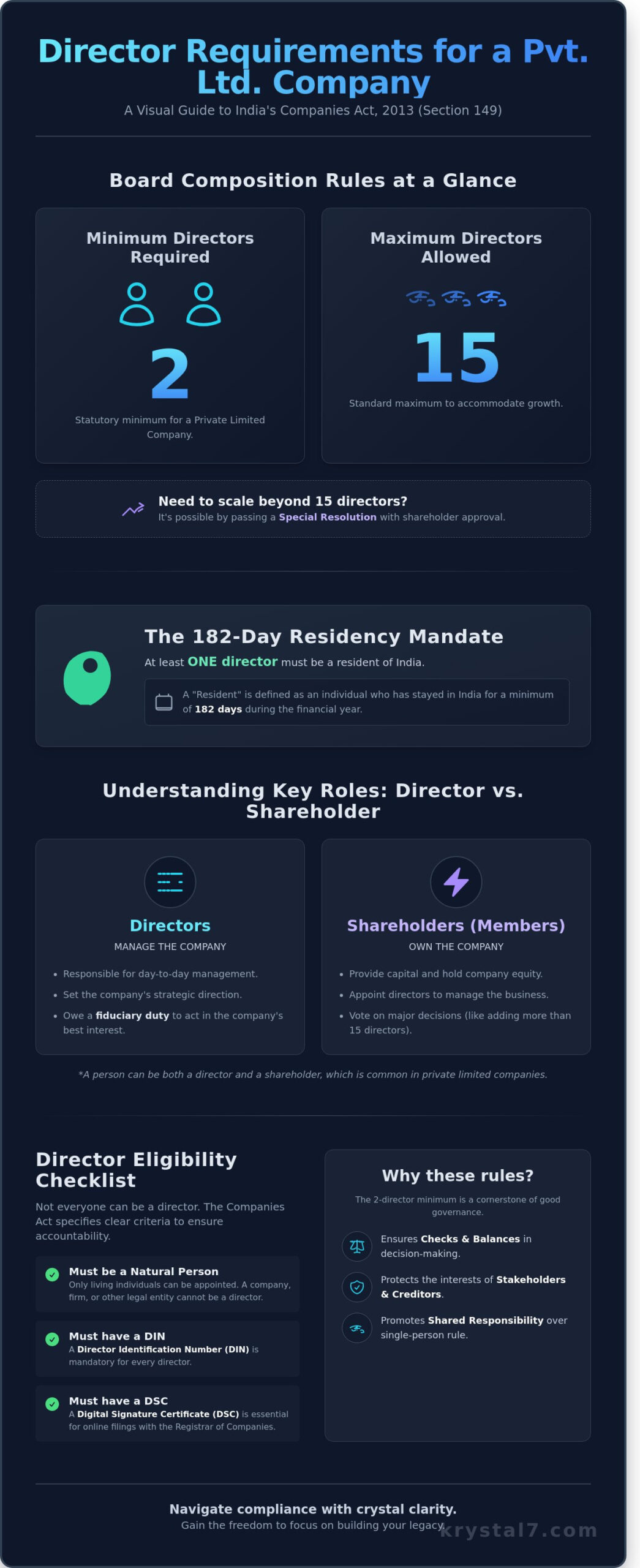
Establishing a business requires more than just a vision; it demands a clear understanding of the legal framework that keeps your operations compliant. For entrepreneurs looking into how many directors are required for pvt ltd entities, the answer lies within the rigorous standards of the Companies Act, 2013. This legislation serves as the backbone for corporate governance in India, ensuring that every private firm operates with a baseline of accountability. Section 149(1) of the Companies Act 2013 mandates that every private limited company must maintain a minimum of two directors at all times. This statutory requirement isn’t just a hurdle. It’s a foundational step toward building a transparent organization where decision-making isn’t left to a single individual.
While the minimum is set at two, the law provides significant room for growth. A Private Limited Company can appoint up to 15 directors to its board. This ceiling offers ample space for most small to medium enterprises to scale their leadership teams. If a company reaches a stage where 15 directors are insufficient, they can expand further by passing a special resolution. This flexibility allows your leadership structure to evolve alongside your market reach. At Krystal7, we believe that understanding these numbers provides the crystal clarity you need to focus on your core business goals without the anxiety of legal red tape.
Why is the Minimum Set at Two?
The requirement for two directors stems from the “private” nature of the company. Unlike a One Person Company (OPC), a Private Limited Company is built on the concept of shared responsibility. Having two distinct individuals ensures a system of checks and balances. It prevents the centralization of power, which protects the interests of stakeholders and creditors alike. This dual-leadership minimum creates a collaborative environment where strategic choices are vetted by at least two minds, reducing the risk of impulsive or biased governance. Section 149 of the Companies Act 2013 defines the minimum director rule to ensure that every private entity maintains a collective management structure.
The 15-Director Ceiling and Growth
The 15-director limit is a standard benchmark that accommodates the complexity of modern private firms. Most startups begin with two or three directors, often the original founders. As venture capital enters the picture or as the business diversifies into new sectors, the board often expands. Reaching the 15-director cap usually indicates a highly sophisticated corporate structure. The law allows you to exceed this limit if your shareholders approve a special resolution, providing a streamlined path for massive enterprises to maintain compliance while adding elite expertise to their boardrooms. This transition from a tight-knit founding duo to a diverse leadership team is a hallmark of a thriving venture.
Directors vs. Members: Understanding the Governance Structure
A common point of confusion for new founders is the distinction between directors and members. Members, also known as shareholders, are the owners of the company. They provide the capital and hold equity. Directors, on the other hand, are the officers responsible for the day-to-day management and strategic direction. While a Director (business) often holds shares in a private company, it’s not a legal requirement unless the company’s Articles of Association state otherwise.
In many pvt ltd setups, the two directors are the only two shareholders. However, they must fulfill different statutory duties in each role. Directors owe a fiduciary duty to the company, meaning they must act in its best interest, regardless of their personal shareholding. Understanding how many directors are required for pvt ltd compliance is just the first step. You must also ensure at least one director is a resident of India, having stayed in the country for at least 182 days during the financial year. This residency rule adds another layer of accountability, ensuring that the authorities have a local point of contact for legal and tax matters. By keeping these roles and requirements clear, you gain the freedom to focus on your legacy while we handle the meticulous details of your compliance journey.
Eligibility and Statutory Requirements: Who Can Be a Director?
The Companies Act 2013 is specific about who can lead a business. Only natural persons, meaning living individuals, can hold a directorship. You cannot appoint another company, a partnership firm, or a legal entity to your board. This rule ensures that there is always a human being held accountable for the company’s actions. While you are calculating how many directors are required for pvt ltd setups, you must first verify that your candidates are at least 18 years old and possess the legal capacity to enter into contracts. Nationality doesn’t limit eligibility, but it does change the documentation process.
Before any paperwork is filed, every director must obtain a Director Identification Number (DIN). This is a permanent 8-digit identification code issued by the Ministry of Corporate Affairs (MCA). Alongside this, a Class 3 Digital Signature Certificate (DSC) is mandatory. Since the MCA moved to a 100% digital filing system in 2006, these tools are the only way to authenticate identity on statutory forms. If you’re an international founder, these requirements apply to you as well, regardless of your residency status.
Legal compliance begins with choosing the right people. According to the DIRECTORS UNDER THE COMPANIES ACT, 2013, the baseline for entry is strictly monitored. You don’t need a specific educational background or a minimum shareholding to be a director unless your company’s Articles of Association say otherwise. However, you do need a clean legal record to pass the initial screening process. This transparency is what builds investor confidence from the moment of incorporation.
The Resident Director Rule: A Critical Requirement
Every Indian company must have at least one director who is a resident of India. To qualify, this person must have stayed in the country for a minimum of 182 days during the previous financial year. For foreign companies launching an Indian subsidiary, this is often the biggest hurdle. You can’t simply fly in for a week and claim residency. At Krystal7, we provide Crystal Clarity for international founders navigating this rule, helping you find reliable local representation so you have the Freedom to Focus on your global strategy. Understanding how many directors are required for pvt ltd entities includes planning for this specific residency mandate from day one to avoid delays in bank account opening or GST registration.
Director Disqualifications to Avoid
Section 164 of the Companies Act 2013 lists several red flags that can strip a person of their eligibility. If an individual is of unsound mind, an undischarged insolvent, or has been convicted by a court for an offense involving moral turpitude with a sentence of 6 months or more, they are barred from the board. These disqualifications aren’t just local; they impact a director’s standing across all companies they serve. It is vital to conduct thorough background checks before extending an invitation. If you’re unsure about a candidate’s status, you can consult our compliance experts to verify their eligibility and protect your company’s reputation. Meticulous vetting ensures your board remains a pillar of strength rather than a legal liability.
Directors vs. Shareholders: Understanding the Governance Structure
Ownership and management are two distinct pillars in a corporate entity. Shareholders are the owners who provide capital, while directors are the professionals who steer the ship. In the early stages of a startup, these roles often overlap. A single founder frequently acts as both the majority shareholder and the sole or lead director. However, the law remains strict about the minimum headcount. When you ask how many directors are required for pvt ltd, the answer is always at least two. This ensures a system of checks and balances from day one. It’s a structure designed to protect the company’s interests even if one person holds all the equity.
Directors carry a heavy legal burden known as fiduciary duties. They must act in good faith, exercise reasonable care, and prioritize the company’s welfare over their personal gain. These aren’t just suggestions; they’re statutory requirements. The Institute of Company Secretaries of India (ICSI) provides the framework for these governance standards, ensuring that directors remain accountable to the shareholders who appointed them. If a director fails to meet these standards, they face personal liability, which is why 92% of seasoned founders seek professional compliance support during their first year of operations.
Management vs. Ownership Roles
Directors handle the day-to-day strategic decisions, such as hiring key executives, approving budgets, and signing contracts. Shareholders, on the other hand, hold the ultimate power to change the company’s constitution or approve major structural shifts. They exercise this power through voting rights. While a director might manage a 1.2 million dollar budget, they still answer to the shareholders during the Annual General Meeting. This separation creates the clarity needed for long-term scaling.
| Criteria | Directors | Shareholders |
|---|---|---|
| Role | Operational Management | Capital Ownership |
| Appointment | Elected by Shareholders | Purchase of Equity |
| Primary Goal | Strategic Growth & Compliance | Return on Investment (ROI) |
The All-in-One Package Approach
Krystal7 simplifies the complexity of dual roles by managing documentation for both appointments and share issuances in one streamlined workflow. We know that founders need the “Freedom to Focus” on their product rather than getting lost in the 2013 Companies Act. Our experts ensure that your board meetings and member registers are updated in under 48 hours, keeping your records krystal-clear for future audits. We help you maintain 100% transparency between your board and your investors, which is crucial for building trust.
A well-structured board is a magnet for venture capital. Investors typically look for a board that balances founder vision with independent oversight. When you clearly define how many directors are required for pvt ltd and fill those seats with competent individuals, you signal maturity to the market. Most Series A investors expect to see at least one independent director or an observer seat. By setting up a professional governance structure early, you’re not just following the law; you’re preparing your business for a successful multi-million dollar funding round.
Scaling Your Board: Appointing and Removing Directors
Managing a board involves more than just filling seats. It’s a strategic move to bring in chartered expertise or legal strategists who can guide your venture toward long-term growth. While the initial question of how many directors are required for pvt ltd usually focuses on the statutory minimum of two, your vision might eventually push you toward the legal limit of 15. Scaling beyond this number isn’t impossible, but it requires a methodical approach to stay compliant with the Ministry of Corporate Affairs (MCA).
The process of adding or removing leadership is a significant governance event. Every change must be documented with precision to avoid the scrutiny of the Registrar of Companies (ROC). At Krystal7, we believe in providing the clarity you need to handle these transitions without losing momentum. Whether you’re a startup adding its first external advisor or a scaling enterprise restructuring its leadership, the legal steps remain the same.
The Special Resolution Process
A Special Resolution is a formal decision made by shareholders where the votes cast in favor are at least three times the votes cast against. This 75% majority is the mandatory gateway to expanding your board beyond the standard 15-member cap. Exceeding 15 directors requires a 75% majority vote from shareholders. Once the resolution passes, the company must file Form MGT-14 with the ROC within 30 days to record the change. This process ensures that massive board expansions have the clear, documented mandate of the company’s owners.
Managing Resignations and Removals
Section 168 of the Companies Act 2013 provides the specific framework for voluntary resignations. A director must submit a written notice to the board, and the company is then obligated to inform the ROC. It’s vital to monitor your numbers during these transitions. If a resignation brings your count below the legal requirement, you must appoint a replacement immediately to maintain your status. We’ve seen cases where founders faced heavy penalties because they didn’t realize how many directors are required for pvt ltd to remain in good standing during a leadership shuffle. Krystal7 handles the red tape by tracking your filing deadlines and preparing Form DIR-12 so you don’t face the standard penalty of 100 to 500 rupees per day for late submissions.
Filing Form DIR-12 is the primary way the government tracks who is running your company. Whether you’re adding a new director or noting a removal, this form must reach the ROC within 30 days of the effective date. It requires specific attachments, including a formal consent letter (Form DIR-2) and a declaration that the individual isn’t disqualified (Form DIR-8). Errors in these documents often lead to “Resubmission” statuses, which can stall your business operations. We provide krystal-clear transparency throughout this process, ensuring your records are always accurate and accessible.
The first board meeting after incorporation is your most important compliance milestone. You must hold this meeting within 30 days of receiving your Certificate of Incorporation. During this session, the board usually appoints the first auditors and approves the opening of corporate bank accounts. It’s the moment your business vision gains statutory clarity. Our team ensures every minute is recorded and every resolution is filed correctly, giving you the freedom to focus on your product while we handle the regulatory heavy lifting.
Ready to scale your leadership without the compliance headache? Get expert assistance with your director appointments today.
Streamlining Your Incorporation with Krystal7 Consultants
Setting up a business involves more than just picking a name. Deciding exactly how many directors are required for pvt ltd registration is a foundational step that dictates your corporate governance. At Krystal7, we transform this complex legal requirement into a clear, manageable strategy. We don’t just process paperwork; we provide the “Crystal Clear” guidance founders need to build a stable foundation. Our team has assisted over 1,200 entrepreneurs in 2023 alone, ensuring every board structure meets the strict mandates of the Companies Act while remaining flexible for future growth.
Our All-in-one Company Incorporation Package removes the friction from the startup phase. We manage the entire lifecycle of your application, including:
- Procuring Digital Signature Certificates (DSC) for all proposed directors within 24 hours.
- Securing Director Identification Numbers (DIN) through the Ministry of Corporate Affairs.
- Drafting customized Memorandum and Articles of Association (MOA/AOA) that reflect your specific business goals.
- Executing all ROC filings with a 99.2% first-time approval rate.
Structuring a board is particularly sensitive for foreign subsidiaries or tech startups eyeing venture capital. You need a balance of local compliance and global vision. Our legal strategists provide expert advisory on board composition, helping you understand why having at least one resident director is non-negotiable. We handle the red tape so you can uphold our “Freedom to Focus” promise. While we manage the statutory filings and regulatory hurdles, you’re free to build your legacy and scale your operations without the weight of administrative anxiety.
From Incorporation to Annual Compliance
Launching your company is only the beginning of your regulatory journey. Staying compliant year-round requires meticulous attention to detail and a deep understanding of evolving tax laws. We bridge the gap between initial setup and long-term sustainability through personalized support from our in-house Chartered Accountants. Whether it’s managing your first board meeting minutes or filing annual returns, our experts are always a call away. You can explore our Annual Compliance Services to ensure your business remains in good standing with the authorities, avoiding the 100 rupee per day penalties that often plague neglected firms.
Get Started with Crystal Clarity
Transparency is the cornerstone of the Krystal7 experience. We’ve eliminated the guesswork by offering a simple, three-step onboarding process for new founders. You’ll receive a comprehensive quote that includes all government fees and professional charges, ensuring there are no hidden statutory costs later. Since 2018, we’ve maintained a policy of upfront pricing because we believe trust is built on honesty. Don’t let the technicalities of how many directors are required for pvt ltd formations slow your momentum. Register your Private Limited Company with Krystal7 today and experience the confidence that comes with professional, methodical support.
Build Your Board and Scale Your Vision
Starting a private limited company in 2026 requires a strategic approach to governance. You must appoint a minimum of 2 directors, and at least 1 of these individuals must have resided in India for 182 days or more during the previous financial year. While you can expand your board to 15 members, your focus should remain on selecting leaders who align with your company’s mission. Understanding exactly how many directors are required for pvt ltd is just the beginning of your compliance journey.
Krystal7 removes the guesswork from incorporation. Our elite team of top-tier CAs and CSs provides krystal-clear transparency with upfront pricing and zero hidden fees. Every client works with a dedicated relationship manager to ensure 100% statutory accuracy. We handle the complex legal filings so you have the freedom to focus on building your legacy. It’s time to turn your entrepreneurial dream into a structured reality with experts who care about your success.
Launch your business with Krystal7’s All-in-one Incorporation Package
Frequently Asked Questions
Can a Private Limited Company have only 1 director?
A standard Private Limited Company requires a minimum of 2 directors to remain compliant with Indian law. If you prefer to operate solo, you must register as a One Person Company (OPC) instead. For most entrepreneurs, knowing how many directors are required for pvt ltd is the first step toward building a balanced board of 2 to 15 members. This structure provides the clarity needed to delegate responsibilities effectively.
Is there a maximum limit on the number of directors in a Pvt Ltd company?
The maximum limit for directors in a Private Limited company is 15 individuals. You can expand beyond this 15 member limit by passing a special resolution under Section 149(1) of the Companies Act 2013. This provision gives you the freedom to focus on scaling your leadership as your business thrives. Our advisors ensure your board expansion follows every statutory requirement with krystal-clear transparency.
Can a foreigner be a director in an Indian Private Limited company?
Foreign nationals can serve as directors in an Indian company without restrictions on their nationality. However, the law mandates that at least 1 director must be a resident of India. This means they’ve stayed in India for a minimum of 182 days during the preceding financial year. We help you navigate these residency rules to ensure your global vision finds a secure legal footing in India.
What is the minimum number of shareholders for a Private Limited company?
You must have at least 2 shareholders to incorporate a Private Limited company in India. These members can be individuals or other corporate entities, providing flexibility in your capital structure. While the minimum is 2, the total number of shareholders can’t exceed 200 under the Companies Act 2013. This setup protects the private nature of your venture while allowing for diverse investment from multiple partners.
What happens if the number of directors falls below two?
If the number of directors falls below the legal minimum of 2, the company must appoint a replacement within 180 days. Failing to fill the vacancy results in non-compliance, which can lead to statutory penalties or the suspension of business operations. Our team handles the paperwork for new appointments, removing the hassle so you can maintain your business momentum without worrying about administrative red tape.
Is it mandatory for a director to be a shareholder in India?
It isn’t mandatory for a director to hold any shares in the company they manage. Directors are often professional experts who provide specialized advisory or management services without owning equity. When you’re determining how many directors are required for pvt ltd, you can choose to appoint independent or professional directors who focus solely on governance. This distinction provides the clarity you need to separate ownership from daily operations.
What is the age limit to become a director in a Private Limited company?
An individual must be at least 18 years old to be appointed as a director. This age requirement ensures the person is legally competent to sign contracts and take on fiduciary responsibilities. While there’s no maximum age limit for directors in a Private Limited firm, those over 70 years in Public companies require a special resolution. We ensure your leadership team meets all eligibility criteria to build a lasting legacy.

Article by
Nihal Srivastava
Nihal Srivastava is the Co-Founder of Krystal7 Consultants, helping Indian entrepreneurs and startups navigate company registration, compliance, trademark protection, and regulatory requirements with clarity and confidence. With 6+ years of hands-on expertise in MCA filings, GST compliance, and corporate structuring, Nihal has guided 1000+ businesses across India through their legal and compliance journeys. He believes every business dream deserves crystal clear foundations, and that no founder should be held back by paperwork or red tape.