

FSSAI Food License Documents: The Complete Checklist for 2026
Navigating the maze of FSSAI regulations can feel overwhelming. The fear of a rejected application over a single missing form is real, turning your entrepreneurial vision into a stressful tangle of guesswork and red tape. This uncertainty stops here. Having the correct set of food license documents prepared from day one is the most crucial step toward securing a fast, hassle-free approval for your business.
This guide is designed to bring you crystal clarity. We’ve created the complete, updated checklist for 2025, detailing every document required for your FSSAI Basic, State, or Central license. We’ll not only tell you what you need but also why you need it, in simple, straightforward language. Get ready to confidently submit your application and gain the freedom to focus on what truly matters: growing your food venture.
First, Identify Your FSSAI License Type: Basic, State, or Central?
Before you can assemble your application, the first step toward achieving compliance is to identify which FSSAI license your business requires. The specific food license documents you need to submit depend entirely on your operational scale, turnover, and the nature of your food venture. This determination is governed by the Food Safety and Standards Authority of India (FSSAI), which has established a clear, three-tiered system.
Understanding where your business fits provides instant clarity and transforms a potentially overwhelming process into a streamlined path forward. This initial identification ensures you don’t waste time gathering unnecessary paperwork, allowing you to focus on what truly matters: your business’s growth.
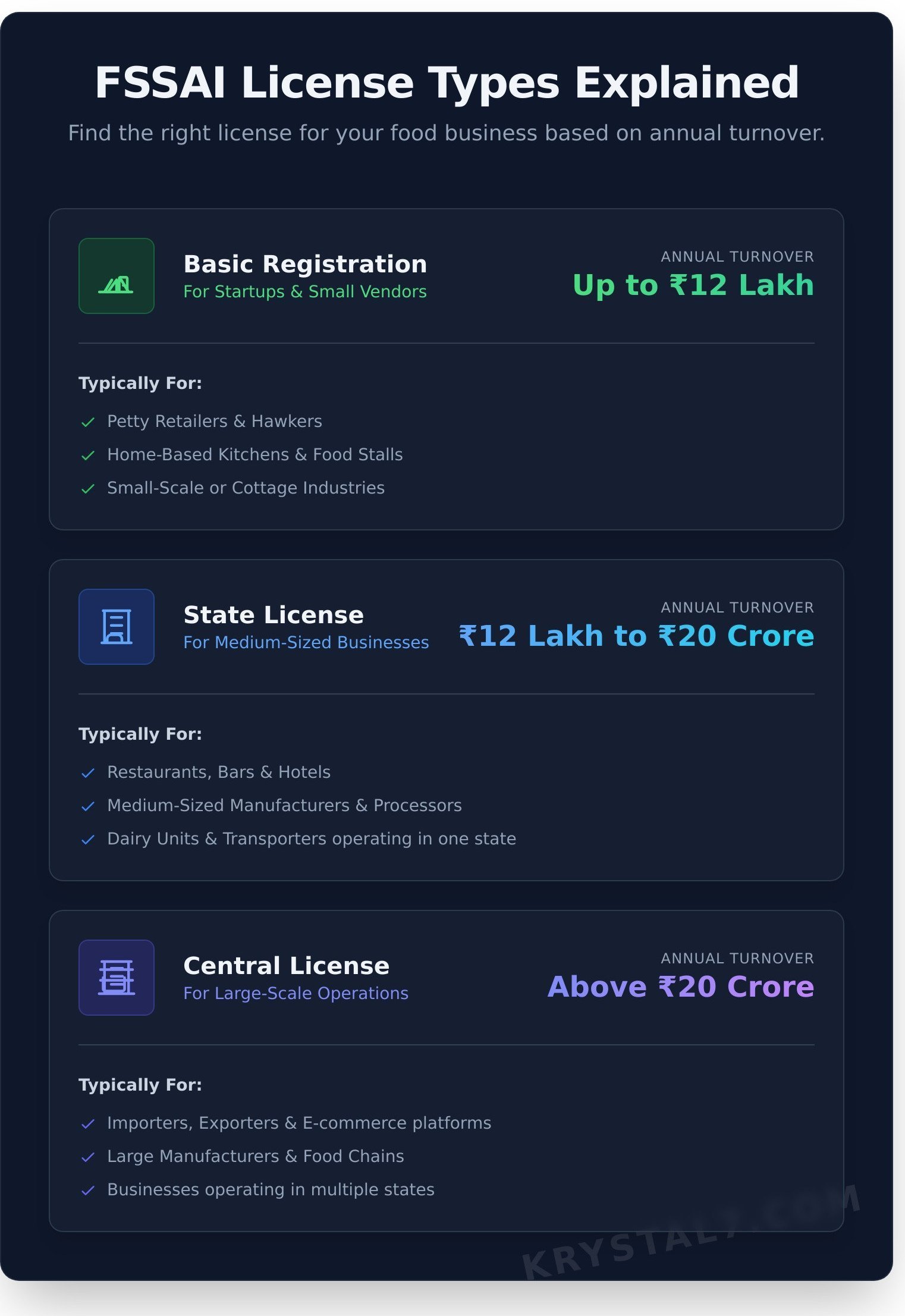
Use this simple table to quickly determine your category:
.fssai-table { width: 100%; border-collapse: collapse; margin: 20px 0; font-family: sans-serif; }
.fssai-table th, .fssai-table td { border: 1px solid #ddd; padding: 12px; text-align: left; }
.fssai-table th { background-color: #f7f7f7; font-weight: bold; }
.fssai-table tr:nth-child(even) { background-color: #fcfcfc; }
| License Type | Annual Turnover | Typically For |
|---|---|---|
| Basic Registration | Up to ₹12 Lakh | Petty Retailers, Hawkers, Home-Based Kitchens |
| State License | ₹12 Lakh to ₹20 Crore | Restaurants, Hotels, Medium Manufacturers |
| Central License | Above ₹20 Crore | Importers, Exporters, E-commerce, Large Chains |
FSSAI Basic Registration
This is the starting point for small food business operators (FBOs). If your annual turnover is up to ₹12 Lakh, this registration is designed for you. It covers petty retailers, street food vendors, hawkers, and small-scale or cottage industries. The documentation process is the simplest of the three, making it the ideal, hassle-free choice for new entrepreneurs and startups testing their vision in the market.
FSSAI State License
For mid-sized businesses that have established a solid footing, the State License is the mandatory next step. This applies to ventures with an annual turnover between ₹12 Lakh and ₹20 Crore. It typically includes restaurants, hotels, dairy units, and medium-sized manufacturers operating within a single state. The documentation is more detailed than the Basic registration, reflecting the larger scale of operations and compliance requirements.
FSSAI Central License
The Central License is reserved for large-scale food businesses. This is mandatory if your annual turnover exceeds ₹20 Crore, you operate in multiple states, or you are an importer or exporter. E-commerce platforms that sell food products also fall under this category. As expected, this license demands the most comprehensive and stringent set of food license documents, ensuring the highest standards of safety and quality for wide-scale distribution.
The Essential Document Checklist for FSSAI Basic Registration
For most small-scale food business operators, home-based chefs, and local food stalls in India, the FSSAI Basic Registration is the mandatory first step into the world of food compliance. This entry-level license is designed for businesses with an annual turnover of up to ₹12 Lakh. The process is intentionally streamlined, and the required food license documents are simple to procure, ensuring that entrepreneurs can achieve compliance without unnecessary hassle.
Think of this checklist as the foundation of your compliance journey. Mastering these initial requirements not only secures your Basic Registration but also prepares you for future growth. As your venture expands, you’ll find that these core documents are also needed for State and Central licenses. For a complete overview of how the different license types compare, this detailed FSSAI License Guide from Forbes India provides excellent context. Now, let’s get your papers in order with this crystal-clear checklist.
Applicant’s Personal Information
- Latest Passport-Sized Photograph: A clear, recent digital or scanned photograph of the Food Business Operator (FBO).
- Government-Issued Photo ID: A copy of your Aadhaar Card, Voter ID, Driving License, or Passport to serve as proof of identity.
- Contact Details: A valid personal email ID and mobile number are mandatory for receiving OTPs, updates, and your final license certificate from FSSAI.
Business & Premises Details
- Proof of Possession of Premises: You must prove you have the legal right to operate from your listed address. This can be a Rental Agreement, Sale Deed, Electricity Bill, or a No Objection Certificate (NOC) from the property owner.
- Name and Address of Business: The official name under which you operate and the complete, accurate address of the premises.
- Details of Food Products: A simple list of the broad categories of food products you intend to manufacture, process, store, or sell. For example, “Bakery Products,” “Snacks & Savouries,” or “Beverages.”
Comprehensive Document List for FSSAI State & Central Licenses
As your food venture grows beyond the scope of a Basic Registration, the compliance framework evolves with it. Moving to a State or Central FSSAI License means demonstrating a more robust commitment to food safety and operational excellence. The list of required food license documents expands to provide regulators with a clearer picture of your large-scale operations. This isn’t about creating hurdles; it’s about building a foundation of trust and safety that supports your growth. These documents are required in addition to the basic identity and address proofs mentioned earlier.
Navigating these requirements can feel complex, but with a structured approach, it becomes a streamlined process. To ensure you are always aligned with the latest regulations, we recommend consulting the Official FSSAI Document Checklist directly on the FoSCoS portal as your single source of truth.
Core Documents for State License
For businesses with an annual turnover between ₹12 lakh and ₹20 crore, a State License is mandatory. The documentation here focuses on your operational setup and management structure.
- Blueprint or Layout Plan: This detailed diagram of your processing unit is crucial. It shows the allocation of space and the flow of operations, helping authorities verify that your layout minimizes cross-contamination risks.
- List of Directors/Partners: A complete list of all directors, partners, or the proprietor with their full address, contact details, and photo ID. This establishes clear accountability for the business.
- List of Equipment and Machinery: A comprehensive list of all equipment to be used, detailing the number, installed capacity, and horsepower. This validates your production capability.
- Food Safety Management System (FSMS) Plan: This is your documented plan for maintaining food safety. It outlines the procedures, controls, and checks you will implement to ensure your product is safe for consumption.
Additional Documents for Central License
A Central License is for large food businesses, including importers, exporters, and operators with a turnover exceeding ₹20 crore. The documentation reflects the scale and complexity of these national-level operations.
- Certificate of Incorporation, MOA & AOA, or Partnership Deed: These documents verify the legal constitution and operational rules of your business entity.
- Import Export Code (IEC): Mandatory for any business engaged in the import or export of food products, this code is issued by the Directorate General of Foreign Trade (DGFT).
- NOC from Central Ground Water Authority (CGWA): This is only applicable if your manufacturing unit extracts groundwater, ensuring responsible and legal use of water resources.
- Source of Raw Material: For manufacturers, declaring the source of key raw materials (like milk, meat, or agricultural produce) is essential for supply chain traceability and quality assurance.
Special Documents for Manufacturers & Processors
If your business involves manufacturing or processing, FSSAI requires further proof of your commitment to quality control and consumer safety.
- Analysis Report of Water: A report from an NABL-accredited laboratory confirming that the water used in the food processing is potable and free from contaminants.
- Proof of Annual Turnover: Audited financial statements or other official documents to substantiate that you are applying for the correct license category based on your turnover.
- Recall Plan: A detailed, proactive plan outlining the procedure you will follow to efficiently recall a product from the market in case of a safety issue. This demonstrates corporate responsibility and preparedness.
Common Mistakes to Avoid When Preparing Your FSSAI Documents
Securing an FSSAI license is a critical step, but the path is often paved with avoidable hurdles in your food license documents. Even a minor error can lead to significant delays or outright rejection, costing you valuable time and resources. At Krystal7, we provide the clarity needed to navigate this complex process, helping our clients bypass the common pitfalls that stall business growth. Think of this as your expert guide to getting it right the first time.
Using Outdated or Illegible Proofs
The devil is in the details, especially with identification. Submitting a blurry scan of your Aadhaar card or a PAN card with a cropped edge is a guaranteed way to trigger a query from the FSSAI. Ensure every document is a high-quality, clear scan. More importantly, check that the name and address on your proofs exactly match the details on your application form. A simple variation like “R. Kumar” versus “Ramesh Kumar” can be enough to cause a rejection.
Incomplete or Vague Premises Documents
Your business address must be proven with absolute precision. We often see entrepreneurs stumble here by submitting documents that lack validity or consistency. Before you upload, verify that:
- Your rental agreement is current, valid for at least the upcoming six months, and clearly in the name of the food business operator (FBO) or the business entity.
- Utility bills (electricity, water, gas) are recent, typically from the last 2-3 months.
- The address is identical across all submitted proofs, from the rental agreement to the utility bill and the application form itself.
Missing Technical or Supporting Documents
For many businesses, especially manufacturers and restaurants, the list of required food license documents extends beyond basic proofs. Forgetting a critical supporting document is one of the most common reasons for application failure. This includes failing to submit a mandatory Food Safety Management System (FSMS) plan, not securing a necessary No Objection Certificate (NOC) from the local municipality, or providing a kitchen layout plan that doesn’t meet FSSAI specifications.
Preparing these documents requires meticulous attention to detail-a single oversight can bring your entire vision to a halt. Don’t let paperwork stand between you and your business goals. Avoid these mistakes. Let our experts manage your application.
How to Get Your Food License Documents in Order, Hassle-Free
Understanding the required FSSAI food license documents is one thing; getting them organised, verified, and submitted correctly is another. The process can feel overwhelming, filled with bureaucratic red tape and the risk of costly delays from simple mistakes. This is where Krystal7 brings crystal clarity to compliance, transforming a complex task into a streamlined, stress-free experience. We handle the paperwork so you have the freedom to focus on what you do best: building your food business.
Our proven, three-step process is designed for maximum efficiency and complete peace of mind.
Step 1: Free Initial Consultation & Krystal-Clear Planning
Your journey begins with clarity. We eliminate the guesswork by understanding the unique nature of your food venture-whether you’re a home kitchen, a cloud kitchen, a restaurant, or a large-scale manufacturer. This allows us to provide precise, expert guidance from the very first interaction.
- Expert Assessment: Our compliance specialists determine the exact FSSAI license type your business needs (Basic, State, or Central).
- Custom Document Checklist: You receive a personalised, easy-to-follow checklist of all the specific documents required for your application.
- Transparent Quote: We provide a fixed-fee quote in Indian Rupees (₹) with no hidden costs, ensuring complete transparency.
Step 2: Secure Document Management & Expert Preparation
Once you have your checklist, our role is to ensure every document is perfect. Our secure, dedicated portal makes it simple to upload your files, while our expert team meticulously vets each one. We catch potential issues before they become problems, ensuring your application is flawless.
- Secure Portal Upload: Easily and safely upload your scanned documents to our private online platform.
- Meticulous Verification: Our team verifies each of your food license documents for accuracy, validity, and compliance with FSSAI standards.
- Error-Free Preparation: We handle all the tedious form-filling and application preparation, leaving no room for error.
Step 3: Seamless Application & Proactive Follow-Up
This is where we take over completely. You won’t have to navigate the complex FoSCoS portal or spend hours on hold with government agencies. We act as your dedicated representative, managing the entire submission and follow-up process until your license is in your hands.
- Official Submission: We submit the complete, verified application on your behalf directly through the official FoSCoS portal.
- Active Follow-Up: Our team proactively communicates and follows up with the FSSAI authorities, addressing any queries swiftly.
- License in Hand: You receive your official FSSAI food license directly, without any bureaucratic hassle.
Stop letting compliance complexities slow your growth. Partner with Krystal7 and experience the confidence that comes from expert-led, hassle-free FSSAI licensing. Ready for clarity? Visit krystal7.com to get started.
Achieve Krystal-Clear Compliance with Your FSSAI License
Navigating the FSSAI licensing process begins with two critical steps: correctly identifying your license type-be it Basic, State, or Central-and meticulously preparing the corresponding documentation. As we’ve detailed, having the right food license documents in order is not just a formality; it’s the foundation of a legally sound and successful food venture in India. Avoiding common mistakes is crucial to prevent delays that can stall your business vision.
Why navigate this complexity alone? At Krystal7, we provide the freedom to focus on your passion. With our Chartered expertise in business licensing, a dedicated relationship manager for your application, and a Krystal-Clear transparent process, we eliminate the guesswork and streamline your path to approval. We manage the red tape so you can manage your menu. Just as protecting your food business with the right license is essential, securing your brand identity through understanding trademark registration fees in India is equally important for long-term business success.
Don’t let paperwork stand between you and your launch. Get crystal-clear guidance on your FSSAI license. Talk to an expert today! Your culinary dream deserves a strong, compliant start, and we are here to help you build it.
Frequently Asked Questions
What is a Food Safety Management System (FSMS) plan and is it mandatory?
A Food Safety Management System (FSMS) plan is a comprehensive document outlining the steps your food business takes to ensure food safety. This includes protocols for personal hygiene, pest control, cleaning, and supplier management. It is a mandatory requirement for obtaining an FSSAI State or Central License, demonstrating your commitment to statutory compliance. However, for the FSSAI Basic Registration, which is for smaller food business operators, an FSMS plan is not required.
Do I need a GST registration number before applying for an FSSAI license?
No, a GST registration number is not a mandatory document for applying for an FSSAI license. These are two distinct legal compliances. You can secure your FSSAI license based on your business scale without having a GSTIN. However, it’s crucial to remember that if your business turnover exceeds the prescribed GST threshold (e.g., ₹40 lakh for goods), you will be required to register for GST separately to operate legally. We can help bring clarity to both processes.
What happens if my FSSAI application is rejected due to incorrect documents?
If your application is rejected due to incorrect food license documents, you don’t need to panic. The FSSAI officer will issue a revert or notice detailing the specific discrepancies. You are typically given a 30-day window to rectify these issues and re-upload the correct documentation. Failing to respond within this timeframe will lead to the application’s final rejection and forfeiture of the fee. Our expert guidance ensures your documents are right the first time, preventing such hassles.
Can I use a residential address for FSSAI basic registration if I have a home kitchen?
Yes, you can certainly use your residential address for an FSSAI Basic Registration. This is a common and accepted practice for home-based food businesses, such as home bakers, cloud kitchens, or tiffin services. You will simply need to provide a valid address proof for your residence, like a recent utility bill. If you are operating from a rented property, the authorities may also require a No Objection Certificate (NOC) from the landlord, confirming their consent.
How long does it typically take to get the license after submitting all documents?
The timeline depends on the type of license. For an FSSAI Basic Registration, the process is streamlined and typically takes 7 to 10 working days after successful document submission. For State and Central licenses, the process is more rigorous, often involving inspections, and can take anywhere from 30 to 60 days. Ensuring all your food license documents are accurate and complete from the start is the key to avoiding delays and achieving a faster approval.
What is the validity of an FSSAI license and what documents are needed for renewal?
An FSSAI license offers flexibility, with a validity period ranging from one to five years, which you select at the time of application. To ensure seamless business continuity, renewal must be initiated before the expiry date. The renewal process is straightforward, typically requiring a copy of your original license, the applicant’s photo ID, and updated versions of any documents that may have changed, such as your rental agreement or FSMS plan. We help you stay compliant and manage renewals effortlessly.

Article by
Nihal Srivastava
Nihal Srivastava is the Co-Founder of Krystal7 Consultants, helping Indian entrepreneurs and startups navigate company registration, compliance, trademark protection, and regulatory requirements with clarity and confidence. With 6+ years of hands-on expertise in MCA filings, GST compliance, and corporate structuring, Nihal has guided 1000+ businesses across India through their legal and compliance journeys. He believes every business dream deserves crystal clear foundations, and that no founder should be held back by paperwork or red tape.