

Memorandum of Association (MoA) in India: A Complete Guide
Feeling overwhelmed by the legal maze of starting your company in India? You’re not alone. The journey from a business vision to a registered entity is often cluttered with complex documents and confusing jargon, especially when navigating the Companies Act, 2013. Terms like ‘object clause’ and the constant mix-up between the MoA and AoA can feel daunting. A single mistake in your memorandum of association in India could limit your company’s future growth, a fear that holds many entrepreneurs back. But it doesn’t have to be this way. Your ambition deserves a clear path forward, free from legal guesswork and administrative red tape.
This comprehensive guide from Krystal7 Consultants is designed to cut through that complexity and provide crystal-clear answers, specifically tailored for the Indian regulatory environment. We will demystify the MoA, breaking down its crucial clauses into simple, understandable terms. You will gain a step-by-step understanding of the drafting and filing process, empowering you to complete your company incorporation smoothly and with absolute confidence. Consider this your roadmap to mastering one of the most vital legal documents, ensuring your business is built on a solid foundation from day one. Let’s transform confusion into clarity and give you the freedom to focus on building your legacy in India.
Key Takeaways
- Understand the memorandum of association india as your company’s foundational charter, defining the legal boundaries and objectives for your entire business venture.
- Master the essential clauses within the memorandum of association india, ensuring your company’s structure is legally sound from day one.
- Gain a crystal-clear understanding of how a memorandum of association india differs from the Articles of Association (AoA), a key distinction in Indian corporate law.
- Discover the formal process for altering your MoA. Knowing how to amend the memorandum of association india is crucial, and this guide explains how to update your memorandum of association india as your business evolves.
What is a Memorandum of Association? The Constitution of Your Company
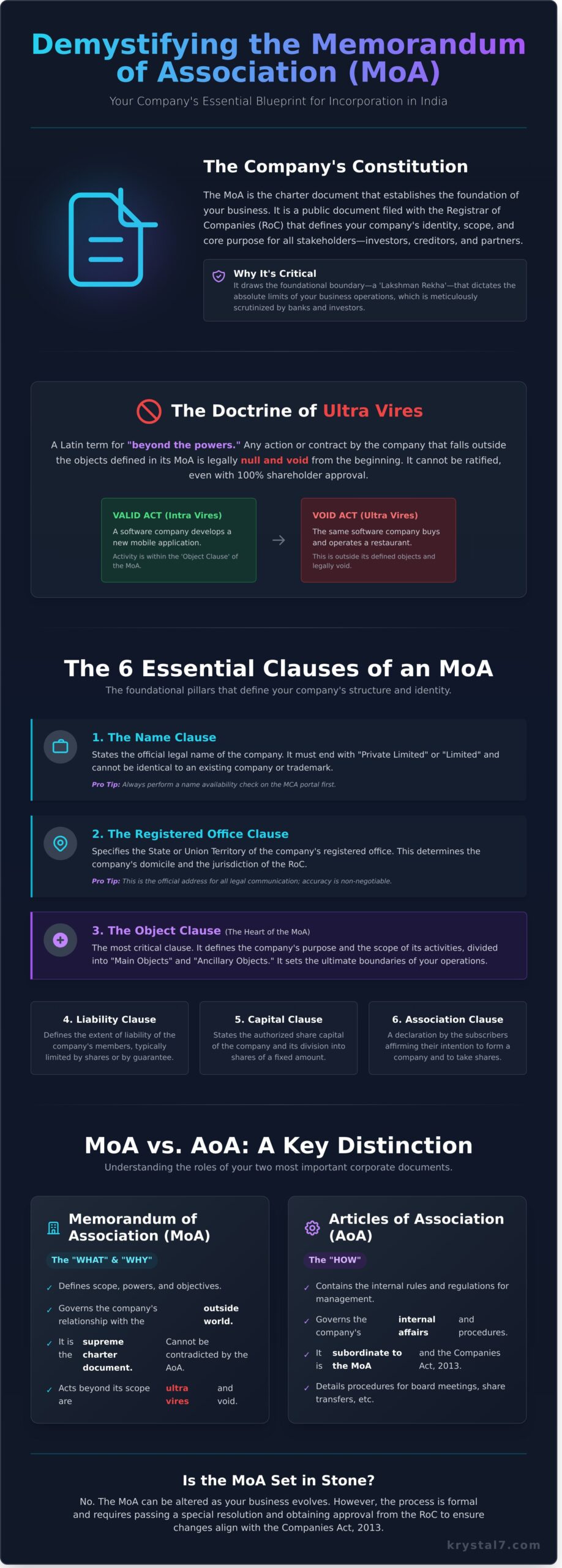
Imagine building a skyscraper without a blueprint. The Memorandum of Association (MoA) is that essential blueprint for your company. It is the charter document that establishes the very foundation of your business, defining its identity, scope, and core purpose for the entire world to see. Governed by the Companies Act, 2013, the Memorandum of Association is not just an internal guideline; it is a public document filed with the Registrar of Companies (RoC). This transparency provides crystal clarity to all external stakeholders-including investors, creditors, and partners-about the powers and limitations of your venture. It is the single most critical document that brings your company into legal existence and sets the stage for its future.
Why the MoA is the Most Important Document for Incorporation
The MoA is paramount because it defines your company’s entire relationship with the outside world. It draws the foundational boundary-a ‘Lakshman Rekha’-that dictates the absolute limits of your business operations. Before providing capital, banks, venture capitalists, and angel investors will meticulously scrutinize this document to ensure your proposed activities align with their investment mandates. This isn’t just a formality; it’s a critical due diligence step. Ultimately, the MoA establishes the legal framework for your company’s existence and powers, forming the bedrock upon which your entire business vision is built and judged. Getting this right provides the clarity you can build on.
The Doctrine of ‘Ultra Vires’: What You Can and Cannot Do
A critical legal principle intrinsically linked to the MoA is the doctrine of ‘ultra vires,’ a Latin term meaning “beyond the powers.” Any action or contract undertaken by the company that falls outside the scope of the objects defined in its MoA is considered ultra vires and is legally null and void from the very beginning. For example, if your memorandum of association in India clearly states your business is software development, you cannot legally use company funds to purchase and operate a restaurant. Such an act cannot be ratified or made valid, even with unanimous approval from every single shareholder. This is why drafting the ‘Object Clause’ with both precision and foresight is absolutely essential to avoid crippling legal roadblocks and ensure your company has the strategic freedom to evolve and thrive.
The 6 Essential Clauses of an MoA: A Detailed Breakdown
Think of the Memorandum of Association in India as the constitution of your company. It is built upon six foundational pillars, or clauses, each defining a fundamental aspect of your business’s identity, scope, and structure. Getting these right from the start provides the clarity you need to build and grow your venture with confidence. The format for these clauses is not optional; it is strictly prescribed by the government, as detailed in the Companies Act, 2013 Schedule I. Let’s explore each one.
1. The Name Clause: Your Company’s Identity
This clause officially states the legal name under which your company will operate. The name must end with “Private Limited” for a private company or “Limited” for a public company. Crucially, it cannot be identical or too similar to an existing company name or registered trademark to avoid public confusion. Pro Tip: Always perform a thorough name availability check on the Ministry of Corporate Affairs (MCA) portal before finalizing your brand identity.
2. The Registered Office Clause (Domicile Clause)
This clause specifies the State or Union Territory in India where the company’s registered office will be located. It doesn’t contain the full address-that is filed separately with the Registrar of Companies (ROC). This clause is vital as it determines the company’s domicile, the jurisdiction of the ROC, and the courts that have authority over the company. Pro Tip: This is the official address for all legal notices and statutory communication, so its accuracy is non-negotiable.
3. The Object Clause: The Heart of the MoA
Arguably the most critical clause, this defines the purpose and scope of your company’s activities. It is divided into “Main Objects” (the business you are being incorporated for) and “Ancillary Objects” (activities necessary to support the main business). This clause sets the boundaries of your operations and is closely scrutinized by investors and lenders. Pro Tip: Draft this clause with foresight. A well-defined yet broad Object Clause can accommodate future growth and diversification without requiring frequent amendments.
4. The Liability Clause: Defining Shareholder Risk
This clause provides a clear declaration of the liability of the company’s members (shareholders). For the vast majority of companies, this liability is “limited by shares,” meaning a shareholder’s financial obligation is restricted to the nominal value of the shares they own. This protects their personal assets from being used to pay off company debts. Pro Tip: This clause is the essence of the “limited liability” concept, a cornerstone of modern corporate structure.
5. The Capital Clause: Your Financial Foundation
Here, the MoA states the company’s maximum authorized share capital-the total value of shares the company is legally permitted to issue. This is divided into a specific number of shares, each with a fixed face value (e.g., ₹10,00,000 divided into 1,00,000 shares of ₹10 each). This is a ceiling, not the amount of capital you must raise immediately. Pro Tip: Start with a realistic authorized capital to keep initial government fees and stamp duty manageable. You can always increase it later.
6. The Subscription Clause (Association Clause)
The final clause is a formal declaration from the first subscribers (the initial shareholders) stating their intention to form a company and their agreement to take a certain number of shares. It includes their names, addresses, and occupations, alongside their signatures. This section legally binds the founding members to the newly formed entity. Pro Tip: Ensure every detail of the subscribers in this clause perfectly matches their official identification documents, like PAN and Aadhaar cards, to prevent compliance issues.
Memorandum of Association (MoA) vs. Articles of Association (AoA)
For entrepreneurs navigating the company registration process, the distinction between the Memorandum of Association (MoA) and the Articles of Association (AoA) is a common point of confusion. Gaining clarity on this is fundamental to establishing a strong legal foundation for your venture. The simplest analogy is this: the MoA is your company’s constitution, defining the ‘what’ and ‘why’ of its existence. In contrast, the AoA is the internal rulebook, detailing ‘how’ the company will be managed day-to-day.
Both documents are mandatory and are filed together with the Registrar of Companies (RoC) during incorporation. They work in tandem, but one clearly sets the boundaries for the other.
What are the Articles of Association (AoA)?
The Articles of Association (AoA) define the internal rules, regulations, and bylaws for a company’s management and operations. This document governs the relationship between the company and its members (shareholders) and outlines the specific procedures for internal governance. Its primary purpose is to ensure the company runs in a smooth and orderly manner, free from internal ambiguity.
Key areas typically covered by the AoA include:
- Procedures for conducting board and shareholder meetings
- Appointment, powers, and duties of directors
- Rules for the transfer and transmission of shares
- Voting rights of members
- Dividend policy and creation of reserves
MoA vs. AoA: A Head-to-Head Comparison
While interconnected, the MoA and AoA serve distinct roles. The legal framework for a memorandum of association in India sets the ultimate boundaries, while the AoA must operate entirely within those limits. This table provides a clear, side-by-side view to eliminate any guesswork.
Ultimately, the MoA is the parent document that establishes the company’s identity and limits, while the AoA provides the operational framework within those limits. Understanding this hierarchy is crucial for ensuring long-term compliance and effective corporate governance.
Drafting and Filing Your MoA: A Practical Step-by-Step Guide
Understanding the theory behind the MoA is one thing; bringing it to life is another. Fortunately, the entire process of creating and filing a memorandum of association in India has been streamlined and digitized. It is now an integral part of the SPICe+ form used for company incorporation. However, this digital convenience doesn’t reduce the need for precision. An incorrectly drafted MoA is a primary reason for application rejection by the Registrar of Companies (ROC), causing unnecessary delays and costs. This guide provides the clarity you need to navigate the process effectively.
Step 1: Choosing the Right MoA Format (Tables A-E)
The Companies Act, 2013, provides specific templates to ensure your MoA is compliant from the very beginning. You don’t have to start from a blank page. Selecting the correct format, prescribed in Schedule I of the Act, is your first critical step.
- Table A: The most common format, used for companies limited by shares.
- Table B: For companies limited by guarantee and not having a share capital.
- Tables C, D, and E: For companies limited by guarantee with share capital, unlimited companies without share capital, and unlimited companies with share capital, respectively.
Step 2: The Drafting Process – Getting the Details Right
This is where precision is paramount. Each clause must be drafted with meticulous care, especially the Object Clause, which defines your company’s entire scope of activities. To avoid the common pitfalls and legal ambiguities that can hinder future growth, engaging a professional like a Company Secretary (CS) is highly recommended. All subscribers (the first shareholders) must also have a valid Digital Signature Certificate (DSC) to sign the e-MoA. Don’t let paperwork become a roadblock to your vision. Let our experts draft a flawless MoA for your business.
Step 3: Filing with the Registrar of Companies (ROC)
Once drafted and digitally signed, your MoA is not filed as a separate document. It is submitted electronically as the e-MoA, an integrated part of the SPICe+ (INC-32) form on the Ministry of Corporate Affairs (MCA) portal. This form is a single, comprehensive application for company incorporation, filed along with the e-AoA (Articles of Association) and other necessary documents. Upon successful verification and approval by the ROC, your MoA becomes a legally binding public document, and the Certificate of Incorporation is issued.
Altering the Memorandum of Association: Is It Possible to Make Changes?
As your business grows and evolves, its initial charter may no longer reflect its current vision or operational needs. Entrepreneurs often worry that their Memorandum of Association is set in stone, but this is a common misconception. The legal framework governing the memorandum of association in India is designed to be flexible, allowing for modifications to accommodate business growth and strategic shifts.
However, altering the MoA is not an informal process. It is a statutory procedure that requires formal approval from shareholders and, in some cases, regulatory authorities like the Registrar of Companies (ROC). This ensures that any fundamental changes to the company’s constitution are made with proper consensus and transparency, protecting the interests of all stakeholders.
The General Process for MoA Alteration
While specific requirements can vary, the standard procedure for amending the MoA under the Companies Act, 2013, involves a clear, methodical sequence of steps:
- Step 1: Pass a Board Resolution. The Board of Directors must first convene a meeting and pass a resolution to propose the specific alteration to the MoA.
- Step 2: Call an Extraordinary General Meeting (EGM). Once the board approves, an EGM of the company’s shareholders must be called to vote on the proposed change.
- Step 3: Pass a Special Resolution. At the EGM, the alteration must be approved by a Special Resolution, which requires a majority vote of at least 75% of the shareholders present and voting.
- Step 4: File Forms with the ROC. After the resolution is passed, the company must file the necessary forms (such as MGT-14) with the Registrar of Companies within 30 days for approval and official record-keeping.
Altering Key Clauses: Specific Requirements
The complexity of the alteration process depends on which clause of the memorandum of association in India is being changed. Each clause has unique compliance requirements.
- Changing the Name Clause: This requires a Special Resolution, followed by obtaining approval from both the ROC and, in certain cases, the Central Government.
- Changing the Object Clause: If you are diversifying your business activities, you must alter the Object Clause. This requires passing a Special Resolution and filing the necessary forms with the ROC.
- Changing the Capital Clause: Increasing the authorised share capital is a common alteration. This process is often simpler and can typically be done by passing an Ordinary Resolution, which requires a simple majority (>50%).
Navigating these procedures requires meticulous attention to detail and a clear understanding of corporate law. Need to amend your company’s MoA? We provide hassle-free compliance services. Our experts at Krystal7 Consultants ensure the entire process is streamlined, giving you the freedom to focus on your business vision.
Your MoA: The Cornerstone of Your Company’s Success
The Memorandum of Association is far more than a procedural document; it is the constitution that defines your company’s purpose, scope, and very identity. As we’ve explored, its six essential clauses set the boundaries for your operations, and getting them right from the outset is non-negotiable for legal compliance and future growth. Understanding the critical role of the memorandum of association in India is the first step toward building a resilient and successful enterprise.
Navigating the complexities of drafting and filing can be daunting, but it doesn’t have to hinder your vision. At Krystal7, we bring clarity and precision to the incorporation process. Our team provides Chartered expertise to ensure your MoA is legally sound, perfectly capturing your business objectives. With our streamlined, hassle-free digital process and transparent pricing with no hidden costs, you can lay a solid foundation with complete peace of mind.
Start your business with confidence. Get our all-in-one Company Incorporation Package today! Let us handle the compliance, giving you the freedom to focus on building your legacy.
Frequently Asked Questions
Who signs the Memorandum of Association in India?
The Memorandum of Association (MoA) is signed by the initial subscribers, who are the very first shareholders of the company. Each subscriber must sign the document in the presence of at least one witness, who will then attest to the signature. This formal act signifies their agreement to form the company and subscribe to the shares mentioned against their names, providing a clear and legally binding foundation for your new venture.
What is the minimum number of subscribers required for an MoA?
The minimum number of subscribers is clearly defined by the Companies Act, 2013, ensuring your company structure has statutory clarity from day one. For a Public Limited Company, a minimum of seven subscribers is required. For a Private Limited Company, the requirement is at least two subscribers. In the case of a One Person Company (OPC), as the name suggests, only one subscriber is needed to sign the MoA and complete the incorporation process.
Can a foreign national be a subscriber to an MoA in India?
Yes, absolutely. A foreign national or a non-resident can be a subscriber to a company’s MoA, provided all regulations under the Foreign Exchange Management Act (FEMA) and other relevant Indian laws are met. The process requires proper, often notarized or apostilled, identity and address proofs to ensure complete compliance. This opens the door for global entrepreneurs to establish their vision within the Indian market, and we can help streamline that process for you.
Where can I find my company’s Memorandum of Association after registration?
Your company’s MoA is a public document, ensuring transparency. Upon successful incorporation, a digital copy is attached to the Certificate of Incorporation emailed by the Ministry of Corporate Affairs (MCA). You can also access and download it anytime from the MCA portal by viewing public documents for a nominal fee. This ensures you always have access to your company’s foundational charter, providing you with clarity on your business’s legal framework and scope of operations.
What happens if a company acts beyond the scope of its MoA?
Any action taken by a company that falls outside the objectives defined in its MoA is legally termed “ultra vires,” meaning “beyond the powers.” Such acts are considered void and legally unenforceable. They cannot be ratified even if all members agree to it. This doctrine protects investors and creditors by ensuring that company funds are used only for the stated business purposes detailed within the memorandum of association in India, preventing misuse and promoting corporate accountability.
Is it mandatory to print the MoA and AoA?
While the incorporation process for a memorandum of association in India is now entirely digital, maintaining physical copies is a crucial governance practice. The Companies Act, 2013, mandates that a company must provide a copy of its MoA and Articles of Association (AoA) to any member upon request. Having printed and properly maintained copies ensures you can meet these statutory obligations promptly and demonstrates a commitment to organized, transparent operations.

Article by
Nihal Srivastava
Nihal Srivastava is the Co-Founder of Krystal7 Consultants, helping Indian entrepreneurs and startups navigate company registration, compliance, trademark protection, and regulatory requirements with clarity and confidence. With 6+ years of hands-on expertise in MCA filings, GST compliance, and corporate structuring, Nihal has guided 1000+ businesses across India through their legal and compliance journeys. He believes every business dream deserves crystal clear foundations, and that no founder should be held back by paperwork or red tape.