

Articles of Association Explained: A Founder’s Guide for India (2026)
Embarking on your entrepreneurial journey in India is an exhilarating venture, but it’s often accompanied by a mountain of complex legal paperwork. If terms like MOA, DIN, and especially the Articles of Association (AoA) leave you feeling overwhelmed, you are not alone. The fear of making a critical mistake during company registration is a common anxiety for founders. This is precisely why Krystal7 Consultants has created this guide. We’re here to provide crystal clarity, with the articles of association explained in simple, straightforward language that cuts through the legal jargon.
This founder’s guide for 2026 is your definitive roadmap. We will demystify the AoA, outlining exactly what it is, the essential clauses it must contain, and why it is the fundamental rulebook for your company’s success. By the end, you will gain the confidence to navigate your company registration smoothly, understand how to prevent future disputes, and secure the freedom to focus on what truly matters-building your business legacy.
Key Takeaways
- Understand the AoA as your company’s internal constitution, a critical document that governs everything from director powers to shareholder rights.
- Learn which essential clauses your AoA must contain for full compliance, and see how the standard ‘Table F’ template provides a starting point.
- Decide whether a standard template is enough or if your business vision requires a professionally customized AoA for better protection and clarity.
- Having the articles of association explained clearly helps you understand it’s a living document you can amend to support future growth, like raising capital.
What Are Articles of Association (AoA)? Your Company’s Internal Rulebook
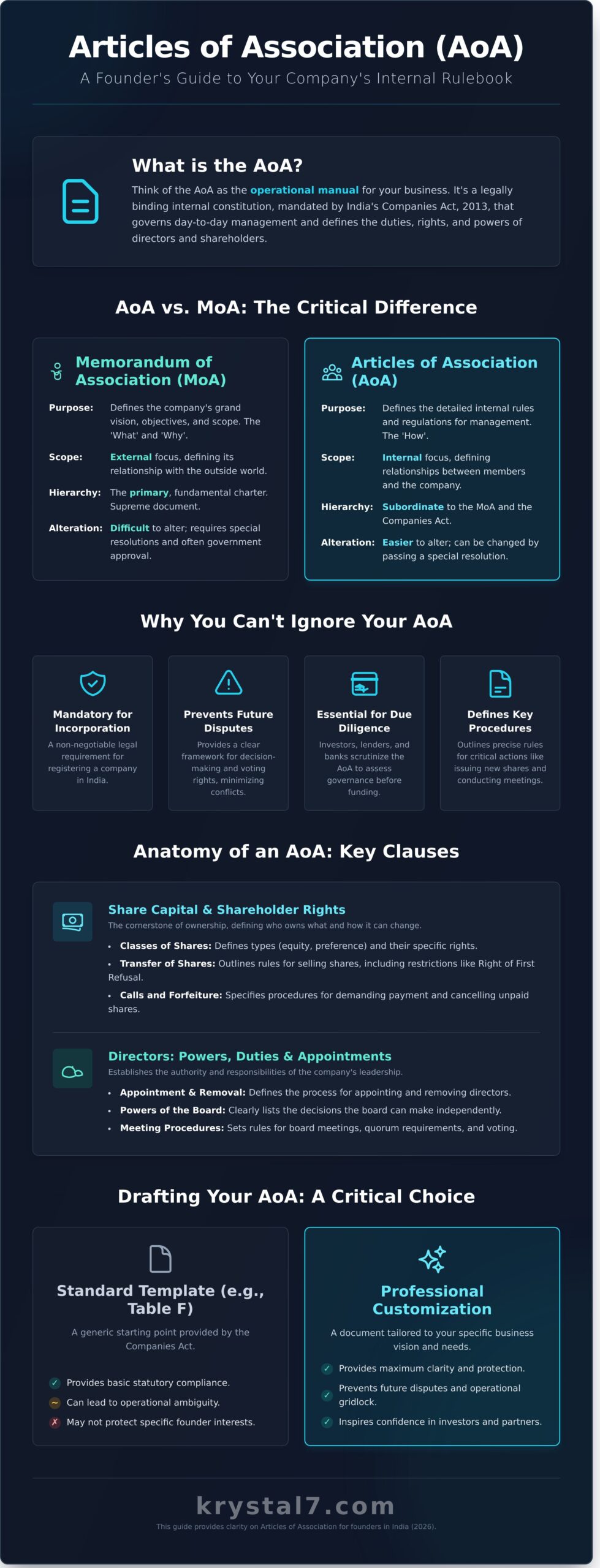
Think of your Articles of Association (AoA) as the operational manual for your business vision. While the concept might seem complex, having the articles of association explained clearly is the first step toward building a solid legal foundation. In essence, the AoA serves as the internal company’s constitution, a legally binding document that governs internal management and day-to-day operations. Mandated by India’s Companies Act, 2013, it meticulously defines the duties, rights, and powers of the company’s directors and management, establishing the formal relationship between the company and its shareholders. It’s the rulebook that ensures everyone is on the same page.
AoA vs. Memorandum of Association (MoA): The Critical Difference
Founders often confuse the AoA with the Memorandum of Association (MoA), but they serve distinct purposes. If the MoA outlines your company’s grand vision-its objectives and scope (the ‘what’ and ‘why’)-the AoA provides the detailed roadmap on ‘how’ to achieve it. The AoA is always subordinate to both the MoA and the Companies Act.
| Feature | Memorandum of Association (MoA) | Articles of Association (AoA) |
|---|---|---|
| Purpose | Defines the company’s objectives and scope of operations. | Defines the internal rules and regulations for management. |
| Scope | External focus; defines the relationship with the outside world. | Internal focus; defines the relationship between members and the company. |
| Hierarchy | The primary, fundamental charter of the company. | Subordinate to the MoA and the Companies Act. |
| Alteration | Difficult to alter; requires special resolutions and often central government approval. | Can be altered more easily by passing a special resolution. |
Why You Can’t Ignore Your Articles of Association
Drafting a robust AoA isn’t just a formality; it’s a strategic necessity for sustainable growth and operational clarity. Ignoring its details can lead to significant future complications. Here’s why it’s crucial:
- Mandatory for Incorporation: In India, filing the AoA is a non-negotiable step for registering a private or public limited company.
- Prevents Future Disputes: It provides a clear framework for decision-making, voting rights, and director appointments, minimizing ambiguity and potential conflicts between shareholders.
- Essential for Due Diligence: Investors, lenders, and banks will scrutinize your AoA to understand your governance structure before committing capital. A well-drafted AoA inspires confidence.
- Defines Key Procedures: It outlines the precise rules for critical actions like issuing new shares, transferring existing ones, and conducting board meetings, ensuring statutory compliance.
Key Clauses Every Indian AoA Must Contain
Think of your Articles of Association (AoA) as the internal constitution for your venture, the rulebook that brings clarity to your operations. It’s structured into numbered paragraphs, or ‘clauses’, that dictate how your company will be governed. While the Companies Act, 2013 provides a standard template known as Table F, relying on it without careful customization can lead to operational ambiguity and future disputes. As Investopedia defines Articles of Association, they outline the company’s purpose and the duties and responsibilities of its members. Getting these clauses right from day one provides a solid foundation for growth and gives you the freedom to focus on your vision.
Share Capital and Shareholder Rights
This is the cornerstone of ownership. These clauses define who owns what and how that ownership can change, preventing future shareholder conflicts. A clear framework ensures transparency and protects every stakeholder’s interests.
- Classes of Shares: Defines different types of shares (e.g., equity, preference) and the specific rights, such as voting power and dividend priority, attached to each.
- Transfer of Shares: Outlines the rules for selling or transferring shares, including any restrictions like a ‘Right of First Refusal’ (ROFR) for existing shareholders.
- Calls and Forfeiture: Specifies the procedure for the company to demand payment for shares not fully paid up (calls) and the process for cancelling shares if a shareholder fails to pay.
Directors: Powers, Duties, and Appointments
Your Board of Directors steers the company. These clauses establish a clear governance structure, defining the board’s authority and ensuring decisions are made efficiently and legally. This is where leadership accountability is formally documented.
- Appointment and Removal: The process for appointing, remunerating, and removing directors from the board.
- Powers of the Board: Details the specific powers granted to the directors, such as borrowing money, making investments, and entering into contracts.
- Board Meetings: Sets the rules for conducting board meetings, including the quorum (minimum number of directors required) and voting procedures.
General Meetings and Voting
While the board manages daily affairs, major decisions require shareholder approval. These clauses ensure that the ultimate owners of the company have a voice and that their meetings are conducted in an orderly, compliant manner.
- AGMs and EGMs: Lays down the rules for conducting Annual General Meetings (AGMs) and the procedure for calling Extraordinary General Meetings (EGMs) for urgent matters.
- Voting Rights: Clarifies the voting rights of each member and the process for passing different types of resolutions (e.g., ordinary vs. special).
- Quorum: Defines the minimum number of members that must be present for a general meeting to be valid.
Company Operations and Financials
This section governs the financial integrity and administrative backbone of your company. Having these processes clearly defined in your AoA is a core part of having your articles of association explained and implemented correctly, ensuring statutory compliance and operational smoothness.
- Auditor: The process for appointing the company’s statutory auditor and defining their role.
- Dividends and Reserves: Rules regarding the declaration of dividends to shareholders and the creation of financial reserves for future use.
- Winding Up: The procedure to be followed for the dissolution or liquidation of the company, should it become necessary.
Drafting Your AoA: Templates vs. Professional Customization
One of the first questions founders ask is, “Can I just use a standard template for my Articles of Association?” When a company is incorporated in India without submitting a custom AoA, it automatically adopts a default set of rules known as Table F. While this provides a basic framework, relying on it without careful consideration can create significant problems down the road. This section of our guide on articles of association explained will give you the clarity to make the right choice for your venture.
When is a Standard Template (Table F) Enough?
For a very straightforward business, a standard template might seem sufficient. This is typically the case for single-founder companies with a simple share structure and no immediate plans to seek external investment. If your operations are standard and you don’t require special rights for different shareholders, Table F can serve as a cost-effective starting point. It’s often suitable for:
- A sole proprietorship transitioning to a private limited company.
- A simple family-owned business with one primary decision-maker.
- A boot-strapped startup with no near-term plans for external funding.
Even in these simple scenarios, a professional review is wise to ensure the default rules don’t inadvertently restrict your future plans.
Why and When You Need a Custom-Drafted AoA
Your business vision is unique; your governing document should be too. A generic template fails the moment your company’s structure involves any complexity. While The Companies Act, 2013 provides Table F as a default, it crucially allows for customization to prevent future disputes and align with your strategic goals. A custom AoA is not a luxury-it’s a necessity if you:
- Have multiple co-founders with different equity stakes, roles, or vesting schedules.
- Plan to raise capital from angel investors or venture capitalists who require specific protective clauses.
- Need to include critical provisions like drag-along rights (to compel a sale), tag-along rights (to protect minority shareholders), or deadlock provisions (to resolve founder disputes).
A tailored AoA provides the clarity and legal framework to protect all stakeholders and support your company’s growth. It transforms your rulebook from a generic liability into a strategic asset. Don’t leave your company’s future to guesswork. Let our experts draft an AoA that protects your vision. Get started with Krystal7.
How to Amend or Alter Your Articles of Association
Your company’s Articles of Association (AoA) is not a static document set in stone. It is a living constitution for your business, designed to evolve as your venture grows and its needs change. As your company scales, you may need to amend your articles for several strategic reasons, such as raising a new round of capital, which often requires creating new classes of shares, or changing internal governance rules like director appointments and voting rights. Now that we have the core concepts of the articles of association explained, understanding the amendment process is the final step to confident corporate governance.
However, altering this foundational document is a formal legal process governed by the Companies Act, 2013. Any change must be executed with precision and cannot contradict the provisions of the Memorandum of Association (MoA) or the Act itself.
The Legal Process for Alteration: Step-by-Step
Navigating the statutory requirements for amending your AoA requires a methodical approach. The process ensures that all stakeholders are properly consulted and the changes are legally binding. Here is the streamlined procedure:
- Convene a Board Meeting: The directors must first meet to discuss and approve the proposed alterations. A board resolution is passed to recommend the changes and to call a General Meeting of the shareholders.
- Issue Notice for a General Meeting: A formal notice, including the agenda and the exact text of the proposed special resolution, must be sent to all shareholders, directors, and auditors at least 21 days before the meeting.
- Pass a Special Resolution: At the General Meeting, the shareholders vote on the alteration. A “Special Resolution” is required, which means at least 75% of the members present and voting must approve the change.
- File with the Registrar of Companies (ROC): Within 30 days of passing the special resolution, you must file Form MGT-14 with the ROC, along with a copy of the resolution and the altered AoA.
Common Pitfalls to Avoid During Amendment
The amendment process is straightforward but leaves no room for error. Mistakes can lead to legal complications, fines, or invalidation of the changes. Be vigilant to avoid these common issues:
- Failing the Vote: Not securing the necessary 75% majority for the special resolution can halt the entire process. Ensure you have shareholder buy-in before the meeting.
- Missing Deadlines: The 30-day window for filing Form MGT-14 with the ROC is strict. Late filing can result in significant penalties.
- Illegal or Contradictory Changes: Any alteration that conflicts with the Companies Act, 2013, or the company’s MoA will be considered void.
This process requires precision and expert oversight to remove any guesswork or risk. Our compliance services ensure it’s done right.
Beyond the Blueprint: Final Thoughts on Your Articles of Association
Understanding your Articles of Association is a critical step in building a resilient business in India. As we’ve covered, this document is far more than a legal formality-it’s the operational rulebook that governs your company’s internal management and protects your vision. Now that we’ve had the articles of association explained, it is clear that getting the key clauses right from day one is non-negotiable for preventing future conflicts and ensuring smooth governance. While templates offer a starting point, they rarely capture the unique needs of your venture.
Don’t let complex paperwork distract you from your mission. Build your company on a foundation of clarity and compliance. With Krystal7, you gain access to Chartered Expertise for Flawless Documentation and a Streamlined Process for Hassle-Free Registration. You’ll be paired with a Dedicated Advisor Who Understands Your Business, ensuring your AoA is perfectly tailored to your goals. Start your company with confidence. Let our experts handle your incorporation from start to finish.
Your vision deserves a flawless foundation. Go forward and build your legacy.
Frequently Asked Questions
What is the main difference between Articles of Association (AoA) and a Memorandum of Association (MoA)?
The primary difference lies in their scope and purpose. The Memorandum of Association (MoA) defines the company’s charter and its relationship with the outside world-its objectives, powers, and capital structure. In contrast, the Articles of Association (AoA) act as the company’s internal rulebook, governing its day-to-day management, director duties, and shareholder rights. Essentially, the MoA sets the boundaries the company can operate within, while the AoA dictates how it operates within those boundaries.
Are the Articles of Association a public document in India?
Yes, absolutely. In India, both the Articles of Association and the Memorandum of Association are considered public documents upon a company’s incorporation. They are filed with the Registrar of Companies (RoC) and are available for public inspection through the Ministry of Corporate Affairs (MCA) portal. This transparency allows potential investors, creditors, and partners to understand the company’s governance structure and operational rules before engaging with it, ensuring corporate clarity and accountability.
What happens if a company acts against its Articles of Association?
Any action taken by a company that goes beyond the powers defined in its Articles of Association is considered “ultra vires,” meaning “beyond the powers.” Such an act is legally void and cannot be enforced against the company, even if every shareholder agrees to it. This can lead to personal liability for the directors involved in the decision. Adhering to the AoA is a critical aspect of statutory compliance and good corporate governance, protecting both the company and its leadership.
Can a One Person Company (OPC) have Articles of Association?
Yes, every company registered under the Companies Act, 2013, including a One Person Company (OPC), is required to have its own Articles of Association. While an OPC has a single member, the AoA is still crucial for defining the rules of its internal management, the appointment of a nominee director, and other operational procedures. This ensures the OPC has a clear, compliant governance framework from its inception, just like any other corporate entity.
How much does it cost to draft and file Articles of Association in India?
The cost to draft and file an AoA is part of the overall company incorporation expense and is not a standalone fee. The total cost includes professional fees for a Chartered Accountant or Company Secretary and government fees, such as stamp duty. These charges vary based on the company’s authorized share capital and the state of registration. Our goal is to have the process of creating and understanding the articles of association explained with crystal-clear, upfront pricing to avoid any surprises.
Do I need a lawyer or Company Secretary to draft my AoA?
While not legally mandatory for you to hire one, it is highly advisable. A Company Secretary (CS) or a corporate lawyer ensures your AoA is not only compliant with the Companies Act, 2013, but is also tailored to your specific business vision and shareholder agreements. Using a professional avoids generic templates that can lead to future disputes or governance issues. This expert guidance provides a robust legal foundation, giving you the freedom to focus on growing your business.

Article by
Nihal Srivastava
Nihal Srivastava is the Co-Founder of Krystal7 Consultants, helping Indian entrepreneurs and startups navigate company registration, compliance, trademark protection, and regulatory requirements with clarity and confidence. With 6+ years of hands-on expertise in MCA filings, GST compliance, and corporate structuring, Nihal has guided 1000+ businesses across India through their legal and compliance journeys. He believes every business dream deserves crystal clear foundations, and that no founder should be held back by paperwork or red tape.