

MCA Compliance Explained: A Simple Guide for Indian Businesses
For any entrepreneur in India, navigating the world of legal requirements can feel overwhelming. You’re focused on building your dream, but terms like ROC, DIN, and MCA can sound like a complex code. This guide is here to provide crystal clarity. Understand your key MCA filing requirements, avoid costly penalties, and learn how to stay compliant with this clear, jargon-free guide.
What is MCA Compliance and Why Does It Matter for Your Business?
Let’s start with the basics. The Ministry of Corporate Affairs (MCA) is the central government body that regulates companies in India. MCA compliance simply means following the rules and regulations laid out in the Companies Act, 2013. The primary goal of these regulations is to ensure transparency in your company’s operations, protect the interests of stakeholders like investors and creditors, and maintain a fair business environment. Think of it as the official process for keeping your company in good legal and financial standing with the government.
The Real Costs of Non-Compliance: More Than Just Fines
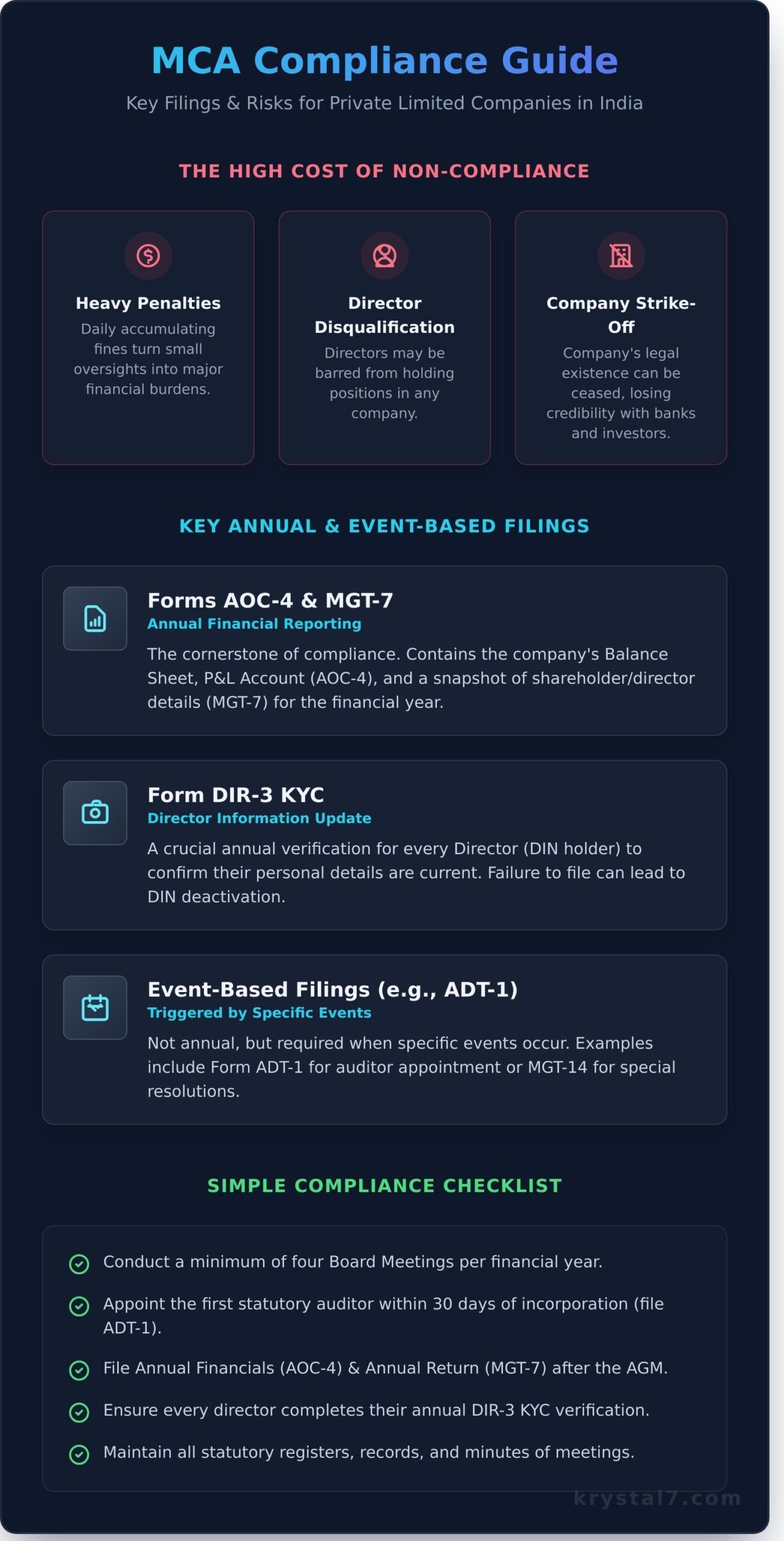
Ignoring MCA compliance can have severe consequences that go far beyond a simple warning. The penalties for late or incorrect filings are significant and can accumulate daily, turning a small oversight into a major financial burden. But the risks don’t stop there. Non-compliance can lead to the disqualification of directors, preventing them from holding positions in any company. In severe cases, your company could even be “struck off” the official register, effectively ceasing its legal existence. Perhaps most damaging is the loss of credibility with banks, investors, and potential clients, which can hinder your growth and funding opportunities.
Key Annual MCA Filings for Private Limited Companies
While there are many different forms, most private limited companies have a core set of mandatory annual filings they must complete. We’ve broken down the most important ones into simple, understandable categories to help you stay on track.
1. Annual Financial Reporting (Forms AOC-4 & MGT-7)
These two forms are the cornerstone of your annual compliance. Form AOC-4 is your company’s yearly financial health report, containing your Balance Sheet and Profit & Loss Account. Form MGT-7 is the Annual Return, which provides a snapshot of your company’s structure, including details about its shareholders and directors. Together, these documents create a public record of your company’s performance and governance for the financial year. For a comprehensive understanding of all the forms and deadlines involved in this process, check out our detailed guide on ROC compliance for private limited company.
2. Director Information Update (Form DIR-3 KYC)
This is a straightforward but crucial annual verification for every individual who holds a Director Identification Number (DIN). The purpose of Form DIR-3 KYC is to confirm that the director’s personal information, such as their address and contact details, is current and accurate. Failure to file this simple form can result in the deactivation of a director’s DIN, which complicates their ability to act on behalf of the company.
3. Other Important Event-Based Filings
Some filings are not annual but are triggered by specific company events. For instance, Form ADT-1 is filed once to notify the Registrar of Companies (ROC) about the appointment of your company’s statutory auditor. Similarly, Form MGT-14 is used to file certain special resolutions passed by the board or shareholders. While not required every year, it’s critical to file them promptly when the situation arises.
How to Achieve ‘Krystal-Clear’ MCA Compliance
Staying compliant doesn’t have to be a source of constant stress or anxiety. By adopting a systematic approach and understanding your obligations, you can gain the freedom to focus on what you do best: growing your business. For a complete roadmap of all mandatory tasks and deadlines, refer to our comprehensive annual compliance for private limited company checklist that covers every aspect of your legal responsibilities.
Your Simple MCA Compliance Checklist
- Conduct a minimum of four Board Meetings each financial year.
- Prepare and finalize the annual financial statements and the Board’s Report.
- Appoint your first statutory auditor within 30 days of incorporation and file Form ADT-1.
- File your Annual Financial Statements (Form AOC-4) and Annual Return (Form MGT-7) after your Annual General Meeting (AGM).
- Ensure every director completes their annual KYC verification (Form DIR-3 KYC).
- Diligently maintain all statutory registers, records, and minutes of meetings as required by law.
The Smart Solution: Partner with an Expert
The most effective way to ensure flawless compliance is to let a professional team manage the entire process. An expert partner tracks every deadline, prepares accurate filings, and handles all the complexities on your behalf. This not only saves you invaluable time but also helps you avoid costly errors and gives you complete peace of mind, knowing that this critical aspect of your business is handled correctly. Get your All-in-One Annual Compliance Package from Krystal7.
Frequently Asked Questions
What is the full form of MCA?
The full form of MCA is the Ministry of Corporate Affairs. It is the Indian government ministry responsible for administering the Companies Act, 2013 and other related acts.
What is the difference between MCA and ROC compliance?
MCA is the ministry that sets the rules, while the Registrar of Companies (ROC) is the office under the MCA that handles the administration and regulation of companies at the state level. ROC compliance for private limited company refers to the act of filing the necessary documents with the local ROC office as per the MCA’s regulations.
What happens if I miss an MCA filing due date?
Missing a due date results in an additional fee (penalty) for each day of delay until the form is filed. Continued non-compliance can lead to more severe consequences, including director disqualification and the company being struck off.
Can I file MCA forms myself or do I need a professional?
While it is technically possible for a director to file some forms, most mandatory annual filings (like AOC-4 and MGT-7) must be certified by a practicing professional like a Chartered Accountant (CA) or Company Secretary (CS). Using a professional is highly recommended to ensure accuracy and avoid errors.
Which companies are required to follow MCA compliance?
All companies registered in India under the Companies Act, 2013, including Private Limited Companies, One Person Companies (OPCs), and Limited Liability Partnerships (LLPs), are required to follow MCA compliance regulations.
How can I check my company’s compliance status on the MCA portal?
You can visit the official MCA portal and use the ‘View Company or LLP Master Data’ service. By entering your Company Identification Number (CIN), you can see the dates of your last filed annual returns and financial statements to check if you are up-to-date.
Navigating the landscape of corporate law is a non-negotiable part of running a successful business in India. By understanding your obligations and partnering with a team of top-tier Chartered Accountants and Company Secretaries, you can operate with confidence. With Krystal7’s commitment to transparent pricing and a dedicated relationship manager who truly understands your business, compliance becomes a background process, not a daily worry. Secure your peace of mind. Let our experts handle your MCA compliance.

Article by
Nihal Srivastava
Nihal Srivastava is the Co-Founder of Krystal7 Consultants, helping Indian entrepreneurs and startups navigate company registration, compliance, trademark protection, and regulatory requirements with clarity and confidence. With 6+ years of hands-on expertise in MCA filings, GST compliance, and corporate structuring, Nihal has guided 1000+ businesses across India through their legal and compliance journeys. He believes every business dream deserves crystal clear foundations, and that no founder should be held back by paperwork or red tape.