

Partnership Firm vs LLP in India: A Clear Guide to Choosing the Right Structure
Launching your business venture with a partner is a defining moment, but it’s often followed by a wave of uncertainty. The crucial decision between legal structures can feel like navigating a maze of jargon, with the fear of hidden costs and future liabilities looming over your vision. This is where clarity becomes your greatest asset. Getting the partnership firm vs llp india decision right from day one sets the stage for sustainable growth and peace of mind, ensuring your dream is built on a solid foundation.
In this straightforward guide, we move beyond complex legal definitions to give you crystal clarity. We’ll provide a side-by-side comparison that unpacks the real-world impact of liability, compliance, and scalability for both structures. By the end, you won’t just understand the differences; you’ll have the confidence to choose the perfect framework that aligns with your budget, risk appetite, and long-term ambitions, giving you the freedom to focus on what truly matters: building your business.
Key Takeaways
- Discover the single most critical difference: how an LLP protects your personal assets while a Partnership Firm can leave them exposed.
- Your decision in the partnership firm vs llp india debate hinges on a clear trade-off between initial simplicity and long-term legal protection.
- Position your venture for future growth by understanding why investors and lenders overwhelmingly prefer the corporate structure and stability of an LLP.
- Get a clear, scenario-based framework to confidently choose the right structure based on your specific goals for cost, risk, and scalability.
Partnership vs. LLP: A Quick Comparison for a Clear Decision
Choosing the right legal structure for your business is one of the most foundational decisions you’ll make. The debate over partnership firm vs llp india often leaves entrepreneurs searching for clarity. While both structures involve multiple partners, their legal and financial implications are worlds apart. Your choice will directly impact your personal liability, compliance requirements, and the future scalability of your venture.
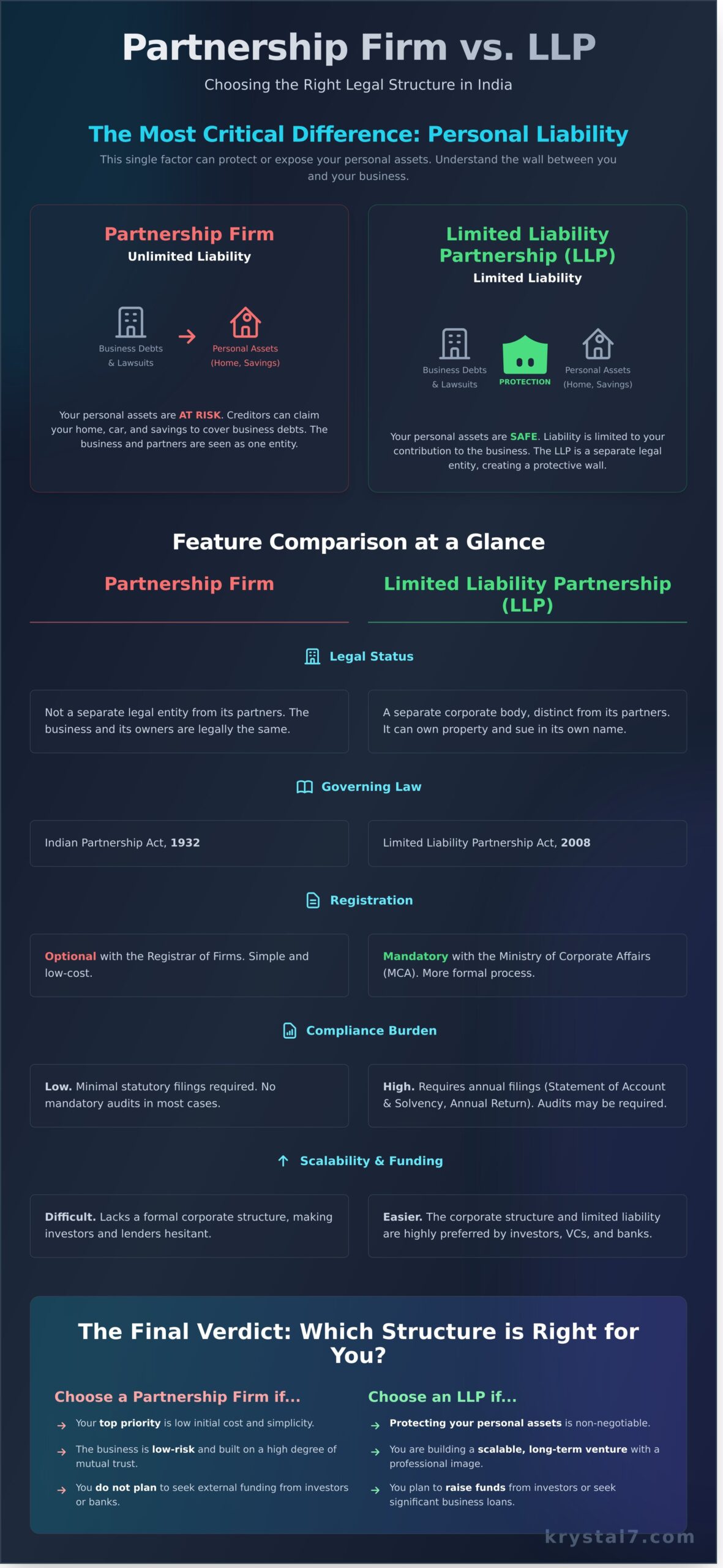
To cut through the complexity, here is a high-level comparison of the five most critical differences. This table provides a snapshot to help you quickly grasp the core distinctions.
| Feature | Traditional Partnership Firm | Limited Liability Partnership (LLP) |
|---|---|---|
| Legal Status | Not a separate legal entity from its partners. | A separate legal entity, distinct from its partners. |
| Liability | Unlimited. Partners’ personal assets are at risk. | Limited to each partner’s agreed contribution. |
| Registration | Optional (but recommended) with the Registrar of Firms. | Mandatory with the Ministry of Corporate Affairs (MCA). |
| Compliance | Minimal statutory filings. Relatively low-hassle. | Higher compliance, including annual financial filings. |
| Scalability | Difficult to raise capital or transfer ownership. | Easier to attract investors and scale operations. |
The right choice depends entirely on your business vision and personal risk tolerance. Are you building a small, trusted operation or a scalable enterprise poised for growth? This guide will break down each of these points in detail, empowering you to make a clear, confident decision for your business’s future.
What is a Traditional Partnership Firm?
Governed by the Indian Partnership Act, 1932, a traditional partnership is a business structure formed through an agreement between partners. Crucially, it is not a separate legal entity; the law views the partners and the business as one and the same. This means partners face unlimited liability for the firm’s debts. This structure is best suited for small, low-risk businesses where partners share a high degree of mutual trust.
What is a Limited Liability Partnership (LLP)?
The Limited Liability Partnership (LLP) is a modern hybrid structure introduced in India under the LLP Act, 2008. It combines the operational flexibility of a partnership with the significant advantage of limited liability, a feature typically associated with private limited companies. As a separate corporate body, an LLP protects its partners’ personal assets from business liabilities, making it an ideal choice for professional services, consultants, and scalable startups seeking credibility and security.
The Core Difference: Liability and Legal Status
When evaluating the choice of a partnership firm vs llp india, one factor stands above all others in determining the future security of your personal finances: liability. This isn’t just legal jargon; it’s the fundamental wall that can either protect or expose your personal assets. Understanding this distinction provides the clarity you need to build your venture on a solid foundation.
The key concept is the ‘Separate Legal Entity’. An LLP is considered a separate entity from its partners, much like a person. It can own property, enter into contracts, and be sued in its own name. A traditional partnership firm, however, has no such distinction; the law sees the business and its partners as one and the same.
Think of it like a car accident. If a delivery driver for an LLP causes an accident, the claim is against the LLP’s assets (the business bank account, its vehicles). But if the same happens with a partnership firm, the claim can extend to the personal bank accounts, homes, and savings of every partner involved.
Unlimited Liability in a Partnership Firm
In a traditional partnership, the liability is unlimited. This means that partners are personally, jointly, and severally responsible for 100% of the business’s debts and legal obligations. If the business cannot pay its creditors, those creditors can legally pursue the personal assets of any and all partners to recover the amount. A single poor decision by one partner can jeopardise the financial security of everyone else involved.
Limited Liability in an LLP
A Limited Liability Partnership (LLP) provides a crucial safety net. As the name suggests, the liability of each partner is limited to the capital they agreed to contribute to the business. Your personal assets are shielded from business debts. This legal separation is a core feature of the LLP structure, which is registered and governed under the guidelines set by the Ministry of Corporate Affairs (MCA). This protection allows entrepreneurs to take calculated business risks with the freedom to focus on growth, not on fear. It is important to note, however, that this shield does not apply in cases of intentional fraud or gross negligence.
Formation Costs and Ongoing Compliance: The ‘Hassle’ Factor
For many entrepreneurs, the choice between a partnership firm vs LLP in India boils down to a simple question: which is less hassle? While initial costs are a factor, the long-term compliance burden often has a bigger impact on your time and resources. Let’s break down the real costs-both in money and effort-to bring crystal clarity to this critical decision.
Registration Process and Initial Costs
The upfront investment to launch your venture differs significantly. A traditional partnership offers a faster, more affordable start, but an LLP’s formal process provides a more robust legal foundation from day one.
- Partnership Firm: Registration is optional but highly recommended. The core requirement is drafting and signing a Partnership Deed. The process is simpler and can cost as little as ₹2,000 – ₹5,000, making it an attractive option for businesses on a tight budget.
- Limited Liability Partnership (LLP): Incorporation is a mandatory, formal process with the Ministry of Corporate Affairs (MCA). It requires obtaining Digital Signature Certificates (DSC) and Director Identification Numbers (DPIN) for all designated partners. Initial setup costs typically range from ₹7,000 to ₹15,000.
Annual Compliance Burden: LLP vs. Partnership
This is where the long-term “hassle factor” truly comes into play. The seemingly lower cost of a partnership must be weighed against the stringent, non-negotiable compliance calendar of an LLP.
- Partnership Firm: The primary annual requirement is filing the firm’s income tax return. There are no mandatory filings with a registrar.
- LLP: An LLP must file its income tax return and submit mandatory annual filings to the MCA. These include Form 11 (Annual Return) and Form 8 (Statement of Account & Solvency). Failure to comply leads to significant daily penalties and can jeopardize the LLP’s status.
Navigating these statutory requirements can be overwhelming. Let us handle the compliance so you have the freedom to focus on your business.
Taxation Differences Explained
From a purely tax perspective, the debate of partnership firm vs llp india is straightforward. Both structures are taxed at a flat rate of 30% on their net profits, plus applicable surcharge and cess. There is no major tax advantage in choosing one over the other. Both entities can claim deductions for interest paid to partners and remuneration paid to working partners, subject to limits prescribed under the Income Tax Act.
Growth, Funding, and Long-Term Viability
Choosing a business structure isn’t just about day-one operations; it’s about building a foundation for your future. For ambitious entrepreneurs, the conversation around partnership firm vs llp india quickly shifts to scalability, investor readiness, and creating a lasting legacy. This is where the structural differences become critically important for your long-term vision.
Raising Funds and Attracting Investors
An LLP is recognised as a formal corporate entity, which inspires significant confidence in investors. Its transparent compliance and governance requirements make it an attractive vehicle for funding. In contrast, traditional partnership firms are typically ineligible for venture capital or private equity funding. Furthermore, LLPs are permitted to receive Foreign Direct Investment (FDI) under the automatic route in sectors where 100% FDI is allowed, opening doors to global capital that remain closed to partnership firms.
Business Continuity and Perpetual Succession
One of the most powerful advantages of an LLP is its ‘perpetual succession.’ As a separate legal entity, the LLP’s existence is not affected by the death, retirement, or insolvency of any partner. Business continues uninterrupted. A partnership firm, however, legally dissolves upon the death or exit of a partner unless the partnership deed explicitly provides a workaround. This inherent stability makes an LLP a more credible and reliable entity for securing long-term contracts and building trust with clients and stakeholders.
Ease of Ownership Transfer
As your business evolves, you may need to bring in new strategic partners or manage exits. In an LLP, this is a streamlined, procedural matter of amending the LLP agreement. Transferring interest in a partnership firm can be far more complex, often requiring the unanimous consent of all existing partners and the drafting of an entirely new deed. This flexibility is vital for a dynamic business planning for growth.
For founders with a clear vision for expansion, the choice becomes clear. The LLP structure is engineered for:
- Investor-Readiness: A credible structure for attracting PE, VC, and FDI.
- Lasting Legacy: Uninterrupted existence through perpetual succession.
- Dynamic Scalability: Simple, structured processes for adding or changing partners.
Building a business that can thrive for years requires foresight. Ensuring you have the right legal framework is the first step. If you need clarity on which structure best aligns with your ambitions, our team of experts is here to provide the guidance you need to build with confidence.
Final Verdict: Which Structure is Right for Your Business?
Choosing between a partnership firm vs LLP in India is a foundational decision that shapes your venture’s future. There is no universal “best” choice, only the structure that aligns perfectly with your vision, risk appetite, and growth ambitions. This final verdict moves beyond features to provide a clear, scenario-based framework, empowering you to make a confident decision for your business.
Choose a Partnership Firm if…
A traditional Partnership Firm is a streamlined, cost-effective choice for ventures built on a foundation of absolute trust. It’s the right path if:
- You are launching a small-scale, low-risk business, perhaps with family or long-trusted colleagues.
- Your initial budget is extremely limited, and minimising setup costs is your top priority.
- The business model is straightforward and you have no immediate plans to seek external investment or loans.
Choose an LLP if…
A Limited Liability Partnership (LLP) offers a robust corporate structure with crucial legal protections. An LLP is the clear choice if:
- Protecting your personal assets from business debts and liabilities is non-negotiable.
- You operate a professional services firm (like consulting, accounting, or design) where credibility is vital for attracting clients.
- Your long-term vision includes scaling the business, raising capital, or eventually bringing in new partners.
Still Unsure? Get Expert Guidance
The debate of partnership firm vs llp india involves more than just registration costs; it impacts your liability, compliance, and ability to grow. Making the wrong choice at this stage can lead to costly restructuring and administrative hassles down the line. Don’t leave this critical decision to guesswork.
Our team of experts at Krystal7 Consultants provides the clarity you need to build your business on a solid legal foundation. We don’t just file paperwork; we partner with you to understand your vision and recommend the perfect structure. Let us handle the complexities so you have the freedom to focus on what you do best.
Ready to move forward with confidence? Schedule a free consultation to find your perfect business structure.
Your Clear Path Forward: Making the Right Choice for Your Venture
The decision between a traditional Partnership Firm and a Limited Liability Partnership is a pivotal moment for any new business. Ultimately, the partnership firm vs llp india debate hinges on your appetite for risk and your vision for growth. A Partnership Firm offers operational simplicity and lower initial compliance, which can be ideal for small, closely-held businesses. However, an LLP provides the non-negotiable security of limited liability, safeguarding your personal assets from business debts, and establishes a credible, separate legal entity. This formal structure is far better suited for businesses aiming to scale, attract external funding, and build a durable brand legacy.
Navigating these legal structures shouldn’t be a source of anxiety. The right foundation frees you to pursue your vision with confidence. Start your business with crystal clarity. Let our experts handle your registration. At Krystal7, our team of Chartered Accountants and legal experts removes the guesswork. We provide a streamlined registration process with transparent, all-inclusive pricing and dedicated support for your venture from day one. We handle the complexities so you have the freedom to focus on building your business.
Your dream deserves a strong start. Let’s build it together.
Frequently Asked Questions
Can an NRI or a foreign national be a partner in a Partnership Firm or an LLP?
Yes, an NRI or a foreign national can become a partner in a Limited Liability Partnership (LLP), subject to compliance with FEMA regulations. However, at least one Designated Partner in the LLP must be a resident of India. In contrast, a traditional Partnership Firm is generally restricted to Indian residents, making the LLP a more flexible and globally accessible business structure for international collaborations.
What are the minimum and maximum number of partners allowed in each structure?
Both a Partnership Firm and an LLP require a minimum of two partners to start. The key difference lies in the maximum limit. A Partnership Firm is capped at a maximum of 50 partners. An LLP, on the other hand, has no upper limit on the number of partners it can have, offering unlimited scalability and making it ideal for ventures planning significant growth in ownership.
Can I convert my existing Partnership Firm into an LLP later on?
Absolutely. The law provides a clear and streamlined process for converting an existing Partnership Firm into an LLP. This strategic move allows your business to evolve, gaining the significant benefits of a separate legal identity and limited liability for its partners. The conversion can be completed without disrupting ongoing operations, offering a seamless upgrade for your growing enterprise and providing greater legal protection.
What are the penalties if an LLP fails to complete its annual compliance filings?
Failing to meet an LLP’s annual statutory compliance, such as filing Form 8 and Form 11, attracts significant penalties. The penalty is a flat ₹100 per day for each form that is delayed, and there is no maximum cap on this amount. This can quickly accumulate into a substantial financial burden. Ensuring timely, accurate filings is crucial to maintain your LLP’s good legal standing and avoid these heavy costs.
Is it mandatory to register a Partnership Firm in India?
While registering a Partnership Firm is not legally mandatory, it is highly advisable. An unregistered firm faces severe disadvantages: it cannot sue third parties to enforce contractual rights, and partners cannot sue the firm or each other. Registration provides the firm with legal recognition and the ability to enforce its rights, offering essential protection that is critical for any serious business operation.
Which business structure is better for a small IT services or consulting business?
For most small IT services or consulting businesses, an LLP is the superior choice. It provides the crucial advantage of limited liability, which protects your personal assets from business debts and lawsuits. When evaluating the partnership firm vs llp india debate, the LLP’s enhanced credibility with clients, perpetual succession, and easier access to funding make it the modern, professional, and secure structure for ambitious entrepreneurs in the service industry.

Article by
Nihal Srivastava
Nihal Srivastava is the Co-Founder of Krystal7 Consultants, helping Indian entrepreneurs and startups navigate company registration, compliance, trademark protection, and regulatory requirements with clarity and confidence. With 6+ years of hands-on expertise in MCA filings, GST compliance, and corporate structuring, Nihal has guided 1000+ businesses across India through their legal and compliance journeys. He believes every business dream deserves crystal clear foundations, and that no founder should be held back by paperwork or red tape.