

Converting Proprietorship to Pvt Ltd Company: A Complete Guide
Your business is growing, a testament to your vision and hard work. But with that success comes a new set of challenges. The thought of converting proprietorship to pvt ltd company can feel overwhelming, tangled in complex legal processes, confusing tax implications, and questions about what happens to your existing assets. You’re likely wondering if this is the right move for your venture and how to navigate the transition without costly mistakes. This uncertainty is a common hurdle for ambitious entrepreneurs, but it doesn’t have to be your roadblock.
This complete guide is designed to provide the clarity you need. We’re here to cut through the red tape and empower you with a clear, step-by-step roadmap for a seamless transition. Inside, you will find a practical checklist to follow, a transparent look at the real benefits to justify the effort, and expert guidance to help you avoid legal pitfalls and unforeseen tax liabilities. Gain the confidence to elevate your business structure, so you can secure your legacy and get back to focusing on growth.
Key Takeaways
- Understand the key growth milestones that signal it’s the right time to transition from a solo venture to a scalable private limited company.
- The process of converting proprietorship to pvt ltd company is streamlined through the SPICe+ form, which our guide demystifies step-by-step.
- Discover a complete checklist of essential documents to gather in advance, ensuring a smooth and hassle-free conversion from the very start.
- Gain clarity on the critical tax implications, including capital gains, to make financially sound decisions during your business transition.
- Learn the immediate compliance responsibilities and next steps to take after incorporation for a strong and legally sound future.
Why and When to Convert Your Proprietorship to a Private Limited Company
Your business began as a vision-a solo venture driven by your passion and hard work. But as your success grows, the simple structure that once served you well can become a limitation. The journey from a one-person operation to a scalable enterprise is a natural growth curve, and recognizing when to evolve is critical. This section provides the clarity you need to validate your decision, focusing on the strategic reasons for converting proprietorship to pvt ltd company and building a foundation for future growth.
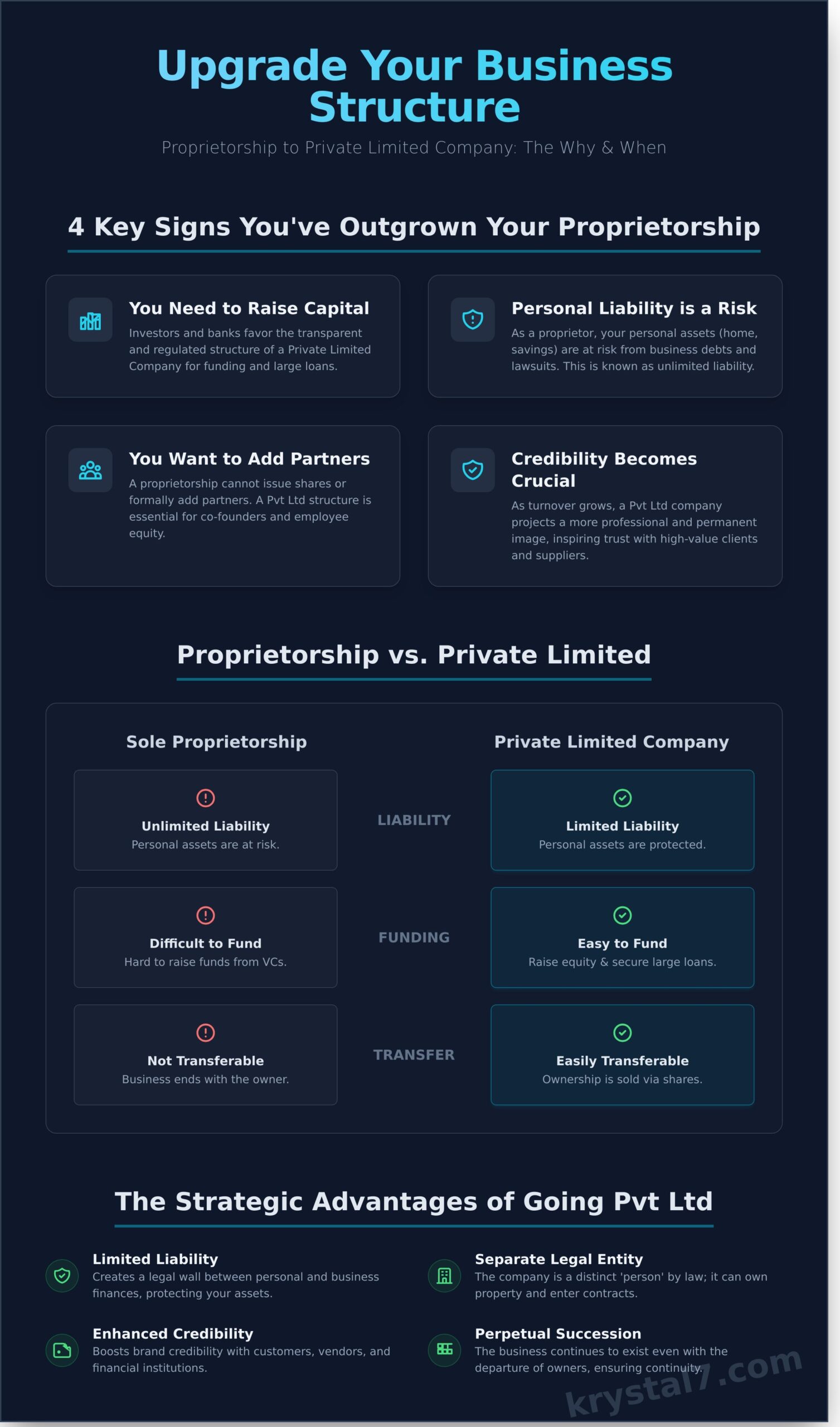
Key Signs Your Business Has Outgrown a Proprietorship
If you’re experiencing any of the following, it’s a clear signal that your business is ready for a more robust legal structure. These are not just administrative hurdles; they are growth opportunities waiting to be unlocked.
- You need to raise capital: Investors, from angel investors to venture capitalists, almost exclusively fund Private Limited companies due to their transparent and regulated structure. Banks also view them as more stable and are more willing to grant substantial business loans.
- Your personal liability is a growing risk: As a proprietor, you are the business. This means your personal assets-your home, car, and savings-are legally exposed to business debts and lawsuits. This concept of unlimited liability is a core characteristic further explained in this guide on What is a Sole Proprietorship?
- You want to bring in partners: A proprietorship cannot have partners or issue shares. If you plan to bring in a co-founder or reward key employees with equity, a Pvt Ltd structure is essential.
- Your turnover is increasing rapidly: A higher turnover often means larger contracts and greater credibility demands. A Pvt Ltd company projects a more professional and permanent image to high-value clients and suppliers.
The Strategic Advantages of a Private Limited Company
The process of converting proprietorship to pvt ltd company is more than just a compliance step; it’s a strategic upgrade that provides a secure platform for your business to thrive.
- Limited Liability: This is the most significant advantage. It creates a legal wall between your personal finances and the business’s liabilities, protecting what you’ve worked so hard to build.
- Separate Legal Entity: The company is recognized as a distinct “person” in the eyes of the law. It can own property, sue or be sued, and enter into contracts in its own name.
- Perpetual Succession: A Pvt Ltd company’s existence is not tied to its owners. It continues to exist even in the event of the death or departure of a director, ensuring business continuity and a lasting legacy.
- Enhanced Credibility: Operating as a registered company under the Ministry of Corporate Affairs (MCA) instantly boosts your brand’s credibility with customers, vendors, employees, and financial institutions.
Proprietorship vs. Pvt Ltd Company: A Quick Comparison
| Feature | Sole Proprietorship | Private Limited Company |
|---|---|---|
| Liability | Unlimited (Personal assets are at risk) | Limited (Personal assets are protected) |
| Funding | Difficult to raise funds from investors | Easy to raise equity funding and secure loans |
| Compliance | Minimal and straightforward | Higher statutory compliance (meetings, filings) |
| Transferability | Cannot be transferred; business ends with owner | Easily transferable by selling shares |
| Credibility | Lower; often perceived as a small-scale venture | High; seen as a more stable and credible entity |
The Legal Process: A Step-by-Step Conversion Guide
Navigating the legal landscape can feel overwhelming, but the journey of converting proprietorship to pvt ltd company is a structured and methodical one. We’ve broken down the official procedure into clear, manageable steps to bring Krystal-Clear clarity to the process. This guide demystifies the jargon and lays out a streamlined path, empowering you to make this transition with confidence.
Step 1: Fulfilling Pre-Conversion Conditions
Before initiating the process, your business structure must meet the foundational requirements for a Private Limited Company. This ensures a smooth transition and compliance from day one. You will need:
- A minimum of two directors and two shareholders (they can be the same individuals).
- At least one director must be a resident of India, meaning they have stayed in India for 182 days or more in the previous calendar year.
- A plan for transferring assets and liabilities from the proprietorship to the new company, typically executed through a formal agreement known as a “slump sale.”
Step 2: Obtain Director Identification Number (DIN) and DSC
Every director of an Indian company must have two crucial digital credentials. A Director Identification Number (DIN) is a unique lifetime ID issued by the government. Think of it as a PAN card for directorship. A Digital Signature Certificate (DSC) is a secure digital key used to electronically sign forms submitted to the MCA, ensuring authenticity and security. Both are mandatory and are applied for during the initial incorporation process.
Step 3: Company Name Approval and Incorporation (SPICe+ Form)
Your new company needs a unique identity. The proposed name must not be identical or too similar to an existing company or trademark. You can verify its availability on the official Ministry of Corporate Affairs (MCA) portal. The entire incorporation process is now handled through a single, integrated web form called SPICe+ (Simplified Proforma for Incorporating Company Electronically Plus), which covers name reservation, DIN allotment, and incorporation application in one streamlined submission.
Step 4: Drafting the Takeover Agreement
This is a critical legal document that formalizes the transition. A Takeover Agreement, or Slump Sale Agreement, is drafted between you (the sole proprietor) and the newly formed Private Limited Company. It meticulously details the transfer of all business assets, liabilities, and intellectual property. Key clauses include the effective date of transfer, the consideration (value) exchanged, and representations from both parties, ensuring a legally sound and transparent handover of the business.
Essential Documentation for a Seamless Transition
To ensure the process of converting proprietorship to pvt ltd company is streamlined and free from delays, meticulous preparation of documents is non-negotiable. Inaccuracies or missing paperwork can lead to unnecessary red tape and procedural setbacks, hindering your growth. This comprehensive checklist is designed to bring Krystal-Clear clarity to your preparation, empowering you to gather everything needed with confidence and precision.
Organizing these documents in advance is the first step toward a hassle-free incorporation. We have structured the requirements by who provides them to simplify the collection process.
Documents Required from the Sole Proprietor
As the visionary behind the business, your personal and business records form the foundation of this legal transition. Ensure every copy is clear, legible, and up-to-date.
- Identity & Address Proof: A self-attested copy of your PAN card and Aadhaar card.
- Photograph: A recent passport-sized photograph.
- Business Address Proof: A recent utility bill (electricity, telephone) or property tax receipt for the proprietorship’s operating address.
- Financial Records: The latest bank statements (last 6 months) for the proprietorship’s primary bank account. These records are vital not just for valuation but also for understanding the detailed tax implications of conversion, a topic that requires expert navigation.
- Firm Registrations: Copies of any existing certificates, such as GST registration, MSME/Udyam registration, or a Shop & Establishment license.
Documents for the New Directors and Shareholders
A private limited company requires a minimum of two directors and two shareholders (they can be the same individuals). Each person involved must provide the following for statutory KYC compliance.
- PAN Card: A self-attested copy is mandatory for all proposed directors and shareholders.
- Identity Proof: A self-attested copy of a Voter ID, Passport, or Driver’s License.
- Address Proof: A recent bank statement or utility bill (not older than two months) in their name.
- Director’s Consent: A signed copy of Form DIR-2, which is a formal consent to act as a director in the new company.
Paperwork for the Registered Office Address
The official address of your new private limited company must be legally verified. The required documents depend on the ownership of the property.
- If the Property is Owned: A copy of the conveyance or sale deed in the owner’s name, along with a recent utility bill.
- If the Property is Rented: A copy of the current rental agreement.
- No Objection Certificate (NOC): In all cases where the proprietor or company does not own the premises, a signed NOC from the legal property owner is required. This document grants permission to use the address as the company’s registered office.
Financial and Tax Implications of Conversion
Understanding the financial and tax shifts is one of the most critical steps when you decide to scale your business. While it may seem complex, the legal framework provides a clear, streamlined path for this transition. We believe in bringing Krystal-Clear Transparency to these topics, ensuring you move forward with confidence and not guesswork.
Seamless Transfer of Assets and Liabilities
When you convert your proprietorship, the entire business undertaking-including all its assets (like machinery, stock, and bank balances) and liabilities (such as loans and creditors)-is legally transferred to the newly formed private limited company. This is typically done through a formal “takeover agreement.” This process is often structured as a slump sale, where the business is transferred as a whole for a lump sum consideration, simplifying the valuation process and ensuring a smooth handover.
Capital Gains Tax: Navigating the Exemptions
A primary concern for any entrepreneur is the potential for capital gains tax on the transfer of assets. Fortunately, the law provides specific relief when converting proprietorship to pvt ltd company. Under Section 47(xiv) of the Income Tax Act, you can claim a complete exemption from capital gains tax, provided you meet these crucial conditions:
- All assets and liabilities of the proprietorship business are transferred to the company.
- The proprietor’s shareholding in the new company is at least 50% of the total voting power.
- This minimum 50% shareholding is maintained for a lock-in period of 5 years from the date of conversion.
Adhering to these conditions ensures your hard-earned capital remains invested in your growing venture without any tax leakage.
Updating Your Financial Identity: PAN, GST, and Banking
The conversion marks the birth of a new legal entity, which requires a fresh set of financial and tax registrations. This is a non-negotiable part of the compliance process.
- New PAN: The private limited company will be issued a new, separate Permanent Account Number (PAN). Your personal PAN remains your own and is delinked from the business.
- GST Migration: You must surrender the GST registration held under your proprietorship and apply for a new GSTIN for the private limited company.
- Bank Accounts: All business transactions must now be conducted through a new corporate bank account opened in the name of the private limited company.
Navigating these financial requirements is where expert guidance provides true peace of mind. Let our team at Krystal7 Consultants bring clarity to your conversion process, giving you the freedom to focus on growth.
Life After Conversion: Key Compliance and Next Steps
Congratulations! You’ve successfully received your Certificate of Incorporation. The journey of converting proprietorship to pvt ltd company is a monumental step towards building a scalable and credible business legacy. But this is just the beginning. Your new corporate structure comes with enhanced responsibilities, and Krystal7 is here to provide the clarity you need to navigate them with confidence.
Think of this as graduating to a new league. With greater potential for funding and growth comes a more structured framework of statutory duties. Here’s a clear roadmap of your immediate priorities.
Mandatory Annual Compliance
As a private limited company, you are now accountable to the Registrar of Companies (ROC). Staying compliant is non-negotiable for maintaining your active status and avoiding heavy penalties. Key annual requirements include:
- ROC Filings: Submitting annual financial statements (Form AOC-4) and an annual return (Form MGT-7) is mandatory.
- Statutory Meetings: You must conduct at least four board meetings each year and one Annual General Meeting (AGM) for shareholders.
- Maintaining Registers: Keeping updated statutory registers for members, directors, charges, and minutes of all meetings is a legal necessity.
Opening a Corporate Bank Account and Issuing Shares
Your company is now its own legal entity, and its finances must be separate. Your first step is to open a corporate current account using your PAN card and Certificate of Incorporation. All subscribers to the Memorandum of Association (MOA) must then deposit their share capital into this new account. Following this, the company must issue formal share certificates to all shareholders within 60 days of incorporation.
Updating Your Business Ecosystem
Your new identity must be reflected everywhere. Proactively inform all your stakeholders-clients, vendors, suppliers, and banking partners-about the change in legal status from a proprietorship to a private limited company. It’s crucial to update all existing contracts, licenses, and official registrations. Don’t forget to revise your website, letterheads, invoices, and all branding materials to include your new company name, complete with “Pvt. Ltd.”
Navigating this new compliance landscape can seem overwhelming, but it doesn’t have to be. After converting proprietorship to pvt ltd company, your focus should be on scaling, not on paperwork. Let Krystal7’s team of experts manage your annual filings and statutory duties, giving you complete peace of mind and the freedom to focus on what you do best: growing your business.
Step Forward with Clarity: Final Thoughts on Your Business Conversion
Making the move from a sole proprietorship is a pivotal moment for any entrepreneur. It’s a strategic leap towards greater scalability, enhanced credibility, and the crucial protection of limited liability. The process of converting proprietorship to pvt ltd company, while detailed, is a clear and manageable path to securing your business legacy. By understanding the legal roadmap, essential documentation, and the financial implications we’ve outlined, you are fully empowered to make a confident decision that fuels your long-term growth.
But navigating this transition doesn’t have to be overwhelming. At Krystal7, our mission is to provide the clarity you need, giving you the freedom to focus on your vision. We ensure a seamless and hassle-free process, backed by Chartered expertise and managed by a dedicated advisor who knows your business. With our commitment to transparent pricing and no hidden costs, you can move forward with absolute confidence and peace of mind.
Ready to scale your business? Get crystal clear guidance on your conversion.
Take the definitive step towards building your legacy. Your next chapter of growth awaits.
Frequently Asked Questions
How long does it take to convert a proprietorship to a private limited company?
The entire conversion process typically takes between 15 to 25 working days. This timeline depends on the speed of government processing at the Ministry of Corporate Affairs (MCA) and the prompt submission of all required documents. Our streamlined approach ensures we manage every step efficiently, from name approval to receiving the Certificate of Incorporation, minimizing delays and providing you with Krystal-Clear timelines so you can plan your business transition with confidence.
What are the estimated government fees and professional costs for conversion?
The total cost includes government fees and professional fees. Government charges consist of MCA filing fees and state-specific stamp duty, which varies based on the authorised share capital. Our professional fees cover expert advisory, document preparation, and end-to-end filing management. We provide a transparent, all-inclusive quote with no hidden costs, giving you complete clarity on your investment in scaling your venture. This ensures you can budget effectively for your company’s growth.
Can I convert my proprietorship to a Pvt Ltd company entirely online?
Yes, the process is almost entirely digital, offering significant convenience. Key steps like filing the SPICe+ form for incorporation, reserving the company name, and applying for DINs are all completed online through the MCA portal. While some documents may require physical signatures and subsequent scanning, our team guides you through a seamless digital workflow. We handle the complexities of online submission, giving you the freedom to focus on your business, not the paperwork.
What happens to the brand name and goodwill of my proprietorship?
Your brand’s legacy is secure. The brand name, goodwill, and all other assets and liabilities of the sole proprietorship are formally transferred to the new private limited company through a legal takeover agreement. This ensures a seamless transition, allowing the new entity to continue operations with the same established reputation you worked hard to build. The process of converting proprietorship to pvt ltd company is designed to protect and carry forward your valuable intangible assets.
Do I need to have a minimum turnover to be eligible for conversion?
No, there is absolutely no minimum turnover requirement to convert your proprietorship into a private limited company. This conversion is a strategic decision based on your vision for growth, not your current revenue. Entrepreneurs often make this move to gain limited liability protection, improve access to funding, attract top talent, and build a more scalable, credible business structure. It’s about preparing your venture for its next big leap forward.
What is the minimum share capital required for a private limited company?
The Companies Act, 2013 has removed the requirement for a minimum paid-up share capital. You can start your private limited company with any amount of capital you see fit. While it’s common practice to begin with an authorised capital of ₹1,00,000, you are not required to deposit this amount immediately. Our experts provide clear guidance on structuring your capital in a way that aligns with your business goals and future funding plans.

Article by
Nihal Srivastava
Nihal Srivastava is the Co-Founder of Krystal7 Consultants, helping Indian entrepreneurs and startups navigate company registration, compliance, trademark protection, and regulatory requirements with clarity and confidence. With 6+ years of hands-on expertise in MCA filings, GST compliance, and corporate structuring, Nihal has guided 1000+ businesses across India through their legal and compliance journeys. He believes every business dream deserves crystal clear foundations, and that no founder should be held back by paperwork or red tape.