

Common ROC Filing Mistakes to Avoid in 2026: A Guide to Crystal-Clear Compliance
The annual ROC filing deadline can feel like a storm cloud on the horizon for any director. The fear of mounting per-day penalties, the confusion surrounding the MCA’s V3 portal, and the sheer volume of mandatory disclosures can be overwhelming, turning a critical compliance task into a source of significant stress. The key to navigating this complex landscape with confidence is understanding the most common roc filing mistakes to avoid. This knowledge doesn’t just prevent errors; it provides the clarity needed for a seamless process.
This guide is your roadmap to crystal-clear compliance in 2026. We will break down the frequent, yet preventable, errors that can lead to severe consequences-from hefty fines to director disqualification. By the end, you’ll be empowered with the expert insights needed to safeguard your company’s compliance record, protect your leadership, and transform your annual filing from a hassle into a streamlined, stress-free achievement. Let’s ensure your business thrives on a foundation of flawless compliance.
Key Takeaways
- Discover why 2026 marks a pivotal year for MCA enforcement and how to prepare your business for enhanced digital transparency.
- Pinpoint the most common roc filing mistakes to avoid, such as critical errors in due date calculations for AOC-4 and MGT-7, to prevent costly penalties.
- Learn to navigate MCA V3 portal errors and resolve common Digital Signature Certificate (DSC) issues before they derail your filing deadlines.
- Build a proactive compliance framework using the “Four-Eye” principle and a customized filing calendar to ensure accuracy and timeliness.
Understanding the ROC Compliance Landscape in 2026
For any registered company in India, ROC filing isn’t optional-it’s a statutory obligation mandated by the Companies Act, 2013. It serves as the official, public record of your company’s financial health and governance. As we move through 2026, this landscape is undergoing a seismic shift. The Ministry of Corporate Affairs (MCA) is leveraging technology to enforce compliance with unprecedented rigor, making it vital to understand the most common roc filing mistakes to avoid.
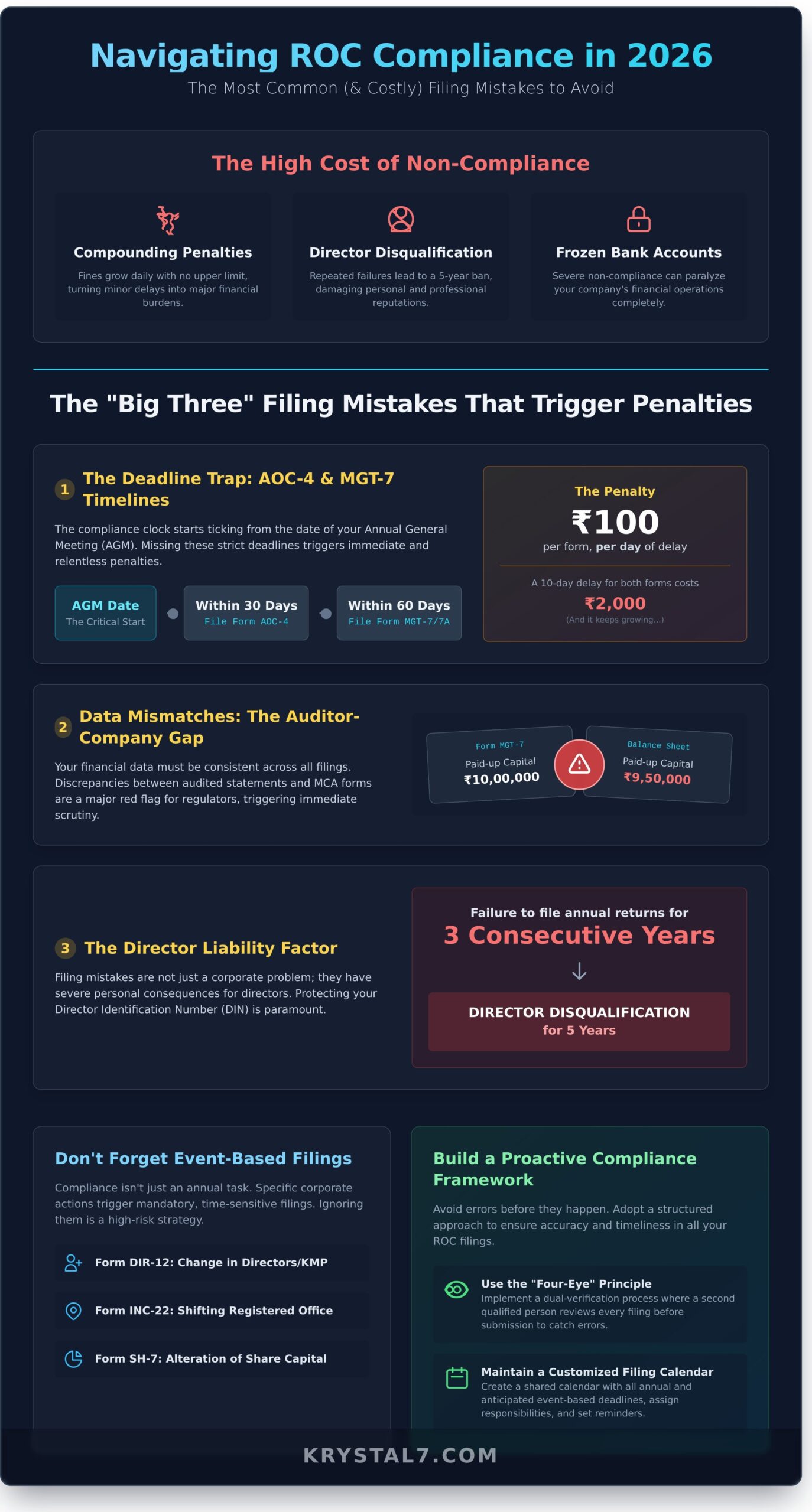
The cost of non-compliance extends far beyond monetary fines. A delayed or incorrect filing can trigger compounding penalties, but the hidden costs are often more severe: a tarnished reputation, disqualification of directors, and even a frozen bank account. In contrast, a clean, up-to-date ROC record provides crystal clarity on your company’s diligence, acting as a powerful ‘green flag’ that builds trust and opens doors for funding and growth.
Annual vs. Event-Based Filings: The First Hurdle
A frequent error is focusing exclusively on the ‘annual season’-the yearly submission of financial statements (AOC-4) and annual returns (MGT-7). This overlooks the critical category of event-based filings, which are required whenever a specific corporate action occurs. Commonly missed triggers include:
- A change in Directors or Key Managerial Personnel (Form DIR-12)
- Shifting the registered office address (Form INC-22)
- An alteration in the company’s share capital (Form SH-7)
Ignoring these time-sensitive updates is a high-risk strategy that invites unnecessary scrutiny and penalties.
The Role of the Ministry of Corporate Affairs (MCA)
The MCA is no longer a passive record-keeper. Its advanced V3 portal functions as a dynamic surveillance system, using data analytics to spot filing gaps and inconsistencies automatically. Under this digital-first approach, the Registrar of Companies (ROC) has a real-time view of your compliance status. For every director, the message is clear: transparency is the new mandate. This proactive enforcement makes it more important than ever to get your filings right the first time.
The “Big Three” ROC Filing Mistakes That Trigger Penalties
Navigating the complexities of ROC compliance can feel overwhelming, but a few specific errors are responsible for the majority of penalties issued by the Ministry of Corporate Affairs (MCA). Understanding these pitfalls is the first step toward building a robust compliance framework. These aren’t minor oversights; they are foundational errors that can trigger a cascade of notices, compounding fines and regulatory scrutiny. Focusing on these three areas is crucial for any business leader looking to avoid costly fines and protect their vision.
The Deadline Trap: AOC-4 and MGT-7 Timelines
The compliance clock starts ticking the moment your Annual General Meeting (AGM) concludes. This date is the single most critical variable in your filing calendar. From this point, you have a strict window to submit your key annual forms:
- Within 30 days of the AGM: You must file Form AOC-4 (Financial Statements).
- Within 60 days of the AGM: You must file Form MGT-7/MGT-7A (Annual Return).
Missing these dates incurs an immediate penalty of ₹100 per form for each day of delay, with no upper limit. A seemingly minor 10-day delay for both forms results in a direct fine of ₹2,000-a cost that grows daily until the default is rectified.
Data Mismatches: The Auditor-Company Gap
Your financial data must tell one consistent story across all platforms. Discrepancies between your audited statements and the figures entered into MCA forms are a major red flag for regulators. Common errors include reporting a Paid-up Capital figure in MGT-7 that doesn’t match the Balance Sheet, or a turnover in AOC-4 that doesn’t reconcile with your GST returns. In the context of MCA XBRL filings, data integrity means that every financial figure reported in your forms must be identical to, and verifiable against, your audited financial statements and other statutory returns.
The Director Liability Factor
ROC filing mistakes extend beyond corporate fines; they carry severe personal consequences for directors. This is one of the most critical and often overlooked common roc filing mistakes to avoid. Failure to file annual returns or financial statements for three consecutive financial years can lead to the dreaded “Disqualified Director” status. This not only tarnishes a director’s professional reputation but also legally prohibits them from being appointed to the board of any other company for five years. Protecting your Director Identification Number (DIN) requires diligent and accurate filings, often managed by certified experts like those governed by the Institute of Company Secretaries of India (ICSI), ensuring your professional legacy remains secure.
Technical Pitfalls: Navigating the MCA V3 Portal Errors
In the digital-first era of compliance, blaming a “technical glitch” for a missed deadline rarely holds up. The Ministry of Corporate Affairs (MCA) V3 portal is a powerful but exacting platform where precision is paramount. Understanding its common errors is key to preventing some of the most frustrating and common roc filing mistakes to avoid. Even small technical oversights can lead to rejected forms, payment failures, and ultimately, the very penalties you’re working to prevent.
One frequent roadblock is the “Pre-scrutiny” error. This isn’t a portal bug; it’s a validation check telling you that data within the form is inconsistent or fails a system rule. The only solution is to meticulously review every field for accuracy before attempting to upload again. Similarly, payment failures can leave a filing in a frustrating “Pending for Payment” limbo. Rushing to pay again can cause duplicate charges. The professional approach is to wait for the prescribed time, check your bank statement for any debits, and only then re-initiate the payment if necessary, ensuring a clear and successful transaction.
DSC and Professional Certification Blunders
Your Digital Signature Certificate (DSC) is your official key to the MCA portal, but it’s a frequent source of trouble. Getting this right provides the clarity needed for a hassle-free submission. Pay close attention to:
- Expired DSCs: An expired or invalid DSC is the number one reason for last-minute filing panics. Proactively track expiry dates for all directors and professionals to avoid this preventable crisis.
- Correct Association: It’s not enough for a DSC to be valid; it must be correctly registered and “Associated” on the V3 business user profile. A mismatch between the DSC and the director’s DIN is a guaranteed rejection.
- Authorised Professional Certification: Ensure the form is certified by the correct, authorised professional (CA, CS, or CMA in practice) whose DSC is also properly associated on the portal.
Form Version Control and Attachment Errors
Using outdated tools or incorrect formats is a simple yet surprisingly frequent mistake. To streamline your process, always download the latest version of an e-form directly from the MCA portal before each use. For attachments, these practical fixes can save you significant time:
- PDF Size Limits: The portal enforces strict file size limits. If your attachment is too large, use a trusted online compression tool to reduce its size without sacrificing legibility.
- The “Corrupt File” Warning: This error often appears if a PDF is password-protected, encrypted, or improperly saved. Ensure all attachments are clean, unlocked, and in a standard PDF format.
- Complete & Correct Attachments: Double-check that all mandatory documents, such as the Notice of AGM, Director’s Report, or MGT-9, are included, correctly named, and fully legible.
A Proactive Compliance Framework: Auditing Your Own Filings
The most effective way to sidestep penalties is to move from a reactive to a proactive compliance mindset. Instead of waiting for a notice, building an internal audit framework provides the clarity and control you need. This approach begins with the “Four-Eye Principle”-a simple rule that directors must personally review and verify all documents prepared by professionals. While you hire experts for their knowledge, the ultimate legal responsibility rests with the board. This final check is your first line of defense against the most common roc filing mistakes to avoid.
A cornerstone of this framework is a localized compliance calendar tailored to your company’s specific financial year. This isn’t a generic template; it’s a strategic map of your unique deadlines for board meetings, AGMs, and annual filings. Complement this with a mid-year “health check” to review event-based compliance, such as changes in directorship or shareholding. Spotting these errors in July is far less stressful and costly than discovering them during the annual filing rush.
The Pre-Filing Checklist for Directors
Before any submission, directors should conduct a final verification. This simple, methodical step can prevent rejections and unnecessary hassle. Your checklist should include:
- Verify DIN KYC Status: Confirm that the DIN for every active director is approved and KYC-compliant to avoid automatic form rejection.
- Cross-check Business Activity Codes: Ensure the Principal Business Activity (NIC) codes listed in the filing accurately reflect your company’s current operational focus and revenue sources.
- Confirm Board Meeting Intervals: Double-check that the gap between any two board meetings does not exceed the statutory 120-day limit and that dates are correctly recorded.
Remedial Actions: Filing Addendums or Revised Returns
Even with a robust system, mistakes can happen. If you’ve already submitted a form with an error, the Ministry of Corporate Affairs (MCA) provides clear pathways for correction. You can file a “Supplementary” form to add information you missed or a “Revised” return to correct inaccurate data. For significant delays, the Condonation of Delay (CoD) scheme allows companies to seek relief, though it’s a more complex process. Remember, proactive correction is always cheaper than reactive defense.
Building a strong internal framework empowers your business with the freedom to focus on growth. For expert guidance on streamlining your compliance process, our team at krystal7.com is always just a call away.
Crystal-Clear Compliance with Krystal7 Consultants
Navigating the complexities of corporate compliance can feel overwhelming, but it doesn’t have to be. At Krystal7, we provide you with the ultimate advantage: the Freedom to Focus on your vision while our experts manage your entire compliance lifecycle. We ensure you sidestep the common roc filing mistakes to avoid that lead to penalties and legal hurdles, transforming compliance from a burden into a business asset.
Our All-in-one Annual Compliance Package is the definitive solution for entrepreneurs who demand peace of mind. It’s a comprehensive, streamlined service designed to keep your business in perfect standing with the Registrar of Companies. This package includes:
- Preparation and filing of all essential annual forms (AOC-4, MGT-7/7A).
- Drafting of Board Meeting and Annual General Meeting (AGM) minutes.
- Maintenance of all statutory registers as required by the Companies Act, 2013.
- Dedicated expert support for all your compliance queries.
The Krystal7 difference is our unwavering commitment to transparent, elite expertise. With no hidden costs, you get access to top-tier Chartered Accountants and Company Secretaries. It’s why over 500 businesses trust us to keep their ROC records spotless and their growth trajectory clear.
Beyond Filing: Strategic Advisory for Growth
Our partnership extends beyond simple filings. During our compliance review, we actively identify tax-saving opportunities and strategic structuring advice. Your dedicated relationship manager understands your business inside and out, offering proactive guidance to help you transition from a promising startup to a compliant corporate legacy. We don’t just file forms; we build frameworks for sustainable success.
Get Started with Krystal7 Today
Our onboarding process is designed for simplicity and speed, getting your compliance on track without delay. We offer specialized support for Gurgaon-based firms and pan-India startups, understanding the unique challenges you face. Stop worrying about the common roc filing mistakes to avoid and start building your future with confidence. Ready to achieve absolute clarity? Experience Krystal-Clear Compliance – View Our Packages.
From Compliance Anxiety to Crystal Clarity: Your Next Steps
The path to flawless ROC compliance in 2026 is paved with diligence. As we’ve explored, success hinges on understanding the evolving regulatory landscape, navigating the MCA portal with precision, and implementing a proactive internal audit system. By being aware of the most common roc filing mistakes to avoid, from simple deadline oversights to inaccurate data submissions, you empower your business to operate with confidence and avoid costly penalties.
But you don’t have to manage this complexity alone. At Krystal7, we provide the expert guidance that turns compliance from a burden into an asset. Our services, handled by top-tier Chartered Accountants and Company Secretaries, boast a zero-penalty track record for our recurring clients. Experience the peace of mind that comes with transparent, upfront pricing and no hidden “red tape” fees. Secure Your Business with our Annual Compliance Package today.
Step away from the guesswork and gain the freedom to focus on your vision. Your business deserves a foundation of crystal-clear compliance to thrive.
Frequently Asked Questions
What is the penalty for late ROC filing in 2026?
As of the current regulations, the penalty for late filing of ROC forms like AOC-4 and MGT-7 is INR 100 per day, per form. This fee is applied for each day of the delay until the filing is completed. It’s crucial to note that there is no maximum cap on this additional fee, meaning the penalty can accumulate to a substantial amount, significantly impacting your company’s finances. These figures are subject to change based on MCA notifications.
Can a company be struck off for missing ROC filings?
Yes, a company can be struck off the Register of Companies for persistent non-compliance. If a company fails to file its financial statements (AOC-4) or annual returns (MGT-7) for two consecutive financial years, the Registrar of Companies (ROC) has the authority to initiate the strike-off process. This action dissolves the company and disqualifies its directors, making timely annual filings absolutely essential for maintaining an active and compliant status.
What happens if there is a mistake in the AOC-4 form after filing?
Once an e-form is filed on the MCA portal, it cannot be edited. If you discover a mistake in your filed AOC-4, you must file a revised form with the correct information. This ensures the company’s financial records are accurate and transparent. Correcting errors is important, but prevention is far more efficient. Understanding the common ROC filing mistakes to avoid from the outset can save your business significant time, resources, and potential compliance issues down the line.
Is it mandatory for a dormant company to file ROC returns?
Yes, even a dormant company must fulfill its annual ROC filing obligations, though the requirements are simplified. Instead of the standard forms, a dormant company is required to file a “Return of Dormant Company” using Form MSC-3 within thirty days from the end of each financial year. Failure to file this return can result in penalties and may lead the ROC to strike the company’s name from the register, revoking its dormant status.
How long should a company keep its records for ROC compliance?
According to the Companies Act, 2013, a company is required to maintain its books of account and relevant records at its registered office for a minimum period of eight financial years immediately preceding the current year. These records must be kept in good order and be accessible for inspection by authorities when required. Proper record-keeping is a foundational aspect of good corporate governance and is critical for ensuring statutory compliance and audit readiness.
What is the difference between AOC-4 and MGT-7?
AOC-4 and MGT-7 are two distinct and mandatory annual filings. Form AOC-4 is used to file the company’s financial statements, including the Balance Sheet and Profit & Loss Account, providing a snapshot of the company’s financial health. In contrast, Form MGT-7 is the Annual Return, which contains comprehensive information about the company’s directors, shareholders, shareholding structure, and other administrative details from the financial year. Both are crucial for complete compliance.
Can I file ROC returns without a Digital Signature Certificate (DSC)?
No, you cannot file ROC returns without a valid Digital Signature Certificate (DSC). All e-forms submitted on the Ministry of Corporate Affairs (MCA) portal must be digitally signed by an authorized signatory of the company, such as a Director or Company Secretary. The DSC serves as an electronic equivalent of a physical signature, ensuring the authenticity and security of the documents filed. Obtaining and maintaining a valid DSC is a prerequisite for all online compliance.
How do I check my company’s current compliance status on the MCA portal?
You can easily verify your company’s compliance status on the official MCA website. Navigate to ‘MCA Services’ and select the ‘View Company or LLP Master Data’ option. By entering your company’s Corporate Identification Number (CIN), you can access key details, including its status, authorized capital, and the date of the last filed annual return and balance sheet. Regularly checking this is a proactive step to ensure you don’t make any common ROC filing mistakes to avoid.