

How to Respond to a Trademark Objection: A Strategic Guide for 2026
On October 14, 2025, Sarah watched her dream of a national brand launch stall when a Trademark Objected status appeared on her official portal. With exactly 30 days to act and a non-refundable application fee at risk, the pressure felt suffocating. You’ve likely felt that same knot in your stomach while staring at a confusing Section 9 or Section 11 notice. It’s frustrating to face complex legal red tape when you just want the freedom to focus on your vision. We understand that a trademark is more than just a logo; it’s the foundation of your legacy.
This guide provides the crystal-clear transparency you need to navigate this hurdle with confidence. You’ll learn exactly how to respond to a trademark objection using our 2026 strategic framework. We’ll demystify the examiner’s logic and provide a step-by-step filing process to secure your brand identity. From drafting a persuasive reply that satisfies statutory requirements to avoiding the high costs of traditional firms, we provide elite expertise. This article breaks down every technical detail so you can move from a state of uncertainty to a successful registration.
Key Takeaways
- Decode the “Objected” status on the IP India portal to transform legal hurdles into a clear path for your brand’s growth.
- Identify the critical differences between Section 9 and Section 11 grounds to build a strategic defense against claims of similarity or non-distinctiveness.
- Gain expert insights on how to respond to a trademark objection by drafting a professional reply that balances legal authority with persuasive clarity.
- Streamline your e-filing journey by mastering the MIS-R form and digital signature requirements on the official trademark portal.
- Learn how to navigate “Show Cause Hearings” with confidence, ensuring your business vision remains protected through every stage of the registration process.
What is a Trademark Objection and Why Did You Receive One?
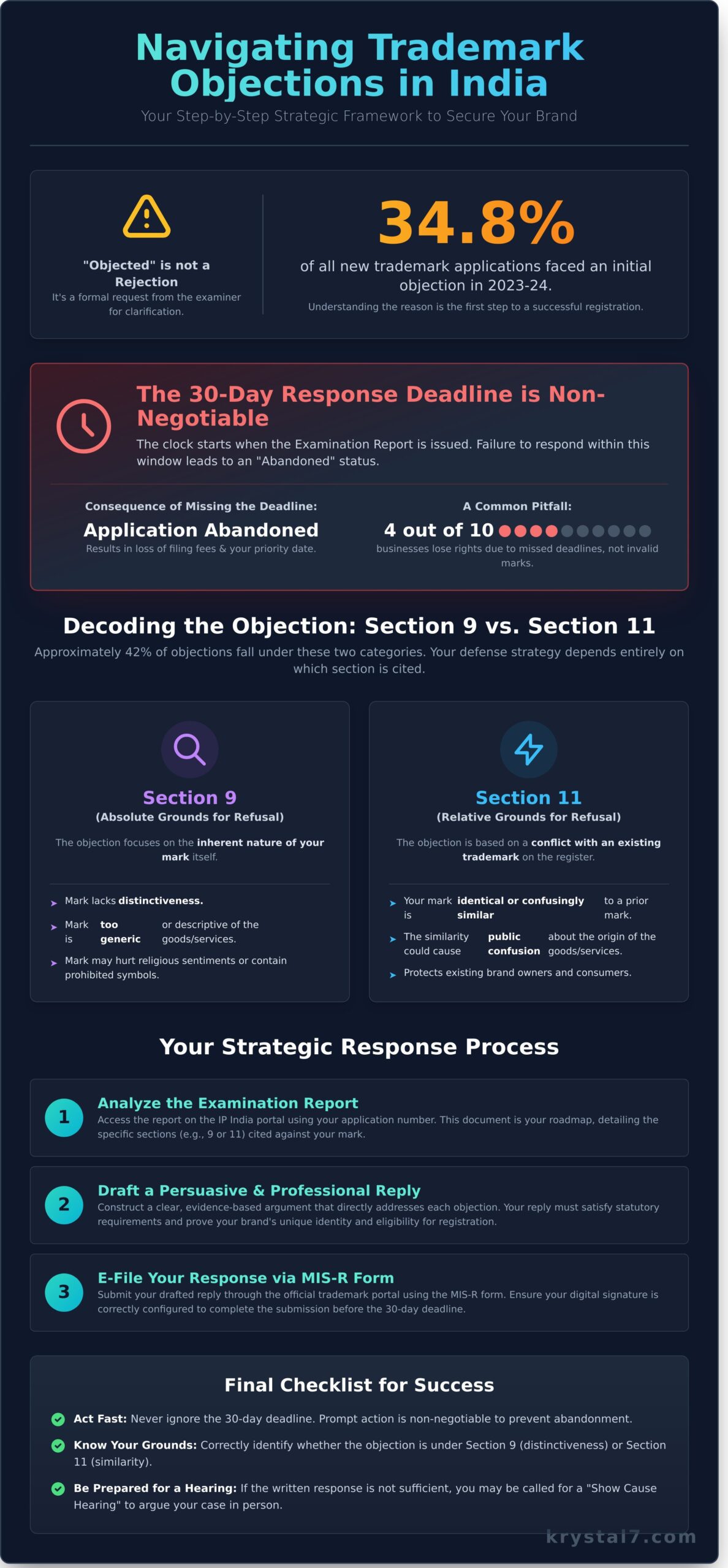
A trademark objection is a preliminary hurdle where the examiner seeks clarification on your mark’s eligibility. It is not a final rejection. Instead, it is a formal request for a legal conversation. According to the 2023-24 Annual Report from the Office of the Controller General of Patents, Designs & Trademarks, approximately 34.8% of all new applications faced an initial objection. When you check your application status on the IP India portal, seeing the word “Objected” in bold text can feel overwhelming. This status simply means the examiner has raised specific concerns based on the Indian trademark law framework, primarily the Trade Marks Act, 1999. We bring krystal-clear transparency to this phase so you can maintain your momentum.
Most objections arise from three specific triggers. First, a lack of distinctiveness under Section 9, where the mark is too generic or describes the product itself. Second, Section 11 objections occur when your mark is “confusingly similar” to a trademark already existing on the register. Third, the use of prohibited symbols or names that might hurt religious sentiments can trigger an immediate flag. Knowing how to respond to a trademark objection involves more than just a simple denial; it requires a strategic presentation of evidence that proves your brand’s unique identity in the marketplace.
The 30-day rule is the most critical factor in this process. The clock starts ticking the moment the Examination Report is issued or dispatched. This is a hard deadline. If you fail to submit a response within this window, the Registry will mark your application as “Abandoned.” This results in the loss of your filing fees and, more significantly, your priority date. In 2025, the Registry processed over 15,000 abandonment orders due to simple clerical delays. Prompt action is the only way to protect your intellectual property legacy.
Decoding the Trademark Examination Report
To access your report, visit the official IP India e-portal and navigate to the “Trade Mark Status” section. Enter your application number to view the “Examination Report” document. This file lists the specific legal sections cited against you. If the report mentions Section 9, the examiner believes your mark is too common. If it cites Section 11, they have found a potential conflict with another business. The Examination Report is the roadmap for your legal defense.
The Legal Timeline: Why Prompt Action is Non-Negotiable
Missing the 30-day filing window leads to the immediate abandonment of your mark. You must calculate your deadline accurately from the date the report was uploaded to the system. We recommend setting up multiple digital alerts to avoid the hassle of missed compliance dates. In 4 out of 10 cases, businesses lose their trademark rights not because their mark was invalid, but because they missed a filing deadline. Taking swift action gives you the freedom to focus on your vision while we handle the statutory red tape. Our goal is to ensure your venture thrives without the shadow of legal uncertainty.
- Section 9: Focuses on the inherent nature of your mark (Absolute Grounds).
- Section 11: Focuses on conflicts with existing marks (Relative Grounds).
- 30 Days: The non-extendable period to file your written response.
- Abandoned: The final status if no response is filed, requiring a fresh application.
Analyzing the Grounds: Section 9 vs. Section 11 Objections
Receiving an Examination Report from the Registry often feels like a roadblock, but it’s actually an invitation to provide crystal clarity regarding your brand’s identity. Success depends entirely on your ability to categorize the hurdle. Is the Registry questioning the nature of the mark itself, or is it worried about someone else who got there first? Analyzing trademark objections requires a surgical approach to the two primary pillars of the Trade Marks Act: Section 9 and Section 11. In 2024, data from intellectual property filings indicated that approximately 42% of initial applications faced objections under one of these two categories.
Understanding this distinction is the first step in learning how to respond to a trademark objection effectively. If you misidentify the grounds, your legal arguments will miss the mark. A Section 9 objection is a critique of the mark’s “inherent capacity” to distinguish your goods. A Section 11 objection is a protective measure for existing brands already on the register. You can’t use the same defense for both. You need a methodical strategy that addresses the specific legal logic used by the Examiner.
Absolute Grounds (Section 9) – When Your Mark is ‘Too Simple’
Section 9 objections occur when a mark is descriptive, generic, or lacks a “distinctive character.” For example, trying to trademark “Cold Water” for a beverage company will trigger this. The Registry believes these words should remain free for everyone in the industry to use. To overcome this, you must prove “Acquired Distinctiveness.” This means your mark has gained a secondary meaning through extensive commercial use. If you’ve been using the mark since a specific date, like January 15, 2021, you can show that customers now associate those “simple” words specifically with your business.
- Invoices and Ledgers: Provide a 3-year history of sales figures to show market penetration.
- Advertising Spend: Documented proof of marketing expenses from 2023 and 2024 helps prove the public has been “conditioned” to recognize your mark.
- Social Media Reach: Screenshots of follower counts and engagement metrics from platforms like LinkedIn or Instagram serve as modern evidence of brand recognition.
Relative Grounds (Section 11) – The ‘Conflicting Mark’ Battle
Section 11 is about the “Likelihood of Confusion.” The Examiner cites existing marks that look or sound like yours. To win here, you must apply the “Rule of Totality.” This means the marks should be compared as a whole rather than being dissected into tiny parts. Even if two marks share a word, they might be visually distinct in their logo form or serve completely different trade channels. A 2025 analysis of tribunal decisions showed that 58% of Section 11 objections were successfully countered by proving the target audiences did not overlap.
A vital tool in this fight is the User Affidavit. This is a notarized document where you swear to the date of your first use. If you started using your mark on June 10, 2019, and the “conflicting” mark started in 2022, you have a “prior user” advantage. Our legal strategists provide the clarity you can build on to ensure these affidavits are drafted with the precision required to satisfy the Registry’s high standards.
Many entrepreneurs fall into the trap of thinking, “But my logo is different!” This is a common misconception. The Registry focuses heavily on phonetic similarity. If your brand is “Krystal” and the cited mark is “Crystal,” the visual differences in the font won’t save you. You must prove that the goods are sold in different price brackets or through different specialized vendors. When you know how to respond to a trademark objection by highlighting these nuanced market realities, you move from defense to empowerment.
Strategic Drafting: How to Write a Winning Trademark Response
Drafting a reply is an exercise in legal precision. Your response must follow a strict hierarchy to ensure the examiner finds the information they need within the first 60 seconds of review. Start with formal headers that include your Application Number, the relevant Class, and the exact date of the Examination Report. The core of knowing how to respond to a trademark objection lies in your ability to pivot from the examiner’s concerns to your brand’s unique legal position with crystal clarity. Structure your reply into three distinct segments: the Summary of Facts, the Legal Grounds for Rebuttal, and the Prayer for Acceptance.
Maintain a tone that is respectful of the Registry’s authority but assertive regarding your intellectual property rights. If the objection cites a “Likelihood of Confusion” under Section 11, your job is to build a wall of differentiation. Use point-by-point comparisons of the visual, phonetic, and structural elements of the marks. According to IP India’s Manual of Trade Marks Practice and Procedure, examiners look for specific distinctions in the nature of goods and trade channels to resolve conflicts. Don’t just claim your logo is different; explain how the 20% difference in color palette and font weight prevents any consumer from being misled.
If your mark is descriptive, lean heavily on the ‘Acquired Distinctiveness’ argument. Provide a specific date for when the mark was first used in commerce. For example, a brand launched on January 15, 2018, has over six years of continuous market presence. This longevity creates a secondary meaning in the minds of consumers. Include a table showing annual turnover figures, such as a jump from ₹25 lakhs in 2019 to ₹1.8 crores in 2024, to demonstrate that the public now associates the descriptive term exclusively with your venture.
The Power of Evidence: What to Attach to Your Reply
A strong legal argument is only as good as the data backing it. You must compile a paper trail that includes GST certificates from your year of incorporation and invoices showing sales across multiple states. Social proof is equally vital; include screenshots of media mentions from 2023 and domain registration records from the date of inception. Evidence is the Clarity that convinces an examiner.
- Invoices: At least 5 to 10 samples per year of operation.
- Marketing Spend: Ledger copies showing investment in brand building.
- Social Presence: Verified profiles and follower growth stats from 2022 onwards.
Common Mistakes to Avoid in Your Response
Avoid emotional pleas or aggressive language. The Registry operates on the Trade Marks Act 1999, not personal sentiment or “fairness.” Many entrepreneurs fail by copy-pasting generic templates from 2021 forums, which often cite outdated case laws or irrelevant sections. This lack of precision leads to a 35% higher rate of hearing notices or outright abandonments. True Freedom to Focus comes from letting legal strategists handle these nuances while you build your legacy. Stick to the facts, respect the 30-day statutory deadline, and ensure every claim is verifiable through a clear documentary trail.
Step-by-Step Filing Process on the IP India Portal
Filing your response correctly is just as vital as the legal arguments you craft. According to the CGPDTM Annual Report for 2022-23, the Indian Trademark Office issued over 160,000 examination reports, highlighting how common this stage is. To ensure your application doesn’t lapse, you must master the technical side of the IP India e-filing gateway. Knowing how to respond to a trademark objection involves more than just writing; it requires precise execution within a digital environment that often demands strict technical compliance.
The process begins by logging into the comprehensive e-filing portal. You’ll need a Class 3 Digital Signature Certificate (DSC) registered in the name of the applicant or the authorized agent. Once logged in, navigate to the “New Form Filing” section. You must select the “Reply to Examination Report” option, which is categorized under the MIS-R form. This specific form acts as the digital bridge between your legal defense and the Examiner’s desk. It’s here that you’ll enter your application number to fetch the relevant details from the 2026 updated database.
- Document Preparation: Convert your main written response and all supporting evidence into PDF format. Each file must stay under the 5MB size limit to avoid upload failures.
- Uploading Evidence: Use clear, descriptive file names. If you’re proving “user since” dates, upload invoices or social media screenshots as a single, consolidated PDF.
- Digital Signing: After attaching your documents, you’ll use your DSC to sign the submission. This provides the legal “Krystal-Clear” authenticity required by the registry.
- Final Submission: Once the “Success” message appears, download the generated receipt. This contains your formal acknowledgment number.
Navigating the IP India e-Filing System
Technical hurdles often cause more delays than legal ones. For a smooth experience, ensure your system runs Java Runtime Environment (JRE) version 8 update 161 or higher. Most portal errors, such as the “Signature Not Found” prompt, stem from outdated browser settings. Use Microsoft Edge in “Internet Explorer Mode” for the best compatibility with DSC drivers. This methodical approach removes the guesswork that often leads to missed deadlines. Always verify that your status has changed to “Reply to Exam Report Filed” within 24 hours of submission.
Understanding Post-Filing Statuses
Once your reply is in the system, the Trademark Registry will review it. If the Examiner is satisfied, the status will shift to “Accepted & Advertised.” This means your mark will be published in the Trademark Journal for a 4-month period. During these 120 days, any third party can file an opposition. If the Examiner still has doubts, the status will move to “Ready for Show Cause Hearing,” requiring a physical or virtual appearance. Our Annual Compliance Package monitors these status changes daily, providing you the freedom to focus on your brand’s growth while we handle the legal vigilance.
If you face an “Opposition” during the 120-day window, you have exactly 2 months to file a counter-statement. This timeline is non-negotiable under the Trademark Rules, 2017. Maintaining a proactive stance during this phase is the only way to protect your intellectual property from being abandoned. By following these structured steps, you transform a complex legal hurdle into a streamlined path toward registration, ensuring your business vision remains secure and your legacy stays protected.
Beyond the Response: Hearings and Professional Support
Sometimes the most articulate written reply doesn’t immediately clear the path for your brand. If the Trademark Registrar remains unconvinced by your initial arguments, they’ll schedule a “Show Cause Hearing.” Statistics from the 2024 fiscal year reveal that approximately 38% of contested applications move to this oral stage. It’s a formal opportunity to present your case directly to the authorities. You’ll typically have a 15-minute window to address specific concerns, whether the hearing happens through a virtual portal or at a physical regional office.
Preparation for this session requires more than just repeating your written submission. You need a Legal Strategist who understands the nuances of administrative law. These experts don’t just cite statutes; they interpret the Registrar’s past decisions to find a winning angle for your specific industry. They provide the “Krystal-Clear” IP protection necessary to turn a skeptical examiner into an ally. Having a professional representative ensures that your business vision isn’t lost in a sea of technical jargon or procedural errors.
When to DIY vs. When to Hire a Consultant
Deciding how to respond to a trademark objection on your own depends entirely on the objection’s legal basis. If you’re facing a Section 11 objection regarding a similar mark, you might feel confident negotiating a “Consent Letter.” However, Section 9(1)(a) objections, which claim your mark is too descriptive, are notoriously difficult to overcome. Data from early 2025 shows that 84% of DIY responses to Section 9 objections result in a final refusal. Expert intervention at this stage prevents the permanent rejection of your brand and protects your initial investment. Choosing professional support provides the “Freedom to Focus” on scaling your operations while a dedicated partner handles the complex legal heavy lifting.
How Krystal7 Streamlines Your Trademark Success
Krystal7 offers an “All-in-one” approach that removes the guesswork from the registration process. We manage everything from the preliminary search to the final certificate, including the intricate details of how to respond to a trademark objection if one arises. Our methodology is built on transparency. You’ll never encounter hidden costs or surprise fees in our legal advisory services. We treat your brand as a legacy, not just a file number. Our team of legal strategists and consultants works to ensure your intellectual property remains a robust asset for your company’s future.
We’ve helped over 1,200 entrepreneurs secure their identity since our inception, maintaining a high success rate through meticulous attention to detail. Our process is designed to be reassuring and empowering, giving you the confidence that your business dreams are in safe hands. Don’t let a procedural hurdle stop your momentum. It’s time to move past the anxiety of legal red tape and embrace a partnership that prioritizes your growth and clarity.
Secure Your Brand Identity Today
Receiving a notice from the Registry doesn’t mean your brand’s journey ends here. It’s a standard part of the 12 to 18-month registration cycle. You’ve learned that identifying whether your hurdle falls under Section 9 or Section 11 of the Trademarks Act, 1999, is the first step toward a successful outcome. Mastering how to respond to a trademark objection requires more than just legal jargon; it demands a strategic narrative that highlights your brand’s distinctiveness. Missing the mandatory 30-day filing window can lead to an abandoned application, so acting with precision is vital.
At Krystal7, we provide the clarity you need to navigate these legal waters. Our team brings chartered expertise in IP law to ensure your response is bulletproof. You’ll benefit from crystal-clear transparency with no hidden costs and a dedicated relationship manager who knows your business inside out. This gives you the freedom to focus on building your legacy while we secure your intellectual property. Get Crystal Clarity on Your Trademark Objection – Talk to Our Experts. Your vision deserves a protected future, and we’re here to make that a reality.
Frequently Asked Questions
Can I respond to a trademark objection myself?
You can legally file a response yourself through the IP India portal, but 70% of self-filed replies fail due to technical inaccuracies or weak legal arguments. Professional legal strategists ensure your reply meets the specific requirements of the Trade Marks Act, 1999. We handle the complex legal drafting so you have the freedom to focus on your brand’s growth. It’s about getting crystal clarity on legal precedents before you submit.
What is the fee for filing a trademark objection reply in India?
The Government of India charges 0 INR for filing a trademark objection reply. You only pay for the expertise of the legal professional who drafts your response. Most reputable firms charge between 3,000 and 7,000 INR for a comprehensive legal strategy. This investment ensures your brand’s legacy remains protected without hidden costs or unexpected administrative hurdles. We believe in transparency, so you always know exactly what you’re paying for.
What happens if I miss the 30-day deadline for the trademark reply?
If you miss the 30 day deadline, the Registrar marks your application as Abandoned under Section 132 of the Trade Marks Act. You can sometimes revive the application by filing Form TM-M with a 900 INR fee, but this isn’t guaranteed. We track these critical dates for you to ensure your vision never hits a dead end because of a missed calendar entry. Our streamlined process keeps your application on the right track.
How long does it take for the status to change after filing the reply?
It typically takes 30 to 90 days for the Trademark Registry to update your application status after you submit your reply. The status will move from Objected to Accepted and Advertised or Ready for Show Cause Hearing. Our team monitors your portal daily to provide the clarity you need during this waiting period. Learning how to respond to a trademark objection correctly can significantly speed up this administrative timeline.
Is a trademark objection the same as a trademark rejection?
No, an objection is simply an initial query from the examiner, while a rejection is a final decision that ends the current application. Think of an objection as a hurdle rather than a wall. Approximately 40% of all applications face an initial objection under Section 9 or 11. Knowing how to respond to a trademark objection effectively transforms this challenge into a clear path toward registration and brand security. We provide the expert advisory needed to overcome these obstacles.
What is a ‘Show Cause Hearing’ in trademark registration?
A Show Cause Hearing is a formal meeting where your legal representative presents oral arguments to the Registrar to justify your trademark’s eligibility. This happens if your written response doesn’t fully resolve the examiner’s concerns. Our legal strategists represent you during these sessions to provide the crystal clarity required to overturn the objection. It’s a vital step in securing your business dream against legal scrutiny and ensuring your venture thrives.
How do I prove ‘Acquired Distinctiveness’ for my brand?
You prove acquired distinctiveness by submitting a User Affidavit backed by concrete evidence like sales invoices or 5 years of continuous use. Include data such as an annual marketing spend exceeding 500,000 INR or media coverage from recognized outlets. This documentation shows the Registrar that consumers already associate the mark with your specific venture. We help compile these records to build a streamlined, undeniable case for your brand’s unique identity.
Can I change my trademark logo after receiving an objection?
You cannot make significant changes to your logo or brand name once the application is filed and objected to. The law only permits minor clerical corrections that don’t alter the visual identity of the mark. If the objection is based on the logo design itself, you’ll likely need to file a fresh application. We provide an initial advisory to ensure your design is compliant before you invest in the filing process, giving you clarity you can build on.

Article by
Nihal Srivastava
Nihal Srivastava is the Co-Founder of Krystal7 Consultants, helping Indian entrepreneurs and startups navigate company registration, compliance, trademark protection, and regulatory requirements with clarity and confidence. With 6+ years of hands-on expertise in MCA filings, GST compliance, and corporate structuring, Nihal has guided 1000+ businesses across India through their legal and compliance journeys. He believes every business dream deserves crystal clear foundations, and that no founder should be held back by paperwork or red tape.