

How to Register a Startup in Bangalore: The 2026 Founder’s Guide to Seamless Incorporation
What if the most dangerous threat to your new venture isn’t a competitor, but a single missed checkbox on the Karnataka e-Karmika portal? Founders in 2026 often realize that securing a Director Identification Number is only the first step in a complex web of local and national mandates. You’ve likely felt the weight of the paperwork already. You want to build the next big thing, not spend 40 hours a week decoding the differences between MCA filings and state labor laws. Understanding how to register a startup in bangalore requires a strategic approach that balances speed with meticulous compliance.
We agree that your time is better spent on innovation than on bureaucratic hurdles. This guide provides the crystal clarity you need to move from a concept to a registered Private Limited Company with full DPIIT recognition. We’ll show you exactly how to handle everything from national incorporation to Bangalore-specific BBMP trade licenses. You’ll finish this article with a clear, step-by-step roadmap to launch your business with total confidence. We’re diving into the essential filings, the e-Karmika registration process, and the specific municipal laws that will protect your legacy from day one.
Key Takeaways
- Discover why Bangalore’s unmatched VC density and R&D ecosystem provide a strategic advantage for visionaries launching in 2026.
- Master the streamlined 5-step national process and learn exactly how to register a startup in bangalore using the latest MCA and NSWS protocols.
- Navigate essential Karnataka-specific mandates, including e-Karmika registration and BBMP trade licenses, with krystal-clear compliance.
- Prepare a precise documentation checklist for directors and office spaces to ensure a seamless, hassle-free incorporation journey.
- Gain the freedom to focus on growth by completing critical post-incorporation steps, from auditor appointments to filing your commencement of business.
Why Registering a Startup in Bangalore is a Strategic Advantage in 2026
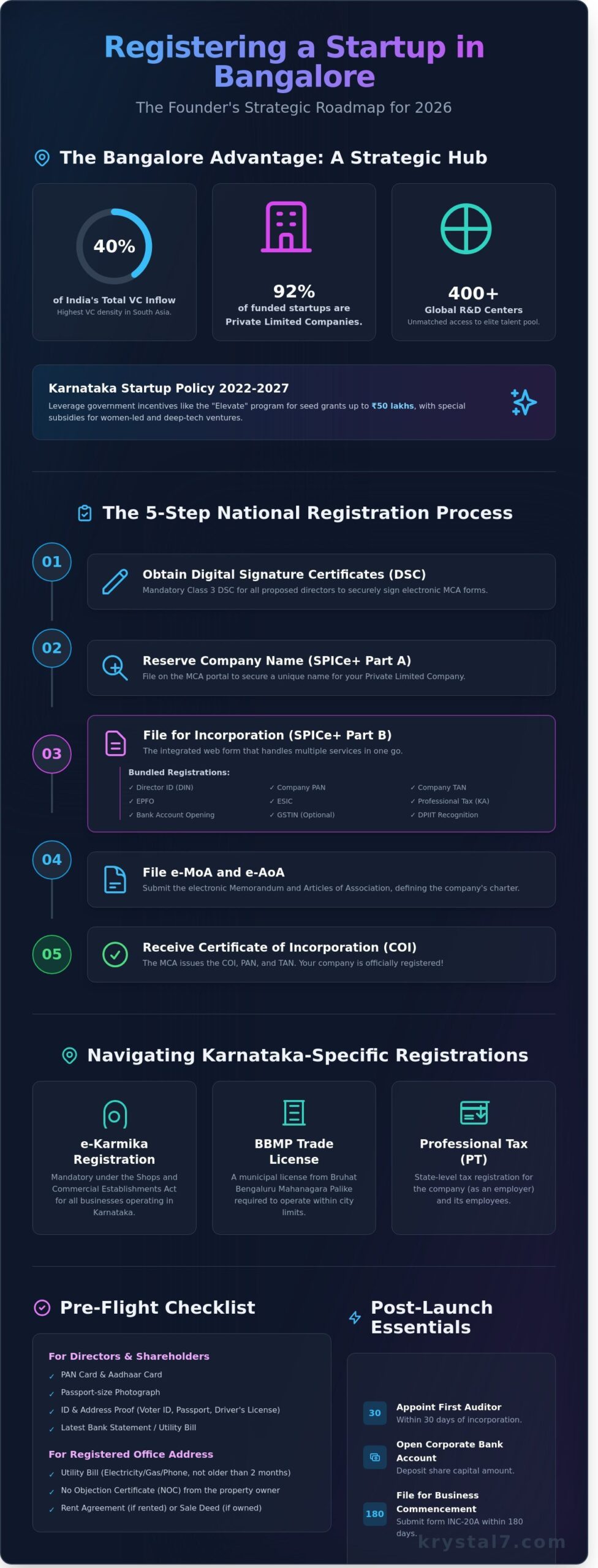
Bangalore remains the undisputed heavyweight champion of Indian innovation. As we move through 2026, the city continues to command nearly 40% of India’s total venture capital inflow. This isn’t a coincidence. It’s the result of a mature infrastructure that supports rapid scaling and provides the highest VC density in South Asia. When you learn how to register a startup in bangalore, you gain immediate access to a specialized talent pool fueled by over 400 global R&D centers and thousands of specialized tech hubs.
Bangalore’s thriving startup ecosystem is built on a foundation of high-tech manufacturing and software services that generate billions in annual revenue. The city’s economy has evolved beyond simple outsourcing. It’s now a global node for deep-tech, biotech, and aerospace. For a founder, this means your neighbor isn’t just a resident; they’re likely a potential collaborator, a senior engineer, or a future investor. The sheer concentration of expertise reduces the “search cost” for high-quality talent, which is often the biggest hurdle for early-stage companies.
Choosing the right legal framework is your first major hurdle. The Private Limited Company remains the preferred choice for 92% of funded startups in the city. It provides the “crystal clarity” investors demand during due diligence. This structure allows for easy equity dilution and share transferability. These features are essential when you’re pitching to the high-density VC firms located along the Outer Ring Road. Most institutional investors won’t even consider a pitch unless the entity is registered as a Private Limited company due to its compliance transparency and perpetual succession.
- Unmatched Capital Access: Home to 30% of India’s unicorns and a massive network of angel investors.
- Elite Talent Pool: Direct access to graduates from IISc, IIMB, and hundreds of specialized engineering colleges.
- Infrastructure: World-class co-working spaces and dedicated tech parks like Electronic City and Whitefield.
- Global Connectivity: A gateway for international partnerships, specifically with Silicon Valley and Southeast Asian markets.
The Ecosystem: Beyond Just a Business Address
Location defines your network in this city. Clusters like Koramangala, HSR Layout, and Indiranagar act as physical LinkedIn feeds. You’re never more than a few blocks away from 15,000 active startups. This density fosters a culture of “pay-it-forward” mentorship that’s hard to replicate elsewhere. Registering in Bangalore is not just about a PIN code; it is about plugging into a self-sustaining engine of capital and talent. It’s about being where the deals happen and where the future is being built in real-time.
Karnataka Startup Policy 2022-2027: 2026 Updates
The Karnataka government’s proactive stance provides a robust safety net for new founders. The “Elevate” program remains a flagship initiative, providing seed grants of up to ₹50 lakhs to promising ventures. By 2026, the policy has expanded to offer 25% higher subsidies for women-led ventures and specialized incubation for deep-tech research. Krystal7 helps you navigate these eligibility requirements during your initial setup. We ensure your documentation meets the rigorous standards needed for state-level tax breaks and government procurement preferences. Understanding how to register a startup in bangalore involves more than just filing forms; it’s about strategic alignment with these lucrative government incentives to ensure your venture has the freedom to focus on growth.
The 5-Step National Registration Process via MCA and NSWS
The Ministry of Corporate Affairs (MCA) has digitized the entire lifecycle of company formation. Learning how to register a startup in bangalore begins with mastering the MCA’s digital ecosystem, specifically the SPICe+ (Simplified Proforma for Incorporating Company Electronically) portal. This integrated web form handles 10 different services simultaneously, cutting down the red tape that previously stalled entrepreneurs for weeks.
- Step 1: Obtaining Digital Signature Certificates (DSC): Every proposed director must obtain a Class 3 DSC. These are secure digital keys used to sign electronic forms. Since physical signatures aren’t accepted on MCA filings, this is your first mandatory investment to ensure document integrity.
- Step 2: Name Approval via RUN: You’ll use the Reserve Unique Name (RUN) service to propose two potential names. The Registrar of Companies (ROC) typically processes these within 48 to 72 hours. A successful reservation stays valid for exactly 20 days.
- Step 3: Filing SPICe+ Part B: This is the most critical stage. It integrates the application for incorporation with PAN, TAN, EPFO, ESIC, and Professional Tax registrations. It also facilitates the mandatory opening of a bank account through an integrated bank selection tool.
- Step 4: Drafting e-MoA and e-AoA: These documents serve as your company’s constitution. The e-MoA (INC-33) defines your business objectives, while the e-AoA (INC-34) outlines internal management rules. Precision here prevents future governance disputes or compliance hurdles.
- Step 5: Receiving CoI and CIN: Once the ROC verifies your data, they issue the Certificate of Incorporation (CoI). This digital document contains your unique 21-digit Corporate Identity Number (CIN), marking the official legal birth of your venture.
The Digital First Approach: Using the NSWS Portal
The National Single Window System has streamlined the 2026 registration journey by offering a unified dashboard for all central and state-level clearances. It eliminates the need to visit multiple departments; reducing the average registration time to just 4 or 5 business days. However, 35% of SPICe+ filings still face resubmission due to minor clerical errors. Common pitfalls include using low-resolution scans of ID proofs or mismatched names between the DSC and the PAN card. You must ensure a Krystal-Clear registered office address verification. This requires a utility bill, such as electricity or gas, that’s strictly less than 60 days old. Even a one-day delay in the bill date can lead to an immediate rejection by the ROC.
Choosing a Name That Passes ROC Bangalore Scrutiny
Bangalore is a competitive hub. Understanding how to register a startup in bangalore requires a deep dive into local trademark sensitivities. When selecting your name, you must avoid any phonetic or visual similarities with existing tech giants like Infosys or Wipro. The ROC Bangalore is particularly strict about descriptive words. If your startup focuses on AI, your name must reflect that activity unless you have a substantial authorized capital. You cannot use generic terms like “Bangalore Consulting” without a unique prefix. A unique name is your first intellectual asset; verify it against both the MCA database and the Trademark Registry to avoid future legal hurdles. If you’re feeling overwhelmed by these technicalities, our legal strategists provide the clarity you need to build on. This methodical approach ensures your brand remains protected while you focus on growth.
Navigating Karnataka-Specific Registrations: e-Karmika, BBMP, and Professional Tax
Securing your federal registrations is only half the battle. To truly understand how to register a startup in bangalore, you must master the local compliance landscape governed by the Government of Karnataka and the BBMP. These state-level mandates ensure your business operates legally within the city’s jurisdiction while protecting your workforce. Ignoring these local statutes can lead to operational halts, even if your federal paperwork is spotless.
The e-Karmika Portal: A Bangalore Founder’s Necessity
Every commercial establishment in Bangalore must register under the Karnataka Shops and Commercial Establishments Act, 1961. You must submit your application through the e-Karmika portal within 30 days of starting your operations. Failure to meet this 30-day window often results in unexpected inspections or penalties from the local labor department. You’ll need specific documents ready, including your registered rental agreement, electricity bill, and clear photographs of the establishment’s storefront showing the name board in both Kannada and English.
While the process is digital, the documentation requirements are meticulous. Krystal7 provides the clarity you need by streamlining these filings from day one. We ensure your application is error-free, preventing the common back-and-forth with government officials that delays your growth. Our team handles the heavy lifting, giving you the freedom to focus on building your product rather than chasing local government approvals.
Professional Tax and GST in the Karnataka Context
Professional Tax (PT) is a state-level levy that every founder must prioritize. In Karnataka, this involves two distinct components. First, the Professional Tax Enrolment Certificate (EC) is mandatory for the business entity itself, typically costing ₹2,500 annually. Second, if you employ staff earning more than ₹25,000 per month, you must obtain a Professional Tax Registration Certificate (RC) to deduct and remit taxes on their behalf. Missing these monthly or annual deadlines can lead to a 1.25% monthly interest penalty on the outstanding amount.
When considering taxes, GST registration is another critical milestone. For service-based startups, which comprise approximately 85% of Bangalore’s new ventures, the mandatory registration threshold is ₹20 Lakhs in annual turnover. If you deal in physical goods, this limit increases to ₹40 Lakhs. However, many founders opt for voluntary registration earlier to claim Input Tax Credit (ITC). While you manage these local filings, don’t forget that national recognition through the official Startup India portal can provide additional tax holidays and benefits that complement your state-level efforts.
Labor Law Compliance and BBMP Trade Licenses
If your startup operates from a dedicated commercial space, you likely need a Trade License from the Bruhat Bangalore Mahanagara Palike (BBMP). This license confirms your business activities comply with local zoning and health regulations. For tech startups, there’s a significant advantage; the Karnataka government frequently grants exemptions to IT and ITES companies regarding working hours and night shift restrictions. To qualify, you must maintain transparent records and prioritize employee safety, especially for late-hour operations. This flexibility is vital for startups running 24/7 cycles.
Knowing how to register a startup in bangalore involves balancing these repetitive monthly filings with high-level strategy. Krystal7 acts as your methodical partner, ensuring every labor law return and PT payment is executed with precision. We eliminate the guesswork, providing a krystal-clear path to total compliance so your vision remains the priority. Let our elite expertise shield you from the red tape while you build your legacy.
Essential Documentation and Capital Requirements for Bangalore Founders
Precision is the foundation of a successful business launch. When you’re learning how to register a startup in bangalore, the paperwork phase often feels like the steepest climb. The Registrar of Companies (ROC) maintains rigorous standards. A single typo or a blurry scan can trigger a “Resubmission” status, delaying your launch by weeks. You need a clean, verified stack of documents to move through the SPICe+ portal without friction.
Every director must provide a clear set of personal identifiers. This includes a PAN card, which is mandatory for Indian nationals, and an Aadhaar card. You’ll also need a secondary address proof, such as a bank statement, electricity bill, or telephone bill. These documents must be current. The ROC rejects any utility bill or statement older than 60 days. For founders in Bangalore’s fast-paced tech hubs, ensuring your current residence matches your ID exactly is the first step toward krystal-clear compliance.
The myth of the 1 Lakh minimum capital continues to circulate among new entrepreneurs. It’s time to retire that idea. The Companies (Amendment) Act, 2015, officially removed the requirement for a minimum paid-up capital for private limited companies. You can technically incorporate with a nominal capital of 10,000 INR or even less. This change gives you the freedom to focus your initial funds on product development rather than locking them in a bank account. However, you must still define your “Authorized Capital,” which is the maximum amount of shares the company can issue.
Bangalore’s global appeal means many startups have NRI or Foreign National directors. These founders face additional hurdles. All identity and address proofs for non-residents must be notarized and apostilled in their home country. If the country isn’t part of the Hague Convention, the documents require consular legalization. This process typically adds 10 to 15 days to your timeline, so plan your roadmap accordingly.
Document Integrity: Avoiding the “Hassle” of Resubmission
Crystal clarity in your documentation prevents costly ROC delays. The most common error involves the “First Subscriber’s List.” This requires a formal board resolution and a signed declaration from each subscriber. Ensure your scans are high-resolution. A common pitfall is a name mismatch on the electricity bill provided for the office address. If the bill says “M. Smith” but the rental agreement says “Michael Smith,” the ROC will likely flag it. We recommend cross-checking every character across your document set before the final upload.
Virtual Office vs. Physical Office in Bangalore
Using a virtual office is a legal and cost-effective way to establish a presence in Karnataka. It’s particularly popular for remote-first teams. However, you must ensure your provider meets MCA physical verification standards. In 2026, the MCA is stricter than ever on physical office verification; ensure your rental agreement is backed by a valid electricity bill and a clear NOC. The No Objection Certificate (NOC) from the landlord must explicitly state that the company has permission to use the premises as a registered office. Without this specific language, your application won’t pass the initial screening.
Stop guessing about compliance and start building your legacy. Our experts provide the streamlined registration support you need to secure your startup’s future in Bangalore.
Post-Incorporation: Scaling Your Bangalore Startup with Krystal-Clear Compliance
Securing your Certificate of Incorporation is a massive milestone, but it’s only the beginning of your journey in India’s startup capital. Once you’ve figured out how to register a startup in bangalore, your focus must shift immediately to administrative hygiene. Your first priority is opening a corporate bank account. Bangalore’s top startup-friendly banks, such as ICICI Bank with its iStartup2.0 program or HDFC’s SmartUp zones, offer zero-balance accounts for the first few months. You’ll need your COI, PAN, and a specific Board Resolution to initiate this process. Digital-first banks in the city often provide integrated tools for payroll and tax, which simplifies your early-stage operations.
The first 30 days require swift action to avoid penalties. You’re legally required to appoint your company’s first Auditor under Section 139(6) of the Companies Act 2013. This professional ensures your financial integrity from the start. Simultaneously, you must file the INC-20A, the Declaration of Commencement of Business. You cannot skip this step. Without this filing, your company can’t exercise borrowing powers or start commercial transactions. Krystal7 handles these filings with meticulous detail, giving you the freedom to focus on building your product while we manage the red tape.
As you shift your focus to building your product, you can discover IT partners that specialize in helping new ventures develop their technology from the ground up.
The First 180 Days: Critical Deadlines
Missing the 180-day window for the Commencement of Business certificate is a costly mistake. The Ministry of Corporate Affairs (MCA) imposes a ₹50,000 flat penalty on the company, and directors face an additional ₹1,000 daily fine. During this period, you must also issue share certificates to your initial subscribers. This has to happen within 60 days of incorporation. In Karnataka, you’re required to pay the applicable stamp duty on these certificates within 30 days of their issuance. Neglecting this can complicate future funding rounds or equity transfers. Don’t forget to set up your statutory registers and minute books at your registered office to remain audit-ready.
Ongoing ROC compliance is what keeps your venture healthy and attractive to investors. Understanding how to register a startup in bangalore is the foundation, but annual filings are the structure. You must manage several key filings annually:
- Form AOC-4: This is for your financial statements and must be filed within 30 days of your Annual General Meeting (AGM).
- Form MGT-7: This annual return contains updated details of directors and shareholders, due within 60 days of the AGM.
- DIR-3 KYC: Every director must complete an annual KYC process to keep their Director Identification Number (DIN) active.
Krystal7’s “Annual Compliance Package” provides the clarity you need to scale without fear. We automate your reminders and handle the complex documentation for MGT-7 and AOC-4, ensuring you never miss a deadline. Our goal is to provide a seamless experience where every business dream finds crystal clarity.
Why Krystal7 is Your Ideal Registration Partner
Our “All-in-one Incorporation Package” covers both Central and State filings, ensuring you meet every Bangalore-specific requirement. You get direct access to seasoned Chartered Accountants and Company Secretaries who understand the local market dynamics. We eliminate the guesswork from compliance so you can build your legacy. Get Started with Krystal7’s Bangalore Startup Package to secure your business’s future with a partner who knows your vision inside out.
Secure Your Place in India’s 2026 Silicon Valley
Bangalore’s ecosystem continues to dominate the global stage. It’s projected to house over 15,000 active tech companies by the end of 2026. Successfully navigating the 5-step MCA process and securing local e-Karmika permits ensures your venture stands on a solid legal foundation. You don’t have to face the red tape alone. Master the technicalities of how to register a startup in bangalore by prioritizing local compliance and upfront documentation. This strategic move protects your intellectual property and prepares you for future funding rounds.
At Krystal7, we believe every business dream deserves crystal clarity. Our all-in-one incorporation and compliance packages remove the guesswork from your journey. You’ll work directly with our expert team of CAs, CSs, and legal strategists who provide elite expertise without the hidden fees. We offer 100% upfront pricing for all filings so you have the freedom to focus on your vision. Let us handle the statutory complexity while you build your legacy. Register your Bangalore Startup with Krystal-Clear Transparency today. Your journey to a streamlined, compliant future starts now.
Frequently Asked Questions
How long does it take to register a Private Limited Company in Bangalore in 2026?
It takes 7 to 10 business days to register a Private Limited Company in Bangalore in 2026. This timeline covers the entire journey from obtaining Digital Signature Certificates to receiving your Certificate of Incorporation. Our streamlined approach brings crystal clarity to the process, ensuring your SPICe+ filings move through the Ministry of Corporate Affairs without a hitch.
Can I register a startup in Bangalore if I live in another city or country?
You can register a startup in Bangalore from any location globally without being physically present. The process of how to register a startup in bangalore is 100% digital and managed through the MCA portal. You simply need to provide scanned documents and a local address for your registered office to establish your venture in India’s tech hub.
What is the total cost of registering a startup in Bangalore, including government fees?
The total cost for registering a startup in Bangalore typically ranges between ₹15,000 and ₹25,000. This figure includes government stamp duty for an authorized capital of ₹1,00,000, name reservation fees, and professional charges for chartered expertise. We provide 100% transparency in our pricing, so you don’t have to worry about hidden costs or unexpected bills.
Is it mandatory to register under the Karnataka Shops and Establishments Act (e-Karmika)?
Registration under the e-Karmika portal is mandatory for every commercial establishment in Bangalore within 30 days of starting operations. This statutory requirement is essential for opening corporate bank accounts and ensuring local legal compliance. Our team handles the entire filing process, giving you the freedom to focus on your product while we secure your permits.
What are the benefits of DPIIT recognition for a Bangalore-based startup?
DPIIT recognition grants your startup access to a 3 year income tax holiday and the ₹10,000 crore SIDBI Fund of Funds. You’ll also enjoy the benefit of self-certifying compliance for 6 labor laws and 3 environmental laws. These incentives are designed to help your venture thrive by reducing the initial tax burden and simplifying complex regulatory hurdles.
Do I need a physical office in Bangalore to register my company there?
You must have a registered office address in Bangalore, but it doesn’t have to be a traditional physical space. Many founders use virtual offices that provide a valid No Objection Certificate and a utility bill dated within the last 60 days. This address acts as your official point of contact for all government correspondence and legal notices.
What is the difference between a Trade License and a Company Registration in Bangalore?
Company registration provides your business with a legal identity across India, while a Trade License from the BBMP permits specific commercial activities at your Bangalore location. Registration is a one-time process, but you must renew your BBMP Trade License every year by March 31. We provide the meticulous guidance needed to manage both these distinct layers of compliance.
How much Professional Tax do I need to pay for my employees in Karnataka?
You must deduct ₹200 per month as Professional Tax for every employee whose monthly gross salary exceeds ₹25,000. Your business entity is also required to pay an annual enrollment fee of ₹2,500 to the Karnataka state government. Our payroll advisory ensures these payments are calculated accurately, providing the clarity you need to maintain a compliant and happy workforce.

Article by
Nihal Srivastava
Nihal Srivastava is the Co-Founder of Krystal7 Consultants, helping Indian entrepreneurs and startups navigate company registration, compliance, trademark protection, and regulatory requirements with clarity and confidence. With 6+ years of hands-on expertise in MCA filings, GST compliance, and corporate structuring, Nihal has guided 1000+ businesses across India through their legal and compliance journeys. He believes every business dream deserves crystal clear foundations, and that no founder should be held back by paperwork or red tape.