

Foreign Company Registration in India: The Ultimate 2026 Guide
India represents one of the world’s most dynamic growth markets, a land of immense opportunity for your global vision. Yet, for many international entrepreneurs, this potential is clouded by the perception of a complex legal maze, bureaucratic hurdles, and the daunting task of choosing the right corporate structure. The fear of hidden costs and navigating ongoing compliance can be enough to stall even the most ambitious venture. We understand this hesitation, and at Krystal7 Consultants, we’re here to replace that uncertainty with absolute clarity.
This ultimate 2026 guide is designed to be your definitive roadmap for foreign company registration in India. We will cut through the noise and eliminate the guesswork. Inside, you’ll find a clear, side-by-side comparison of all legal entry structures, a detailed step-by-step checklist for a streamlined setup, and a transparent overview of your long-term tax and compliance obligations. Our goal is to empower you with the knowledge and confidence needed to not just enter the Indian market, but to thrive in it. Let’s begin building your legacy in India.
Key Takeaways
- Understand the strategic differences between a Subsidiary, Branch, and Liaison Office to select the optimal structure for your business goals.
- Navigate the incorporation process with a clear, step-by-step roadmap, ensuring you avoid common pitfalls and delays.
- Clarify essential requirements for directors, share capital, and your registered office to streamline the foreign company registration in India.
- Prepare for long-term success by understanding the mandatory annual compliance tasks required to keep your Indian entity in good legal standing.
Understanding Your Options: How to Establish a Business Presence in India
Entering the vibrant Indian market is a significant step for any global venture. Fortunately, India provides several well-defined and structured pathways for foreign businesses to establish a presence. The process of foreign company registration in India is primarily governed by the Companies Act, 2013, and the Foreign Exchange Management Act (FEMA), which together create a robust regulatory framework. The consistent growth in Foreign Direct Investment in India is a testament to this structured approach, offering clarity and security for global investors.
Choosing the right entity is the first critical decision, as it directly impacts your operational scope, liability, and long-term vision. This choice depends entirely on the scale and nature of your intended operations. Let’s bring clarity to your primary options.
Option 1: Incorporate as an Indian Company (Private Limited)
For businesses seeking a long-term, committed presence, incorporating an Indian entity is the most robust path. This structure treats your enterprise as a domestic company, allowing for full-scale operations from manufacturing to sales. Your primary choices are:
- Wholly-Owned Subsidiary (WOS): Gives your parent company 100% ownership and complete control over Indian operations, while being subject to Indian laws and regulations.
- Joint Venture (JV): Involves partnering with an Indian entity to share ownership, risk, and local market expertise. The ownership stake is mutually agreed upon.
Ideal for: Companies planning significant investments, manufacturing facilities, or comprehensive sales and marketing operations in India.
Option 2: Establish as a Foreign Company
If your initial goal is to explore the market or manage specific local activities without full incorporation, establishing a direct extension of your parent company is a streamlined option. These entities operate under specific restrictions:
- Liaison Office (LO): Acts as a communication channel and market research hub. It cannot engage in any commercial activity or earn revenue in India.
- Branch Office (BO): Permitted to conduct business activities similar to its parent company, such as import/export of goods, research, and providing professional services.
- Project Office (PO): A temporary setup specifically to execute a project awarded to the foreign company in India. Its existence is tied to the project’s duration.
Option 3: Limited Liability Partnership (LLP)
A modern and flexible alternative, the LLP combines the operational ease of a partnership with the crucial benefit of limited liability found in a company. This hybrid structure is an excellent choice for service-oriented businesses, offering a streamlined compliance framework compared to a private limited company.
Suitable for: Professional services, tech consultancies, and other ventures where partner collaboration is key and limited liability is a priority.
Strategic Comparison: Choosing the Best Entry Route for Your Business
Choosing the right legal structure for your entry into India is not merely a procedural step; it is the strategic foundation upon which your long-term success will be built. This decision profoundly impacts your operational freedom, liability, tax obligations, and overall compliance burden. Gaining clarity on these structures is the first and most critical part of the foreign company registration in India. Let’s break down the key factors to empower you to make the most informed choice for your venture.
Factor 1: Permitted Activities & Scope
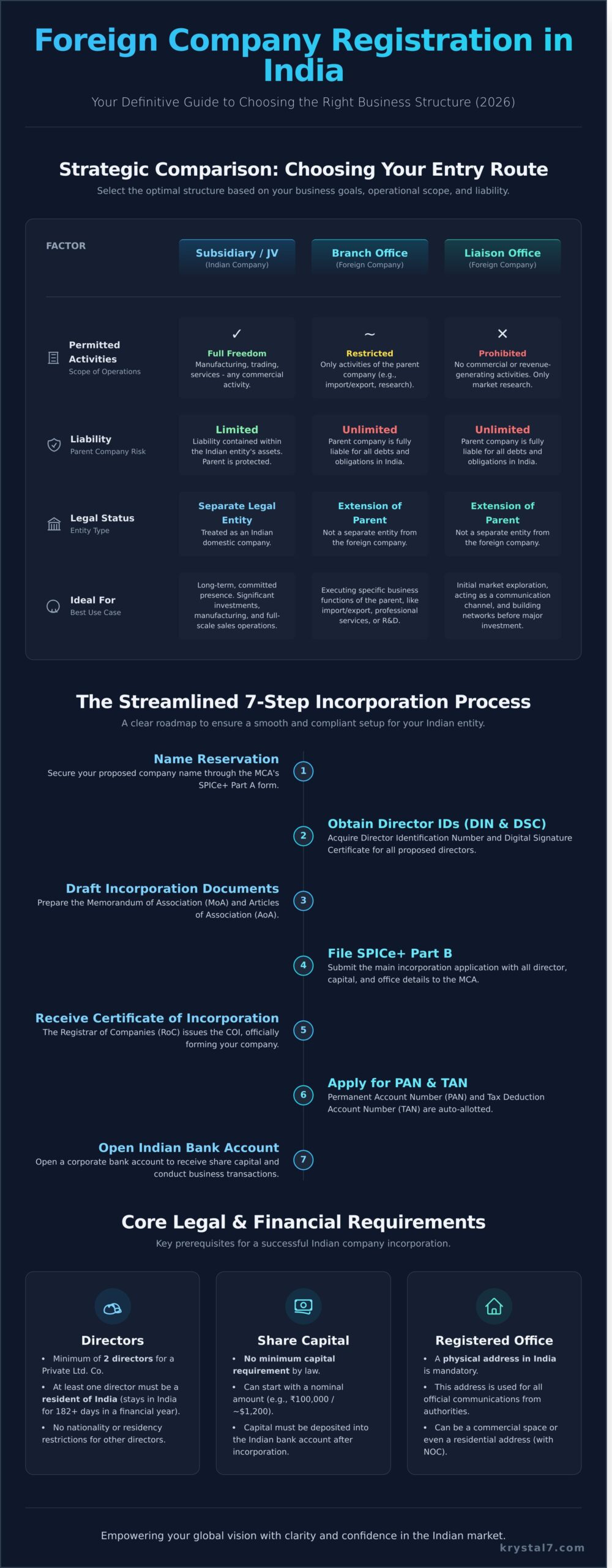
Your intended business activities are the primary filter for selecting an entity. A Wholly-Owned Subsidiary (WOS) or Joint Venture (JV) offers complete operational freedom, allowing you to engage in any commercial activity, including manufacturing, trading, and services. In contrast, a Branch Office is restricted to the same activities as its foreign parent company, while a Liaison Office is strictly prohibited from any commercial or revenue-generating activities, serving only as a communication channel for market exploration.
Factor 2: Liability and Control
Protecting your global assets is paramount. Incorporating a Private Limited Company (WOS or JV) creates a separate legal entity in India, meaning liability is limited to the assets held by the Indian company. Conversely, for a Branch or Liaison Office, the foreign parent company is fully liable for all debts and obligations incurred in India, posing a significant risk. A WOS offers 100% control, whereas a JV necessitates shared control with an Indian partner, a strategic choice for leveraging local expertise.
Factor 3: Compliance and Regulatory Burden
Each structure carries a different compliance weight. Indian companies (WOS/JV) and LLPs are governed by Indian corporate law, requiring regular filings, board meetings, and statutory audits as mandated by the Ministry of Corporate Affairs (MCA). While their compliance is more intensive, their setup is often more streamlined. Branch and Liaison Offices, though having simpler annual compliance, require prior approval from the Reserve Bank of India (RBI), which can be a lengthy process.
Comparative Analysis at a Glance
| Feature | Wholly-Owned Subsidiary (WOS) | Branch Office (BO) | Liaison Office (LO) | Limited Liability Partnership (LLP) |
|---|---|---|---|---|
| Liability | Limited to the Indian entity’s capital | Unlimited (Parent company is fully liable) | Unlimited (Parent company is fully liable) | Limited to partners’ agreed contribution |
| Permitted Activities | All commercial activities are permitted | Only activities of the parent company | No commercial or industrial activity | All business activities are permitted |
| Minimum Capital | No minimum requirement | No minimum requirement | No minimum requirement | No minimum requirement |
| Compliance Level | High (Companies Act, MCA filings) | Moderate (RBI & MCA filings) | Low (RBI & MCA filings) | Moderate (LLP Act, MCA filings) |
| Taxation | Taxed as a domestic Indian company | Taxed at a higher rate for foreign companies | Not subject to income tax | Taxed at a flat rate; no dividend tax |
Making the Right Choice for Your Venture
Ultimately, the best path depends on your strategic goals. For a long-term, full-scale commitment with manufacturing or trading, a Wholly-Owned Subsidiary is the clear winner. If you are executing a specific project for your parent company, a Branch Office may be suitable. For initial market research without commercial transactions, the Liaison Office is the ideal low-risk option. Finally, for service-oriented businesses or partnerships, an LLP offers a modern, flexible, and tax-efficient structure, making it a strong contender in the process of foreign company registration in India.
The 7-Step Registration Process for Foreign Companies in India
Navigating the path to establishing your business in India can seem complex, but it’s a structured and transparent journey. The most robust and popular route for global enterprises is forming a wholly-owned Private Limited Subsidiary. This structure provides complete control and limits liability. The entire process of foreign company registration in India is now streamlined through the digital portal of the Ministry of Corporate Affairs (MCA), ensuring efficiency and clarity.
While the steps are clear, they require meticulous attention to detail. A dedicated expert can manage this entire process for you, removing the guesswork and giving you the freedom to focus on your business vision. Here is a crystal-clear breakdown of the journey.
Step 1-2: Obtain Director Identification & Digital Signatures
The foundation of your digital incorporation begins here. Every proposed director, including foreign nationals, must obtain a Director Identification Number (DIN). Simultaneously, at least one director must acquire a Class 3 Digital Signature Certificate (DSC) to securely sign and file all electronic forms. For foreign directors, identity and address proofs must be notarized and apostilled in their home country, a critical detail for seamless verification.
Step 3-4: Company Name Approval & Document Preparation
Your company’s identity starts with a unique name. An application is filed through the SPICe+ form on the MCA portal to reserve a name that is distinct and compliant with Indian naming regulations. While the name is being approved, we prepare the constitutional documents of your company:
- Memorandum of Association (MoA): Defines the company’s objectives and scope of business.
- Articles of Association (AoA): Outlines the internal governance, rules, and management structure.
You will also need to provide proof of a registered office address in India, which can be a leased or owned commercial property.
Step 5-7: Filing for Incorporation and Post-Incorporation Steps
With all documents in place, the final integrated incorporation form, SPICe+, is submitted to the MCA. This single application intelligently combines requests for the company’s name, DINs, and incorporation. Upon successful verification, the Registrar of Companies issues the Certificate of Incorporation (COI), which includes your unique Corporate Identification Number (CIN). This is the official milestone of your company’s legal birth. The process also automatically applies for your company’s PAN and TAN. Your immediate next steps will be to open a corporate bank account and fulfill any industry-specific licensing needs, such as the mandatory Importer-Exporter Code (IEC) registration if your business involves international trade.
Essential Legal & Financial Requirements for Your Indian Entity
Navigating the regulatory landscape can feel overwhelming, but it doesn’t have to be. This is where the red tape and guesswork end. At Krystal7, we believe in providing the crystal clarity you need to move forward with confidence. Let’s demystify the core legal and financial pillars that support a successful foreign company registration in India.
Directors and Shareholders
Forming the leadership and ownership structure of your Private Limited Company is a foundational step. The rules are straightforward and designed to ensure proper governance and local accountability. Here’s what you need to know:
- Resident Director: Your company must have at least one director who is a resident of India, meaning they have stayed in the country for a minimum of 182 days during the financial year.
- Minimum Numbers: A Private Limited Company requires a minimum of two directors and two shareholders.
- Shareholder Flexibility: Shareholders can be either foreign individuals or foreign corporate entities, offering you flexibility in how you structure your investment.
Registered Office and Capital Requirements
A common source of confusion for foreign investors revolves around physical presence and capital. The reality is far more streamlined than many assume. A physical registered office address within India is mandatory for receiving official correspondence. However, when it comes to capital, India’s pro-business stance is clear: there is no minimum paid-up capital requirement to start a private limited company. You can begin with a nominal amount.
It’s important to understand the difference between Authorized Capital (the maximum amount of capital the company is authorized to issue) and Paid-up Capital (the amount actually paid by shareholders). This structure gives your venture the flexibility to grow.
Foreign Direct Investment (FDI) Policy
Foreign Direct Investment (FDI) is the designated pathway for international capital to enter India. The government has simplified this process significantly to encourage global business. Investments are primarily categorized into two routes:
- The Automatic Route: For most sectors, no prior approval is needed from the government. You can invest directly and simply report the transaction to the Reserve Bank of India (RBI).
- The Approval Route: A few sensitive sectors (like defence or broadcasting) require explicit government approval before investment.
The great news for most international ventures is that over 95% of sectors fall under the 100% Automatic Route, making the process of foreign company registration in India faster and more predictable. Navigating these policies is simple with the right partner, giving you the freedom to focus on your business vision.
Beyond Registration: Ongoing Annual Compliance for Foreign Companies
Successfully completing your foreign company registration in India is a major milestone, but it marks the beginning of your operational journey, not the end. To thrive in the Indian market, your business must maintain good legal standing through consistent and timely annual compliance. While this can seem like a complex web of regulations, understanding your obligations provides the clarity needed for sustainable growth.
Think of annual compliance not as a burden, but as the framework that protects your investment, ensures operational legitimacy, and builds trust within the Indian business ecosystem. Here’s a clear breakdown of your key responsibilities.
Mandatory MCA/ROC Filings
The Ministry of Corporate Affairs (MCA) requires every company to maintain transparency through annual filings with the Registrar of Companies (ROC). These are non-negotiable and form the backbone of your corporate governance. Key requirements include:
- Annual Return (Form MGT-7/7A): A yearly statement detailing the company’s shareholding structure, directors, and other key management details.
- Financial Statements (Form AOC-4): Filing of the audited Balance Sheet and Profit & Loss Account.
- Statutory Meetings: Holding the required number of Board Meetings and at least one Annual General Meeting (AGM) each financial year.
Taxation and Audit Compliance
Financial integrity is paramount. Indian tax laws are comprehensive and require meticulous attention to detail. Your company must ensure full compliance with direct and indirect tax regulations, which includes:
- Statutory Audit: An independent audit of your company’s financial statements by a qualified Chartered Accountant is mandatory.
- Income Tax Returns: Filing an annual income tax return with the tax authorities before the specified due date.
- Other Tax Laws: Adherence to regulations concerning Goods and Services Tax (GST), Tax Deducted at Source (TDS), and any other applicable levies.
The Cost of Non-Compliance
Failing to meet these statutory deadlines is not an option. The consequences of non-compliance are severe and designed to deter negligence. Penalties can include substantial daily fines that accumulate quickly, disqualification of directors, and even the company being struck off from the ROC register. This not only incurs financial loss but also damages your business’s credibility.
Navigating this landscape doesn’t have to be a source of anxiety. Partnering with a dedicated compliance expert provides the peace of mind that every deadline is met and every filing is accurate. Let us handle your compliance, so you have the freedom to focus on growth.
Your Indian Venture Awaits: A Clear Path to Success
Embarking on your business journey in India is a significant and exciting step. As this guide has shown, your success hinges on two core principles: choosing the right entry strategy for your goals and meticulously navigating the legal framework. A successful foreign company registration in India is not just about paperwork; it’s the foundation for your long-term growth and requires a clear understanding of everything from initial setup to ongoing annual compliance.
While the path may seem complex, you don’t have to walk it alone. At Krystal7, we replace complexity with clarity. Our Chartered expertise in Indian corporate law, commitment to transparent pricing with no hidden costs, and dedicated advisors ensure your process is seamless and secure. We handle the red tape, giving you the freedom to focus on what you do best: growing your business vision.
Ready to enter the Indian market? Get Krystal-Clear guidance on your company registration.
Frequently Asked Questions
Do I need an Indian citizen as a partner or director to start a company in India?
No, it is not mandatory to have an Indian citizen as a partner or director. However, the Companies Act, 2013, requires that every company must have at least one director who is a resident of India. A person is considered a resident if they have stayed in India for a total period of not less than 182 days during the previous calendar year. This resident director can be a foreign national who meets this stay requirement, providing you with operational flexibility.
How long does the entire foreign company registration process take in India?
While timelines can vary based on document verification and government processing speeds, a streamlined process typically takes between 25 to 45 working days. This period covers obtaining Digital Signature Certificates (DSC) and Director Identification Numbers (DIN) for the directors, securing name approval, and filing the final incorporation documents. Our goal is to navigate this efficiently, removing guesswork and ensuring a smooth path to your company’s launch in India.
What is the approximate cost to register a foreign subsidiary in India?
The cost to register a foreign subsidiary depends on factors like authorized share capital, the number of directors, and the state of registration. Generally, the total cost, including government fees, stamp duty, and professional advisory fees, can range from ₹40,000 to ₹1,00,000 (approx. $500 – $1200 USD). We provide a detailed, upfront cost breakdown, ensuring Krystal-Clear Transparency so you can budget for your Indian venture with complete confidence.
Can a foreign company own 100% of an Indian company?
Yes, absolutely. India’s Foreign Direct Investment (FDI) policy permits 100% foreign ownership in most sectors through the “automatic route,” meaning no prior government approval is needed. This makes the foreign company registration in India an attractive proposition for global businesses. However, a few regulated sectors like defense and multi-brand retail have specific caps and conditions. Our experts can provide clear guidance based on your industry to ensure full compliance.
Is it mandatory to have a physical office address in India?
Yes, every company incorporated in India must have a registered office address within the country from day one. This address is used for all official correspondence from government authorities. To provide flexibility during your initial setup, you can use a virtual office address. This allows you to meet the statutory requirement without immediately committing to a long-term physical lease, giving you the freedom to focus on your core business operations.
How can a foreign company open a bank account in India?
Once your company is successfully incorporated, opening a corporate bank account is a straightforward but crucial next step. You will need to submit key documents to the bank, including the Certificate of Incorporation, Memorandum and Articles of Association (MOA & AOA), the company’s PAN card, and a board resolution authorizing the opening of the account. Our team guides you through this process, ensuring all paperwork is in order for a hassle-free experience.
What are the main differences between a Liaison Office and a Branch Office?
The primary difference lies in the scope of permitted activities. A Liaison Office (LO) acts only as a communication channel and cannot engage in any commercial or revenue-generating activity; its role is limited to market research and representation. In contrast, a Branch Office (BO) can conduct the same business activities as its parent company, allowing it to generate revenue in India. Choosing the right structure is a critical strategic decision based on your business goals.

Article by
Nihal Srivastava
Nihal Srivastava is the Co-Founder of Krystal7 Consultants, helping Indian entrepreneurs and startups navigate company registration, compliance, trademark protection, and regulatory requirements with clarity and confidence. With 6+ years of hands-on expertise in MCA filings, GST compliance, and corporate structuring, Nihal has guided 1000+ businesses across India through their legal and compliance journeys. He believes every business dream deserves crystal clear foundations, and that no founder should be held back by paperwork or red tape.