
CSR-1 Registration Online: A Step-by-Step Guide for NGOs in 2026
What if the only thing standing between your NGO and a 50 Lakh INR corporate grant is a single eleven-digit number? You likely already know that corporate donors are more cautious than ever about where they direct their CSR funds. It’s frustrating to have the passion and the programs ready, yet feel stuck behind the technical hurdles of the MCA V3 portal. Completing your csr-1 registration online is no longer just a checkbox; it’s the bridge to your organization’s financial future.
At Krystal7, we believe in giving you the freedom to focus on your social impact while we bring crystal-clear transparency to your compliance. This guide will show you how to master the registration process with absolute precision, ensuring your NGO gains the unique registration number needed to access official corporate social responsibility funding in 2026. We’ll walk through the specific documentation required, the correct sequence for 12A and 80G certifications, and the step-by-step filing process on the new portal.
Key Takeaways
- Understand how CSR-1 registration unlocks vital corporate funding and ensures your NGO remains fully compliant with the Ministry of Corporate Affairs.
- Follow our crystal-clear, step-by-step instructions to complete your csr-1 registration online via the MCA V3 portal with absolute confidence.
- Identify the essential eligibility criteria, including the mandatory 12A and 80G registrations and the “3-year track record” rule for implementing agencies.
- Prepare your documentation early by learning the specific Digital Signature Certificate (DSC) and PAN requirements for your trustees and directors.
- Discover how to leverage your registration to access the National CSR eXchange Portal and gain the freedom to focus on your social mission.
What is CSR-1 Registration and Why is it Mandatory in 2026?
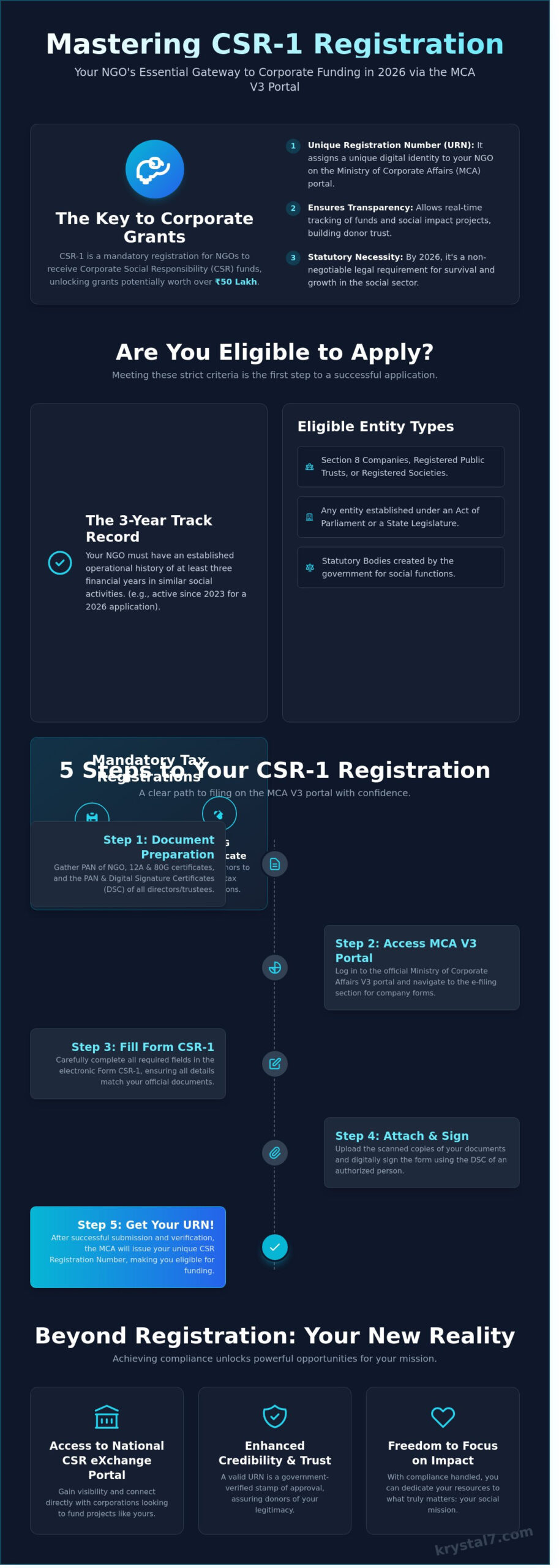
Form CSR-1 is the mandatory registration for all implementing agencies intending to undertake Corporate Social Responsibility (CSR) activities in India. Under the Companies Act, 2013, the Ministry of Corporate Affairs (MCA) requires NGOs to register to ensure accountability and transparency. This registration process moved entirely to the MCA V3 portal to facilitate real-time tracking of social impact projects. It serves as a verification layer that connects credible NGOs with corporate entities looking to fulfill their legal obligations.
By 2026, the government has tightened the strings on how social funds are handled. Corporate donors cannot legally disburse funds to any NGO that lacks a valid CSR-1 Unique Registration Number. This system prevents the misuse of funds and ensures that every rupee spent reaches the intended beneficiaries. Completing your csr-1 registration online is no longer an option; it’s a statutory necessity for survival in the social sector.
The shift toward digital transparency means the MCA can now monitor CSR spends with surgical precision. This data-driven approach helps the government identify which sectors, such as education or healthcare, receive the most support. For NGOs, this registration acts as a digital identity that builds trust with large-scale donors and government bodies alike.
The Legal Framework: Section 135 and Beyond
Section 135 of the Companies Act, 2013, mandates that companies with a net worth of ₹500 crore, a turnover of ₹1000 crore, or a net profit of ₹5 crore must spend 2% of their average net profits on CSR. This requirement is a core part of annual compliance for a private limited company that meets these financial thresholds. The CSR-1 Unique Registration Number is the only way for these companies to prove to auditors that their funds went to a recognized implementing agency.
If a company fails to spend this amount or gives it to an unregistered NGO, they face heavy penalties under the law. The registration ensures that the implementing agency has a proven track record and valid tax registrations. It bridges the gap between corporate compliance and grassroots social work.
Who Needs to File Form CSR-1?
Not every organization can apply for this registration. The law specifies certain types of entities that are eligible to act as implementing agencies. You must fall into one of these categories to successfully complete your csr-1 registration online:
- Registered Societies and Public Charitable Trusts: These must be registered under Section 12A and 80G of the Income Tax Act, 1961, and have at least three years of established track record.
- Section 8 Companies: These are companies established specifically for social, charitable, or environmental causes without the motive of profit.
- Government Entities: Any entity established under an Act of Parliament or a State Legislature that is involved in social welfare activities.
- Statutory Bodies: Organizations created by the government to perform specific social functions.
Krystal7 helps you determine your eligibility and ensures your documents are in order before you hit the submit button. We handle the complexity of the MCA portal so you can focus on making a real difference in your community.
Eligibility Criteria for CSR-1 Registration Online
Not every non-profit organization can immediately access corporate social responsibility funds. The Ministry of Corporate Affairs (MCA) maintains strict filters to ensure only credible entities receive these contributions. You must verify your eligibility status before you begin the csr-1 registration online process to avoid unnecessary delays or rejections.
The primary hurdle for most non-profits is the three-year track record rule. Under Section 135 of the Companies Act, 2013, an implementing agency must have an established history of at least three financial years in undertaking similar activities. If you are applying in 2026, your organization should have been active and filing returns since at least 2023. You’ll need audited financial statements and annual reports to prove this consistent impact.
The 12A and 80G Pre-requisite
You cannot secure a CSR-1 certificate without first obtaining valid 12A and 80G registrations from the Income Tax Department. Registration under Section 12A proves your organization’s income is used for charitable purposes and is tax-exempt. Many NGOs face rejection because they forget to convert their “provisional” registration into a “final” registration within the six-month window before expiry. Securing an 80G certificate is a mandatory prerequisite that enables corporate donors to claim tax deductions on the funds they provide through the CSR-1 framework. If your 80G status is lapsed or pending, the MCA portal will not validate your csr-1 registration online application.
Entity-Specific Requirements
The rules vary slightly depending on how your organization is structured. Section 8 companies, registered Trusts, and registered Societies are all eligible, but their governing documents must clearly outline charitable objectives. While a private limited company india structure is built for profit, a Section 8 company is its non-profit counterpart. You must ensure your Trust Deed or Memorandum of Association (MOA) is updated and digitally signed. If you feel overwhelmed by these structural requirements, you can consult with a compliance expert to review your documents.
Documentation requirements also extend to your leadership. You must provide valid PAN cards for the organization and all Key Management Personnel (KMP), such as Directors or Trustees. The MCA system cross-references these PAN details with the Income Tax database in real-time. Specific exemptions exist for entities established by an Act of Parliament or a State Legislature. These government-owned or statutory bodies don’t need to meet the three-year track record requirement; they are eligible for CSR-1 immediately upon formation.
- Section 8 Companies: Must have a valid CIN and active status on the MCA portal.
- Registered Trusts: Must have a registration number and a valid Trust Deed.
- Registered Societies: Must be registered under the Societies Registration Act, 1860.
- PAN Compliance: Mandatory for the entity and all authorized signatories.
Documents Required for CSR-1 Registration in 2026
Success in your csr-1 registration online journey depends on the quality of your paperwork. The Ministry of Corporate Affairs (MCA) V3 portal is highly sensitive to document clarity and data consistency. You’ll need to gather these essentials before starting the webform to ensure a smooth approval process without technical glitches.
- Digital Signature Certificate (DSC): The authorized signatory must have a valid Class 3 DSC. This is mandatory for signing the form electronically.
- PAN Cards: Gather self-attested copies of PAN cards for every Director, Trustee, or Governing Committee member. The names must match the government database exactly.
- Verified Contact Credentials: You need a dedicated mobile number and email ID. These are used for real-time OTP verification on the MCA portal during the filing process.
- NGO Registration Documents: Depending on your structure, you’ll need the Trust Deed, Society Registration Certificate, or the Certificate of Incorporation (COI).
The Role of Professional Certification
Form CSR-1 isn’t a simple self-declaration. It must be digitally signed by a practicing Chartered Accountant, Company Secretary, or Cost Accountant. This professional certification confirms that your NGO complies with the provisions of Section 135 of the Companies Act, 2013. We recommend using high-resolution, “Krystal-Clear” scans for all attachments. Poor quality uploads are the leading cause of technical rejections on the V3 portal. Always include a formal Board Resolution or an Authorization Letter that explicitly names the individual empowered to sign on behalf of the organization.
Common Documentation Pitfalls
Small errors often lead to significant delays in your csr-1 registration online application. Address mismatches are a frequent headache. If the address on the NGO’s PAN card doesn’t align with the registration certificate, the system may flag the application for review. Check your DSC mapping status well in advance. An expired DSC or one that isn’t correctly linked to the MCA V3 user profile will prevent you from submitting the form. Don’t leave out any board members. The web-based form requires a full disclosure of the governing body, and any omission can result in the application being marked as “Defective,” requiring a complete resubmission.
Step-by-Step CSR-1 Registration Online Process
Completing your csr-1 registration online is a structured process designed to bring transparency to social impact work. It moves through the Ministry of Corporate Affairs (MCA) V3 portal. You’ll need your organization’s PAN and a valid Digital Signature Certificate (DSC) before you begin.
The transition to the V3 portal has streamlined how NGOs interact with the government. This digital shift ensures that every rupee spent on social welfare is traceable. By following a methodical approach, you can secure your registration without technical delays.
Navigating the MCA V3 Portal
Log in using your business or professional user credentials. Many users face the “OTP not received” hurdle during peak hours. If the code doesn’t arrive within 120 seconds, try logging in during off-peak hours, such as early morning or late evening. You must associate your DSC with your V3 ID by visiting the “Profile Update” section and selecting “Associate DSC.” It’s a relief for many non-profits to know that the government currently charges no fee for filing Form CSR-1.
Find the form under the “MCA Services” tab and select “CSR-1” from the e-Filing menu. Enter your entity’s PAN to pre-fill basic details. You must specify if you’re a Section 8 company, a registered Trust, or a registered Society. Upload your registration certificate and PAN card copy in a clear PDF format. Ensure the total file size stays within the MCA’s prescribed limits, usually under 2MB, to avoid upload failures.
The authorized signatory must sign the form digitally using their DSC. Once you click “Submit,” the system generates a Service Request Number (SRN). Keep this number safe to track your application status or for future correspondence with the MCA.
Post-Submission: Approval and Unique ID
The csr-1 registration online form follows Straight Through Processing (STP). This means the system validates your data against the PAN database and grants immediate approval if everything matches. You’ll receive a unique CSR Registration Number via email almost instantly. The format usually starts with “CSR” followed by a 12-digit sequence, which you must quote in all future CSR project reports.
If the Registrar of Companies (ROC) marks your form for “Resubmission,” don’t panic. Check the “My Workspace” tab for specific comments regarding missing documents or data mismatches. You usually have 15 days to rectify these errors and re-upload the form. Failing to resubmit within this window may lead to the cancellation of your application, requiring a fresh start.
Get expert help with your CSR-1 registration to ensure a smooth, error-free filing that protects your NGO’s compliance status.
Beyond Registration: Freedom to Focus on Social Impact
Completing your csr-1 registration online isn’t the finish line; it’s your starting block. Once you receive your unique CSR Registration Number, your NGO gains access to the National CSR eXchange Portal. This government platform acts as a bridge, connecting your verified projects with corporate donors who must meet their 2% spending mandate under Section 135 of the Companies Act, 2013.
Think of your registration as a permanent credential that requires active upkeep. While the certificate doesn’t expire, your eligibility to receive funds depends on maintaining a clean compliance record. When you approach a corporate donor in 2026, your CSR-1 status serves as a compliance shield, proving your organization is transparent and ready for audit.
Ongoing Compliance for Registered NGOs
Registered NGOs must stay vigilant with their annual filings to keep their status active. Section 8 companies need to file Form AOC-4 and MGT-7 every year without fail. If your NGO operates as a social wing of a corporation, you must synchronize these filings with the annual compliance for private limited company schedules to ensure group-level transparency.
Managing the Foreign Contribution Regulation Act (FCRA) alongside your CSR-1 status is also critical. If you handle international grants, any lapse in FCRA renewals can lead to the suspension of your local CSR fundraising privileges. We recommend keeping a centralized compliance calendar to track these overlapping deadlines.
Why Partner with Krystal7 for CSR-1?
We believe your time is best spent on the ground, not buried under paperwork. Our team brings elite expertise in how to register various legal structures with zero guesswork. We manage the entire process, from procuring the necessary Digital Signature Certificates (DSC) to the final generation of your certificate on the MCA portal.
Krystal7 provides more than just a filing service. You get a dedicated relationship manager who understands your social vision and helps you navigate the “red tape” of the Ministry of Corporate Affairs. We ensure your csr-1 registration online is handled with krystal-clear transparency so you can scale your impact with confidence.
Don’t let complex regulations slow down your mission. Contact Krystal7 Consultants today at business@krystal7.com or visit krystal7.com to secure your NGO’s future and start making a bigger difference.
Empower Your NGO for Lasting Social Impact
Compliance shouldn’t stand between your vision and the social change you want to create. By 2026, the Ministry of Corporate Affairs has refined the digital filing landscape, making accuracy the most critical factor for success. Securing your csr-1 registration online ensures your NGO remains eligible for corporate funding and keeps your statutory standing secure under the Companies Act. Our elite team of CAs and CSs in Gurgaon specializes in complex MCA V3 portal filings to eliminate technical delays before they happen.
You’ll benefit from upfront pricing with no hidden costs, giving you the financial clarity needed to plan your upcoming projects. We handle the paperwork and technical hurdles so you can reclaim your freedom to focus on community welfare. Your mission deserves a professional partner who values transparency and precision as much as you do. Let’s turn your compliance requirements into a foundation for growth and trust.
Get your CSR-1 Registration with Krystal-Clear Clarity; Contact Krystal7 today
Frequently Asked Questions
Is CSR-1 registration mandatory for all NGOs in India?
Yes, CSR-1 registration is mandatory for every NGO that intends to receive Corporate Social Responsibility (CSR) funds from companies. Since April 1, 2021, the Ministry of Corporate Affairs (MCA) requires this registration to ensure transparency in social welfare activities. Without this unique registration number, your organization can’t legally accept CSR grants from any corporate entity in India.
Can a new NGO apply for CSR-1 without a 3-year track record?
You can apply for csr-1 registration online without a three year track record if a company or the government established your NGO. However, independent private Trusts, Societies, or Section 8 companies must complete three years of active social work before they qualify. This rule ensures that only established organizations with a proven history handle public corporate funds.
What is the government fee for CSR-1 registration online?
There’s no government fee for filing the Form CSR-1 on the MCA portal as of 2026. The Ministry of Corporate Affairs provides this service free of cost to encourage social development across the country. You’ll only need to account for the professional fees of the Chartered Accountant or Company Secretary who certifies your form and ensures your documents meet statutory requirements.
How long does it take to get the CSR-1 certificate after filing?
You’ll receive your CSR-1 certificate almost immediately after successful submission because the process is system-driven. Once the MCA portal validates your Digital Signature Certificate (DSC) and attachments, it generates a unique CSR Registration Number via email. This automated approval provides the clarity you need to start your fund-seeking journey without long waiting periods.
Is 12A and 80G registration compulsory for CSR-1?
Yes, having valid 12A and 80G registrations is a strict prerequisite for obtaining your csr-1 registration online. The MCA portal requires you to provide the registration dates and unique numbers for these tax exemptions during the filing process. These registrations prove your NGO’s tax-exempt status under the Income Tax Act, 1961, which is essential for corporate donors to claim their tax benefits.
Can I file CSR-1 without a Digital Signature Certificate (DSC)?
No, you can’t file the form without a Class 3 Digital Signature Certificate (DSC). The form must be digitally signed by the authorized representative of the NGO and then certified by a practicing professional like a Chartered Accountant. This digital signature ensures the authenticity of your application and maintains the security of the online filing system.
Does CSR-1 registration expire, or is it a one-time process?
CSR-1 registration is a one-time process and doesn’t have an expiry date. Once the MCA issues your unique registration number, it remains valid for the lifetime of your organization. You won’t need to renew it annually; this gives you the freedom to focus on your social impact projects instead of recurring paperwork.
What happens if my CSR-1 application is rejected by the MCA?
If the MCA rejects your application, you can rectify the errors and file a fresh form immediately. Rejections usually happen due to mismatched data or invalid attachments like expired 12A certificates or incorrect PAN details. Our experts at Krystal7 help you review your documents carefully before submission to prevent such setbacks and ensure a successful registration.
For expert assistance with your NGO compliance, contact Krystal7 Consultants at business@krystal7.com or visit krystal7.com to secure your registration today.

Article by
Nihal Srivastava
Nihal Srivastava is the Co-Founder of Krystal7 Consultants, helping Indian entrepreneurs and startups navigate company registration, compliance, trademark protection, and regulatory requirements with clarity and confidence. With 6+ years of hands-on expertise in MCA filings, GST compliance, and corporate structuring, Nihal has guided 1000+ businesses across India through their legal and compliance journeys. He believes every business dream deserves crystal clear foundations, and that no founder should be held back by paperwork or red tape.