

What Is Annual Compliance for a Company? A Clear Guide for Indian Businesses
You’ve successfully launched your business in India, turning your vision into a reality. But now you’re facing a new set of challenges: a maze of legal jargon, confusing acronyms like ROC and MCA, and the nagging worry of missing a critical deadline. If you feel overwhelmed by the post-incorporation formalities, you are not alone. This is where understanding what is annual compliance for a company becomes absolutely essential. It’s not just bureaucratic paperwork; it’s the non-negotiable process that keeps your business in good legal standing and protects the legacy you’re building.
Forget the guesswork and the fear of facing heavy penalties. This clear guide is designed to cut through the complexity and deliver Krystal-clear answers. We will demystify the essential statutory requirements, map out the critical deadlines, and show you the benefits of a streamlined compliance strategy for your specific company type. Our goal is to provide the clarity you need to manage your obligations with confidence, giving you the freedom to focus on what truly matters: growing your venture.
Key Takeaways
- Understanding what is annual compliance for a company is your first step to security-it’s a mandatory legal duty for every registered business in India, not an optional task.
- Effective compliance is a year-round process, not a single event. It involves multiple filings, maintaining statutory registers, and conducting board meetings on time.
- The penalties for non-compliance are severe and can include heavy fines, director disqualification, and even the striking-off of your company’s name from the ROC.
- Proactively managing your compliance calendar is the key to avoiding penalties and giving you the freedom to focus on growing your business.
Defining Annual Compliance: Your Company’s Yearly Health Check-up
Think of annual compliance as a mandatory yearly report card for your business. It’s not just good practice; it’s a legal obligation designed to present a clear, transparent picture of your company’s financial health and operational status to stakeholders, lenders, and government bodies like the Registrar of Companies (ROC). So, what is annual compliance for a company? It’s the structured process of filing specific documents and returns every financial year, as mandated by the Indian Companies Act, 2013. This framework, detailed in the broader Indian Company Law Overview, ensures your venture is recognized as active, operational, and fully compliant with the law, giving you the clarity and confidence to grow.
This annual exercise proves that your company is a legitimate, functioning entity. It’s the official way to keep the government informed about your company’s management, financial performance, and shareholding structure, removing guesswork and building a foundation of trust.
Why Is Annual Compliance Non-Negotiable for Your Business?
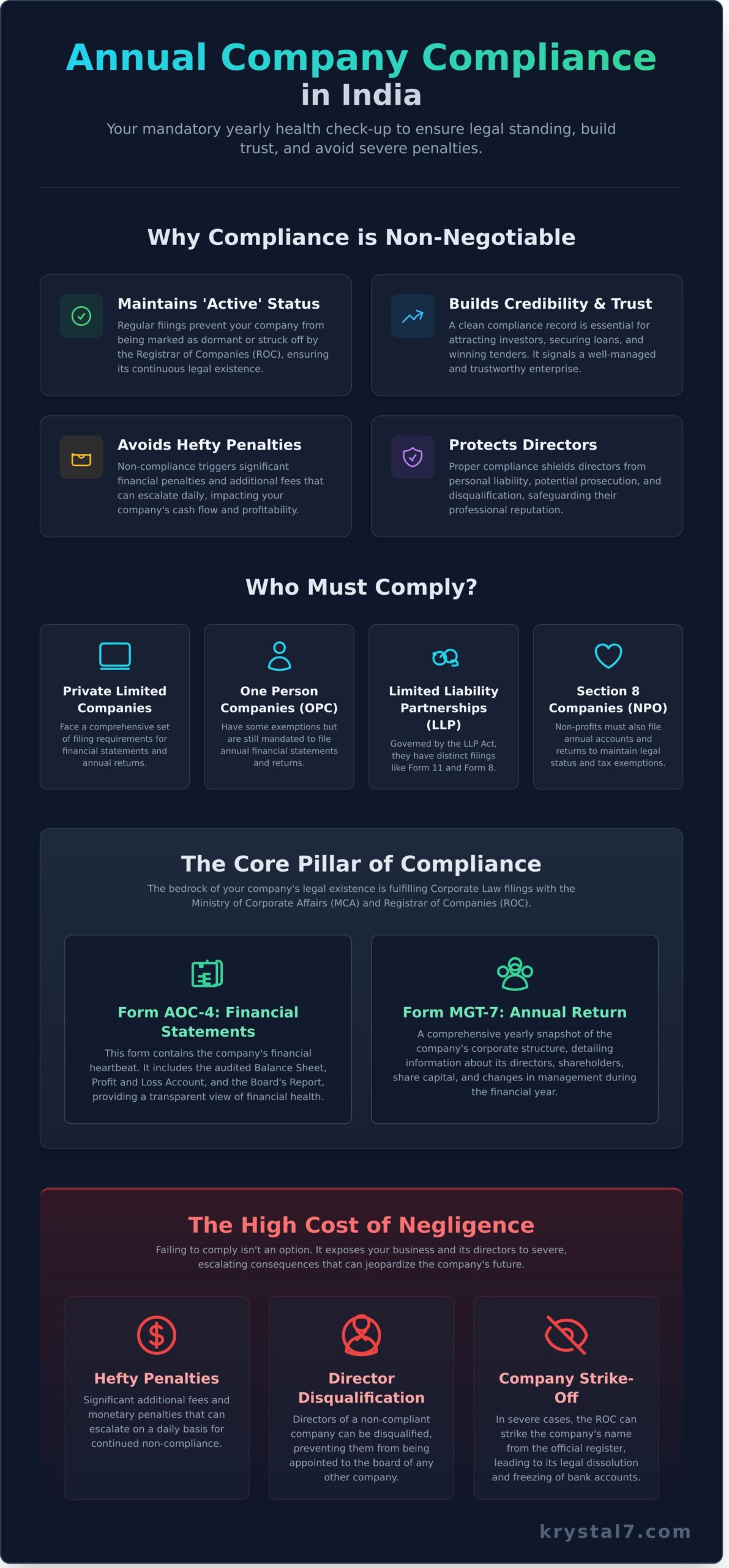
Failing to meet these statutory deadlines isn’t an option. It exposes your business to significant risks and erodes the very foundation you’re working to build. Consistent compliance is crucial for several key reasons:
- Maintains ‘Active’ Status: Regular filings prevent your company from being marked as dormant or, in severe cases, struck off the official register by the ROC.
- Builds Credibility: A clean compliance record is essential for attracting investors, securing bank loans, and winning government or corporate tenders. It’s a hallmark of a trustworthy enterprise.
- Avoids Hefty Penalties: Non-compliance leads to significant additional fees and penalties that can escalate daily, impacting your cash flow and profitability.
- Protects Directors: It shields directors from potential disqualification, prosecution, and personal liability, safeguarding their professional reputation.
Who Needs to Comply? Applicability Across Company Types
Understanding what is annual compliance for a company also means knowing who is required to file. The obligation extends across virtually all registered business structures in India, though the specifics may vary:
- Private Limited Companies: As the most common corporate structure, they face a comprehensive set of annual filing requirements, including financial statements and annual returns.
- One Person Companies (OPC): While they enjoy certain exemptions, OPCs are still mandated to file annual financial statements and returns with the ROC.
- Limited Liability Partnerships (LLP): Governed by the LLP Act, 2008, LLPs have their own distinct set of annual filings, such as Form 11 and Form 8.
- Section 8 Companies (NPOs): Non-profit organizations must also adhere to compliance, filing their annual accounts and returns to maintain their legal status and tax exemptions.
The Core Pillars: What Does Annual Compliance Actually Involve?
Many entrepreneurs wonder, what is annual compliance for a company in practice? It’s a common misconception to view it as a single, year-end task. In reality, it is a continuous, year-round process that ensures your business remains in good standing with multiple government bodies. This isn’t about filing just one form; it’s about navigating a landscape of interconnected duties.
To bring Krystal-Clear clarity to this complexity, we can break down annual compliance into three core pillars. Each pillar addresses a different set of regulations, involves distinct government departments like the MCA and the Income Tax Department, and operates on its own set of deadlines. Understanding these pillars provides a streamlined roadmap, removing the guesswork and empowering you to stay ahead.
Pillar 1: Corporate Law Filings (MCA/ROC Compliance)
This is the bedrock of your company’s legal existence. Governed by the Ministry of Corporate Affairs (MCA), these filings ensure your corporate structure is transparent and up-to-date with the Registrar of Companies (ROC). The core requirements are laid out in The Companies Act, 2013, and failing to meet them can lead to significant penalties. Key activities include:
- Filing Annual Financial Statements (Form AOC-4): Submitting your audited balance sheet and profit and loss account.
- Filing the Annual Return (Form MGT-7): A yearly snapshot of your company’s shareholder and director details.
- Maintaining Statutory Registers: Keeping meticulous, updated records of members, directors, charges, and more.
- Reporting Significant Changes: Notifying the ROC of any changes in directorship, registered office address, or capital structure.
Pillar 2: Income Tax Compliance
While the MCA governs your corporate structure, the Income Tax Department oversees your financial obligations. This pillar is about accurately reporting your company’s income and paying the requisite taxes. It’s a critical component of your financial integrity and requires meticulous attention to detail throughout the financial year.
- Filing the Annual Income Tax Return (ITR): Declaring the company’s income and calculating its tax liability for the financial year.
- Tax Audit: Mandatory if your company’s turnover exceeds the prescribed threshold under the Income Tax Act.
- TDS Regulations: Ensuring Tax Deducted at Source (TDS) is properly deducted, deposited, and reported via quarterly returns.
- Timely Tax Payments: Paying advance tax installments and self-assessment tax without delay to avoid interest and penalties.
Pillar 3: Internal Governance and Meetings
Effective compliance isn’t just about external reporting; it’s also about maintaining internal procedural discipline. This pillar ensures that major company decisions are made, documented, and ratified according to legal standards. It creates an official, legally-sound record of your company’s strategic direction and management oversight.
- Board of Directors Meetings: Conducting the minimum number of board meetings as required by law.
- Annual General Meeting (AGM): Holding an AGM with shareholders within the specified timeframe after the financial year ends.
- Drafting and Keeping Minutes: Properly recording the proceedings and decisions of all Board and General Meetings.
- Auditor Appointment: Appointing or reappointing the company’s statutory auditor at the AGM.
A Typical Compliance Calendar: Key Deadlines to Watch
Understanding what is annual compliance for a company becomes much clearer when you visualize it as a year-long cycle rather than a single, stressful event. In India, the financial year runs from April 1st to March 31st, creating a predictable rhythm for statutory duties. By mapping out these key deadlines, you can move from a reactive position to a proactive one, eliminating last-minute chaos and ensuring your business remains in good standing. Missing these deadlines isn’t just an administrative slip-up; it can lead to significant penalties and legal complications. Let’s break down the year into manageable phases.
Throughout the Year: Ongoing Duties
Compliance isn’t just a year-end task; it’s a continuous commitment. These foundational duties ensure your company’s governance and records are always in order, forming the bedrock of your annual filings. These ongoing duties are not just best practices; they are statutory requirements mandated by The Companies Act, 2013, which governs corporate operations in India.
- Board Meetings: A private limited company must hold a minimum of four Board Meetings during the year, with at least one in every quarter.
- Statutory Registers & Records: Maintaining proper books of accounts, minutes of meetings, and other statutory registers is a non-negotiable, year-round responsibility.
- Event-Based Filings: Any significant change-such as appointing a new director, changing your registered office address, or altering share capital-requires filing specific forms with the Registrar of Companies (RoC) within a prescribed timeframe.
Post Financial Year-End (April – September)
Once the financial year closes on March 31st, the focus shifts to consolidating and verifying the year’s financial activities. This preparatory phase is critical for a smooth and accurate annual filing season. It involves a systematic review and formalization of your company’s performance.
- Finalization of Accounts: Your team will prepare the final financial statements, including the Balance Sheet and the Profit & Loss (P&L) Account.
- Statutory Audit: A qualified, independent Chartered Accountant must audit your financial statements to ensure they are true and fair.
- Preparation of Reports: The Board of Directors prepares its Board’s Report, which, along with the audited financials, forms part of the Annual Report.
The Annual Filing Season (September – November)
This is the culmination of the year’s efforts, where the finalized reports and returns are formally presented to shareholders and filed with the authorities. The deadlines in this period are strict and are central to answering the question of what is annual compliance for a company. Missing them is not an option.
- Annual General Meeting (AGM): Must be conducted by September 30th to present the audited accounts and reports to the shareholders for approval.
- Filing Form AOC-4: This form, containing your company’s financial statements, must be filed with the RoC within 30 days of the AGM.
- Filing Form MGT-7: This is the Annual Return, detailing information about the company’s directors and shareholders. It must be filed within 60 days of the AGM.
- Income Tax Return (ITR): The deadline for filing the company’s ITR is typically October 31st, but it’s crucial to verify the date for the current assessment year as it can be subject to change.
The High Cost of Negligence: Consequences of Non-Compliance
Many entrepreneurs view annual compliance as mere administrative red tape. However, failing to meet these statutory duties is not a minor oversight-it’s a significant business risk that can jeopardise your entire venture. The penalties for non-compliance often far exceed the cost of staying current, turning a manageable task into a financial and operational crisis. Understanding what is annual compliance for a company is the first step, but appreciating the severe consequences of ignoring it is what truly protects your vision.
Steep Financial Penalties
The most immediate consequence of non-compliance is financial. The Ministry of Corporate Affairs (MCA) imposes strict penalties that are designed to escalate quickly, impacting both the company and its leadership directly.
- Daily Late Filing Fees: A standard penalty of ₹100 per day is levied for each form not filed on time. This seemingly small amount accumulates rapidly across multiple forms, turning into a substantial liability.
- Ad-Valorem Penalties: In addition to flat fees, the MCA can impose further percentage-based penalties, significantly increasing the financial burden.
- Joint Liability: Crucially, these fines are not just the company’s responsibility. Both the company and its officers (directors) are held liable, putting personal assets at risk.
Legal Action Against Directors
The repercussions extend beyond monetary fines and can have severe, career-altering consequences for a company’s leadership. Directors are held personally accountable for ensuring the company meets its statutory obligations.
- Director Disqualification: A director of a non-compliant company can be disqualified from holding any directorship in any company for a period of five years, severely impacting their professional career.
- Prosecution and Imprisonment: For serious or repeated violations, authorities can initiate legal proceedings against directors, which in the worst-case scenarios may lead to imprisonment.
Severe Business Disruption
Beyond fines and legal action, non-compliance can cripple your company’s ability to operate and grow, effectively halting your business in its tracks. A poor compliance record erodes trust and operational stability.
- Frozen Bank Accounts: Authorities have the power to freeze the company’s bank accounts, paralyzing cash flow and making it impossible to pay employees, vendors, or conduct any business.
- Inability to Raise Funds: A poor compliance history is a major red flag for investors and lenders, shutting the door on raising capital or securing loans needed for growth.
- Company Strike-Off: Ultimately, the Registrar of Companies (RoC) can strike the company’s name from the register, leading to its dissolution and the loss of its legal identity.
These consequences are daunting, but they are entirely preventable. Proactive compliance management is not an expense; it is an essential investment in your company’s stability and your freedom to focus on growth. Let our experts bring Krystal-Clear clarity to your compliance needs and safeguard your business journey.
How to Manage Your Annual Compliance: The Smart Way Forward
Understanding the fundamentals of annual compliance is the first crucial step. The next, and more strategic, decision is how you will manage these ongoing responsibilities. As a visionary founder, your time and energy are your most valuable assets. Choosing the right approach to compliance ensures those assets are invested in growth, not buried in paperwork.
The DIY Route vs. Professional Services
For a new entrepreneur, the temptation to handle compliance independently to save on costs is understandable. However, this path is fraught with risk. Without deep legal and financial expertise, navigating the maze of statutory deadlines, ROC filings, and tax submissions can lead to costly errors, penalties, and even legal trouble. The DIY route demands immense time and meticulous attention to detail that most founders simply cannot spare.
Professional services, on the other hand, transform compliance from a burden into a streamlined process. You gain immediate access to expertise, ensuring every filing is accurate and on time, giving you invaluable peace of mind.
Why a Compliance Partner Gives You the ‘Freedom to Focus’
Engaging a compliance partner is not an expense; it’s a strategic investment in your company’s future. When you delegate the complexities of statutory requirements, you unlock the freedom to focus on what you do best: innovating, serving your customers, and scaling your venture. A true partner does more than just file forms. They provide:
- Proactive Management: We track every deadline and send timely reminders, so you never have to worry about missing a crucial date.
- Expert Guidance: Our team offers strategic advice on maintaining good corporate governance, setting your business up for long-term health and success.
- Unmatched Efficiency: We handle the red tape, freeing up your calendar and mental space for core business activities.
Stop wrestling with the question of what is annual compliance for a company and start focusing on your vision. Let us handle the complexity. Explore our Annual Compliance Packages.
Choosing the Right Partner: What to Look For
Not all compliance services are created equal. To ensure you’re building a partnership that adds real value, look for a firm that offers:
- Krystal-Clear Pricing: Upfront, transparent costs with no hidden fees. You should know exactly what you are paying for.
- A Team of Qualified Experts: Your business deserves the best. Ensure the team includes certified Chartered Accountants (CAs) and Company Secretaries (CSs).
- A Dedicated Relationship Manager: A single point of contact who understands your business and is always just a call away.
- A Proven Track Record: Look for positive client testimonials and a history of helping businesses like yours thrive.
Navigate Your Compliance with Confidence and Clarity
Ultimately, annual compliance is far more than a statutory obligation-it’s a cornerstone of your company’s long-term health and credibility in the Indian market. The key takeaways are clear: meeting deadlines is non-negotiable, and the penalties for negligence can be severe. Understanding what is annual compliance for a company is the first step, but proactive and expert management is what truly safeguards your business vision from unnecessary risk.
Navigating the maze of ROC filings and statutory requirements can feel overwhelming, but it doesn’t have to be. At Krystal7 Consultants, we provide the freedom to focus on your growth. Our services are managed by top-tier Chartered Accountants and Company Secretaries, ensuring meticulous attention to detail. With transparent pricing that has no hidden fees and a dedicated relationship manager for every client, you get a genuine partner invested in your success.
Don’t let compliance complexities become a roadblock to your ambition. Get Krystal-Clear Guidance on Your Annual Compliance Today. Let us handle the paperwork, so you can build your legacy with complete peace of mind.
Frequently Asked Questions About Annual Compliance
Is annual compliance required even if my company had zero business activity or revenue?
Yes, absolutely. A company’s legal existence creates statutory obligations, regardless of its operational status. You must file a “Nil” return with both the Registrar of Companies (ROC) and the Income Tax Department. This officially informs the authorities that the company is active but had no transactions. Ignoring this can lead to significant penalties and your company being marked as non-compliant, jeopardising its good standing and future.
What is the difference between ROC/MCA compliance and Income Tax compliance?
Think of them as two separate but mandatory reporting streams. ROC/MCA compliance, governed by the Companies Act, focuses on corporate governance and transparency. This includes filing annual returns (Form MGT-7) and financial statements (Form AOC-4). In contrast, Income Tax compliance deals with calculating and paying taxes on your company’s income by filing an Income Tax Return (ITR) as per the Income Tax Act. Both are critical for legal health.
How much does it typically cost to manage annual compliance for a small company in India?
For a typical small private limited company in India, professional fees for managing complete annual compliance generally range from ₹15,000 to ₹30,000 per year. This cost covers essential filings like AOC-4, MGT-7, and the company’s ITR. The final price can vary based on the volume of transactions, business complexity, and the expertise of your chosen firm. Always seek Krystal-Clear transparency in pricing to avoid hidden charges and ensure value.
What are the very first compliance tasks I need to do after my company is incorporated?
Once incorporated, your venture must immediately address a few key tasks. First, you must hold the first Board Meeting within 30 days. You must also appoint the first statutory auditor within this period. Another critical step is depositing the paid-up share capital into a corporate bank account and filing Form INC-20A (Declaration of Commencement of Business) within 180 days. Getting these initial steps right sets a strong foundation for future compliance.
Can a director be held personally responsible for the company’s failure to comply?
Yes, directors can be held personally liable. The Companies Act designates directors as “officers in default” for non-compliance. This means they can face significant monetary penalties, prosecution, and even disqualification from holding a directorship in any other company. Understanding what is annual compliance for a company is not just a corporate duty but a personal responsibility for every director to avoid severe personal repercussions and protect their professional legacy.
What happens if I miss the deadline for an Annual General Meeting (AGM)?
Missing the AGM deadline is a serious compliance breach that triggers immediate penalties. The company and every “officer in default,” including directors, can face a significant fine for the period of the default. Furthermore, failing to hold an AGM prevents the timely approval of financial statements, which in turn delays your mandatory ROC filings. This creates a domino effect of non-compliance, attracting further late fees and potential legal action.

Article by
Nihal Srivastava
Nihal Srivastava is the Co-Founder of Krystal7 Consultants, helping Indian entrepreneurs and startups navigate company registration, compliance, trademark protection, and regulatory requirements with clarity and confidence. With 6+ years of hands-on expertise in MCA filings, GST compliance, and corporate structuring, Nihal has guided 1000+ businesses across India through their legal and compliance journeys. He believes every business dream deserves crystal clear foundations, and that no founder should be held back by paperwork or red tape.