

Penalty for Not Filing Annual Return with MCA: A Complete 2026 Guide
That sinking feeling when you realize a crucial MCA deadline has passed is a familiar anxiety for many entrepreneurs. The fear of escalating fines, the looming threat of director disqualification, and the complex maze of compliance can feel overwhelming. For many business leaders, understanding the exact penalty for not filing annual return mca is a source of significant stress, turning a simple oversight into a major concern.
This comprehensive 2026 guide is designed to replace that uncertainty with absolute clarity. We will demystify the entire process, providing a clear breakdown of the financial penalties you face and the serious implications of non-compliance. More importantly, we provide a straightforward, step-by-step action plan to correct the default, secure your company’s good standing, and ensure you have the knowledge to avoid this hassle in the future. It’s time to move from worry to action and regain your freedom to focus on growing your business.
Key Takeaways
- Gain clarity on the two essential MCA annual filings that are mandatory for every company, forming the foundation of your legal compliance.
- Discover how the daily penalty for not filing annual return mca is calculated, quickly turning a minor delay into a substantial financial liability.
- Understand the severe consequences that go beyond fines, including director disqualification and the risk of your company being struck off.
- Get a clear, step-by-step action plan to resolve existing filing defaults and implement proactive strategies for future compliance.
The Core Obligation: Understanding MCA Annual Filings
Under the Companies Act, 2013, annual compliance is not an optional task-it is a fundamental legal duty for every registered company in India. This statutory requirement ensures a high standard of corporate governance and transparency. By mandating these filings, the Ministry of Corporate Affairs (MCA) provides crucial visibility to stakeholders, including investors, creditors, and government authorities, into a company’s financial health and operational structure. This obligation is absolute; it applies to all private limited companies, one-person companies (OPCs), and public companies, regardless of their business activity or revenue. Even dormant companies must fulfill these requirements to avoid penalties.
The entire framework is designed to create a transparent and accountable corporate ecosystem. Failing to submit these core documents within the prescribed timelines is the most common reason businesses face a significant penalty for not filing annual return mca. Understanding these two primary filings is the first step toward ensuring seamless compliance and protecting your business’s good standing.
Form MGT-7/MGT-7A: The Annual Return
The Annual Return is a comprehensive snapshot of a company’s non-financial information as of the close of the financial year. It details the company’s corporate structure, including its shareholding patterns, director and key managerial personnel details, and changes in directorship. Most companies file Form MGT-7, while a simplified version, MGT-7A, is available for One Person Companies (OPCs) and Small Companies. This form must be filed within 60 days of conducting the Annual General Meeting (AGM).
Form AOC-4: The Financial Statements
This form contains the heart of your company’s financial story for the year. Form AOC-4 is used to file the audited financial statements, which include the Balance Sheet, Profit and Loss Account, Cash Flow Statement, and the Directors’ Report. Depending on the company’s structure, different versions may be required, such as AOC-4 CFS for consolidated financials or AOC-4 XBRL for certain classes of companies. The deadline for filing Form AOC-4 is within 30 days of the AGM.
Together, these filings create a clear and public record of your company’s performance and governance. Every submission is made to the Registrar of Companies (ROC), the governing body responsible for company administration in India. Diligent and timely filing is not just about avoiding the penalty for not filing annual return mca; it’s about building a trustworthy and credible business legacy.
The Financial Cost: Calculating the Penalty for Late Filing
Missing the MCA annual return deadline moves your company from paying standard government fees to incurring “additional fees.” This is the official term for late filing penalties, and understanding how they are calculated brings true clarity to the high cost of non-compliance. It’s not a one-time fine; it’s a daily charge that can quickly spiral, turning a simple administrative task into a significant financial burden.
Standard Additional Fee Structure
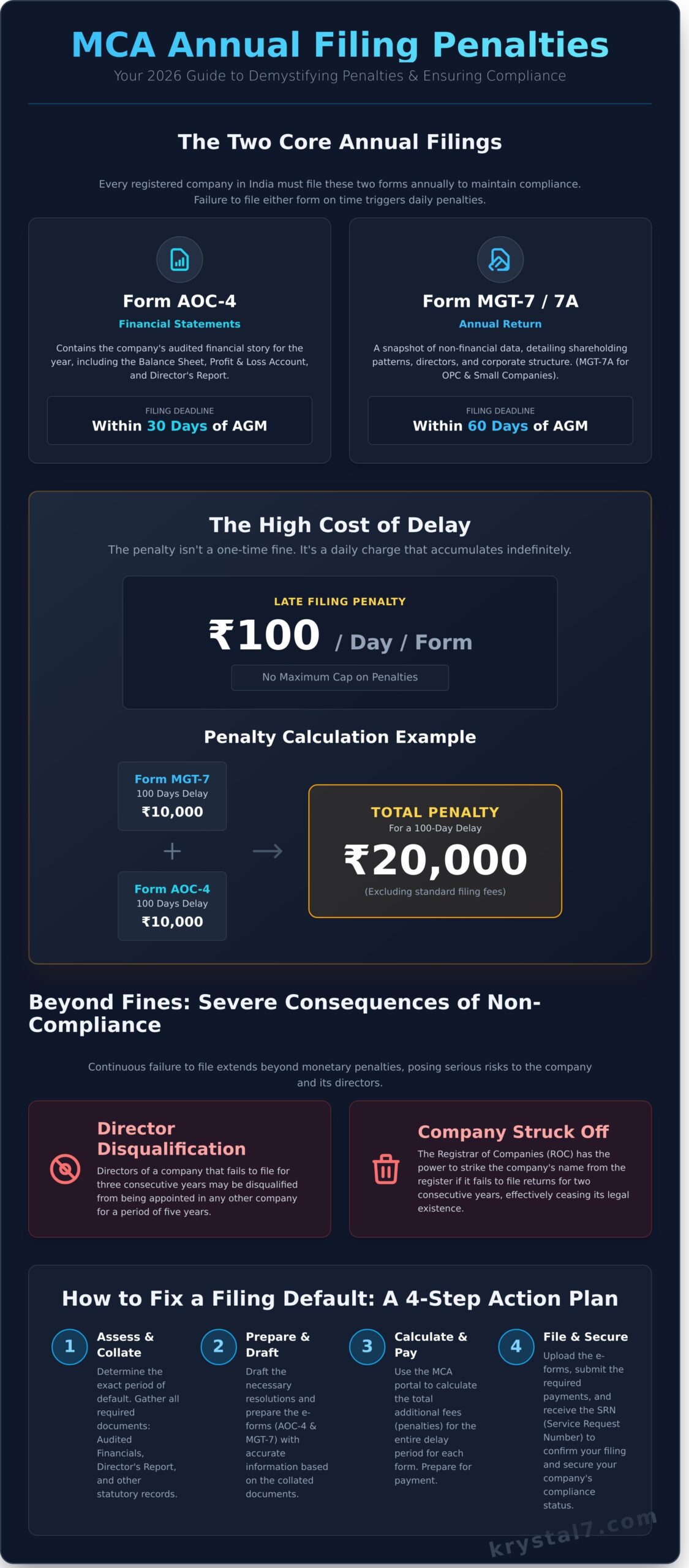
Under the Companies Act, 2013, the penalty for not filing annual return mca is straightforward and severe. For each day of delay past the due date, an additional fee of ₹100 is levied. This isn’t a single penalty for the entire return; it applies individually to each overdue form, primarily Form AOC-4 (Financial Statements) and Form MGT-7/MGT-7A (Annual Return). The Ministry of Corporate Affairs has established these strict penalties for failing to file annual returns to enforce timely compliance. Crucially, there is no maximum cap on this amount, meaning the fees accumulate indefinitely until the filings are completed.
Penalty Calculation Example
To illustrate how quickly these costs add up, let’s consider a clear, practical scenario. Imagine a private limited company that has delayed filing both its annual return and financial statements by 100 days.
- Penalty for Form MGT-7 (Annual Return): 100 days of delay × ₹100 per day = ₹10,000
- Penalty for Form AOC-4 (Financial Statements): 100 days of delay × ₹100 per day = ₹10,000
In this example, the total additional fee payable to the MCA would be a staggering ₹20,000, on top of the standard filing fees. This simple calculation demonstrates why proactive compliance is not just a legal obligation but a vital financial strategy to protect your business from unnecessary expenses and give you the freedom to focus on growth.
Beyond Fines: The Severe Consequences of Non-Compliance
The daily late fees are a pressing concern, but the true penalty for not filing annual return mca extends far beyond monetary costs. Continuous non-compliance triggers a cascade of severe legal and operational consequences that can jeopardize your directors’ careers and the very existence of your company. It’s a risk no visionary entrepreneur should take, as it can bring business operations to a complete standstill.
Disqualification of Directors
One of the most immediate and personal risks involves the company’s leadership. Under Section 164(2) of the Companies Act, 2013, any director of a company that fails to file its annual returns or financial statements for three consecutive financial years faces automatic disqualification. This isn’t just a minor setback; the consequences are significant:
- Five-Year Ban: The disqualification lasts for a full five years, preventing the individual from holding any directorship.
- Widespread Impact: The director is barred from being appointed or re-appointed as a director in any company, not just the defaulting one.
- Career Halting: This action can damage a director’s professional reputation and bring their corporate journey to an abrupt halt.
Company Status: Dormant and ‘Strike Off’
The Registrar of Companies (ROC) actively monitors statutory compliance. When a company repeatedly fails to file, the ROC may presume it is not conducting business and mark it as ‘Dormant’. If the default continues, the ROC can initiate the process to ‘Strike Off’ the company’s name from the official register. This is more than an administrative change; it is the legal termination of your business. Once struck off, the company ceases to exist and cannot legally trade, operate bank accounts, or own assets. Understanding the full range of these Impacts and Remedies Under Companies Act, 2013 is crucial for every business owner.
Prosecution and Imprisonment
In the most serious cases of willful default, the consequences escalate from administrative to criminal. The penalty for not filing annual return mca can include the prosecution of the company’s officers. As per Sections 92(5) and 137(3) of the Act, such defaults are punishable with substantial fines and, in extreme circumstances, even imprisonment. While this is reserved for the most severe non-compliance, it underscores the gravity with which the law treats these statutory obligations.
How to Fix a Filing Default: Your Step-by-Step Action Plan
Discovering a filing default can be stressful, but regaining compliance is a straightforward process when you have a clear plan. The key is to act decisively, as every day of delay increases the late filing fees. This guide breaks down the complexity into manageable steps, empowering you to resolve the issue efficiently and get your business back in good standing with the Ministry of Corporate Affairs (MCA).
Step 1: Collate All Necessary Documents
Before you can file, you must gather the correct documentation. Having everything organised upfront prevents delays and ensures a smooth process. Your compliance checklist should include:
- Audited Financial Statements: The Balance Sheet, Profit & Loss Account, and Cash Flow Statement for each missed financial year.
- Board Resolutions: The official records showing the board’s approval of the financial statements and annual return.
- AGM Documentation: The notice and minutes of the Annual General Meeting where the accounts were adopted.
- Director’s Digital Signature Certificates (DSCs): Ensure every director’s DSC is active and has not expired. A lapsed DSC is a common roadblock that can halt the entire filing process.
Step 2: Prepare and File Overdue Forms
With your documents in hand, the next step is to prepare the statutory forms for each year of default. You will need to draft Form AOC-4 (for financial statements) and Form MGT-7/MGT-7A (the annual return). Once these are prepared and signed with the valid DSCs, you can proceed to the MCA portal. The system will automatically calculate the total penalty for not filing annual return mca based on the period of delay. Simply upload the forms and complete the payment to finalize your filing.
Step 3: Consider Professional Assistance
While filing for a single year is manageable, rectifying multiple years of non-compliance adds significant complexity. A minor error in documentation or form-filling can lead to rejection, further delays, and mounting penalties. A professional ensures every detail is accurate, streamlining the process and removing the guesswork. This not only restores your compliance but also provides the peace of mind that it’s done right. Get Krystal-Clear guidance on your annual filings.
Proactive Compliance: How to Avoid MCA Penalties in the Future
Dealing with late fees is a reactive, stressful, and costly exercise. The most successful businesses, however, treat compliance proactively. They reframe it not as a regulatory burden, but as a strategic pillar that builds immense credibility, enhances brand reputation, and unlocks opportunities for funding and key partnerships. A flawless compliance record is a powerful asset, signalling stability and trustworthiness to investors, lenders, and clients alike. By shifting your mindset from fixing problems to preventing them, you build a foundation for sustainable growth and gain invaluable peace of mind.
Implement a Compliance Calendar
The first step towards flawless compliance is crystal-clear organisation. We recommend creating a master compliance calendar that maps out every statutory deadline for the financial year. This isn’t just about final filing dates; it’s a comprehensive timeline that includes preparatory steps. Key dates to include are:
- Quarterly Board Meeting due dates
- Annual General Meeting (AGM) planning and execution timelines
- Statutory audit finalisation
- Filing deadlines for Form AOC-4 (Financial Statements)
- Filing deadlines for Form MGT-7/7A (Annual Return)
Assigning these tasks to a specific person or internal team creates clear accountability and eliminates the guesswork that often leads to delays.
Partner with a Compliance Expert
For visionary entrepreneurs, managing a detailed compliance calendar can be a significant distraction from core business activities. This is where a professional partner provides unparalleled value. Engaging an expert for an annual compliance package moves the entire responsibility from your shoulders to a team of specialists dedicated to safeguarding your business. A dedicated partner ensures you never face the stress of a penalty for not filing annual return mca again.
This proactive partnership offers more than just timely filings; it delivers the Freedom to Focus on what you do best-innovating, strategizing, and growing your venture. Let us handle the complexities so you can pursue your vision with confidence.
Ready to eliminate compliance stress for good? Explore our hassle-free Annual Compliance Packages.
Secure Your Business’s Future: Beyond MCA Penalties
Staying compliant with the Ministry of Corporate Affairs is not merely a procedural task; it’s a foundational pillar for your business’s long-term health and credibility. As we’ve explored, the consequences of delayed or missed filings extend far beyond financial levies, potentially leading to director disqualification and even the striking-off of your company. Acknowledging the severe nature of the penalty for not filing annual return mca is the first critical step toward proactive governance.
You don’t have to navigate this complex regulatory landscape alone. At Krystal7 Consultants, we are dedicated to replacing compliance anxiety with the clarity and confidence you need to thrive. Our team of top-tier Chartered Accountants and Company Secretaries is your dedicated partner, offering streamlined support backed by our Krystal-Clear pricing with no hidden costs. With a dedicated relationship manager who understands your business, you can finally leave the guesswork and red tape behind.
Take the decisive step towards seamless compliance today. Ensure your business stays compliant. Contact our experts for a consultation and gain the freedom to focus on what truly matters-building your vision.
Frequently Asked Questions
Can the penalty for not filing an annual return with MCA be waived?
Generally, the penalty for not filing annual return mca is statutory and cannot be waived. These late fees are auto-calculated by the system based on the period of delay. While the government occasionally introduces amnesty schemes for defaulters, these are rare exceptions and not a reliable strategy. The most prudent course of action is to ensure all filings are completed on time, providing you with clarity and freedom from financial burdens.
What happens if my company is struck off by the ROC?
If the Registrar of Companies (ROC) strikes off your company for non-compliance, it legally ceases to exist. This triggers severe consequences, including the freezing of company bank accounts, an inability to conduct any business, and the disqualification of its directors. Restoring the company’s name is a complex and expensive legal process through the National Company Law Tribunal (NCLT). Proactive compliance is the best way to protect your business legacy.
How long does a director’s disqualification last, and can it be removed?
A director’s disqualification resulting from non-filing of annual returns lasts for a mandatory period of five years. During this time, you cannot be appointed as a director in any other company. Removal is possible but requires rectifying the default by filing all overdue returns for the company. Following this, a formal application must be made to the appropriate authorities, often involving a legal process, to have your Director Identification Number (DIN) reactivated.
Do I need to file an annual return for a dormant or non-operational company?
Yes, annual filing is mandatory even for companies that are not actively trading. If your company has officially obtained “Dormant Status” from the MCA, you must file a simpler ‘Return of Dormant Company’ (Form MSC-3). If it is merely non-operational without this status, you are still required to file the full Annual Return (MGT-7/7A) and financial statements (AOC-4). Ignoring this statutory duty leads to the same penalties as an active company.
What is the difference between an Annual Return (MGT-7) and an Income Tax Return (ITR)?
These are two separate and equally important compliance requirements filed with different authorities. The Annual Return (Form MGT-7/7A) is submitted to the Ministry of Corporate Affairs (MCA) and details your company’s corporate structure, shareholding, and management changes. The Income Tax Return (ITR) is filed with the Income Tax Department and reports your company’s financial performance, calculating its tax liability. Both are mandatory for maintaining a compliant business.
How can I check if my company’s annual filings are up to date?
You can gain instant clarity on your company’s compliance status through the official MCA portal. Navigate to ‘MCA Services’ and use the ‘View Company/LLP Master Data’ feature. By entering your company’s Corporate Identification Number (CIN), you can view key details, including the dates of the last filed Annual Return and financial statements. This public record provides a transparent overview of your filing history and highlights any pending obligations.

Article by
Nihal Srivastava
Nihal Srivastava is the Co-Founder of Krystal7 Consultants, helping Indian entrepreneurs and startups navigate company registration, compliance, trademark protection, and regulatory requirements with clarity and confidence. With 6+ years of hands-on expertise in MCA filings, GST compliance, and corporate structuring, Nihal has guided 1000+ businesses across India through their legal and compliance journeys. He believes every business dream deserves crystal clear foundations, and that no founder should be held back by paperwork or red tape.