

How to Start a Business in India Legally: A Complete 5-Step Guide
You have the vision, the drive, and a game-changing business idea. But standing between that dream and reality is often a daunting maze of government portals, complex jargon, and the paralyzing fear of missing a critical legal step. If you feel overwhelmed by the process of how to start a business in India legally, you are not alone. This guide is designed to be your Krystal-Clear roadmap, transforming confusion into confidence and ensuring your venture is built on a solid, compliant foundation from day one.
Forget the red tape and the guesswork. We will walk you through a streamlined, 5-step journey-from choosing the right legal structure for your ambition to navigating the essential licenses and registrations that follow. Our goal is simple: to provide you with the clarity and peace of mind you need to move past the paperwork. It’s time to gain the freedom to focus on what truly matters: growing your business and building your legacy.
Step 1: Choose the Right Legal Structure for Your Business
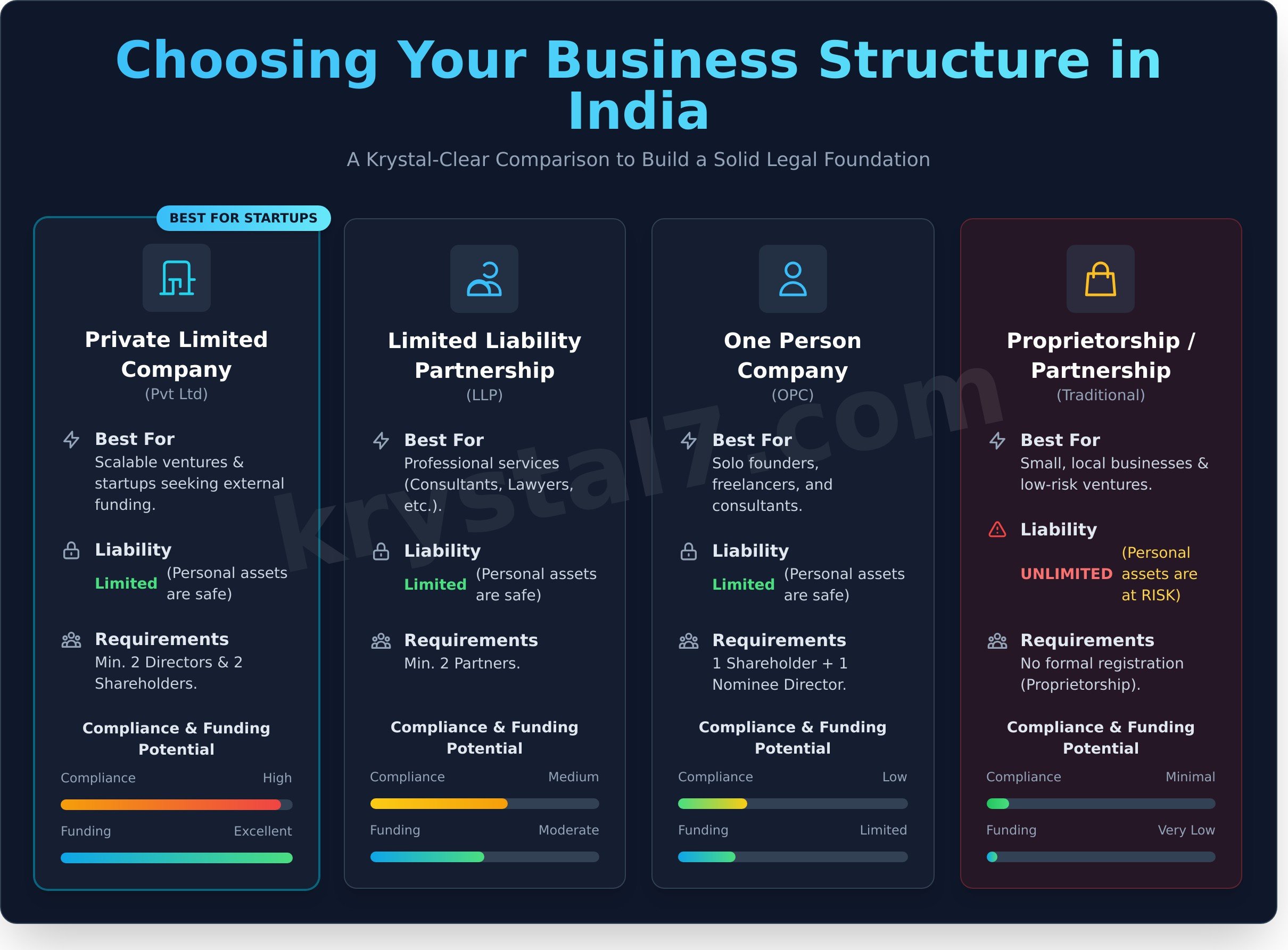
Embarking on your entrepreneurial journey is exhilarating. The first, most critical step in understanding how to start a business in India legally is selecting the correct legal structure. This isn’t just a formality; it’s the foundational decision that dictates your liability, taxation, compliance burden, and ability to raise funds. Your choice will depend on factors like the number of owners, your long-term vision for growth, and your personal risk tolerance. Making the right choice from the outset provides the clarity you need to build on, preventing complex and costly restructuring down the line.
Private Limited Company (Pvt Ltd)
A Private Limited Company is a separate legal entity, meaning your personal assets are protected from business debts and liabilities. This structure is the preferred choice for startups with ambitious growth plans, as it provides credibility and makes it easier to raise capital by issuing equity to investors. It is often a prerequisite for participating in government programs like the Startup India initiative.
- Best for: Startups seeking external funding and scalable ventures.
- Liability: Limited to the capital invested.
- Key Requirement: Minimum of two directors and two shareholders.
- Compliance: Higher statutory compliance, including regular board meetings and annual filings with the Registrar of Companies (RoC).
Limited Liability Partnership (LLP)
An LLP offers a powerful blend of a traditional partnership’s operational flexibility and a company’s limited liability protection. This structure shields partners’ personal assets from the business’s liabilities, a significant advantage over a general partnership. It is simpler and less expensive to manage than a Pvt Ltd company, making it an excellent choice for many professional service providers.
- Best for: Consultants, lawyers, architects, and other professional service firms.
- Liability: Limited to each partner’s agreed contribution.
- Key Requirement: Minimum of two partners.
- Compliance: Fewer compliance formalities compared to a Pvt Ltd.
One Person Company (OPC)
The OPC is a modern structure designed for the solo entrepreneur who wants the benefits of a corporate entity without the need for multiple directors. It provides the founder with limited liability protection, ensuring personal assets are secure. An OPC offers a credible business structure with a streamlined compliance process, perfect for a single founder with a bold vision.
- Best for: Solo founders, freelancers, and consultants wanting a corporate identity.
- Liability: Limited liability for the sole owner.
- Key Requirement: One shareholder and a nominee director.
- Compliance: Simpler than a Pvt Ltd, with certain exemptions in reporting.
Sole Proprietorship & Partnership Firm
These are the simplest and most traditional business structures, requiring minimal paperwork and cost to set up. However, their simplicity comes with a major drawback: unlimited liability. There is no legal distinction between the owner(s) and the business, meaning your personal assets are at risk to cover business debts. While easy to start, these structures are not suitable for businesses that plan to scale or seek investment.
- Best for: Small, local businesses, and low-risk home-based ventures.
- Liability: Unlimited; personal assets are at risk.
- Key Requirement: No formal registration required for a proprietorship.
- Compliance: Minimal, mainly related to tax filings.
Step 2: The Core Company Incorporation Process (via MCA)
Once your business structure is decided, the next phase is to give it a formal legal identity. This is the most critical part of how to start a business in India legally, and it all happens under the purview of one central authority. All company registrations are governed by the Government of India’s Ministry of Corporate Affairs (MCA).
Thankfully, the days of cumbersome physical paperwork are over. The entire process is now digital, streamlined through a single, comprehensive web form called SPICe+. This stage transforms your idea into a recognized legal entity, but its success depends on meticulous preparation. Having all your documents and details in order beforehand is the key to a smooth, hassle-free incorporation.
Obtaining Digital Signature Certificates (DSC) & Director IDs (DIN)
Before you can file any electronic forms, all proposed directors must obtain a Digital Signature Certificate (DSC). Think of a DSC as the digital equivalent of a physical signature-it’s a secure electronic key used to verify your identity and sign documents online. Alongside this, each director needs a Director Identification Number (DIN), a unique lifetime ID. In a move towards greater efficiency, the DIN is now directly allotted during the SPICe+ form submission, eliminating a previously separate step.
Reserving Your Unique Company Name (RUN)
Your company’s name is its first impression. It must be unique and not identical or deceptively similar to any existing company or registered trademark. You can check for name availability on the MCA portal before applying. The name should ideally reflect your business activities and must comply with the MCA’s naming guidelines. This crucial step, formerly known as Reserve Unique Name (RUN), is now seamlessly integrated into Part A of the SPICe+ form, simplifying the process for new companies.
Filing Incorporation Forms (SPICe+, MoA, AoA)
This is the final leg of the incorporation journey. The SPICe+ form is the heart of the modern registration process, an integrated application that handles multiple requirements in one go:
- Part A: Name reservation
- Part B: Company incorporation, DIN allotment, and applications for PAN, TAN, GSTIN, and EPFO.
Along with SPICe+, you will file two foundational documents: the Memorandum of Association (MoA), which defines the company’s objectives and scope of operations, and the Articles of Association (AoA), which outlines the internal rules for managing the company. These documents provide the constitutional framework for your business, bringing true clarity to its purpose and governance.
Step 3: Securing Essential Post-Incorporation Registrations
Receiving your Certificate of Incorporation is a moment to celebrate-your business is officially a legal entity. However, this is the starting line, not the finish. To operate, transact, and stay compliant, you must secure several mandatory post-incorporation registrations. These steps are a non-negotiable part of how to start a business in India legally and form the financial backbone of your new venture. Neglecting them can lead to significant penalties and operational roadblocks, turning your initial momentum into a struggle with red tape.
Here’s the clarity you need to navigate this critical phase and give your business the freedom to focus on growth.
Opening a Corporate Bank Account
A dedicated current account in your company’s name is not just good practice; it’s a legal requirement. It ensures a clear separation between your personal and business finances, which is crucial for transparent accounting and compliance. This account is where you will deposit the initial share capital and manage all business-related transactions. Banks will typically require the following documents:
- Certificate of Incorporation
- Memorandum of Association (MoA) and Articles of Association (AoA)
- Company PAN Card
- Board Resolution authorising the opening of the bank account
- KYC documents of all directors
Applying for PAN and TAN
For any entity in India, the Permanent Account Number (PAN) and Tax Deduction Account Number (TAN) are fundamental. The PAN is your unique identifier for all income tax purposes, while the TAN is mandatory if your business is required to deduct tax at source (TDS) on payments like salaries or rent. Fortunately, the process is now streamlined. Both PAN and TAN are applied for automatically through the integrated SPICe+ incorporation form, removing a significant piece of administrative hassle for new entrepreneurs.
Mandatory GST Registration
The Goods and Services Tax (GST) is the cornerstone of India’s indirect tax system. GST registration is mandatory if your business’s annual turnover is projected to exceed the prescribed threshold (currently ₹40 lakh for goods and ₹20 lakh for services in most states). Registration is also compulsory for certain businesses regardless of turnover, including e-commerce sellers and those making interstate sales. Securing your GSTIN allows you to legally collect GST from customers and claim Input Tax Credit (ITC) on your business purchases, which is vital for efficient cash flow.
With these foundational financial and tax frameworks in place, your business is operationally ready. The next crucial step in building a lasting legacy is protecting your most valuable asset: your brand identity. This involves securing trademarks and copyrights, a process managed by the official Intellectual Property India portal, which we will cover in our next section.
Step 4: Protecting Your Brand and Ideas (Intellectual Property)
As you build your business, your brand name, logo, and unique products become your most valuable assets. They are the face of your vision and the foundation of your customer relationships. Legally protecting these assets isn’t just about dealing with red tape; it’s a strategic move to prevent competitors from copying your hard work and diluting your market presence. Understanding this is a vital part of learning how to start a business in India legally.
Securing your Intellectual Property (IP) early provides a powerful competitive advantage. It transforms your ideas into exclusive, legally-defensible assets, building long-term value and investor confidence. Think of it as one of the smartest investments you can make for your venture’s future growth and legacy.
Trademark Registration for Your Brand
A trademark is your brand’s unique identity. It protects your business name, logo, and tagline, giving you the exclusive legal right to use them for your specific goods or services across India. Registration prevents competitors from using a confusingly similar name, which could mislead your customers. A registered trademark (®) is a public declaration of ownership that builds immense brand value, trust, and credibility in the marketplace.
Copyright for Original Creative Works
Your creativity is an asset that deserves protection. Copyright safeguards your original literary and artistic works, which in a modern business context includes your website content, marketing brochures, product packaging designs, and even software code. While copyright protection is automatic upon creation, formally registering it provides strong, undeniable evidence of ownership in a court of law. This secures your creative output from unauthorized use or outright theft.
Other Essential Registrations and Licenses
Beyond protecting your brand, your day-to-day operations must also be compliant. Navigating the required licenses is a key step in setting up your business for smooth, uninterrupted operations. Key registrations include:
- Shops and Establishment Act License: Mandatory for any commercial premise, including offices and retail stores, to regulate working conditions.
- MSME Registration (Udyam): While not mandatory, this registration provides access to government schemes, subsidies, and priority sector lending for small and medium-sized enterprises.
- Industry-Specific Licenses: Depending on your sector, you may need specific permits, such as an FSSAI license for a food business or an IEC code for import-export activities.
This landscape of compliance can seem overwhelming, but it doesn’t have to be. Get clarity on the right licenses for your venture. Our team at Krystal7 ensures your business is fully compliant, giving you the freedom to focus on what truly matters-growth.
Step 5: Establishing Ongoing Legal & Tax Compliance
Successfully registering your company is a monumental first step, but the journey of how to start a business in India legally doesn’t end there. True long-term success is built on a foundation of consistent and meticulous ongoing compliance. This final, critical stage ensures your venture remains in good standing with the authorities, protecting it from penalties and allowing you the freedom to focus on what truly matters: growth and innovation.
Think of compliance not as a burden, but as the framework that supports your business legacy. Neglecting these mandatory duties can lead to severe consequences, including heavy fines and even director disqualification. By streamlining this process, you gain the Krystal-Clear confidence to lead your business forward.
Mandatory Annual ROC Filings
Every private limited company in India must report its performance and status to the Registrar of Companies (ROC) annually. This is non-negotiable and involves two primary forms:
- Form AOC-4: Used to file your company’s audited financial statements, including the Balance Sheet and Profit & Loss Account.
- Form MGT-7: Your company’s Annual Return, which contains details about its shareholders, directors, and other key corporate information.
These filings are subject to strict deadlines, and failing to meet them results in significant daily penalties.
Maintaining Statutory Books and Records
Indian company law mandates the diligent maintenance of statutory records at your registered office. This is crucial for transparency and corporate governance. Key records include:
- Books of Accounts: Proper and accurate financial records reflecting all transactions.
- Statutory Registers: Including the Register of Members, Register of Directors, and others.
- Meeting Minutes: Formal records of all Board Meetings and General Meetings held throughout the year.
Regular Tax Filings (GST & Income Tax)
Staying on top of your tax obligations is fundamental to legal operations. Depending on your business, you will need to manage several key tax filings, each with its own schedule. These include monthly or quarterly GST returns based on your turnover, TDS payments and their corresponding returns, and the annual company Income Tax Return. Proactive and timely tax management prevents legal notices, interest, and penalties, ensuring smooth financial operations.
Navigating this complex web of statutory and tax requirements can feel overwhelming, pulling your attention away from your core vision. Let our experts provide the clarity you need. Handle your compliance hassle-free with our all-in-one packages.
Launch Your Indian Business with Confidence and Clarity
Navigating the path from a brilliant idea to a registered company in India involves critical decisions. As we have covered, selecting the right legal structure sets the foundation for your venture, while establishing ongoing compliance ensures its long-term health and success.
While this guide provides a clear roadmap on how to start a business in india legally, the journey can still feel overwhelming. You do not have to navigate the complexities of incorporation and statutory regulations alone.
At Krystal7, we transform legal complexity into crystal clarity. Partner with us and gain Chartered expertise for every legal step, the guidance of a dedicated advisor through the entire process, and the assurance of Krystal-Clear pricing with no hidden costs. We handle the formalities so you have the freedom to focus on your vision.
Start your business with crystal clarity. Explore our Company Incorporation Package.
Your entrepreneurial ambition deserves a strong, compliant foundation. Take the next step with confidence, and turn your business dream into a thriving reality.
Frequently Asked Questions
How much does it cost to start a business in India legally?
The cost to legally start a business in India varies by company structure and the state of registration. For a Private Limited Company, expect a total expense between ₹6,000 and ₹15,000. This typically includes government filing fees, stamp duty, and professional charges for essentials like Digital Signature Certificates (DSC) and Director Identification Numbers (DIN). We provide a clear, itemised breakdown to ensure complete transparency, removing the guesswork from your initial investment and helping you start your venture with confidence.
How long does the entire company registration process take?
With a streamlined process and all documents in order, the company registration process in India can be completed in approximately 7 to 15 working days. This timeline includes obtaining Director Identification Numbers (DIN) and Digital Signature Certificates (DSC), securing name approval from the Ministry of Corporate Affairs (MCA), and final submission of incorporation documents. Delays can occur due to government processing times or name rejections, but a meticulous approach helps minimise these and ensures a swift, hassle-free launch.
Can a foreigner or NRI start a company in India?
Yes, absolutely. Foreign nationals and Non-Resident Indians (NRIs) can start a company in India, subject to RBI and FEMA guidelines. The key regulatory requirement is that at least one director on the board must be a resident of India, meaning they have stayed in the country for a minimum of 182 days during the previous financial year. This policy makes India an accessible and attractive destination for global entrepreneurs looking to establish their venture in a thriving market.
Do I need a physical office address to register a company?
Yes, a registered office address in India is a mandatory requirement for company incorporation. However, this does not have to be a commercial space initially. You can use a residential address, provided you have a No Objection Certificate (NOC) from the property owner. Many entrepreneurs also opt for virtual office services, which provide a professional address and mail handling facilities. This flexibility helps new ventures manage costs while fulfilling all statutory requirements from day one.
What is the difference between a Director and a Shareholder?
Think of it this way: Directors manage the company, while Shareholders own it. Directors are responsible for the day-to-day operations, strategic decisions, and ensuring legal compliance. They are appointed by the shareholders. Shareholders, on the other hand, are the owners who have invested capital in the company in exchange for shares. Their primary role is to appoint directors and approve major decisions, and they earn returns through dividends. An individual can be both a director and a shareholder.
What happens if I miss a compliance deadline after my company is registered?
Missing a statutory compliance deadline in India results in significant financial penalties and late fees, which accumulate daily. For those figuring out how to start a business in India legally, it’s crucial to understand that post-registration compliance is just as important. Continuous non-compliance can lead to the disqualification of directors and the company being marked as inactive by the Registrar of Companies. Partnering with a compliance expert ensures you never miss a deadline, giving you the freedom to focus on growth.

Article by
Nihal Srivastava
Nihal Srivastava is the Co-Founder of Krystal7 Consultants, helping Indian entrepreneurs and startups navigate company registration, compliance, trademark protection, and regulatory requirements with clarity and confidence. With 6+ years of hands-on expertise in MCA filings, GST compliance, and corporate structuring, Nihal has guided 1000+ businesses across India through their legal and compliance journeys. He believes every business dream deserves crystal clear foundations, and that no founder should be held back by paperwork or red tape.