

The Hidden Risks of Cheap Company Registration Services: Why Low Cost Can Cost You Your Business
Choosing the cheapest registration service is often the most expensive financial decision an Indian founder can make. It’s natural to want to preserve every Rupee of capital for your product or team, especially when India saw a record 247,658 new companies incorporated in the last fiscal year. However, the hidden risks of cheap company registration services often manifest as a “compliance debt” that can paralyze your business before it even scales.
You probably feel that incorporation is just a one-time administrative checkbox, and you’re right to prioritize your primary business goals. But when budget services skip vital steps like the INC-20A commencement of business filing, you’re the one left facing heavy penalties from the Registrar of Companies (ROC). We’ve seen many entrepreneurs struggle with anxiety over sudden notices or hidden professional fees that weren’t disclosed upfront.
This article will show you how to identify these legal pitfalls and protect your startup from long-term regulatory damage. We’ll break down the essential filings you need to know and explain why transparency in your partnership with a CA firm is the ultimate way to gain operational liberty. You’ll gain a clear roadmap to ensure your Private Limited company stays compliant with the Ministry of Corporate Affairs (MCA) without any unwelcome surprises.
Key Takeaways
- Learn how improper drafting of your Memorandum of Association (MOA) can lead to expensive ROC penalties and restrict your future business activities.
- Discover the direct link between budget incorporation errors and the loss of GST Input Tax Credit or significant delays in opening your corporate bank account.
- Understand the hidden risks of cheap company registration services that often trigger “compliance debt” and cause investors to reject your startup during due diligence.
- Identify why setting the wrong Authorized Capital during registration can create massive legal hurdles when you attempt to raise your first round of funding.
- Gain a clear roadmap for managing your first 12 months of mandatory MCA filings to ensure operational liberty and long-term security.
The Lure of Low Cost: Why Risks of Cheap Company Registration Services Are Often Hidden
Many Indian founders view incorporation as a simple transaction. They search for the lowest price point and assume every provider delivers the same result. This mindset creates the primary risks of cheap company registration services. You aren’t just buying a certificate; you’re building a legal foundation for your future growth.
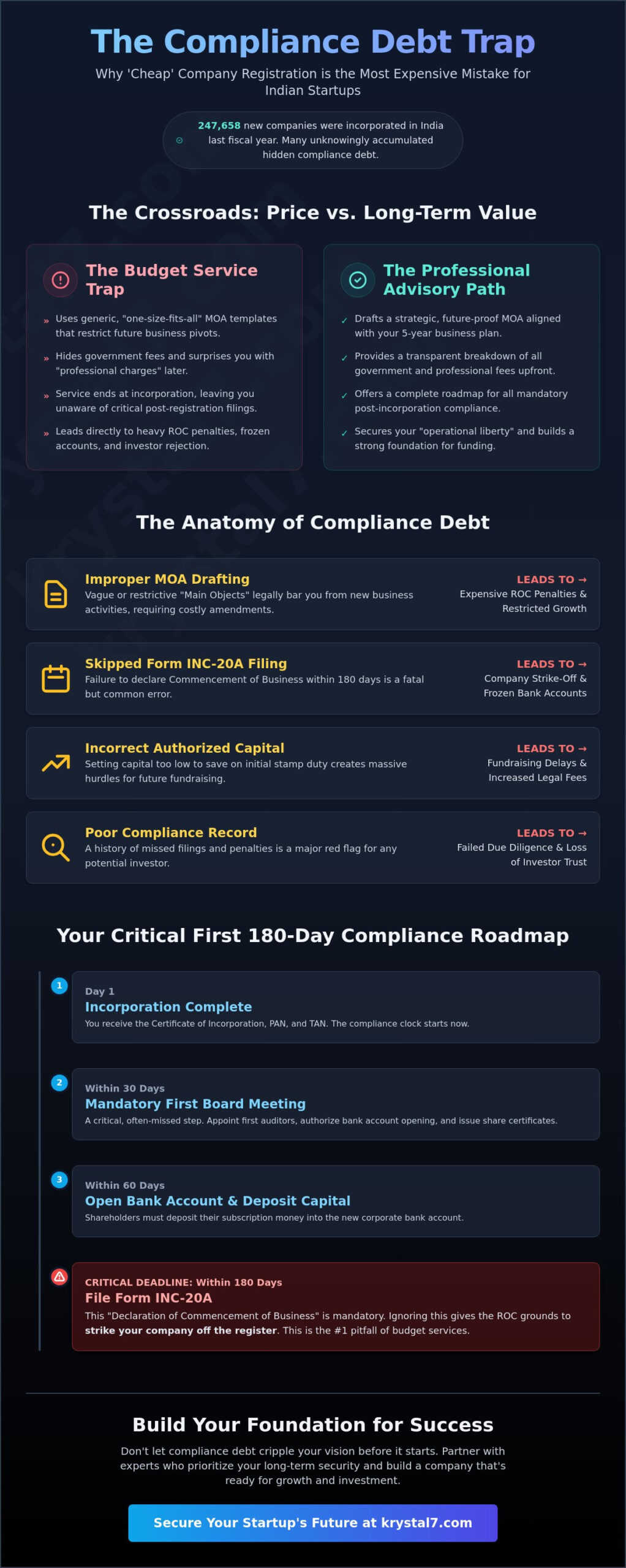
Automated platforms often use generic templates for your Memorandum of Association (MOA). These “one-size-fits-all” documents rarely align with your specific business objectives. If your MOA doesn’t cover a future pivot into a new sector, you’ll face expensive amendment fees at the MCA portal later. A strategic advisor looks at your five-year plan. A form-filler only looks at today’s submission. The process of incorporation requires a deep understanding of the Companies Act, 2013, to ensure your business structure remains flexible.
The 2026 regulatory environment demands higher precision than ever before. With the introduction of the Companies Compliance Facilitation Scheme (CCFS) in April 2026, the government signaled a new era of strict enforcement. While this scheme allows companies to rectify past defaults at a lower cost until July 15, 2026, it also indicates that future scrutiny will be intense. Cutting corners now creates a “compliance debt” that compounds with daily penalties of ₹100 for every missed filing.
The Difference Between Price and Value in Incorporation
It’s vital to distinguish between professional fees and government charges. The MCA fee for a company with ₹1,00,000 authorized capital is currently ₹200, but stamp duty varies significantly by state. Some low-cost providers lure you with “free” professional services while masking these mandatory costs. If they advise you to keep authorized capital too low just to save on initial stamp duty, you’ll pay significantly more to increase it when you’re ready for seed funding. True value lies in a structure that scales with your ambition.
Identifying the Red Flags of Budget Providers
Be wary of providers who don’t offer a dedicated Chartered Accountant for your account. If the platform feels like a faceless call center, your compliance is at risk. Many budget services also fail to mention vital post-incorporation requirements. Consider these common red flags:
- Missing Post-Incorporation Support: Failing to hold the mandatory First Board Meeting within 30 days is a serious compliance failure.
- Hidden Exclusions: Vague “all-inclusive” packages often exclude PAN, TAN, or GST registration.
- Lack of Transparency: If they can’t provide a clear breakdown of government fees versus professional charges, they’re likely hiding costs.
Protect your vision by choosing a partner who prioritizes long-term security over short-term savings. Contact Krystal7 Consultants at business@krystal7.com or visit krystal7.com for expert assistance.
MCA and ROC Compliance Nightmares: Technical Risks You Can’t Ignore
Technical errors are often invisible until the Registrar of Companies (ROC) issues a formal notice. One of the primary risks of cheap company registration services is the superficial handling of the SPICe+ filing process. If your consultant misinterprets the “Main Objects” in your Memorandum of Association, you might find yourself legally barred from executing contracts in your chosen industry.
Failing to file Form INC-20A (Declaration of Commencement of Business) within 180 days of incorporation is a fatal mistake. The ROC has the power to strike off your company name from the register if this filing is ignored. Budget providers frequently stop their service once they hand over the Certificate of Incorporation, leaving you unaware of this critical deadline. The impacts of noncompliance can be devastating, leading to frozen bank accounts and personal liability for directors.
Registered office verification has also become significantly stricter. MCA officials now use geo-tagging and physical verification to ensure a company actually exists at its listed address. Cheap services often use unverified or “virtual” addresses that don’t meet these rigorous standards. If the official verification fails, your incorporation can be cancelled, or you may face heavy penalties for providing misleading information.
The Companies Act 2013: Non-Negotiable Provisions
Compliance with Section 7(1) is the bedrock of a valid incorporation. It requires accurate filing of declarations from every director and the professional certifying the forms. If a budget provider submits false information to speed up the process, you face the severe consequences of Section 448. This section deals with punishment for fraud and false statements, which can lead to significant fines or even imprisonment for the founders.
Errors in share allotment entries further complicate your journey. If the initial share certificates aren’t issued within 60 days or the state-specific stamp duty on shares isn’t paid, your ownership remains legally questionable. Ensuring these details are perfect from day one provides the operational liberty you need to lead your team with confidence.
The ‘Form-Filling’ vs. ‘Legal Review’ Debate
Automated software can’t understand the specific nuances of your business model. Generic Articles of Association (AOA) templates often fail to include vital clauses for “Right of First Refusal” or “Drag-Along Rights” that specialized startups need. Relying on a template might save a few thousand Rupees today, but it creates massive friction during future shareholder disputes or equity rounds.
A professional legal review ensures your private limited company india is structured for long-term growth. Experts catch conflicts between your AOA and the Companies Act that software simply misses. You can secure your foundation by choosing an Annual Compliance Package that covers these technical intricacies from the very start.
The Financial Trap: Hidden Costs and Tax Compliance Failures
Low upfront prices often mask a mountain of upcoming debt. Many founders realize too late that the risks of cheap company registration services include significant financial leakage. When a provider cuts corners, they ignore essential tax registrations that your business needs to actually function.
Missing your Permanent Account Number (PAN) or Tax Deduction and Collection Account Number (TAN) applications can stall your progress for weeks. Without these, you cannot open a corporate bank account or hire your first employees. Budget services also frequently neglect mandatory state-specific registrations like Professional Tax or the MSME Udyam registration, which offers vital benefits for startups.
The compounding nature of Indian compliance penalties is brutal. Most ROC filings carry a late fee of ₹100 per day from the due date. A simple delay in filing your annual return can quickly snowball into a liability of thousands of Rupees. This “compliance debt” often exceeds the original savings you made by choosing a budget service provider.
- GST Pitfalls: Incorrect GST registration can lead to the permanent loss of Input Tax Credit (ITC) on your initial setup expenses.
- TDS Defaults: Failing to apply for TAN means you cannot deduct tax at source, leading to 1.5% interest penalties per month on the tax amount.
- Bank Delays: Incomplete documentation often leads to multiple rejections by bank compliance teams, delaying your ability to receive capital.
The High Price of Late Filings in India
Filing Form ADT-1 for the appointment of your first auditor is a non-negotiable step. This must be done within 15 days of the first board meeting. If this window is missed, the late fees start ticking immediately. Budget platforms rarely provide the professional guidance needed to track these micro-deadlines.
Missing the 180-day deadline for Form INC-20A doesn’t just attract fines. It can lead to the personal liability of directors for the company’s debts. If you need to rectify these errors later, you must file a “condonation of delay” application with the Regional Director. This process is expensive, time-consuming, and requires professional legal intervention that far outweighs the cost of doing it right the first time.
GST and TDS: The Post-Registration Compliance Gap
Registration is merely 10% of your legal journey. The remaining 90% is consistent, monthly compliance. If you fail to file GST returns for six consecutive months, the department can cancel your registration automatically. Recovering a cancelled GSTIN involves a complex “revocation of cancellation” process that most budget providers aren’t equipped to handle.
Realize that annual compliance for private limited company starts from the very day you receive your certificate. You must track TDS payments, GST filings, and payroll taxes every single month. We provide the visual transparency you need to see every upcoming deadline clearly. Contact Krystal7 Consultants at business@krystal7.com or visit krystal7.com for expert assistance.
How Substandard Incorporation Blocks Fundraising and Future Growth
Institutional investors don’t just buy into your idea; they buy into your legal structure. The long-term risks of cheap company registration services often surface during your first serious meeting with a Venture Capital (VC) firm. If your foundation is cracked, your valuation will suffer. A “dirty” compliance record at the ROC, filled with late fees and missed filings, signals a lack of professional governance to potential partners.
Incorrect share certificate issuance is a common deal-breaker. If certificates weren’t issued within 60 days of incorporation or the mandatory state-specific stamp duty wasn’t paid, your cap table is legally unstable. Investors want to see a clear, documented trail of ownership from day one. Any ambiguity here creates anxiety that can stall your term sheet indefinitely.
Authorized capital errors also create massive friction during a Series A round. Budget providers often suggest the minimum possible capital to save on initial fees. However, increasing this capital later involves significant MCA filing fees and professional costs. It’s much cheaper to structure your company for growth from the beginning than to pay for “clean-up” services later.
Due Diligence: The Investor’s Microscope
Clean company registration documents are the bedrock of the legal due diligence phase. VCs will scrutinize your Memorandum of Association (MOA) and Articles of Association (AOA) for any restrictive clauses that hinder their rights. Correcting these errors post-incorporation requires special resolutions and fresh MCA filings, which can delay your funding by months. You don’t want to lose a competitive investment round because of a technical error made by a budget service provider.
Scaling Beyond the Initial Registration
Your business structure must support future Employee Stock Option Plan (ESOP) pools to attract top talent. Standard, generic AOA templates used by budget platforms rarely include the necessary provisions for equity incentives. You might find yourself forced to undergo an expensive “alteration of MOA” just to hire your first CTO. This is a classic example of how saving a few thousand Rupees now leads to much higher costs later.
A professional advisor also ensures your startup meets the criteria for various government benefits. For example, maintaining a perfect compliance record facilitates a smoother path to stand up india loan eligibility. Secure your startup’s future by choosing a Company Incorporation Package designed for scale. Our team ensures your legal foundation is ready for the scrutiny of any global investor.
Beyond the Certificate: Secure Your Business with Professional Advisory
A Certificate of Incorporation is a beginning, not a destination. You shouldn’t ignore the long-term risks of cheap company registration services that stop the moment you receive your digital documents. A dedicated compliance partner ensures your first 12 months are characterized by growth rather than technical defaults.
Your energy belongs to product-market fit and customer acquisition. Navigating the TRACES portal or troubleshooting GST filing errors takes you away from your primary mission. We handle the administrative complexity so you can pursue operational liberty with a clear mind and a secure foundation.
The Krystal7 Advantage: Transparency and Liberty
We believe in visual transparency for every government fee and professional charge. You’ll never encounter hidden costs or unexplained markups when you partner with our firm. Our methodical approach involves drafting custom AOA and MOA documents that reflect your unique industry requirements and future scaling plans.
Our support extends far beyond the initial filing. We provide comprehensive accounting, bookkeeping, and annual return services to keep your business in good standing with the MCA. This partnership grants you the freedom to scale without the weight of impending ROC notices or financial uncertainty.
Next Steps for Your Indian Startup in 2026
If you used a budget service previously, conduct a “Compliance Health Check” immediately. The Companies Compliance Facilitation Scheme (CCFS) 2026 is active until July 15, 2026. This is a critical window to rectify past errors with reduced penalties before the next cycle of strict enforcement begins.
Migrating your compliance to a professional firm before the next ROC deadline is a proactive step toward security. Ensure your foundation includes these essentials:
- Active Director Identification Numbers (DIN) and Digital Signature Certificates (DSC).
- Correct PAN and TAN registrations linked to your corporate bank account.
- A verified registered office address that meets physical verification standards.
Investing in professional advisory is the most effective way to mitigate the risks of cheap company registration services. You deserve a partner who values your long-term success as much as you do. Contact Krystal7 Consultants at business@krystal7.com or visit krystal7.com for expert assistance.
Build Your Business on a Foundation of Clarity
Your vision deserves a legal structure that protects your growth rather than one that creates compounding compliance debt. We’ve seen how technical errors in MOA drafting or missed INC-20A filings lead to heavy ROC penalties and deter VCs during the due diligence process. Navigating the risks of cheap company registration services is the most critical step you can take to ensure your startup remains attractive to investors and compliant with the MCA.
Krystal7 Consultants provides elite CA-led advisory from our office in Gurgaon. We specialize in startup registration and foreign subsidiary incorporation, offering a methodical approach that prioritizes visual transparency. Our pricing models are open and honest; we don’t believe in hidden compliance traps that surprise you later. We handle the administrative complexity so you can focus entirely on achieving product-market fit.
Secure your startup’s future. Contact Krystal7 Consultants for professional company registration today. Reach out to our team at business@krystal7.com or visit krystal7.com for expert assistance. You have the vision to lead a successful business in India. We have the expertise to ensure your foundation is unbreakable. Let’s start your journey with confidence and clarity.
Frequently Asked Questions
What are the most common risks of cheap company registration services in India?
The most common risks of cheap company registration services include incorrect drafting of the Memorandum of Association (MOA), missing mandatory post-incorporation filings, and undisclosed professional fees. These budget providers often function as simple form-fillers rather than strategic advisors. This leads to long-term compliance debt that can hinder your ability to raise capital or open corporate bank accounts when you need them most.
Can the ROC cancel my company registration if I miss a filing?
Yes, the Registrar of Companies (ROC) has the authority to strike off a company if it fails to file the Declaration of Commencement of Business (Form INC-20A) within 180 days. Non-filing of annual returns for two consecutive years can also trigger a strike-off notice. This process effectively cancels your registration and can lead to the disqualification of directors for a period of five years.
Is it possible to fix errors made by a previous low-cost registration provider?
It’s entirely possible to rectify errors, though it often involves additional MCA filing fees and professional intervention. You can file an “Alteration of MOA or AOA” to fix structural issues or use the Companies Compliance Facilitation Scheme (CCFS) 2026 to clear past defaults. This scheme is active from April 15, 2026, to July 15, 2026, and allows you to file pending documents at only 10% of the usual penalty.
How much are the typical penalties for late MCA filings in 2026?
For the financial year 2025-26, the late filing penalty for mandatory forms like AOC-4 and MGT-7 is a flat ₹100 per day. There’s no upper limit on these daily fines, meaning a few months of delay can result in a significant financial burden. Late filing of Director KYC (DIR-3 KYC) carries a much higher fixed penalty of ₹5,000 per director if not filed on time.
Why do investors care about the quality of my company’s MOA and AOA?
Investors scrutinize these documents because they define the legal boundaries of your business and the specific rights of shareholders. A poorly drafted MOA might restrict your business from entering new sectors, while a generic AOA may lack essential clauses like “Right of First Refusal”. Clean, customized documents demonstrate professional governance and make the legal due diligence process much smoother during competitive funding rounds.
Do cheap registration services include PAN, TAN, and GST applications?
Most budget providers exclude PAN, TAN, and GST applications from their base price to make the initial offer look more attractive. While PAN and TAN are technically part of the SPICe+ incorporation form, incorrect data entry often leads to rejections or delays in receiving these documents. GST registration is a separate process that requires specific documentation for the principal place of business, which cheap services rarely handle correctly.
What is the mandatory INC-20A form and why is it often missed by budget services?
Form INC-20A is the mandatory Declaration of Commencement of Business that must be filed within 180 days of incorporation. It requires proof that every subscriber has paid the agreed-upon share capital into the company’s bank account. Budget services often miss this because it’s a post-incorporation requirement, and their engagement usually ends the moment the Certificate of Incorporation is issued.
How does professional advisory help during the first year of business operations?
Professional advisory provides a safety net by tracking every MCA, GST, and TDS deadline on your behalf. Beyond just filing forms, a dedicated partner helps you structure your first board meeting and ensures share certificates are issued within the legal 60-day window. Mitigating the risks of cheap company registration services through expert guidance grants you the operational liberty to focus on your product while we handle the regulatory complexity.

Article by
Nihal Srivastava
Nihal Srivastava is the Co-Founder of Krystal7 Consultants, helping Indian entrepreneurs and startups navigate company registration, compliance, trademark protection, and regulatory requirements with clarity and confidence. With 6+ years of hands-on expertise in MCA filings, GST compliance, and corporate structuring, Nihal has guided 1000+ businesses across India through their legal and compliance journeys. He believes every business dream deserves crystal clear foundations, and that no founder should be held back by paperwork or red tape.