

How to Create a Cap Table for a Startup: A Founder’s Guide to Equity Management in India (2026)
Imagine sitting across from a top-tier Indian VC during a funding round only to find your equity tracker doesn’t match your PAS-3 filings. For many Gurgaon-based founders, managing equity is a source of anxiety due to the fear of accidental dilution. This guide explains how to create a cap table for a startup to ensure your ownership records remain investor-ready and compliant with the Companies Act 2013.
Krystal7 Consultants understands that entrepreneurs need the freedom to focus on their vision without getting bogged down in red tape. We provide the clarity you need to handle complex instruments like CCPS and equity shares within the Indian regulatory framework. This step-by-step guide will help you build a professional capitalization table that aligns with your statutory registers on the MCA portal.
Key Takeaways
- Understand why your capitalization table serves as the ultimate “source of truth” for investors during the due diligence process.
- Identify the structural differences between Equity Shares and CCPS to effectively manage founder ownership and VC expectations.
- Follow a methodical, step-by-step framework on how to create a cap table for a startup that scales alongside your business.
- Learn to navigate mandatory MCA compliance, including the critical PAS-3 filings required after every fresh issue of shares.
- Discover how syncing your internal records with statutory registers provides the crystal clarity needed to avoid accidental dilution.
What is a Cap Table and Why is it Critical for Indian Startups?
A Capitalization table is a comprehensive ledger tracking every stakeholder’s equity stake in your Private Limited company. It serves as the definitive record for ownership, detailing equity shares, CCPS, and ESOP pools. Mastering how to create a cap table for a startup early provides the clarity needed to manage your business’s most valuable asset.
In the Indian context, this document acts as a dynamic planning tool for founders. It is distinct from the statutory Register of Members required under Section 88 of the Companies Act 2013. While the register is a legal mandate, the cap table is what investors use to model future scenarios.
Most Gurgaon founders begin with a spreadsheet to maintain cost-effectiveness and flexibility. This allows you to make quick adjustments as you negotiate with early partners or new hires. It also builds investor confidence by showing a methodical approach to governance.
The Role of the Cap Table in Fundraising
Investors treat this table as the primary source of truth during due diligence. It helps them calculate pre-money and post-money valuations with precision. You can visualize how a new term sheet impacts your existing ownership before signing.
Compliance Benefits for Private Limited Companies
Maintaining an accurate table ensures your records align with mandatory MGT-7 annual returns filed on the MCA portal. It simplifies the process of issuing Share Certificates and paying the correct Stamp Duty in your state. You can also monitor authorized capital limits to avoid the heavy penalties outlined in the Companies Act.
Essential Components: Understanding Share Classes in India
Ownership in an Indian Private Limited company is rarely a simple list of names and percentages. As you learn how to create a cap table for a startup, you’ll find that different stakeholders often hold different classes of securities. Each class carries specific rights regarding voting, dividends, and liquidation. Understanding these distinctions is vital for maintaining crystal clarity during investor negotiations.
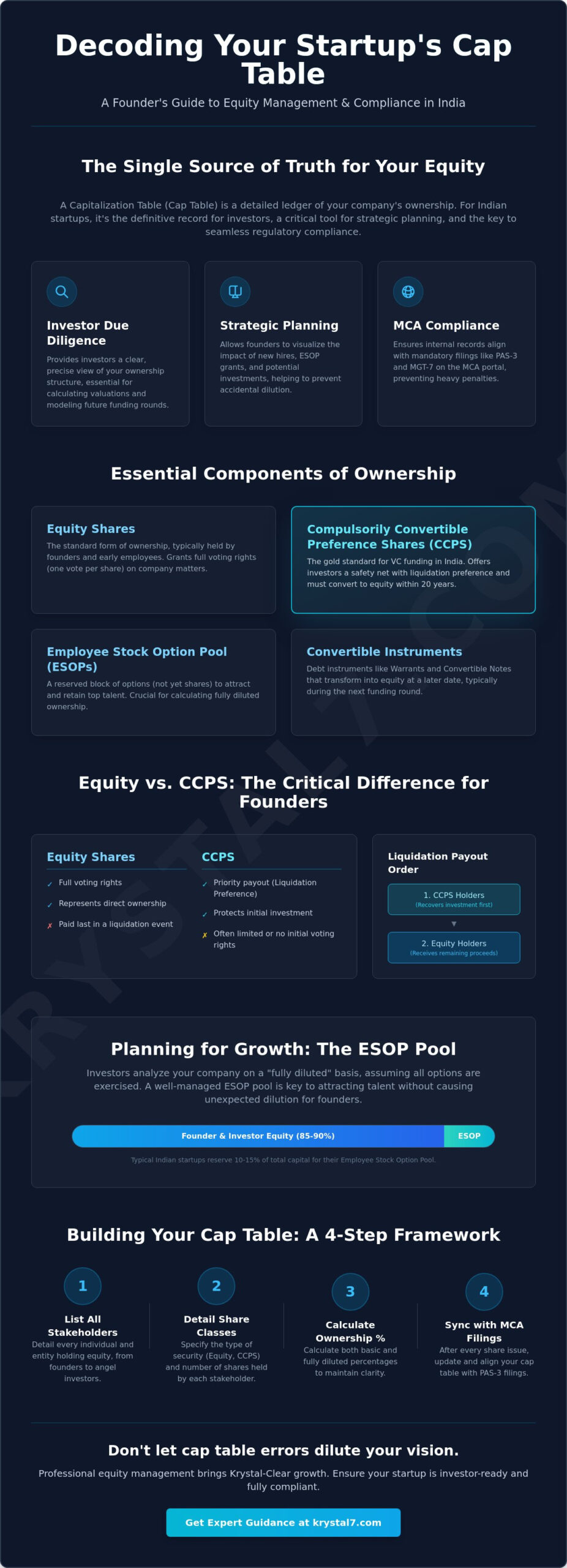
Equity shares are the most common unit of ownership. Founders and early employees typically hold these shares, which grant full voting rights on company matters. However, institutional investors in India rarely accept standard equity. They prefer Compulsorily Convertible Preferred Shares (CCPS) because these instruments offer a safety net while allowing for future upside. Our legal strategists can help you draft these rights to ensure they align with your long-term vision.
- Equity Shares: These represent permanent ownership and carry one vote per share under the Companies Act 2013.
- CCPS: This is the gold standard for VC funding in India. It provides liquidation preference and must convert into equity within a maximum of 20 years.
- ESOPs: Options granted to employees that vest over time. They are not shares yet but must be tracked as part of your “fully diluted” capital.
- Warrants and Convertible Notes: Debt instruments that convert into equity at a later date, usually during the next funding round.
Equity vs. CCPS: What Founders Need to Know
The primary difference between equity and CCPS lies in the hierarchy of rights. Equity holders are usually the last to get paid during a liquidation event. In contrast, CCPS holders often have a “liquidation preference,” meaning they recover their investment before founders receive any proceeds. Conversion ratios are also critical. Most CCPS convert at a 1:1 ratio, but this can change if the startup issues new shares at a lower valuation than the previous round.
The ESOP Pool: Planning for the Future
Most Indian startups reserve between 10% and 15% of their total capital for an Employee Stock Option Pool. While these shares aren’t issued immediately, they impact your ownership percentages. When you master how to create a cap table for a startup, you must always look at the “fully diluted” view. This view assumes all options and convertible instruments have been exercised. Failing to account for this pool can lead to unexpected dilution when you finally hire top-tier talent. Maintaining this pool correctly is also a key part of your Annual Compliance for Private Limited Company requirements.
Step-by-Step: How to Create a Cap Table for a Startup
Building a capitalization ledger from scratch requires a methodical approach. Most founders in India find that a manual spreadsheet offers the best transparency during the early stages. Learning how to create a cap table for a startup ensures your internal records mirror the statutory filings you submit to the ROC.
Step 1: Design your sheet with clear columns for the Shareholder Name, Type of Security, and the Number of Shares. You should also include a column for the date of allotment. This layout provides an immediate view of your current equity distribution.
Step 2: Enter Founder Equity based on your initial Company Registration papers. Use the exact share counts listed in your Memorandum of Association to maintain consistency. Any discrepancy here can cause significant issues during future audits.
Step 3: Record external investors by tracking their specific share price in INR and the investment date. This chronological log helps you monitor valuation growth across different funding rounds. It also simplifies the process of calculating capital gains for future exits.
Step 4: Create a “Fully Diluted” column to account for your ESOP pool and any convertible notes. This column reflects the future ownership structure once all options are exercised. It gives you a realistic view of your actual stake in the company.
Step 5: Calculate ownership percentages by dividing individual shares by the total fully diluted share count. Multiply this number by 100 to find the final percentage for each stakeholder. Use automated formulas to ensure accuracy as you add new rows.
Formatting Your Cap Table for Clarity
Organize your data into distinct tiers for founders, investors, and employees. Use date-stamped versions to track changes and avoid version control errors during board meetings. A summary tab with a visual pie chart helps stakeholders grasp the ownership split quickly.
Common Pitfalls to Avoid
Founders often overlook the need to update their sheet after a share transfer under Form SH-4. Mismatches between your tracker and the MCA Register of Members lead to significant delays during due diligence. You must also account for “Pro-Rata” rights that allow existing investors to maintain their stake in future rounds.
Managing Dilution and Mandatory MCA Compliance
Ownership in a startup is a dynamic journey. As you scale, you’ll naturally issue new shares to investors and employees, causing your initial 100% stake to shrink. This process is called dilution. While your percentage of the company decreases, the goal is to make the “pie” significantly more valuable. Understanding how to create a cap table for a startup involves tracking these shifts with precision to avoid losing control of your vision.
In India, every fresh issue of shares must be reported to the Ministry of Corporate Affairs (MCA). You’re required to file Form PAS-3 (Return of Allotment) within 30 days of the board’s allotment decision. Failing to meet this deadline results in heavy penalties under the Companies Act 2013. These fines can accumulate daily, creating a financial burden that distracts you from growth.
Accuracy in your cap table is also legally tied to valuation rules. Under Section 62(1)(c) of the Companies Act, any preferential allotment requires a report from a Registered Valuer. This report justifies the price at which you’re issuing shares. It ensures transparency for existing shareholders and prevents the arbitrary pricing of equity. Our Annual Compliance Package streamlines these filings so you can maintain a clean legal record.
Section 42 and Private Placements
Issuing shares to a select group of investors falls under the “Private Placement” rules of Section 42. This process is more rigorous than a standard rights issue. You must pass a formal Board Resolution and a Shareholders’ Resolution. The latter requires filing Form MGT-14 with the ROC before you can even open the offer. For a deeper look at these structures, check our guide on the Private Limited Company in India.
Stamp Duty and Share Certificates
Compliance doesn’t end with an MCA filing. You must issue physical or demat share certificates to your investors within 2 months of the allotment date. These certificates must be in Form SH-1 and signed by authorized directors. Additionally, you must calculate and pay the applicable Stamp Duty on the total value of shares issued. Each state in India has its own rates under the Indian Stamp Act. Neglecting this step makes your share certificates legally inadmissible in court and can lead to penalties of up to 10 times the original duty amount. By mastering how to create a cap table for a startup that accounts for these duties, you protect the legal integrity of your company’s equity.
Why Professional Equity Management Brings Krystal-Clear Growth
While a spreadsheet is a great starting point, relying on a DIY tracker as you scale introduces significant operational risks. A single broken link or an outdated valuation can lead to disputes during board meetings or investor audits. As you master how to create a cap table for a startup, you’ll find that the transition from a manual sheet to a statutory-linked record is where most founders struggle. Managing the cap table isn’t just about data entry; it’s about interpreting the 2026 regulatory shifts with precision.
Krystal7 Consultants offers a “Dedicated Relationship” model that bridges this gap. We don’t just provide a template; we act as your outsourced compliance department. Our legal strategists ensure your equity tracking is in total harmony with your Register of Members and the latest MCA filings. This methodical approach gives you the freedom to focus on your product while we handle the meticulous red tape of equity administration.
Beyond simple tracking, we provide elite expertise in ESOP structuring and Shareholder Agreements (SHA). The tax implications of ESOPs in 2026, particularly the deferral of perquisite tax for eligible startups, require careful statutory navigation. We help you design plans that attract top talent without creating future compliance headaches. Our advisors ensure that every equity instrument you issue is backed by chartered expertise and legal clarity.
From Spreadsheet to Statutory Compliance
Our Chartered Accountants audit your entire equity history to ensure every share transfer and allotment is documented with crystal-clear transparency. This process is essential for startups aiming to benefit from the IPO rule changes notified in March 2026. We ensure your annual returns reflect every change, providing a solid foundation for your company’s legacy. This audit prepares your startup for the most rigorous due diligence from global venture capital firms.
Get Started with Krystal7 Consultants Today
Krystal7 Consultants provides elite startup advisory with transparent, upfront pricing and no hidden costs. Contact us at business@krystal7.com or visit krystal7.com for a comprehensive cap table audit or share issuance support. Trust our methodical experts to handle the complexity so your vision can thrive in India’s growing economy. We take care of the statutory burdens so you can focus on building a market-leading enterprise.
Building a Foundation for Crystal-Clear Growth
Managing equity is about more than just numbers; it’s about the legal integrity of your vision. You now understand the nuances of CCPS, the importance of the ESOP pool, and the strict 30-day deadline for PAS-3 filings under the Companies Act 2013. By mastering how to create a cap table for a startup, you’ve taken a vital step toward investor readiness in an ecosystem with over 674,184 active ventures. This methodical approach ensures you avoid accidental dilution and stay perfectly aligned with official MCA records.
A professional tracker provides the transparency needed to secure your next funding round with confidence. It acts as a shield during due diligence, proving that your governance is as strong as your growth. This clarity allows you to lead with certainty rather than guesswork.
Ready for Krystal-clear equity management? Contact Krystal7 Consultants for expert cap table advisory. Our team of legal strategists has earned the trust of over 500 Indian startups by offering compliance management with no hidden costs. We handle the complex red tape so you have the freedom to focus on your legacy. Your business dream deserves a partner that values clarity as much as you do.
Frequently Asked Questions
What is the difference between authorized capital and paid-up capital in a cap table?
Authorized capital is the maximum limit of share capital a company is legally allowed to issue as per its Memorandum of Association. Paid-up capital represents the actual amount of money stakeholders have paid to the company in exchange for shares. When learning how to create a cap table for a startup, you must track both to ensure you don’t exceed your statutory limits registered with the MCA.
Do I need a cap table if I am the sole director of a One Person Company (OPC)?
Yes, maintaining a cap table is beneficial even for an OPC to track the nominee director’s details and future dilution plans. While your ownership is currently 100%, having a structured ledger prepares you for the moment you convert into a Private Limited company to raise capital. It establishes a methodical habit of crystal-clear documentation from the very beginning of your venture.
How often should a startup update its capitalization table?
You should update your capitalization table immediately after any “trigger event” such as a fresh allotment, share transfer, or ESOP grant. Best practices suggest a monthly internal audit to ensure your spreadsheet remains a reliable source of truth for the board. Regular updates prevent the guesswork that often leads to accidental dilution during high-pressure funding negotiations in India’s fast-paced market.
Can I issue shares to employees without an ESOP plan?
You can issue shares directly through sweat equity or preferential allotment, but these methods have strict regulatory hurdles under the Companies Act 2013. Issuing sweat equity requires a special resolution and must comply with Section 54. Most founders find that a structured ESOP plan provides more flexibility and better tax benefits for the elite talent they wish to attract and retain.
What happens if my cap table does not match my MCA filings?
A mismatch between your internal records and MCA filings is a major red flag that can ruin investor due diligence. It suggests poor governance and may lead to legal disputes over actual ownership percentages or voting rights. If you find a discrepancy, you must rectify your statutory registers and PAS-3 filings immediately to restore clarity and protect your company’s valuation.
Is a cap table a legally binding document in India?
A cap table is not a legally binding document; the Register of Members maintained under Section 88 of the Companies Act 2013 is the official proof of ownership. However, the cap table is the primary tool used for financial modeling and negotiating term sheets with VCs. Mastering how to create a cap table for a startup ensures your internal planning always mirrors your legally binding statutory records.
How do convertible notes appear on a cap table before they convert?
Convertible notes appear in the “Fully Diluted” section of your cap table as a potential future equity obligation. Since they are technically debt that converts upon a future trigger event, you don’t list them as active shares in the current cap. Instead, you track the principal amount and the conversion terms to show current stakeholders how much their ownership will shrink once the notes convert.
What is the penalty for late filing of PAS-3 with the ROC?
If you fail to file Form PAS-3 within 30 days of allotment, the company and its defaulting officers face a penalty of INR 1,000 for each day of delay. This penalty can reach a maximum of INR 25 lakhs under the current provisions of the Companies Act 2013. Staying deadline-driven is essential to avoid these preventable financial losses that can drain your startup’s precious capital.

Article by
Nihal Srivastava
Nihal Srivastava is the Co-Founder of Krystal7 Consultants, helping Indian entrepreneurs and startups navigate company registration, compliance, trademark protection, and regulatory requirements with clarity and confidence. With 6+ years of hands-on expertise in MCA filings, GST compliance, and corporate structuring, Nihal has guided 1000+ businesses across India through their legal and compliance journeys. He believes every business dream deserves crystal clear foundations, and that no founder should be held back by paperwork or red tape.