

Building a Legally Sound Business from Day One: The Ultimate Founder’s Checklist (2026)
What if your biggest business risk isn’t a lack of customers, but a hidden ₹50,000 penalty sitting in a government portal you didn’t even know existed? Most Indian founders start with a vision, not a law degree. It’s completely normal to feel overwhelmed by the choice between a Private Limited company and an LLP, or to lose sleep over the new April 2026 labor code requirements. You want to build a legacy, but the fear of red tape often creates a heavy mental burden.
Building a legally sound business from day one shouldn’t feel like navigating an endless maze. You deserve the freedom to focus on your product while knowing your compliance is handled with crystal clarity. We understand the anxiety of missing a GST filing or failing to protect your brand name properly. This article provides a comprehensive, India-specific roadmap to ensure your startup is compliant and ready for scale from the very first minute.
We’ll walk you through the mandatory registrations for 2026, explain the 50% wage rule under the new Code on Wages, and help you choose the right structure to avoid future tax headaches. By the end, you’ll have a streamlined path to growth without legal distractions.
Key Takeaways
- Understand how choosing the right structure under the Companies Act 2013 secures your personal assets and prepares your startup for future VC funding.
- Identify the essential statutory registrations like PAN, TAN, and GST that you need before processing your very first business transaction.
- Follow a clear roadmap for building a legally sound business from day one by protecting your intellectual property and drafting solid founders’ agreements.
- Avoid heavy government penalties by mastering critical post-incorporation deadlines, including the appointment of your first statutory auditor and filing Form INC-20A.
- Navigate the latest 2026 labour code requirements for EPFO, ESIC, and state-specific Professional Tax to ensure your payroll remains fully compliant.
Choosing the Right Legal Structure: The Foundation of Your Venture
Your choice of entity isn’t just an administrative checkbox. It’s a strategic decision that dictates your tax liability and personal risk under the Companies Act 2013. Building a legally sound business from day one starts with selecting a structure that matches your long term vision. While there are many types of legal business entities globally, Indian founders typically choose between three main models based on their capital needs and growth plans.
The Private Limited Company remains the gold standard for startups. It provides a clear framework for issuing equity, making it the only structure Venture Capitalists (VCs) truly trust for investment. If you’re planning to raise funds or scale rapidly, a private limited company india is the ideal vehicle for scalable growth. For solo entrepreneurs, the One Person Company (OPC) offers the protection of limited liability without the need for a second director. Meanwhile, the Limited Liability Partnership (LLP) serves as a flexible, cost-effective alternative for professional service firms that don’t require external funding.
Private Limited vs. LLP: A Quick Comparison
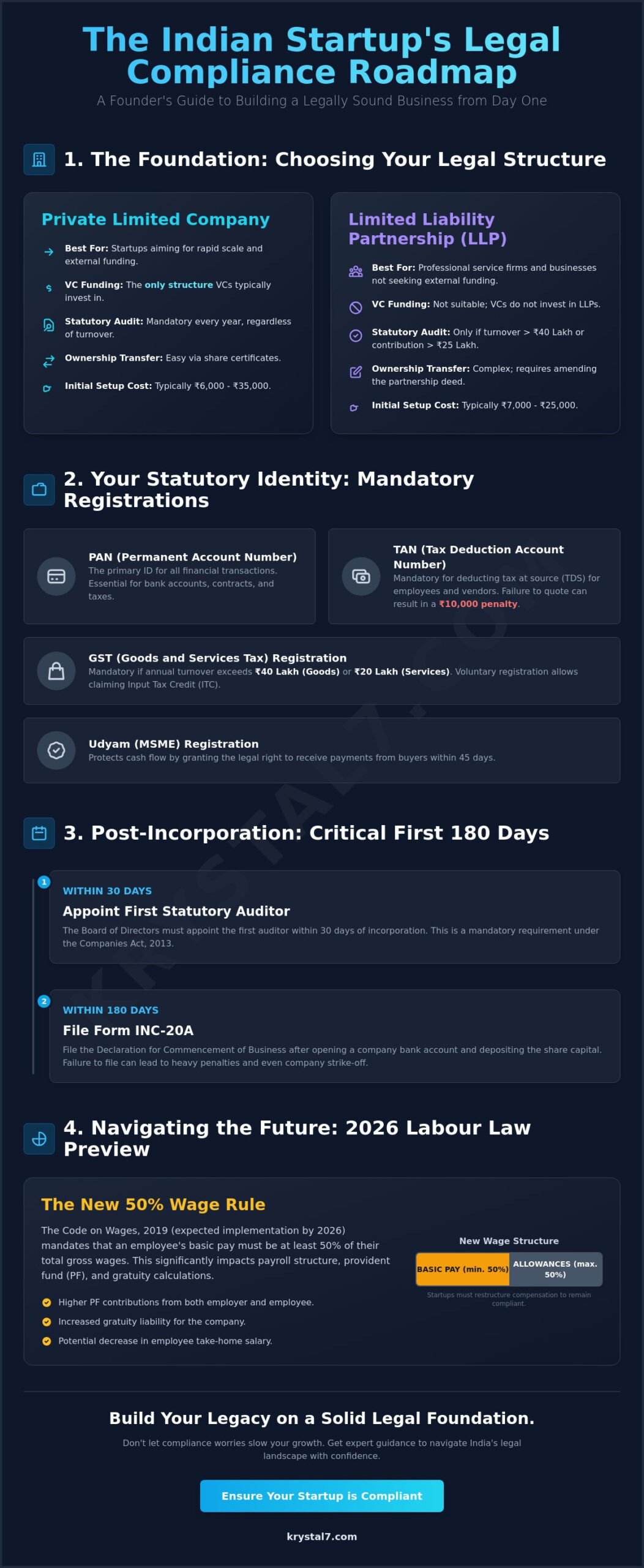
Compliance burdens and costs differ significantly between these two structures. A Private Limited company must conduct a statutory audit every year, regardless of its turnover or capital. In contrast, an LLP only requires an audit if its annual turnover exceeds ₹40 lakh or its capital contribution goes above ₹25 lakh. Ownership is also easier to transfer in a company through share certificates, whereas an LLP requires amendments to the partnership deed for every change. Initial setup costs for a Private Limited entity generally range from ₹6,000 to ₹35,000, while an LLP typically costs between ₹7,000 and ₹25,000 depending on the state and authorized capital.
The Registration Process via the MCA Portal
The Ministry of Corporate Affairs (MCA) has streamlined incorporation through the SPICe+ (Simplified Proforma for Incorporating Company Electronically) form. This single window system allows you to apply for your name reservation, incorporation, PAN, and TAN simultaneously. You’ll need to obtain Digital Signature Certificates (DSC) for all proposed directors first. The process also generates Director Identification Numbers (DIN) automatically during the filing. You must draft and file the Memorandum of Association (MoA) and Articles of Association (AoA), which act as the legal constitution of your new venture. These documents define your business objectives and internal rules, ensuring you’re building a legally sound business from day one.
Securing Your Statutory Identity: PAN, TAN, and GST
Your business identity starts with the Permanent Account Number (PAN). It’s the primary key for every financial move you make, from signing vendor contracts to opening your office. Building a legally sound business from day one requires this ten-digit alphanumeric code to ensure your entity is recognized by the Income Tax Department.
If you plan to hire employees or work with professional contractors, you must also apply for a Tax Deduction and Collection Account Number (TAN). Under Section 203A of the Income Tax Act, 1961, it’s mandatory for anyone responsible for deducting or collecting tax at source. Failing to quote your TAN on TDS certificates or challans can lead to a flat penalty of ₹10,000 per instance.
Beyond tax IDs, you should consider your standing in the global market. While you focus on Indian compliance, many high-growth startups also look toward international standards, often referencing USPTO startup resources to understand how global identity and intellectual property intersect. Securing your Udyam registration is another vital step that protects your cash flow. This MSME registration grants you the legal right to receive payments within 45 days, shielding you from the credit cycles that often cripple new ventures.
The GST Registration Checklist
Goods and Services Tax (GST) registration is mandatory if your aggregate turnover exceeds ₹40 lakh for goods or ₹20 lakh for services in a financial year. Even if you’re below these limits, registering voluntarily can be a strategic move. It allows you to claim Input Tax Credit (ITC) on your business expenses, effectively reducing your overall tax burden. You’ll need your PAN, proof of business address like a rent agreement, and bank details to start the process. It’s wise to work with a gst consultant to ensure you select the correct HSN and SAC codes, as errors here can lead to incorrect tax rates and future litigation.
Opening a Business Current Account
You must never mix personal and business finances. This separation is the cornerstone of corporate transparency and protects your limited liability status. Indian banks require strict ‘Know Your Customer’ (KYC) documentation, including your Certificate of Incorporation, PAN, and board resolution. Once your account is active, integrate it with cloud-based accounting software. This automation creates a streamlined trail for your annual audits and tax filings. If you’re feeling overwhelmed by these initial steps, you can explore our incorporation packages to get everything set up correctly from the start.
Protecting Your Intellectual Property and Drafting Contracts
Your brand is more than just a name; it’s the reputation you build every single day. Building a legally sound business from day one requires you to treat your ideas as tangible assets that need defense. If you don’t protect your logo or unique product name early, you risk expensive legal battles or a forced rebrand just as you start to gain market traction. Intellectual property (IP) protection isn’t just for tech giants. Even a small boutique or a local service provider needs to ensure their creative work stays theirs.
You must also secure your internal relationships before the first line of code is written or the first product is sold. A well-drafted Founders’ Agreement defines equity splits, vesting schedules, and exit clauses. This document prevents “founder fallout” from sinking your venture before it truly sails. It’s about creating a clear roadmap for the partnership so everyone understands their rights and responsibilities from the start.
The Trademark Application Journey
Every trademark journey begins with a comprehensive search on the IP India portal. You need to ensure your brand name isn’t already in use within your specific class of goods or services. There are 45 different classes, and picking the wrong one can leave your brand vulnerable. As of May 2026, the government fee for online trademark registration for startups and small enterprises is ₹4,500 per class. For a more detailed look at these costs, check our guide on trademark registration fees to plan your budget with crystal clarity.
Essential Legal Agreements for Startups
Handshake deals are a significant legal liability in the Indian business environment. You need written contracts that clearly state who owns the work created for your company. This is especially true for employment and consultant contracts. Without a specific, irrevocable IP assignment clause, a freelancer could technically claim ownership of the code or designs they produced for you. This creates a messy legal situation that can block future funding rounds or acquisitions.
Digital ventures must also prioritize their Customer Terms of Service and Privacy Policies. These documents are your first line of defense against user disputes and ensure you comply with the Information Technology Act. You should also use Non-Disclosure Agreements (NDAs) when pitching to potential partners or vendors. These documents protect your trade secrets and ensure your “secret sauce” doesn’t become public knowledge. Setting these boundaries gives you the freedom to focus on growth without the constant threat of contract disputes. Building a legally sound business from day one means ensuring every signature adds a layer of security to your vision.
Post-Incorporation Compliance: The First 30 to 180 Days
Receiving your Certificate of Incorporation is a major milestone, but the clock starts ticking for statutory filings the moment your company is born. Building a legally sound business from day one requires you to transition from the excitement of launch to the discipline of compliance. These first few months are critical for establishing your entity’s standing with the Ministry of Corporate Affairs (MCA) and the Income Tax Department.
One of your first legal obligations is appointing a Statutory Auditor within 30 days of incorporation. This appointment is made by the Board of Directors and ensures your financial records meet Indian auditing standards from the start. Within 60 days, you must issue share certificates to the subscribers of your Memorandum of Association. You are also required to pay the applicable Stamp Duty on these certificates, a process that varies depending on the state where your registered office is located.
The most vital deadline in this period is filing the Declaration of Commencement of Business, also known as Form INC-20A. You have 180 days from the date of incorporation to file this form, which confirms that every subscriber has paid the value of the shares they agreed to take. You cannot start any business operations or exercise any borrowing powers until this form is approved. Additionally, your registered office must be functional with a visible nameplate displaying the company name and Corporate Identity Number (CIN) in a prominent location.
Mandatory MCA Filings for New Companies
Your Board of Directors must hold its first official meeting within 30 days of incorporation. During this meeting, you will formalize the appointment of auditors, authorize the opening of bank accounts, and approve the issuance of shares. You are also legally required to maintain statutory registers and minutes of all meetings as per the Companies Act 2013. To stay prepared for your year end requirements, you can refer to our guide on annual compliance for private limited company filings.
Tax Compliance and TRACES Portal
Compliance quickly becomes a monthly and quarterly rhythm. You must establish a strict calendar for GST filings and TDS returns to avoid heavy late fees. Use the TRACES portal to manage your tax deductions and download necessary certificates like Form 16 or 16A for your team and vendors. Remember that advance tax payments are due in four installments throughout the year. Missing these deadlines results in mandatory interest penalties under Section 234B and 234C of the Income Tax Act.
If you want to ensure your first 180 days are completely error-free, you can sign up for our annual compliance package to handle these filings with professional precision.
Labour Law Compliance and Financial Governance
Scaling your team is a sign of success, but it also triggers a new set of statutory obligations. Building a legally sound business from day one involves more than just tax IDs; it requires a commitment to your employees’ social security. As of April 1, 2026, India’s four new labor codes are in full operational enforcement, making compliance even more critical for every growing startup.
You must register with the Employees’ Provident Fund Organisation (EPFO) once your headcount reaches 20 employees. Similarly, Employees’ State Insurance Corporation (ESIC) registration is mandatory for businesses with 10 or more employees in most states. Failing to register or delaying contributions isn’t just a financial lapse. It can lead to criminal liability for directors under the updated codes.
Local compliance is equally important. You must obtain a registration under the Shop and Establishment Act for your physical office or commercial space. If you’re based in Haryana, you must also navigate state-specific Professional Tax (PT) requirements. Implementing Internal Financial Controls (IFC) early on helps prevent fraud and ensures your business is always audit-ready for future investors.
Social Security and Payroll Compliance
The new 2026 labor regulations dictate that basic pay and certain allowances must constitute at least 50% of an employee’s total CTC. You must deposit employee contributions on time every month. Any delay can result in penalties that wipe out your margins. You also need a clear HR policy that complies with the POSH (Prevention of Sexual Harassment) Act, which is mandatory for any office with 10 or more staff members. This isn’t just a legal requirement; it’s about building a safe and professional culture.
The Role of Professional Advisory
Managing these moving parts alone often leads to burnout and missed deadlines. Partnering with a dedicated CA or CS firm gives you the ‘Freedom to Focus’ on your core product. This relationship becomes even more vital if you’re dealing with cross-border compliance or foreign subsidiaries; for instance, if you are exploring international growth, you can check out Relay Registered Agent for professional LLC formation and compliance assistance. Expert advisors know your business inside out and act as a shield against regulatory surprises.
Building a legally sound business from day one is a marathon, not a sprint. It requires meticulous attention to detail and a proactive approach to every new regulation. Krystal7 is your ‘Krystal-Clear’ partner for this journey, handling the complexity so you can pursue your passion with total confidence. Contact Krystal7 Consultants at business@krystal7.com or visit krystal7.com for expert assistance.
Future-Proof Your Vision with Crystal Clarity
Success in the Indian market requires more than a great product; it demands a foundation that can withstand regulatory scrutiny. You’ve learned that choosing the right structure and securing your statutory identity are the first steps in building a legally sound business from day one. From mastering the April 1, 2026 labor codes to filing Form INC-20A within the mandatory 180 day window, every step you take today protects your growth tomorrow. You don’t have to navigate this complexity alone or worry about hidden costs and missed deadlines.
Our team of elite Chartered Accountants and legal strategists provides the dedicated relationship management your venture deserves. We bring transparency to every filing so you can focus on your passion while we handle the red tape. Don’t let compliance guesswork slow your momentum or lead to unnecessary penalties. Get Krystal-Clear Legal Guidance for Your Business—Contact Krystal7 Consultants Today. Your business dream matters; we’re here to ensure it thrives with total security and professional precision.
Frequently Asked Questions
What is the most legally sound business structure for a startup in India?
The Private Limited Company is the most robust structure for startups seeking external investment. It offers limited liability protection and a clear framework for equity distribution under the Companies Act 2013. This structure is essential for building a legally sound business from day one if you plan to scale. VCs and institutional lenders always prefer this entity type over partnerships or sole proprietorships.
Is GST registration mandatory from day one of starting a business?
GST registration is only mandatory from day one if you conduct interstate sales or operate via e-commerce. Otherwise, you must register when your aggregate turnover exceeds ₹40 lakh for goods or ₹20 lakh for services in a financial year. Many founders choose voluntary registration early to claim Input Tax Credit on their setup expenses. This strategy ensures you don’t lose money on taxes paid to vendors.
What are the penalties for non-compliance with MCA filings in the first year?
Late filings with the MCA attract a penalty of ₹100 per day for each form. Missing the deadline for the Commencement of Business certificate can result in a ₹50,000 penalty for the company. Directors may also face a fine of ₹1,000 per day up to a maximum of ₹1 lakh. These penalties can significantly drain a startup’s initial capital and impact your credit rating.
How do I protect my brand name before I even register my company?
You can protect your brand name by filing a trademark application as an individual before incorporating your company. This secures your rights under the Trade Marks Act 1999 and prevents competitors from using similar names in your industry. Once your company is registered, you can easily transfer the trademark to the corporate entity. This proactive step is a cornerstone of building a legally sound business from day one.
Do I need a separate bank account for my LLP or Private Limited Company?
Yes, opening a separate business current account is a legal and practical necessity for LLPs and Companies. Since these entities are separate legal persons, their finances must remain distinct from the founders’ personal wealth. Mixing funds leads to severe compliance issues and makes your annual audit much more difficult. Most banks require the Certificate of Incorporation and PAN to open this account officially.
What is the Commencement of Business certificate and why is it critical?
The Commencement of Business certificate, filed via Form INC-20A, is a mandatory declaration filed with the MCA within 180 days of incorporation. It proves that all subscribers have paid for their shares as agreed in the MoA. You cannot legally start operations or exercise borrowing powers until this form is filed. Failure to comply can lead to the permanent removal of your company name from the register.
Can I handle all legal compliance myself or do I need a consultant?
While the MCA and GST portals are public, the complexity of Indian compliance usually requires professional expertise. A single error in an HSN code or a missed TDS deadline can lead to litigation or heavy interest. Hiring a consultant gives you the freedom to focus on your product. They ensure your statutory registers and filings are always accurate and up to date according to current laws.
What are the key tax deadlines every Indian founder should mark on their calendar?
Founders must track monthly GST filings by the 20th and TDS deposits by the 7th of every month. Advance tax installments are due on the 15th of June, September, December, and March. Annual ROC filings and Income Tax Returns also have strict deadlines in September and October. Marking these dates helps you avoid the 1.5% monthly interest charged on delayed tax payments under the Income Tax Act.

Article by
Nihal Srivastava
Nihal Srivastava is the Co-Founder of Krystal7 Consultants, helping Indian entrepreneurs and startups navigate company registration, compliance, trademark protection, and regulatory requirements with clarity and confidence. With 6+ years of hands-on expertise in MCA filings, GST compliance, and corporate structuring, Nihal has guided 1000+ businesses across India through their legal and compliance journeys. He believes every business dream deserves crystal clear foundations, and that no founder should be held back by paperwork or red tape.