

Trademark vs Copyright vs Patent India: A Founder’s Guide to IP Protection (2026)
Your most valuable business asset isn’t your office space or inventory; it’s the invisible idea that a competitor could replicate in a single afternoon. For many Indian founders, the confusion between trademark vs copyright vs patent india leads to analysis paralysis while their brand remains vulnerable. You likely feel a spike of anxiety when navigating the IP India portal or worry that high legal fees are the only path to security.
Krystal7 Consultants agrees that legal jargon surrounding the Trade Marks Act of 1999 often feels like a wall of red tape. This guide provides the crystal clarity you need to distinguish between these protections so you can maintain your freedom to focus on growth. We handle the complexity so you can pursue your vision with total confidence.
You will master the critical differences between trademarks, copyrights, and patents in India to secure your business assets. This article breaks down specific government fees and provides a clear roadmap for the registration process. We’ll move from basic definitions to strategic sequencing for your Private Limited company or LLP.
Key Takeaways
- Identify whether your asset is a brand identity, a creative expression, or a technical invention to choose the correct legal shield.
- Understand the trademark vs copyright vs patent india distinction to avoid costly filing errors on the official IP India portal.
- Learn the specific validity periods for each protection, ranging from 10 years for brand marks to 20 years for innovative patents.
- Leverage DPIIT recognition to access 80% fee reductions and expedited examination processes for your startup’s patent applications.
- Secure a Digital Signature Certificate (DSC) to streamline your online filing and ensure full statutory compliance from the start.
Understanding Intellectual Property Rights (IPR) in the Indian Business Landscape
Viksit Bharat 2026 fuels a massive shift in how Indian entrepreneurs view their intellectual assets. Founders now realize that their competitive edge lives in what they own, not just what they sell. Understanding the distinction of trademark vs copyright vs patent india prevents costly mistakes during the early stages of a venture.
Indian Venture Capitalists (VCs) place a heavy premium on “defensibility” when evaluating local startups. A clean IP portfolio often increases a company’s valuation by 15% to 25% during Series A or B funding rounds. This financial boost provides the capital needed to scale operations across the country with confidence.
Many Indian founders often confuse brand names with inventions, leading to incorrect filings and wasted resources. This confusion delays the usage of the “R” symbol and leaves actual innovations vulnerable to copycats. We see this most often in the software and manufacturing sectors where the lines between a brand and a process blur.
The Office of the Controller General of Patents, Designs and Trademarks (CGPDTM) serves as the primary governing body for these rights. This department manages the IP India portal where all statutory filings occur. They ensure that your brand identity and technical innovations receive the legal protection they deserve under Indian law.
The Legal Pillars: Acts That Govern IP in India
Three specific legislative acts form the foundation of Intellectual property in India. The Trade Marks Act, 1999, protects your brand names and logos. Meanwhile, the Copyright Act, 1957, safeguards creative expressions like software code and marketing content.
The Patents Act, 1970, supports the “Make in India” initiative by protecting novel inventions and industrial processes. Each act sets strict rules, timelines, and penalties for non-compliance. Following these regulations ensures your Private Limited company or LLP stays on the right side of the law.
Why Gurgaon Startups Prioritize IP Early
Founders in the high-pressure Gurgaon tech corridor prioritize IP to build asset-backed growth models. They recognize that a registered trademark acts as a transferable asset on the company’s balance sheet. This strategic move creates long-term value for shareholders and potential acquirers in the Indian market.
Krystal7 Consultants provides the clarity required to navigate these complex legal waters. We help you move from “red tape” to a streamlined registration process. Our expert legal strategists handle the statutory details so you can maintain the freedom to focus on your business goals.
Decoding the Big Three: Definitions and Scope under Indian Law
Intellectual Property is the legal protection of intangible human intellect under Indian statutes. This definition serves as the foundation for the trademark vs copyright vs patent india framework. It allows you to convert your creative ideas into tradeable business assets that sit on your balance sheet.
Trademark Scope: Beyond Just a Logo
A trademark protects the unique markers that identify your brand to the Indian consumer. Under the Trade Marks Act 1999, you can register brand names, logos, slogans, and even specific sounds. This protection ensures that no competitor can profit from the reputation your Private Limited company has built.
Distinctiveness is the primary requirement for a successful registration in India. Your mark cannot simply describe your service; it must distinguish your source from others. Iconic Indian trademarks like the Amul girl or the Tata “T” symbol illustrate how a strong identity creates immediate market trust.
Copyright Scope: Protection for Creators and Coders
Copyright protects the original expression of an idea rather than the idea itself. For a tech-focused LLP, this covers your website’s source code, marketing content, and internal training manuals. This shield prevents competitors from literally “copy-pasting” your hard work.
Protection begins the moment you create the work under the Copyright Act 1957. The Protecting Intellectual Property in India guide notes that this right lasts for the author’s lifetime plus 60 years. While protection is automatic, formal registration on the IP India portal provides the statutory evidence needed to win infringement lawsuits.
Patent Scope: Innovations and Utility
Patents protect functional inventions that offer a new technical solution to a problem. Your invention must prove novelty, an inventive step, and industrial application to qualify for this 20-year monopoly. This protection is vital for startups developing new hardware or proprietary industrial processes.
India grants both product patents and process patents under the Patents Act 1970. You must remain aware of Section 3, which lists non-patentable subject matter like mathematical methods or mere discoveries. Navigating these exclusions ensures you don’t waste resources on unregistrable ideas.
An IP audit from Krystal7 Consultants helps you identify exactly which assets require a legal shield. We provide the clarity needed to choose the right protection for your specific innovation. Our team ensures your legal foundation remains as strong as your business vision.
Key Differences: Trademark vs Copyright vs Patent India
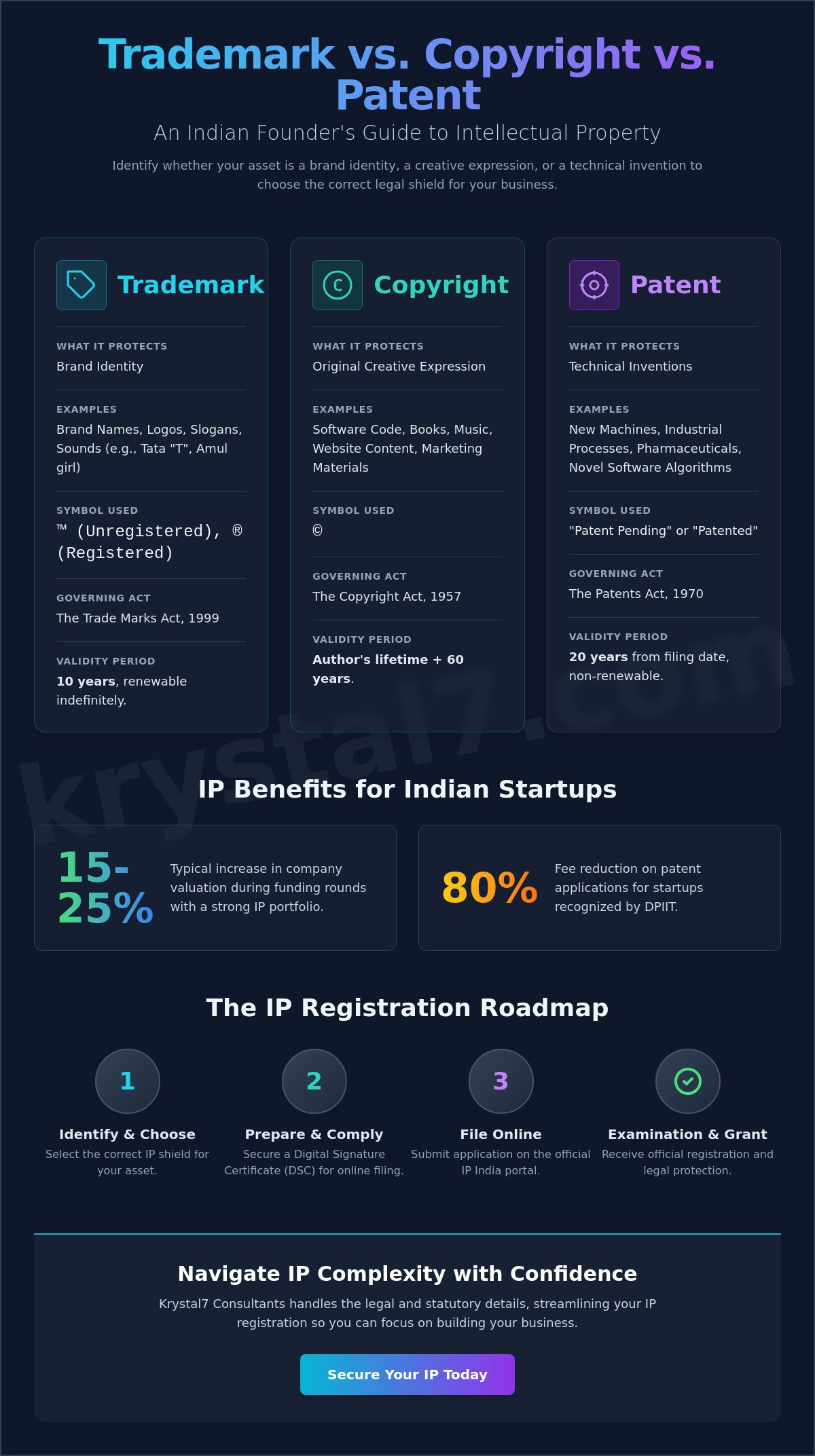
Choosing between a trademark, copyright, or patent is a strategic decision that affects your balance sheet. While they all fall under the Intellectual Property India umbrella, their rules for survival differ. A trademark can last forever if you renew it every 10 years. In contrast, a patent expires after 20 years; it then becomes public property. This distinction is why understanding trademark vs copyright vs patent india is vital for your long-term business planning.
The government incentivizes startups and small businesses with lower fees to encourage innovation. For example, a startup pays ₹4,500 for a trademark e-filing, while a large corporation pays ₹9,000. Patent filing fees are also reduced by 80% for DPIIT-recognized entities. These cost differences make it easier for early-stage ventures to build a robust IP portfolio without draining their capital.
Comparison Framework for Indian Founders
The following table summarizes the legal landscape for IP in India. Use this as a quick reference to determine which Act governs your specific asset.
- Trademark: Protects brand identity under the Trade Marks Act, 1999. Valid for 10 years and renewable indefinitely.
- Copyright: Protects original expression under the Copyright Act, 1957. Valid for the author’s lifetime plus 60 years. No renewal is required.
- Patent: Protects functional inventions under the Patents Act, 1970. Valid for 20 years. Requires annual maintenance fees.
Remember that these rights are territorial. Registering with the Indian authorities only protects you within the borders of India. If you plan to expand to international markets, you will need separate filings in those jurisdictions. Indian law provides both civil and criminal remedies for infringement, including injunctions to stop competitors and fines for counterfeiting.
Strategic Sequencing: What Should You Register First?
Founders often struggle with which protection to prioritize. Usually, trademark registration is the first step. You should secure your brand name as soon as you incorporate your private limited company india to prevent others from squatting on your identity. This builds immediate brand equity and trust with your customers.
If you are building deep-tech or a unique hardware product, file your patent before you launch your MVP. Publicly showing your invention can disqualify it from being “novel” under Indian law, which kills your chances of a grant. Use copyright as a secondary shield for your marketing collateral, website content, and software code. This layered approach ensures that every facet of your intellect stays protected as you scale.
The Registration Process in India: Timelines, Portals, and Compliance
Moving from strategy to execution requires logging into the official IP India portal at ipindiaonline.gov.in. This digital gateway is where your trademark vs copyright vs patent india journey becomes a formal legal record. Before you begin, ensure you have a valid Class 3 Digital Signature Certificate (DSC). The portal uses this for secure authentication and to verify every document you upload. It’s a critical piece of the statutory compliance puzzle that prevents unauthorized filings.
Manage your expectations regarding the clock because different assets move at different speeds. A trademark typically moves from application to registration in 6 to 12 months if no one objects to it. Patents are a marathon, often taking 3 to 5 years for a standard grant. Form TM-A is the primary application form for trademark registration in India as of 2026. This consolidated form simplified the process for founders by replacing several older, more complex versions.
Handling Objections and Oppositions
Most founders hit a wall when the Registrar issues an Examination Report with objections. These usually fall under Section 9, which covers absolute grounds like lack of distinctiveness, or Section 11, which covers similarity to existing marks. If you’ve been using your brand before filing, a “User Affidavit” supported by dated invoices is your strongest defense. Krystal7 handles these complex responses and manages hearings before the Registrar to ensure your application moves toward the “Advertised” stage with crystal clarity.
Startup India Benefits for IP Filers
If your venture is recognized by the DPIIT, the financial burden of protection drops significantly. You’re entitled to an 80% rebate on patent filing fees and a 50% rebate on trademark fees. These recognized entities also gain access to “Fast-Track” examination options. This can reduce the waiting period for a patent grant from years to just 12 to 18 months. These benefits are designed to give Indian visionaries the freedom to focus on innovation rather than government fees.
Secure your startup’s future today by booking a professional trademark consultation with our expert legal strategists.
Securing Your Startup’s Legacy: How Krystal7 Streamlines IP Protection
Building a business is about creating a legacy, but a legacy without protection is just a target. Moving from the red tape of government portals to crystal clarity requires a methodical approach that only professional advisory can provide. At Krystal7, we specialize in helping Gurgaon entrepreneurs understand the nuances of trademark vs copyright vs patent india so they can secure their vision from day one. We handle the complexity of the law so you can maintain the freedom to focus on your passion.
Many founders attempt a DIY approach to save costs, but this often leads to expensive legal rejections. A simple error in class selection or a poorly drafted patent specification can result in a permanent loss of rights. We integrate IP strategy directly with your company registration process. This ensures your brand identity and innovations are shielded before you even issue your first invoice or hire your first employee.
Our IP Advisory Services
Our team conducts exhaustive trademark searches to ensure your brand name is truly registrable and unique. We don’t just file applications; we draft robust patent specifications that withstand rigorous examination by the CGPDTM. For tech startups, we handle copyright filings for software code and creative assets. This meticulous attention to detail ensures every line of your intellect is legally documented and defensible.
Beyond Registration: Annual Compliance and Monitoring
Securing a certificate is only the beginning of your IP journey. We provide automated trademark renewal alerts to prevent the accidental loss of your brand rights after the 10 year validity period. Our team also monitors the Indian market for potential infringers. This allows you to address brand squatters before they damage your reputation. This proactive stance transforms your IP from a mere document into a powerful business asset that builds long term value.
Mastering the landscape of trademark vs copyright vs patent india is essential for any visionary founder. Don’t leave your most valuable assets to guesswork or chance. Contact Krystal7 Consultants today at business@krystal7.com or visit krystal7.com to schedule your comprehensive IP audit. Our elite experts are ready to turn your business dreams into a secure, asset-backed reality.
Empower Your Vision with Crystal-Clear IP Strategy
Securing your intellectual property is the most effective way to turn a creative spark into a statutory business asset. You now have the roadmap to distinguish between brand identities, original expressions, and technical inventions. Mastering the nuances of trademark vs copyright vs patent india ensures your venture remains secure as you scale toward your 2026 goals.
Don’t let the complexity of the IP India portal or the fear of legal rejections stall your growth. We provide the transparency you need to thrive through our Chartered expertise and zero hidden costs policy. Our dedicated relationship managers handle the methodical filing process so you can stay focused on your core mission without the burden of administrative red tape.
Ready to protect your brand? Contact Krystal7 Consultants today at business@krystal7.com to secure your startup’s legacy. You’ve built something remarkable; now give yourself the freedom to focus on the future with total peace of mind.
Frequently Asked Questions
Can I register a trademark and a patent for the same product in India?
Yes, you can obtain both for the same product to create a layered shield by understanding the trademark vs copyright vs patent india hierarchy. A trademark protects the brand name or logo, while a patent covers the functional technology. This strategy is common for consumer electronics where the internal hardware is patented and the external branding is trademarked.
Is copyright registration mandatory in India to sue for infringement?
Registration is not strictly mandatory for protection, but it’s vital for litigation. Under the Copyright Act 1957, your work is protected the moment it’s created. However, having a registration certificate provides prima facie evidence in court. This simplifies the process of proving ownership during an infringement suit and claiming statutory damages.
What are the government fees for trademark registration for a startup in 2026?
The government e-filing fee for a startup is ₹4,500 per class in 2026. This is a 50% discount compared to the ₹9,000 fee charged to large corporations. By securing these lower rates, founders gain the freedom to focus on innovation while we handle the statutory filings on the IP India portal.
How long does a patent last in India, and can it be renewed?
A patent in India lasts for exactly 20 years from the date of filing. Unlike trademarks, patents cannot be renewed once this term expires; the invention then enters the public domain. You must pay annual maintenance fees to the Patent Office to keep the protection active during those two decades.
Can I protect my business idea under Indian copyright law?
No, you cannot protect a bare business idea under Indian copyright law. Copyright only covers the specific expression of that idea, such as a written business plan or website code. If your idea is a functional invention, you should explore the trademark vs copyright vs patent india framework to see if it qualifies for a patent instead.
What happens if my trademark application receives an objection from the Registrar?
You must file a formal written response within 30 days of receiving the Examination Report. The Registrar typically raises objections under Section 9 for lack of distinctiveness or Section 11 for similarity to existing marks. If your written arguments don’t resolve the issue, you’ll need to attend a show-cause hearing to present your case.
Does an Indian patent protect my invention globally?
No, an Indian patent only provides legal protection within the geographical boundaries of India. Patent rights are territorial. If you want global protection, you must file a Patent Cooperation Treaty (PCT) application or apply directly in individual countries within 12 months of your Indian filing date.
What is the penalty for infringing on someone else’s trademark in India?
Infringement can lead to imprisonment for up to 3 years and a fine of up to ₹2 Lakhs. These criminal penalties are outlined in Sections 103 and 104 of the Trade Marks Act 1999. Civil courts can also grant injunctions to stop the infringer immediately and award damages or an account of profits to your business.

Article by
Nihal Srivastava
Nihal Srivastava is the Co-Founder of Krystal7 Consultants, helping Indian entrepreneurs and startups navigate company registration, compliance, trademark protection, and regulatory requirements with clarity and confidence. With 6+ years of hands-on expertise in MCA filings, GST compliance, and corporate structuring, Nihal has guided 1000+ businesses across India through their legal and compliance journeys. He believes every business dream deserves crystal clear foundations, and that no founder should be held back by paperwork or red tape.