

Sole Proprietorship vs Private Limited Company India: The 2026 Founder’s Guide
A record 26,631 new companies were incorporated in December 2025, signaling a massive shift toward formal business structures in the Indian economy. You’re likely weighing the simplicity of a sole proprietorship vs private limited company India to see which path fits your 2026 growth plans. Choosing the wrong setup early on can limit your ability to raise capital or leave your personal savings vulnerable to business risks.
It’s natural to feel overwhelmed by MCA regulations or the fear that business debts could put your family’s assets at risk. You want a professional brand that investors trust without getting buried under piles of GST and income tax paperwork. We believe in providing the visual clarity and operational liberty you need to focus on your primary business goals.
This guide will help you discover the critical differences between these two structures so you can protect your wealth and build a scalable model. You’ll learn about the latest 2026 tax rates, liability protections, and the exact steps to transition from a solo venture to a registered entity. Let’s explore how to secure your professional future with confidence.
Key Takeaways
- Understand how limited liability decouples your personal wealth from business debts to ensure your family’s assets remain secure.
- Compare the latest 2026 corporate tax rates against individual income tax slabs to determine which structure offers the most efficient path for your revenue.
- Learn why a Private Limited company is the only viable choice for founders looking to raise equity funding or attract top talent via ESOPs.
- Evaluate the core differences of a sole proprietorship vs private limited company India to align your legal structure with your long-term scalability goals.
- Discover the methodical process of obtaining DSC, DIN, and name approval through the MCA portal to formalize your business presence.
Sole Proprietorship vs Private Limited Company India: Defining the Basics
Starting a business in India often feels like standing at a legal crossroads. You’re choosing more than just a business name; you’re selecting the foundation that determines how you pay taxes and who’s responsible for your debts. The choice of sole proprietorship vs private limited company India usually boils down to a trade-off between immediate simplicity and long-term security. While one offers a quick start, the other provides a fortress for your personal assets.
A sole proprietorship is essentially an extension of yourself. Under Indian law, there’s no distinction between the founder and the firm. If you’re running a boutique or a freelance consultancy, this structure offers the fastest way to get moving. Conversely, a Private Limited Company in India is a separate legal entity governed by the Companies Act, 2013. It’s a “person” in the eyes of the law, capable of owning property, entering contracts, and even suing or being sued in its own name.
This legal separation creates a concept known as “perpetual succession.” A company continues to exist even if shareholders change or pass away. A proprietorship ends the moment the owner stops working or dies. This distinction is vital for founders building a legacy that outlasts their personal involvement. It creates a sense of stability that clients and vendors value deeply.
The Legal Identity of a Sole Proprietorship
Since the owner and business are one, your business income is taxed at individual slab rates under the Income Tax Act. You won’t need complex filings with the Ministry of Corporate Affairs (MCA). Registration is lean. Most founders simply obtain a GST certificate or an MSME Udyam registration to open a business bank account. While this ease is tempting, it offers zero protection for your personal savings if the business faces a lawsuit or debt.
The Corporate Veil of a Private Limited Company
Registering with the MCA creates a “corporate veil” that shields you from personal liability. This structure is the gold standard for entrepreneurs who want a professional brand image. It’s often the only way to gain high-level credibility, especially when dealing with large vendors or international clients. Choosing a private limited company india allows you to issue shares and build a scalable foundation from day one. It transforms your vision from a personal project into a structured institution.
Liability Protection: Protecting Your Personal Assets
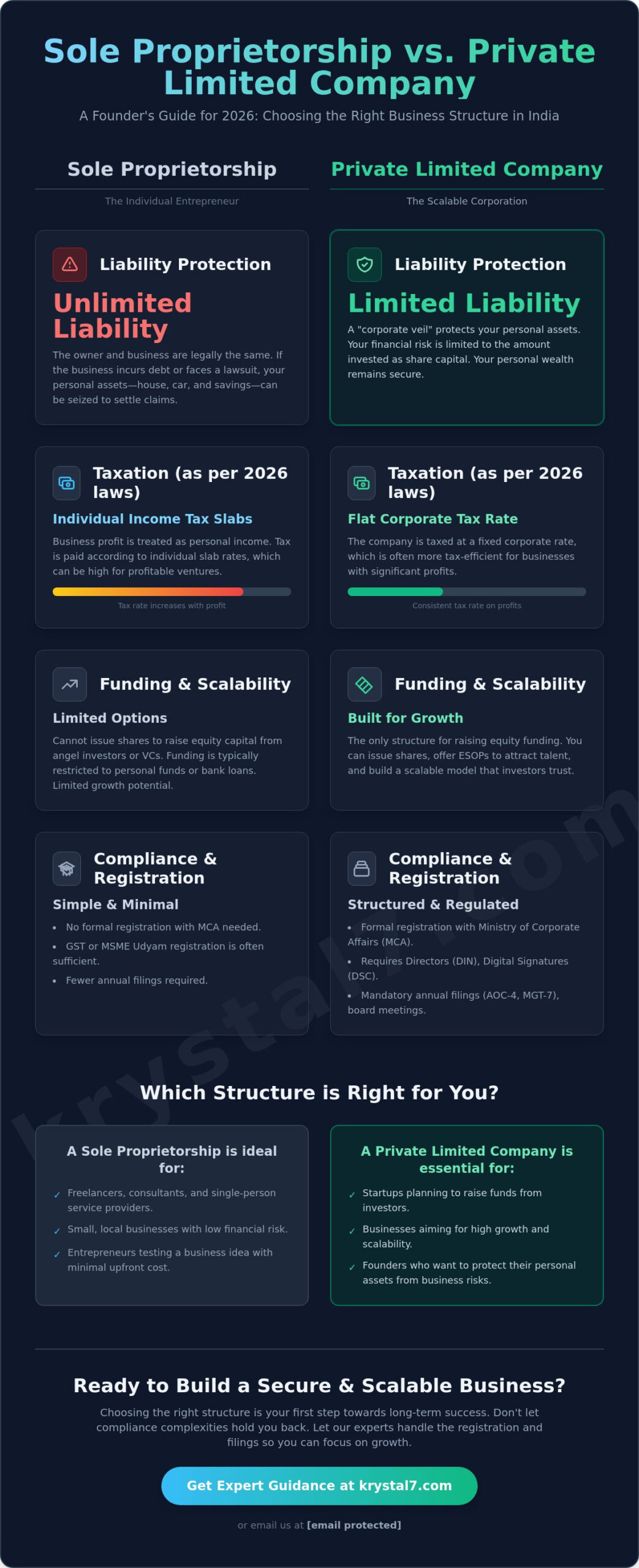
The most significant risk in the sole proprietorship vs private limited company India debate is how your personal wealth interacts with business failure. In a sole proprietorship, you face “unlimited liability.” This means the law sees no distinction between your business debt and your personal savings. If your firm defaults on a loan or loses a legal battle, your house, car, and personal investments can be seized to settle the dues. It’s a heavy burden that many entrepreneurs carry without realizing the potential consequences until a crisis hits.
A Private Limited structure changes this dynamic completely by introducing “limited liability.” Your financial exposure is capped at the amount you’ve invested as share capital. This protection is essential for high-risk sectors like manufacturing or e-commerce where capital requirements are heavy and market volatility is high. It creates a safety net that encourages innovation, allowing you to take calculated risks without betting your family’s future on every business decision.
Scenario Analysis: Business Debt Default
Consider a situation where a business in Gurgaon cannot pay a vendor INR 25 lakhs due to a sudden supply chain disruption. If you’re a sole proprietor, that vendor can approach the court to freeze your personal bank accounts and attach your property. Your personal life becomes a casualty of your professional struggle. However, in a Private Limited company, the creditor can only claim the company’s assets. Your personal wealth remains walled off and secure, which is the primary reason for company registration.
The Psychological Benefit of Limited Liability
Operating without a shield often leads to rapid founder burnout. The constant anxiety of personal ruin stifles growth and prevents you from making bold, strategic moves. When your assets are protected, you gain the “operational liberty” to pursue aggressive expansion. A Board of Directors also helps manage corporate risk by providing a structured oversight mechanism. If you’re ready to secure your personal future, you can visit krystal7.com to explore our incorporation services. This separation of risk allows you to lead with confidence rather than fear.
Compliance and Taxation: The 2026 Regulatory Landscape
The financial heart of the sole proprietorship vs private limited company India decision lies in how the government takes its share of your success. For a sole proprietor, business income is simply your personal income. You’ll pay according to the 2026-27 slab rates, where income up to INR 12 lakh is effectively tax-free due to Section 87A rebates. However, profits exceeding INR 24 lakh hit the 30% tax bracket quickly. In contrast, a Private Limited company can opt for a concessional rate of 22% under Section 115BAA of the Income Tax Act, regardless of how high the profit climbs.
Choosing a corporate structure demands a methodical approach to paperwork. Every company must undergo a statutory audit by a Chartered Accountant, even if the bank balance is zero. You’re also required to file annual returns like Form AOC-4 for financial statements and Form MGT-7 for annual returns with the MCA. Neglecting these leads to heavy financial drains. Maintaining annual compliance for private limited company ensures your business remains in good standing and avoids the “active non-compliant” tag on the MCA portal.
Taxation Nuances under the Income Tax Act
Proprietors can simplify their lives using Section 44AD, which allows for presumptive taxation if turnover is under the specified limits. You don’t need to maintain detailed books; you just declare a fixed percentage of your turnover as profit. For companies, the landscape is more rigid but offers unique benefits. Dividend Distribution Tax (DDT) is no longer paid by the company; instead, dividends are taxed in the hands of the shareholders. New manufacturing units can even opt for a lower 15% tax rate under Section 115BAB, providing a massive boost to industrial startups in 2026.
Deadlines and Penalties for 2026
Missing a deadline is an expensive mistake in the current regulatory environment. The MCA levies a penalty of INR 100 per day for every day a form like AOC-4 or MGT-7 remains unfiled. For the 2026-27 assessment year, companies must file their income tax returns by October 31st. Failing to file a GST return on time results in a late fee of INR 50 per day for regular taxpayers, which can significantly erode your monthly margins. These costs add up quickly, turning a simple oversight into a significant liability that could have been avoided with professional guidance.
Scalability, Funding, and Trust: Which Structure Wins?
Your choice between a sole proprietorship vs private limited company India dictates how far your business can actually go. If your goal is to build a local lifestyle business, a proprietorship works well. But if you’re aiming for a pan-India presence or global expansion, the corporate structure is non-negotiable. Venture Capitalists and Angel Investors in India almost exclusively fund Private Limited companies. They require a clear way to own a portion of your vision, which is only possible through the issuance of equity shares.
A Private Limited company acts as a magnet for top-tier talent. Startups often can’t match the high salaries of tech giants, so they use Employee Stock Option Plans (ESOPs) to bridge the gap. You simply cannot offer a share of a proprietorship to a key hire. Banks also view companies with more favor. A registered entity with a Corporate Identity Number (CIN) and audited financials presents a much lower risk profile for credit lines and term loans. This transparency on the MCA portal allows vendors and partners to verify your existence in seconds, building instant trust that a solo venture lacks.
Attracting Investment and Equity Dilution
A corporate structure allows you to slice your ownership into millions of pieces. This flexibility lets you raise multiple rounds of funding, from Seed to Series A and beyond. In a sole proprietorship, you are the business; you can’t sell a 10% stake to an investor without changing the legal structure entirely. Brand protection is equally vital during this growth phase. You’ll need to account for trademark registration fees to ensure your intellectual property remains a company asset rather than a personal one. If you’re ready to build a fundable business, visit krystal7.com to explore our company incorporation packages.
Transferability and Exit Strategy
What happens when you’re ready to move on or retire? Selling a Private Limited Company is a methodical process of transferring shares. The business continues to run smoothly under new ownership because the entity is separate from the individual. Closing a proprietorship is much more disruptive. It usually involves selling off physical assets and terminating all contracts manually. Legacy planning is also simpler with a company structure. You can transfer shares to the next generation over time, ensuring a seamless transition of power and wealth. A CIN isn’t just a regulatory requirement; it’s your ticket to global business credibility and long-term value.
Making the Transition: How Krystal7 Consultants Empowers Your Growth
Moving your business from a solo venture to a formal corporate entity is a significant milestone. It’s the moment you stop being just an owner and start becoming a director of a legacy. The process of transitioning from a sole proprietorship vs private limited company India requires a methodical approach to ensure every legal requirement is met without disrupting your daily operations.
The journey to incorporation involves three primary steps that we handle with meticulous precision. First, we obtain Digital Signature Certificates (DSC) and Director Identification Numbers (DIN) for all proposed directors. This step is essential because all MCA filings are now digital and require these credentials for verification.
Second, we use the Reserve Unique Name (RUN) service to secure your brand identity. We ensure your chosen name complies with the Companies Act, 2013, and doesn’t conflict with existing trademarks. Finally, we file the comprehensive SPICe+ form. This single window application covers your certificate of incorporation, PAN, and TAN, effectively bringing your company to life in the eyes of the law.
The Krystal7 Advantage: Transparency and Liberation
Our Gurgaon-based team specializes in clearing the administrative fog that often traps founders in a cycle of compliance anxiety. We provide a transparent roadmap where every fee and filing is visible from the start. This openness builds a foundation of trust that allows you to focus on your product while we manage the bureaucracy.
We offer more than just a registration service; we offer operational liberty. By delegating the complex MCA and GST paperwork to our experts, you reclaim the time needed to scale your business. Our goal is to be your long-term partner, ensuring your annual returns and compliance requirements are always met well before the deadlines.
Getting Started with Your Incorporation
Every business niche has unique requirements, which is why we start with a personalized consultation. We analyze your specific goals to confirm that a Private Limited structure is the right vehicle for your vision. We then handle the entire transition from a proprietor to a director, ensuring a seamless transfer of business assets and tax registrations.
Deciding between a sole proprietorship vs private limited company India is the most significant choice you’ll make this year. It sets the stage for your asset protection, future fundraising, and professional credibility. Secure your future by choosing a structure that fuels your growth rather than limiting your potential.
Contact Krystal7 Consultants today at business@krystal7.com or visit krystal7.com to receive your custom incorporation roadmap and start your journey toward a scalable business model.
Build Your Legacy with Confidence
Choosing the right structure is the first step toward long-term business security. You now understand that the debate of sole proprietorship vs private limited company India isn’t just about taxes. It’s about ensuring your personal assets remain protected while you build a fundable, scalable brand. Transitioning to a company structure allows you to attract investors and top talent through equity while benefiting from lower corporate tax rates.
Our team of expert Chartered Accountants in Gurgaon is ready to simplify this journey for you. We provide end-to-end MCA and GST compliance management with completely transparent pricing. There are no hidden fees or administrative fog; just clear, methodical guidance to help you focus on your primary goals. Let us handle the complexity so you can lead your vision with absolute operational liberty.
Register your Private Limited Company with Krystal7 Consultants today and take the first step toward professional growth. We’re here to be your trusted partner in every compliance milestone. Your future as a visionary founder starts with a solid legal foundation.
Frequently Asked Questions
Is a Private Limited Company better than a Sole Proprietorship for a small business?
The choice depends entirely on your long-term vision and risk appetite. A Private Limited Company is superior if you intend to raise venture capital, protect your family’s assets from business debts, or build a brand that exists independently of yourself. If you prefer a simple setup with minimal compliance for a local service, a proprietorship works. However, most founders choose the corporate structure for its credibility and the safety net of limited liability.
What is the minimum capital required to start a Private Limited Company in India in 2026?
There’s no mandatory minimum paid-up capital requirement to incorporate a Private Limited Company under the Companies Act, 2013. You can start your entity with a nominal amount of authorized capital. You only need to account for the Ministry of Corporate Affairs (MCA) filing fees and stamp duty, which are calculated based on your chosen authorized capital. For instance, a company with capital up to INR 1,00,000 pays a nominal incorporation fee of INR 200.
Can a Sole Proprietorship be converted into a Private Limited Company later?
Yes, you can transition your business as it grows through a formal conversion process or a slump sale. This involves transferring all assets and liabilities to the new corporate entity and filing specific conversion forms with the MCA. Many entrepreneurs start as proprietors to test their ideas and then formalize into a company once they reach a certain turnover or need to issue equity to new partners. We handle these transitions to ensure your business history remains preserved.
Do I need a partner to start a Private Limited Company, or can I do it alone?
A standard Private Limited Company requires a minimum of two directors and two shareholders to incorporate. If you want to be the only owner, you should explore the One Person Company (OPC) structure instead. The OPC allows a single founder to enjoy limited liability while maintaining total control. However, most high-growth startups prefer the standard Private Limited model because it makes it much easier to add co-founders or investors later by simply issuing new shares.
Which structure offers more tax savings for a startup with INR 50 lakhs turnover?
A sole proprietorship is often more cost-effective at this scale because it avoids mandatory audit fees and complex MCA filings. However, when evaluating a sole proprietorship vs private limited company India for tax efficiency, the corporate structure wins as profits grow. While a proprietor quickly hits the 30% tax bracket for income over INR 24 lakhs, a company can opt for a flat 22% concessional tax rate. This allows you to reinvest more profit back into your business growth.
What are the mandatory annual filings for a Private Limited Company vs. a Proprietorship?
Companies must file annual financial statements in Form AOC-4 and annual returns in Form MGT-7 with the MCA every year. They also require a mandatory statutory audit by a Chartered Accountant regardless of their turnover. A sole proprietorship has much lighter requirements, primarily focusing on Income Tax returns and GST filings if the registration threshold is met. While the company has more paperwork, this structured approach is exactly what banks and investors look for during due diligence.
Can a foreigner be a director in an Indian Private Limited Company?
Yes, a foreign national can hold a directorship in an Indian company as long as they obtain a Director Identification Number (DIN). The law requires that at least one director on the board must be a resident of India, having stayed in the country for at least 182 days in the previous financial year. This allows global entrepreneurs to register their business in India while ensuring there’s a local point of contact for regulatory and compliance matters.
How much time does it take to register a Private Limited Company in Gurgaon?
The registration process typically takes between 7 to 10 working days once we have all your KYC documents. This timeframe includes obtaining your Digital Signature Certificate (DSC), securing name approval through the RUN service, and receiving the final Certificate of Incorporation. Our methodical process ensures your PAN and TAN are processed simultaneously. This allows you to open your business bank account and begin your operations in Gurgaon without any unnecessary administrative delays.

Article by
Nihal Srivastava
Nihal Srivastava is the Co-Founder of Krystal7 Consultants, helping Indian entrepreneurs and startups navigate company registration, compliance, trademark protection, and regulatory requirements with clarity and confidence. With 6+ years of hands-on expertise in MCA filings, GST compliance, and corporate structuring, Nihal has guided 1000+ businesses across India through their legal and compliance journeys. He believes every business dream deserves crystal clear foundations, and that no founder should be held back by paperwork or red tape.