

Can I Do My Own ROC Filing? A Complete 2026 Guide for Indian Founders
Is saving a few thousand rupees on professional fees worth a ₹100 per day penalty that never stops growing? You’ve likely asked yourself, can i do my own roc filing to cut costs and stay in control of your startup’s paperwork. It’s natural to want to handle every detail yourself when you’re building a vision from the ground up in India.
We understand that the pressure to keep your company status “Active” on the MCA portal is high, especially with the technical hurdles of the newer V3 system. This guide will help you decide if DIY filing is a smart move for your business or a hidden trap that could lead to heavy legal penalties. We want to empower you with the clarity needed to make the best decision for your operational liberty.
You’ll discover the current 2026 deadlines for AOC-4 and MGT-7, the truth about the Companies Compliance Facilitation Scheme (CCFS-2026), and how to manage the mandatory DIR-3 KYC without losing sleep. We will break down the technical requirements and portal glitches so you can protect your company’s standing and focus on your primary growth goals.
Key Takeaways
- Understand the legal flexibility of the Companies Act, 2013 and why many founders ask “can i do my own roc filing” to manage their early-stage overheads.
- Identify the technical prerequisites for the MCA V3 portal, including mandatory Class 3 Digital Signature Certificates and specific browser configurations.
- Stay ahead of critical 2026 deadlines for Form AOC-4 and MGT-7 to avoid the compounding INR 100 per day penalty for late submissions.
- Evaluate the hidden risks of DIY filing, such as data entry errors that could jeopardize your company’s “Active” status on the MCA portal.
- Discover how professional annual compliance packages provide financial insurance and grant you the operational liberty to focus on scaling your business.
Understanding ROC Filing and the Legal Framework for DIY
ROC filing is the mandatory process of submitting your company’s financial statements and management details to the government every year. Think of it as an annual health check for your business. The Registrar of Companies (ROC) ensures every Private Limited company or LLP follows the transparency standards set by the Ministry of Corporate Affairs (MCA). Without these filings, your business effectively loses its legal standing in the eyes of the state.
Maintaining an “Active” status on the MCA portal is vital for your operational liberty. If you miss these filings, the ROC can mark your company as “Active Non-compliant.” This status change often leads to frozen bank accounts, the inability to sign new contracts, and the potential disqualification of directors. Compliance isn’t just a chore; it’s a shield that protects your vision from administrative shutdown.
What is the Registrar of Companies (ROC)?
The ROC acts as the primary administrator of the Companies Act, 2013 across different Indian states. Your journey as a founder likely began with company registration; annual filing is the natural continuation of that process. By monitoring corporate governance through these submissions, the ROC tracks the financial health of the Indian economy and protects the interests of stakeholders and creditors.
Can a Director File Without a Professional?
Many entrepreneurs ask, can i do my own roc filing to manage their early-stage expenses? Legally, the Companies Act, 2013 does not strictly prohibit directors from filing certain forms themselves. If you have a valid Class 3 Digital Signature Certificate (DSC), you can technically access the MCA V3 portal to upload documents. For example, small companies filing Form MGT-7A (Abridged Annual Return) face fewer certification hurdles than larger entities.
However, the real question for a visionary founder is “should you” rather than “can you.” While simple forms are accessible, core filings like AOC-4 (Financial Statements) often require a professional certification from a practicing Chartered Accountant (CA) or Company Secretary (CS). This certification serves as a guarantee that your data is accurate and compliant with Indian Accounting Standards. Errors in these filings aren’t just technical glitches; they trigger a standard penalty of ₹100 per day, per form. In the complex landscape of 2026 compliance, professional oversight acts as financial insurance for your growing business.
The Technical Requirements: What You Need to File on the MCA V3 Portal
The shift to the MCA V3 Portal represents a major digital overhaul for Indian corporate compliance. As of early 2026, 38 forms are fully live on this system, including the essential AOC-4 and MGT-7. Unlike the older V2 portal that relied on standalone PDF uploads, the V3 system uses web-based forms. This means you must maintain a stable internet connection throughout the process, as data is validated in real time.
To ensure your filing doesn’t crash, you need specific hardware and software configurations. The portal is optimized for Google Chrome (version 100+) and Microsoft Edge. You must also install and regularly update the emsigner utility. This software bridges your physical Digital Signature Certificate (DSC) with the web browser. If your emsigner isn’t updated for V3 compatibility, you’ll face frustrating login failures and signature errors.
Many entrepreneurs ask, can i do my own roc filing given these technical layers? While it’s possible, the system’s sensitivity to browser cache and Java versions makes it a meticulous task. If you prefer to avoid these technical hurdles, our Annual Compliance Package handles the portal glitches so you can focus on scaling your business.
Step 1: Obtaining and Registering your DSC
A Class 3 Digital Signature Certificate is non-negotiable for all Indian directors. You must register on the portal as a “Business User” rather than a “Registered User” to perform statutory filings. Associating your DSC with your Director Identification Number (DIN) is a critical step. If your DIN isn’t updated via DIR-3 KYC by the September 30th deadline, the portal will block your attempts to sign and submit any forms.
Step 2: Navigating the V3 Web-Based Forms
The V3 portal introduces smart pre-fill features that pull data directly from the MCA database. While this saves time, it also means any historic errors in the database will automatically populate your new forms. You must review this data with extreme precision. Use the “Save as Draft” feature frequently. The Institute of Company Secretaries of India (ICSI) reported issues with lost data and upload failures in May 2026, so saving your progress every few minutes is your best defense against portal instability. You can track all pending and submitted filings under the “My Workspace” tab.
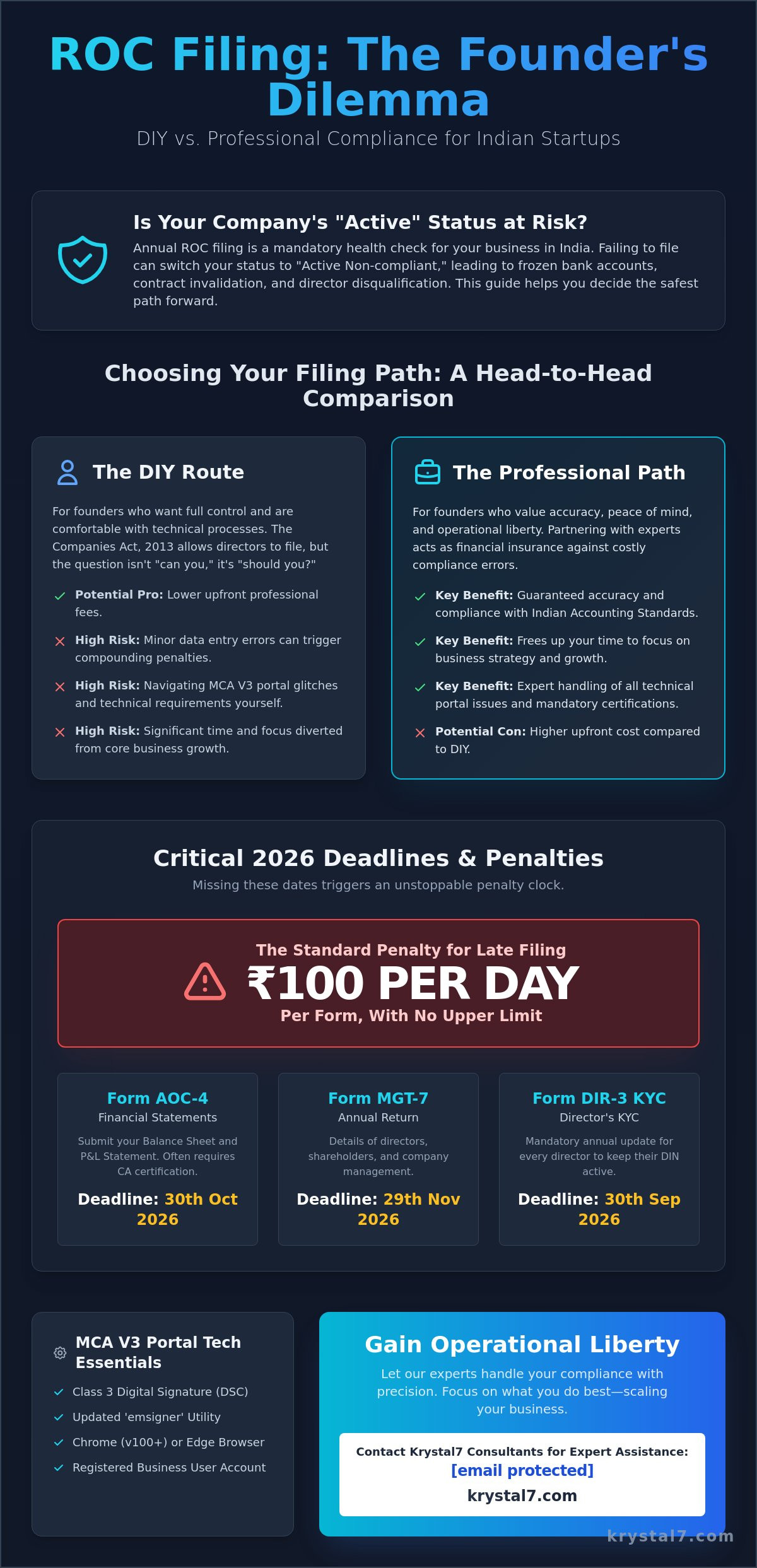
DIY vs. Professional ROC Filing: Analyzing Risks, Costs, and Accuracy
Deciding whether to manage your company’s statutory returns yourself involves more than just looking at a service fee. While you might wonder, can i do my own roc filing to save on immediate costs, the time investment is often underestimated. A founder might spend 15 to 20 hours troubleshooting portal errors and preparing documents. In contrast, a professional team handles this in a fraction of the time, allowing you to focus on your primary business goals.
The real danger lies in the “Cost of Error.” Under the Companies Act, 2013, any mismatch in data can lead to your filing being marked as “Defective” or “Invalid.” This doesn’t just mean a simple fix. It often results in re-filing fees and the accumulation of the standard ₹100 per day penalty while you resolve the discrepancy. Using a comprehensive annual compliance for private limited company checklist can mitigate some risks, but it cannot replace professional certification.
Professional certification acts as a shield against regulatory scrutiny. When a Chartered Accountant or Company Secretary signs your forms, they verify the accuracy of your financial disclosures. This validation builds a foundation of reliability with the Ministry of Corporate Affairs and potential investors. It transforms a bureaucratic requirement into a symbol of your company’s commitment to transparency.
Common Mistakes in DIY Filing
- Inaccurate calculation of paid-up capital or annual turnover, which incorrectly determines your filing fee bracket.
- Failure to attach mandatory documents such as the Board Report, Auditor’s Report, or the Notice of the Annual General Meeting (AGM).
- Mathematical mismatches between the audited financial statements and the data entered into the web-based AOC-4 form.
The Value of Professional Advice
Professional oversight offers more than just data entry. Experts identify potential compliance red flags, such as undisclosed related party transactions or loans to directors, before they ever reach the ROC. This proactive approach ensures your records maintain visual precision and legal integrity. It prevents minor administrative oversights from turning into expensive legal obstacles.
Delegating these tasks grants you operational liberty. You gain a partner with deep institutional knowledge of the MCA V3 portal while you pursue your visionary growth. Strategic advisory during the filing process also helps you plan for future capital expansion or restructuring without hitting regulatory roadblocks. This partnership fosters a feeling of security and optimism for your business journey.
Important Deadlines and Penalties for ROC Non-Compliance in 2026
Missing a statutory deadline turns a simple administrative task into a significant financial burden. If you decide that can i do my own roc filing is the right path for your startup, you must monitor the calendar with absolute precision. The Registrar of Companies (ROC) enforces strict timelines that begin immediately after your Annual General Meeting (AGM).
The consequences of neglect extend far beyond mere fines. Under Section 164 of the Companies Act, 2013, directors face disqualification for five years if the company fails to file annual returns for three consecutive years. This legal action halts your visionary journey and prevents you from holding board positions in any other Indian entity. It’s a risk that can permanently tarnish your professional standing.
Persistent non-compliance can lead the ROC to initiate a “Strike Off” process. This administrative move effectively shuts down your business operations and freezes your corporate bank accounts. Every private limited company in India needs a spotless compliance record to maintain its operational liberty and attract future investment.
Key Dates for Your Compliance Calendar
- Form AOC-4 (Financial Statements): Due within 30 days of your AGM. For a typical AGM held on September 30, 2026, the deadline is October 30, 2026.
- Form MGT-7 (Annual Return): Due within 60 days of the AGM. Following the same timeline, your deadline is November 29, 2026.
- Form DIR-3 KYC: Every director must complete this by September 30, 2026. Missing this date results in an immediate ₹5,000 late fee to reactivate your DIN.
The Financial Impact of Neglect
The standard penalty for late filing is ₹100 per day, per form. This daily accumulation applies separately to AOC-4 and MGT-7. A single month of delay costs your company ₹6,000 in additional fees. Over two or three years, these accumulated penalties can easily cross ₹3 to ₹5 lakhs per company, draining your essential capital.
There’s a temporary window of relief available right now. The Companies Compliance Facilitation Scheme (CCFS-2026) is active from April 15, 2026, to July 15, 2026. This scheme allows defaulting companies to file pending returns with a 90% waiver on late fees. You only pay the normal filing fee plus 10% of the penalty. It’s a rare chance to restore your company’s “Active” status with visual precision and financial efficiency.
Secure your company’s future and avoid these compounding costs by choosing an Annual Compliance Package today.
Why Founders Partner with Krystal7 for Annual Compliance
Choosing the right compliance partner is a strategic decision that affects your company’s long-term health. While you might initially ask, can i do my own roc filing to manage costs, the technical friction of the MCA V3 system often turns a simple task into a major distraction. We provide a bridge between complex regulatory requirements and your need for operational liberty.
Our “Transparency Motif” is at the heart of every partnership. We believe in total financial openness, which is why our service models feature clear pricing with no hidden filing charges. This visual clarity allows you to budget with certainty while we handle the meticulous details of your statutory obligations.
We offer end-to-end management that begins with precise bookkeeping and concludes with the final ROC acknowledgment. Our experts navigate the technical glitches of the V3 portal, ensuring your Digital Signature Certificates and web-based forms are processed without error. This methodical approach transforms a bureaucratic burden into a foundation of security for your business.
The Krystal7 Advantage for Startups
We act as a dependable extension of your team, handling the administrative weight so you can focus on scaling your vision. Our meticulous experts ensure 100% accuracy in every submission, from Form AOC-4 to MGT-7. We eliminate the anxiety of “Defective” filings by validating every data point against the standards of the Companies Act, 2013.
Proactive alerts are a standard feature of our Annual Compliance Package. We track your specific AGM dates and filing windows to ensure you never face the compounding ₹100 per day penalties. This constant vigilance protects your company’s “Active” status and keeps your director records spotless for future growth or funding rounds.
Get Started with Stress-Free Compliance
Transitioning from DIY uncertainty to professional security is a seamless experience. We provide a clear roadmap for your annual filings, offering visual precision in our reporting so you always know your compliance standing. Our goal is to liberate you from the complexities of the MCA portal, granting you the freedom to pursue your primary business goals.
We treat every founder as a visionary partner in a long-term journey. By humanizing our elite expertise, we offer a supportive environment where your questions are answered with calm competence. Let us handle the regulatory hurdles while you lead your company toward its next milestone.
Ensure your company remains compliant and secure by partnering with our expert team. Contact Krystal7 Consultants today at business@krystal7.com or visit krystal7.com to schedule your consultation.
Securing Your Company’s Future in 2026
The choice regarding can i do my own roc filing ultimately balances short-term savings against long-term operational liberty. You’ve seen how the MCA V3 portal’s technical requirements and the strict ₹100 per day penalties make precision non-negotiable. Protecting your company’s “Active” status is the most effective way to ensure your vision remains unhindered by administrative obstacles.
Krystal7 Consultants provides the calm competence you need to navigate these regulatory waters. Our Gurugram-based CA expertise and deep knowledge of the MCA V3 portal ensure every filing is methodical and accurate. We believe in financial openness, offering transparent, upfront pricing models that allow you to plan your growth with total confidence.
Delegate your compliance to the experts at Krystal7 and focus on your business growth. You can also contact us at business@krystal7.com to begin your journey toward stress-free compliance. Your business deserves the security that comes from professional partnership.
Frequently Asked Questions
Can I file my own ROC returns if my company is small?
Yes, directors of small companies can technically file certain forms like MGT-7A themselves if they possess a valid Class 3 Digital Signature Certificate. Small companies benefit from simpler reporting requirements and fewer certification hurdles compared to larger entities. While you might wonder, can i do my own roc filing to save on overheads, keep in mind that your financial statements still require a Chartered Accountant’s audit and signature to be legally compliant.
What are the mandatory forms for annual ROC filing in 2026?
The mandatory forms for your 2026 compliance include Form AOC-4 for financial statements and Form MGT-7 or MGT-7A for the annual return. Additionally, every director must complete Form DIR-3 KYC by the September 30th deadline to keep their DIN active. These forms provide the Ministry of Corporate Affairs with a transparent view of your company’s financial health and management structure for the previous financial year.
How much is the penalty for late ROC filing in India?
The standard penalty for late filing in India is a flat INR 100 per day, per form, with no maximum limit. If you miss the deadlines for both your financial statements and annual return, you’ll accumulate INR 200 in penalties every single day. For startups, these costs can quickly escalate into lakhs of rupees, making it essential to file on time to protect your company’s capital and reputation.
Do I need a Chartered Accountant for AOC-4 and MGT-7?
You generally require a Chartered Accountant to certify Form AOC-4 and conduct the mandatory statutory audit of your company’s books. Although the question of can i do my own roc filing often comes up for the data entry phase, the law requires a professional to verify the accuracy of your financial disclosures. This certification builds trust with stakeholders and ensures your filings meet the rigorous standards of the Companies Act, 2013.
What is the MCA V3 portal and how do I register as a business user?
The MCA V3 portal is a web-based platform that currently handles 38 specific corporate forms, including all annual filing documents. To register as a “Business User,” you must create an account on the official MCA website and link your Digital Signature Certificate to your profile. This registration level is mandatory for directors who wish to perform statutory filings or update their KYC details directly on the portal without an intermediary.
Can a director be disqualified for not filing ROC returns?
Yes, a director faces disqualification under Section 164 of the Companies Act if the company fails to file its annual returns for three consecutive years. Once you’re disqualified, you cannot be appointed or re-appointed as a director in any Indian company for a period of five years. This severe action effectively halts your visionary journey and serves as a critical reminder of the importance of maintaining an active compliance record.
What documents are required for annual ROC compliance?
You must prepare several key documents, including the audited Balance Sheet, Profit and Loss account, Board’s Report, and the Auditor’s Report. You also need to attach the Notice of the Annual General Meeting and a list of shareholders as of the end of the financial year. These documents must be converted into specific formats and signed digitally by the directors before they’re uploaded to the MCA V3 portal for government review.
How do I check my company’s filing status on the MCA website?
You can check your filing status by visiting the MCA portal and using the “View Company Master Data” service under the MCA Services tab. By entering your Corporate Identification Number (CIN), you’ll see your company’s current status and the date of your last filed annual return. For a more comprehensive look at past filings, you can use the “View Public Documents” feature, which requires a nominal payment of INR 100.

Article by
Nihal Srivastava
Nihal Srivastava is the Co-Founder of Krystal7 Consultants, helping Indian entrepreneurs and startups navigate company registration, compliance, trademark protection, and regulatory requirements with clarity and confidence. With 6+ years of hands-on expertise in MCA filings, GST compliance, and corporate structuring, Nihal has guided 1000+ businesses across India through their legal and compliance journeys. He believes every business dream deserves crystal clear foundations, and that no founder should be held back by paperwork or red tape.