
Is Trademark Registration Mandatory? The Essential Guide for Founders in 2026
On January 14, 2024, a founder in Los Angeles received a cease and desist notice that threatened to erase three years of brand building overnight. They had a thriving community and a distinct logo, but they lacked the legal shield of a registered mark. You likely feel that legal paperwork is a secondary concern when managing a tight budget. It is natural to ask, is trademark registration mandatory for a startup still finding its feet? Many entrepreneurs believe common law rights are enough; however, relying on them often leads to expensive courtroom battles and rebranding costs that exceed $10,000.
At Krystal7 Consultants, we believe your vision deserves absolute security. This guide provides crystal-clear answers on the legal necessity of trademarking and the real risks of remaining unregistered in the U.S. market. You’ll learn the difference between the TM and R symbols, the exact costs involved, and how to protect your assets without the stress. We outline a streamlined path to brand protection that gives you the freedom to focus on your legacy. By the end of this article, you’ll have a methodical plan to secure your intellectual property for 2026 and beyond.
Key Takeaways
- Understand why is trademark registration mandatory for long-term brand security, even if Indian law allows you to conduct business without it.
- Discover the critical protection gap between local and nationwide rights and why the “burden of proof” is much heavier for unregistered brands.
- Learn how to shield your venture from “trademark squatting” and avoid the high costs of a forced rebrand by securing your name early.
- Master the strategic timeline for brand protection, from conducting “stealth” searches to filing for a priority date before your official launch.
- Gain crystal clarity on how expert-led advisory removes the guesswork from IP law, giving you the freedom to focus on building your business legacy.
Is Trademark Registration Mandatory? The Short and Long Answer
The short answer is no. You won’t face legal penalties or be barred from operating a business simply because you haven’t registered your brand name. In India, the Trade Marks Act, 1999, provides a framework where rights can be established through “Use in Commerce.” This means that the moment you sell a product or offer a service under a specific name, you begin to build a legal claim to that identity. However, there’s a massive gap between using a name and owning a trademark legally. Without a registration certificate, you’re essentially building a brand on rented land.
One of the most frequent questions entrepreneurs ask our team is: is trademark registration mandatory to start a venture? While it’s not a legal prerequisite for business setup, the law treats registered and unregistered marks very differently. An unregistered mark relies on the principle of “prior use.” If you can prove you used the name first, you have some protection. But proving this in court often requires years of invoices, marketing spends, and witness testimonies. While the law doesn’t say is trademark registration mandatory for every startup, the lack of a formal certificate leaves your most valuable asset vulnerable to copycats and squatters.
Legal frameworks across the globe, including U.S. trademark law, recognize these common law rights, but they always prioritize the clarity that comes with formal registration. In the Indian context, the 1999 Act allows you to sue for “passing off” if someone steals your unregistered brand. This is a grueling, expensive legal battle. Registered owners, conversely, can sue for “infringement,” which is a much faster and more powerful legal remedy. Registration transforms your brand from a mere name into a piece of intellectual property that you can license, sell, or use as collateral for loans.
Common Law Rights vs. Statutory Rights
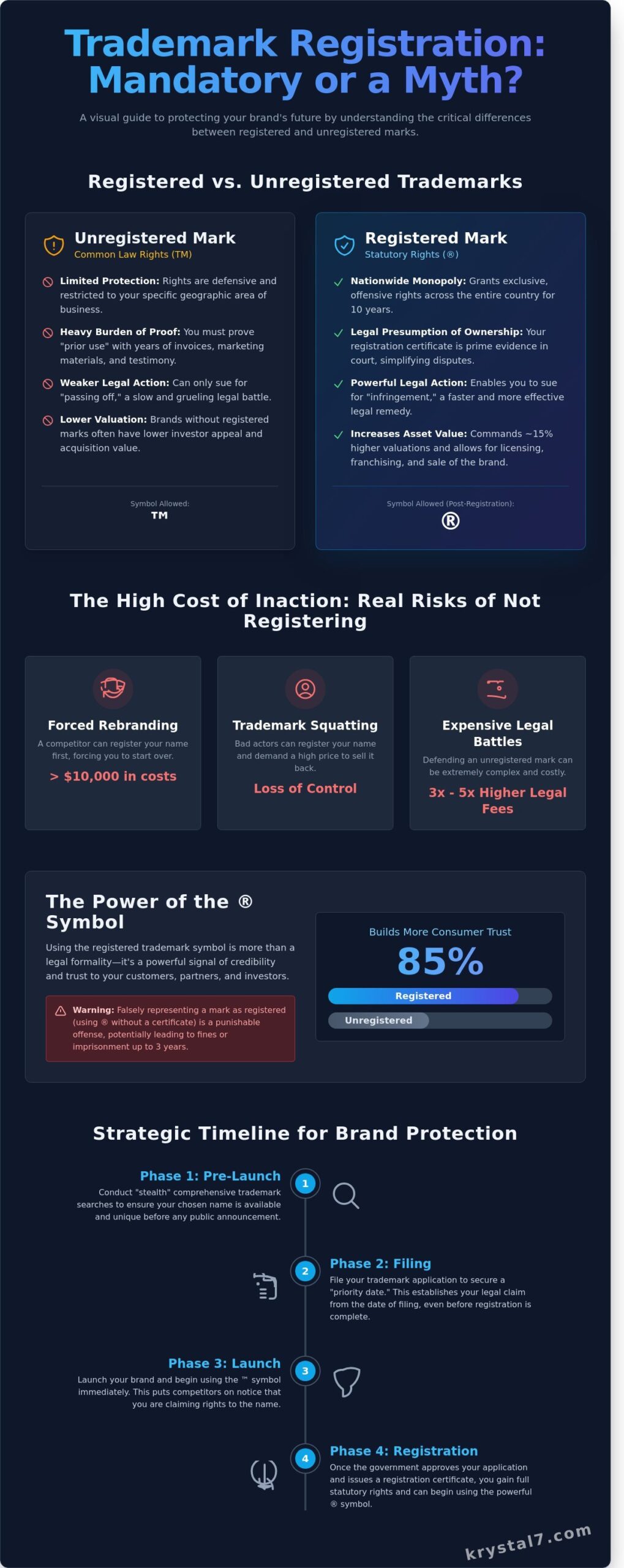
Common Law rights are defensive. They protect you only if you can prove you were the first to use a mark in a specific geographic area. This is often called a “Prior Use” right. Statutory Rights, granted through registration, are offensive. They give you an exclusive, nationwide monopoly over the mark for 10 years. Relying on Common Law is risky because it doesn’t prevent others from applying for the same name. You might find yourself in a position where you’ve used a name for 5 years, but a competitor registers it tomorrow, forcing you into a costly legal defense to keep your own identity.
The TM vs. R Symbol: What Can You Use?
The symbols you use next to your logo signal your brand’s maturity to the market. You can use the TM symbol the moment you start using a mark or as soon as you file an application. It tells competitors you’re claiming the name as your own. However, the ® symbol is reserved exclusively for marks that have received a registration certificate. Under Section 107 of the Trade Marks Act, 1999, falsely representing a mark as registered is a punishable offense. This can lead to imprisonment for up to 3 years or a significant fine. Using the ® symbol correctly builds 85% more trust with consumers, as it proves your brand has passed the government’s rigorous compliance checks.
Registered vs. Unregistered Trademarks: A Comparison
While the technical answer to the question, is trademark registration mandatory, remains no, the practical reality for business growth is quite different. An unregistered mark relies entirely on common law rights. These rights only exist where you actually conduct business. If you operate a boutique in South Delhi, your protection stops at the edge of that district. You can’t stop someone in Mumbai from using the same name unless you can prove your reputation has reached that city through significant effort and expense.
In a legal dispute, a registered owner simply presents their certificate. The law presumes they own the mark. An unregistered owner faces a mountain of paperwork. They must provide invoices, tax returns, and marketing spend records from the last 5 or 10 years to prove their “goodwill.” This evidentiary process often costs 3 to 5 times more in legal fees than a standard infringement suit. Founders often wonder, is trademark registration mandatory when they are just starting out, but they quickly realize that the cost of proving ownership later far exceeds the initial registration fee.
Investors look for clean, protected intellectual property. A 2023 survey of startup acquisitions showed that brands with registered trademarks commanded a 15% higher valuation on average compared to those without. You can’t easily license or franchise a brand you don’t officially own. Selling an unregistered brand is like selling a house without a title deed. Buyers are hesitant because they can’t verify the boundaries of what they’re buying. In 2022, nearly 40% of small business M&A deals faced delays due to unclear IP ownership. Registration turns your brand into a liquid asset that you can sell, lease, or use as collateral for bank loans.
Infringement vs. Passing Off
Registered owners file for “infringement,” which is a straightforward violation of a statutory right. You don’t need to prove the other party caused you damage; the unauthorized use of your mark is enough. Unregistered owners must rely on “Passing Off,” a tort that requires proving three things: your reputation, the defendant’s misrepresentation, and actual damage to your business. Passing Off is the legal remedy for unregistered marks in India. These cases often drag on for years in court, costing small businesses upwards of ₹2,00,000 in initial litigation expenses alone. Proving “goodwill” is a subjective and grueling process that offers no guarantees of success.
Geographic Limitations
Unregistered marks are tethered to the ground. If you operate in Bangalore but haven’t registered, a competitor in Kolkata could potentially use your name without issue. Registration changes the game by providing a blanket of protection across all of India. The Controller General of Patents Designs and Trademarks maintains these nationwide records, ensuring no one else can claim your brand identity in any state. For those looking at international expansion, understanding the official trademark process helps clarify how these protections scale globally. The Controller General’s database acts as a public warning. When a new business searches for a name, your registered mark appears immediately. This prevents conflict before it starts. In contrast, an unregistered owner often discovers a competitor only after that rival has already spent thousands on signage and marketing, leading to a messy battle for brand rights.
Securing your brand early provides the krystal-clear transparency you need to scale without fear. By moving from an unregistered “common law” mark to a registered asset, you gain the freedom to focus on your vision rather than legal defense.
The Real Risks of Skipping Brand Registration
Operating a business without a registered mark leaves your most valuable asset exposed to predators. While entrepreneurs often ask if trademark registration is mandatory to launch a product, the legal reality suggests it’s a necessity for long-term survival. Without a certificate from the trademark office, you lack “Prima Facie” evidence of ownership. This means that in any legal dispute, the burden of proof rests entirely on your shoulders. You must provide years of invoices, marketing spends, and customer testimonials just to prove you own your own name.
Trademark squatters represent a predatory threat to growing companies. These bad actors monitor emerging brands and register their names in “First-to-File” jurisdictions before the original creator does. In 2012, Apple famously paid $60 million to settle a dispute with Proview Technology over the “iPad” trademark in China. If a global giant faces these hurdles, a small business can be erased overnight. Relying on common law rights is a gamble that rarely pays off when a competitor decides to claim your digital territory.
Protection is about more than just a name; it’s about your right to exist in the marketplace. According to the legal definition of a trademark, the primary purpose is to identify the source of goods and prevent consumer confusion. Without registration, you lose the ability to use the Amazon Brand Registry or similar protective tools on e-commerce platforms. This leaves the door wide open for counterfeiters to siphon your sales. You won’t have the legal leverage to issue take-down notices effectively, allowing bad-faith actors to profit from your reputation.
The Rebranding Nightmare
Forced rebranding is a financial catastrophe that destroys years of hard work. When a “First-to-File” competitor claims your name, you’re often given a 30-day window to cease all operations under that identity. A mid-sized firm can expect rebranding costs to exceed $150,000 when accounting for new signage, packaging, and legal fees. The damage isn’t just financial; it’s digital. A sudden name change typically results in a 30% to 50% drop in organic search traffic within the first 90 days. You lose the SEO authority you spent years building, effectively handing your market share to competitors on a silver platter.
Investor and Funding Obstacles
Capital follows clarity. Venture capital firms and banks view unregistered intellectual property as a high-risk liability that can tank a deal during due diligence. Statistics show that 75% of Series A investors require a clean intellectual property audit before releasing funds. They want to see that the brand they are investing in is legally bulletproof. An unregistered trademark is a red flag that suggests a lack of professional oversight. Registered IP increases the “Book Value” of your company, transforming a creative idea into a tangible corporate asset. Many government tenders and international trade agreements also list trademark registration as a non-negotiable requirement for participation. Krystal7 provides the elite expertise needed to secure these assets, giving you the freedom to focus on your vision while we handle the statutory red tape.
Strategic Timeline: When Should You Prioritize Registration?
Timing determines your brand’s survival. While you might wonder is trademark registration mandatory from a purely legal standpoint, the strategic answer depends on your growth stage. Waiting too long creates legal gaps that competitors can exploit. Success follows a four phase lifecycle designed to give you crystal clarity and total control over your intellectual property.
Phase 1 is the stealth stage. This happens before you buy a domain or print business cards. You must scan the IP India public search database to ensure your vision is unique. This prevents you from investing in a mark that will be rejected for being too similar to an existing one. Phase 2 is the launch. Filing your application immediately creates a “Priority Date.” This date acts as a legal shield against anyone who tries to register a similar name after you. Even if your registration takes 12 months to complete, your protection starts from the day you file.
Phase 3 involves scaling your operations. Trademark protection in India lasts for 10 years. During this decade, you must monitor the Trademark Journal. This weekly publication lists new applications. If someone tries to copy you, you have a 4 month window to file an opposition. Phase 4 is global expansion. If you plan to sell products in the US, Europe, or Australia, you should use the Madrid Protocol. This system allows you to protect your brand in up to 131 countries through a single application, provided you have a basic registration in India first.
The Pre-Incorporation Search
Searching the public database is the non-negotiable first step of company registration. You can’t just pick a name because it sounds professional. You need to ensure it doesn’t violate Section 11 of the Trade Marks Act. Avoiding names that are “Deceptively Similar” prevents immediate objections from the registry. This step saves you the 15,000 to 50,000 INR cost of rebranding and legal fees later. It’s about building on a foundation that’s legally sound. For more guidance, see our article on Choosing a Company Name: Rules for Name Registration.
Filing During the Incorporation Process
Bundling your trademark filing with an “All-in-one Company Incorporation Package” is the most efficient path for founders. Krystal7 streamlines this process to prevent MCA name rejections. Data shows that roughly 18% of new filings face delays due to naming conflicts that a simple search could have avoided. If you’ve been using your brand name before formalizing the business, we help you draft a “User Affidavit” under Rule 25. This document provides clear evidence of your prior use. It’s a powerful tool that strengthens your claim if a competitor tries to challenge your rights.
Don’t leave your brand’s future to chance. Our legal strategists handle the complexity so you can enjoy the freedom to focus on your vision. We provide the elite expertise needed to secure your identity from day one. Our team ensures every document is filed with precision, giving your business the protection it deserves.
Ready to secure your brand? Get started with Krystal7’s expert registration services today.
Achieving Brand Clarity with Krystal7 Consultants
While the technical answer to whether is trademark registration mandatory remains “no” under common law, the 2023 surge in digital brand infringement makes registration a practical necessity for survival. Krystal7 removes the guesswork from this complex legal landscape. We provide a streamlined path to protection that transforms a bureaucratic hurdle into a competitive advantage. Our team understands that your brand is more than a logo; it’s the culmination of your hard work and vision.
We’ve perfected a 3-step process to ensure your intellectual property remains secure:
- Exhaustive Search: We perform deep-dive analytics across all 45 classes of the NICE classification. This prevents you from investing in a name that’s already claimed, saving you from potential 2024 litigation risks.
- Precision Application: Our experts draft filings that minimize the 35% average objection rate seen in DIY submissions. We get the details right the first time.
- Advisory for Objection Hearings: If the registry raises a query or a third party files an opposition, our legal strategists represent your interests directly. We handle the complex legal arguments so you don’t have to.
Transparency is our foundation. You won’t find hidden administrative fees or surprise consultation charges here. We provide flat-rate clarity from day one. This financial predictability allows you to allocate your budget toward growth rather than legal “surprises.” We handle the registry. You build the legacy. This is our Freedom to Focus promise to every visionary we serve.
Beyond Filing: Strategic IP Advisory
A simple filing doesn’t secure a legacy. You need a robust ‘Statement of Use’ to prove your mark is active in commerce. Our legal strategists handle registry objections by building a factual evidence trail that stands up to scrutiny. We also look ahead. We ensure your trademark classes cover your 5-year growth plan. For example, if you’re selling software today but plan to offer hardware by 2026, we’ll structure your application to protect that future expansion. This proactive approach prevents the need for costly re-filings later. We don’t just look at where your business is today; we look at where it’s going.
Your Partner in Compliance
Trademarking isn’t a siloed task. It’s a vital pillar of your broader ‘Annual Compliance’ strategy. We integrate your IP protection with your statutory filings and corporate governance. This holistic view ensures that your brand protection evolves as your company structure changes. The Krystal7 promise combines elite expertise with a human touch. We’re always just a call away, acting as a genuine partner in your journey. You’ll work with advisors who know your business inside out, providing the calm competence you need to thrive in a crowded market. It’s time to move past the uncertainty of whether is trademark registration mandatory and start building a protected, scalable asset.
Secure your brand name with a Krystal-Clear Trademark Strategy
Secure Your Brand Clarity for 2026 and Beyond
Your brand is your most valuable asset. While the technical answer to is trademark registration mandatory is no, skipping this step leaves your business vulnerable to 100% avoidable legal disputes. By 2026, the digital marketplace will be even more crowded, making early registration a critical move for every visionary founder. Relying on unregistered common law rights is a gamble that rarely pays off when facing national competitors. It’s about moving from a state of uncertainty to a position of absolute legal strength.
Krystal7 provides the crystal-clear transparency you need to scale without fear. Our team of top-tier Chartered Accountants and Legal Strategists handles the entire process so you have the freedom to focus on growth. We operate with a strict zero hidden costs policy, ensuring you know your investment from day one. You’ll also work with a dedicated relationship manager for every client to ensure your specific goals are met. Don’t leave your legacy to chance when elite expertise is just a click away.
Protect your vision today with Krystal7’s Trademark Services
Build your business on a foundation of clarity and watch your vision thrive.
Frequently Asked Questions
Is it mandatory to register a trademark for a private limited company?
Registration isn’t a legal requirement for a private limited company under the Companies Act 2013. While many founders ask is trademark registration mandatory, the law allows you to operate without it. However, you won’t have statutory ownership. This leaves your brand vulnerable to competitors. Obtaining a trademark provides the krystal-clear clarity needed to defend your identity in court. It ensures your business dream remains secure as you scale.
What happens if I don’t register my trademark in India?
You lose statutory protection under the Trade Marks Act 1999 if you don’t register. You’ll have to rely on passing off legal actions, which require heavy evidence of reputation. Proving your case in court often costs 3 times more than a standard registration fee. Without registration, you can’t use the ® symbol next to your logo. This creates uncertainty for your brand’s future and limits your legal leverage.
Can someone else register my business name if I haven’t trademarked it?
Yes, another entity can apply for your business name because India follows a first-to-file system. While you might claim prior user status, defending this in a 2 year legal battle is exhausting. A competitor could potentially stop you from using your own name. Securing your registration early gives you the freedom to focus on growth without legal threats. It prevents others from hijacking your hard-earned reputation and market position.
How long does a trademark registration last in India?
A trademark registration lasts for 10 years from the date of application. You must file a renewal every 10 years to keep the protection active. The Registrar of Trademarks allows renewal applications 6 months before the expiry date. If you miss this window, you have a 6 month grace period with additional fees. This system ensures your brand legacy remains protected for decades through simple, methodical compliance steps.
Can I sell or license an unregistered trademark?
You can sell or license an unregistered mark through a common law assignment, but it’s legally complex. Buyers usually pay 40 percent less for unregistered brands due to the lack of guaranteed ownership. A registered trademark acts as an intangible asset on your balance sheet. It provides the transparency needed for investors to value your company properly. Registration makes the transfer of rights straightforward, secure, and legally binding for all parties.
Is a trademark search mandatory before filing an application?
A trademark search isn’t legally mandatory, but skipping it leads to a 70 percent higher chance of office actions or oppositions. We recommend a comprehensive search through the IP India online database. This step identifies 45 different classes of goods and services that might conflict with your name. It brings clarity to your filing strategy. A thorough search saves you from wasting non-refundable government filing fees on a rejected application.
What is the difference between brand registration and trademark registration?
Brand registration is an informal term used in marketing, while trademark registration is the formal legal process under the Trade Marks Act. People often ask is trademark registration mandatory for their brand, and the answer lies in legal security. A trademark protects specific logos, sounds, or names. Brand registration usually refers to setting up social media profiles or internal identity. Only a registered trademark gives you the power to sue for infringement.
Does company registration automatically protect my brand name?
No, registering your company with the Ministry of Corporate Affairs (MCA) only protects the corporate name. It doesn’t stop another business from using your name as a brand for their products. For example, a company registered as XYZ Private Limited can still be sued if their brand name Alpha infringes on an existing trademark. You need separate trademark registration to ensure krystal-clear protection across all commercial channels and product lines.

Article by
Nihal Srivastava
Nihal Srivastava is the Co-Founder of Krystal7 Consultants, helping Indian entrepreneurs and startups navigate company registration, compliance, trademark protection, and regulatory requirements with clarity and confidence. With 6+ years of hands-on expertise in MCA filings, GST compliance, and corporate structuring, Nihal has guided 1000+ businesses across India through their legal and compliance journeys. He believes every business dream deserves crystal clear foundations, and that no founder should be held back by paperwork or red tape.