

GST Filing for Service Providers in 2026: The Complete Compliance Guide
For modern service providers, the path to business growth is often clouded by the evolving complexities of tax compliance. Between the persistent fear of GST-Income Tax data mismatch notices and the technical confusion surrounding Place of Supply rules for digital services, it is easy to feel overwhelmed by administrative red tape. Navigating gst filing for service providers in 2026 requires more than just guesswork; it demands a methodical, expert-backed approach to ensure every transaction is recorded with krystal-clear transparency and precision.
This comprehensive guide is designed to replace compliance anxiety with calm competence, empowering you to master the intricate landscape of 2026 regulations. You will learn how to achieve 100% error-free filing and secure the maximum Input Tax Credit (ITC) possible, ensuring you never lose revenue to unclaimed or blocked credits again. By streamlining your statutory obligations and addressing the nuances of service-based taxation, you reclaim your most valuable asset: the freedom to focus on your clients and your vision. Let us help you turn complex paperwork into a streamlined strategy for your thriving venture.
Key Takeaways
- Gain crystal clarity on the updated 2026 threshold limits to determine exactly when your business must register for statutory compliance.
- Master the transition to real-time reporting by understanding the critical relationship between GSTR-1, GSTR-3B, and the automated GSTR-2B.
- Maximize your bottom line by identifying eligible business expenses that allow you to claim every rupee of Input Tax Credit you deserve.
- Protect your venture from costly tax notices by learning to avoid the five most frequent mistakes in gst filing for service providers.
- Discover how streamlining your compliance with expert advisory provides the freedom to focus on your vision while we handle the complex red tape.
Understanding GST Compliance for Service Providers in India
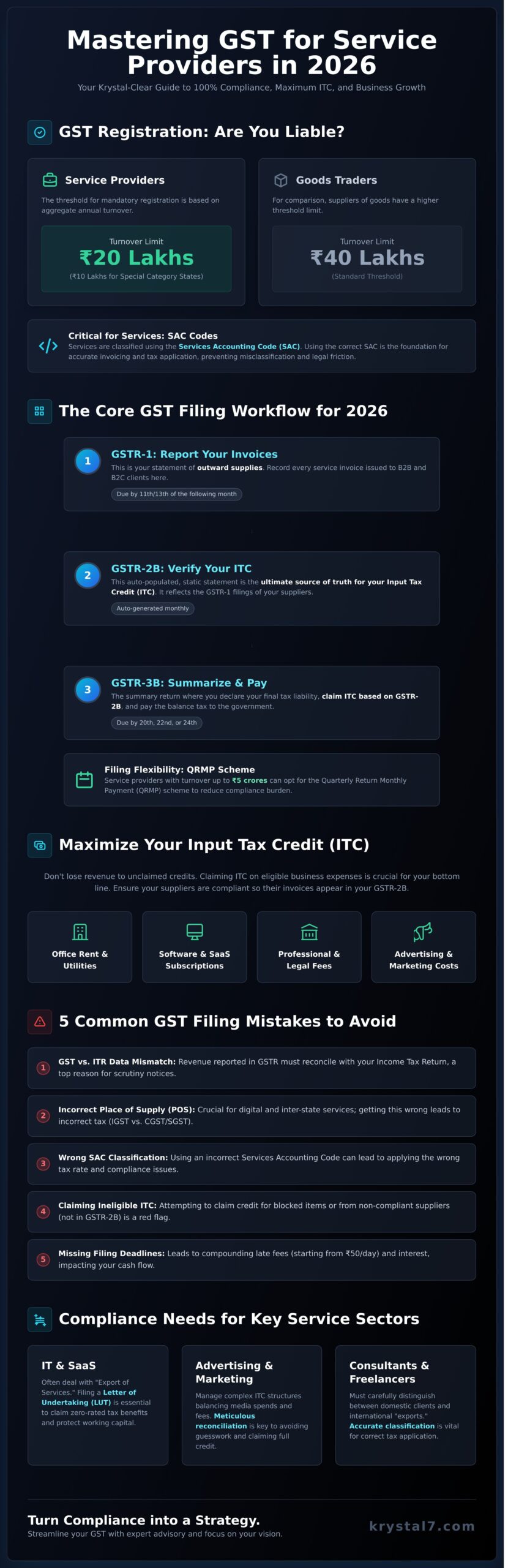
In the evolving landscape of the Indian economy, a service provider is defined under the GST Act 2017 as any individual or entity providing services-essentially anything other than goods, money, and securities-for a consideration. Navigating the Goods and Services Tax (GST) in India requires a shift in perspective from traditional goods trading. While goods traders often benefit from a 40 Lakh threshold, the 2026 compliance standards maintain a 20 Lakh aggregate turnover limit for service providers (10 Lakhs for Special Category States). This distinction ensures that the vast service sector remains a transparent pillar of national revenue.
Service providers face unique challenges, primarily because their “product” is intangible. Unlike physical stock, services rely on the Services Accounting Code (SAC) for classification. Using the correct SAC is not just a formality; it is the foundation of krystal-clear invoicing and accurate tax application. Without this clarity, businesses risk misclassification, leading to unnecessary legal friction and financial “red tape.”
Mandatory vs. Voluntary GST Registration
Registration becomes mandatory the moment your turnover crosses the threshold, or if you provide inter-state services. However, streamlining gst filing for service providers often starts with voluntary registration. For B2B visionaries, having a GSTIN is a badge of trust. It allows your clients to claim Input Tax Credit (ITC), making your services more cost-effective for them. In 2026, even if you operate below the threshold, voluntary registration provides the “Freedom to Focus” on scaling without the sudden hurdle of mandatory compliance once you hit the limit.
Service Sectors with Special Compliance Needs
Different sectors require tailored legal strategies to ensure seamless growth:
- IT and SaaS: These entities often deal with the “Export of Services.” To enjoy zero-rated tax benefits, filing a Letter of Undertaking (LUT) is essential to avoid blocking working capital.
- Advertising and Marketing: These firms manage complex ITC structures, often balancing heavy media spends against service fees. Meticulous reconciliation is the only way to avoid “guesswork” in your returns.
- Consultants and Freelancers: Whether you are a legal strategist or a creative consultant, managing the distinction between domestic clients and international “exports” is vital for accurate gst filing for service providers.
By bringing crystal clarity to these compliance requirements, service providers can transition from feeling overwhelmed to feeling empowered, ensuring their business legacy is built on a foundation of statutory excellence.
Key GST Returns and Filing Frequency for 2026
Navigating gst filing for service providers requires a methodical approach to ensure crystal-clear compliance and financial health. In 2026, the GST ecosystem continues to prioritize transparency through a streamlined digital framework. For most service-based businesses, compliance revolves around three core components: GSTR-1, GSTR-3B, and the real-time data reflected in GSTR-2B.
- GSTR-1: This is your statement of outward supplies. It is where you record every service invoice issued to clients.
- GSTR-3B: A monthly or quarterly summary return where you declare your final tax liability, claim Input Tax Credit (ITC), and pay the balance tax.
- GSTR-2B: In 2026, this static statement is the ultimate source of truth for ITC. It ensures you only claim credits that your suppliers have actually reported.
Service providers can choose between monthly filing or the QRMP (Quarterly Return Monthly Payment) scheme if their aggregate turnover is up to ₹5 crores. This flexibility provides the “Freedom to Focus” on your core business while keeping the administrative burden low.
GSTR-1 vs. GSTR-3B: A Service Provider Perspective
In GSTR-1, service providers must distinguish between B2B (business-to-business) and B2C (business-to-consumer) supplies. Accurate reporting is essential, especially considering recent GST rate revisions for services which may impact your tax liability. While GSTR-1 is due by the 11th or 13th of the following month, GSTR-3B must be filed by the 20th (or 22nd/24th for QRMP) to avoid late fees, which typically start at ₹50 per day for delayed submissions.
GST and ITR Data Synchronization
Modern compliance is no longer siloed. The GST portal now shares extensive data with the Income Tax department to ensure total transparency. For gst filing for service providers, this means the turnover reported in your monthly returns must align perfectly with the revenue declared in your annual Income Tax Returns (ITR). Any mismatch in these figures in 2026 will likely trigger automated red flags, leading to unwanted scrutiny and demand notices.
In 2026, failing to reconcile your GST turnover with your Income Tax filings creates an immediate risk of being flagged for high-intensity tax audits.
By maintaining meticulous records and filing GSTR-9 annual returns along with necessary reconciliation statements, you ensure your business vision remains unclouded by legal hurdles.
Maximizing Input Tax Credit (ITC) for Service Businesses
For many entrepreneurs, the true power of efficient gst filing for service providers lies in the strategic management of Input Tax Credit (ITC). ITC is not just a tax benefit; it is a vital financial mechanism that provides you with the freedom to focus on growth by reducing your overall tax liability. By claiming credit for the GST paid on business-related purchases, you ensure that tax does not become a hidden cost that erodes your margins.
To achieve crystal-clear compliance, you must identify every eligible expense. Common claims for service-based businesses include:
- Infrastructure: Office rent, internet bills, and utilities (provided the business GSTIN is on the invoice).
- Technology: Monthly SaaS subscriptions, cloud hosting fees, and hardware like laptops or networking equipment.
- Expertise: Fees paid for consultancy, marketing, or legal advice. Citing the correct GST on Professional Services is essential for capturing these credits accurately.
The “Golden Rule” of ITC is absolute: your claim must match the data reflected in your GSTR-2B. If a vendor fails to upload an invoice, your credit remains inaccessible. Furthermore, you must steer clear of “Blocked Credits” under Section 17(5), which specifically prohibits claims on items like food and beverages, club memberships, and most motor vehicles, unless used for specific business categories.
Reconciliation: The Key to Saving Money
Monthly reconciliation is a non-negotiable practice for agencies aiming for total financial transparency. By meticulously comparing your internal purchase register with the GST portal, you can identify non-compliant vendors who have neglected their filings. Utilizing automated matching tools or a methodical advisory service ensures you never lose money due to a supplier’s oversight, keeping your gst filing for service providers both streamlined and cost-effective.
Reverse Charge Mechanism (RCM) in Services
Certain services, such as legal fees from advocates or services from a Goods Transport Agency (GTA), are subject to RCM. Here, the responsibility to pay tax shifts from the seller to you, the recipient. To maintain a smooth cash flow, you should pay the RCM amount via GSTR-3B and claim the equivalent ITC within the same month. A common mistake is forgetting to issue a self-invoice; ensuring this step is completed will safeguard your business during statutory audits.
5 Common GST Filing Mistakes Service Providers Must Avoid
Navigating gst filing for service providers requires more than just submitting numbers; it demands precision and a methodical approach. Even seasoned entrepreneurs can find themselves overwhelmed by the intricacies of the law. Avoiding these five common pitfalls ensures your business maintains its momentum without the burden of statutory notices.
- Incorrect Place of Supply: Misidentifying the tax jurisdiction (IGST vs. CGST/SGST) is the leading cause of compliance friction in the service sector.
- Mismatched Invoices: Ensuring your GSTR-1 (sales data) and GSTR-3B (summary return) link perfectly is essential to avoid automated system flags.
- Ignoring Zero-Rated Supplies: Mistakes in reporting exports or SEZ transactions can lead to blocked refunds and cash flow bottlenecks.
- Late Filing: The cumulative impact of daily late fees and interest can significantly erode your profit margins over time.
- Failing to File “Nil” Returns: If there is no business activity in a month, you must still file a “Nil” return to keep your GSTIN active and avoid penalties.
The Place of Supply Complexity
Determining the “Place of Supply” is often the most technical hurdle in gst filing for service providers. While the general rule focuses on the recipient’s location, specialized rules apply to services like OIDAR (Online Information and Database Access). For example, a Gurugram-based creative agency serving a client in Bengaluru must charge IGST. Mistakenly charging CGST and SGST creates a compliance gap that requires a refund claim and a fresh payment, causing unnecessary administrative “red tape.”
Navigating AI-Driven Scrutiny in 2026
The GSTN has transitioned into a high-tech ecosystem, using big data analytics to identify outliers and discrepancies instantly. Automated GST notices (ASMT-10) are now frequently issued for even minor mismatches. To maintain your Freedom to Focus on your vision, you must maintain a “Krystal-Clear” audit trail for every transaction. This level of transparency isn’t just a goal-it is a requirement. Partnering with experts like Krystal7 provides the chartered expertise needed to streamline your compliance, ensuring your business remains resilient against AI-driven scrutiny while you build your legacy.
Streamlining Your Compliance with Krystal7 Consultants
Navigating the complexities of gst filing for service providers doesn’t have to be a source of anxiety. At Krystal7 Consultants, we replace regulatory guesswork with crystal-clear certainty. Our approach combines elite, multi-disciplinary expertise with a deeply personal touch, ensuring your business isn’t just another file number, but a vision we are committed to protecting.
Our Annual Compliance Package is specifically engineered to handle the red tape for you. We move beyond simple data entry to provide strategic oversight that safeguards your standing with tax authorities. We operate on two core pillars: transparency and integrity. This means you benefit from upfront pricing with no hidden costs, allowing you to budget with absolute confidence.
- Chartered Expertise: Access to top-tier CAs and legal strategists.
- Personalized Attention: Dedicated relationship managers who know your business inside out.
- Proactive Advisory: We don’t just react to deadlines; we anticipate changes in tax laws to keep you ahead.
Why Outsource Your GST Filing?
For many service providers, hiring a full-time, in-house CA is a significant financial overhead that doesn’t always guarantee multi-sector expertise. By partnering with Krystal7, you gain the collective intelligence of a full legal and financial department at a fraction of the cost. This grants you the “Freedom to Focus” on your core business growth while we manage the meticulous details of gst filing for service providers. We turn compliance from a burden into a streamlined competitive advantage.
Get Started with Krystal-Clear Compliance
Transitioning your current filings to Krystal7 is a seamless, stress-free experience. Our signature onboarding process is designed to move your business from compliance chaos to total clarity in just 7 days. We conduct a thorough audit of your filing history, identify immediate optimization opportunities, and implement a structured calendar that ensures you never miss a deadline again.
Ready to experience the relief of expert-led compliance? Schedule a free consultation with our GST experts at Krystal7 today and build your business on a foundation of clarity.
Secure Your Business Future with Crystal Clarity
Navigating the complexities of gst filing for service providers in 2026 requires more than just basic knowledge; it demands a strategic approach to compliance. By staying ahead of evolving return deadlines, maximizing your Input Tax Credit, and avoiding common reporting errors, you protect your business from unnecessary red tape and financial penalties. Compliance should never be a barrier to your growth; instead, it should be the stable foundation upon which you build your professional legacy.
At Krystal7, we believe in giving you the freedom to focus on your core passion. Our team of top-tier Chartered Accountants and Company Secretaries provides elite expertise with upfront, transparent pricing and absolutely no hidden costs. With a dedicated advisor who understands your specific business journey, we transform complex statutory requirements into a streamlined, hassle-free process that ensures your peace of mind.
Don’t let regulatory guesswork hold your venture back. Get Your Professional GST Filing Handled with Crystal Clarity and experience the confidence that comes with expert-led compliance. Your business dream deserves a partner as committed to your success as you are.
Frequently Asked Questions
Is GST mandatory for all service providers in 2026?
GST registration remains mandatory in 2026 for service providers whose annual aggregate turnover exceeds ₹20 lakhs, or ₹10 lakhs for specific North-Eastern and hill states. Even if you are currently below this limit, voluntary registration offers the freedom to focus on securing high-value corporate clients who require tax-compliant vendors. At Krystal7, we ensure your registration process is handled with crystal clarity, protecting your business from future statutory surprises.
What is the GST rate for professional consultancy services?
Professional consultancy services, including management, technical, and legal advice, are generally taxed at an 18% GST rate under SAC code 9983. Accurate gst filing for service providers requires identifying the specific Services Accounting Code relevant to your niche. Applying the correct rate on your invoices ensures you collect the right tax amount from clients, facilitating a smooth, transparent transition from billing to final tax remittance without any guesswork.
Can freelancers claim Input Tax Credit on laptop and software purchases?
Yes, freelancers can claim Input Tax Credit (ITC) on business-related assets such as laptops, monitors, and professional software subscriptions like Adobe or Microsoft 365. To benefit, you must ensure the vendor issues a tax invoice featuring your GSTIN. This allows you to offset the GST paid on these purchases against the GST collected from your clients. It is a methodical way to lower your operational costs and reinvest savings into your vision.
How do I handle GST for international clients (Export of Services)?
Exporting services to international clients is classified as a “zero-rated supply.” To handle this without paying upfront IGST, you should file a Letter of Undertaking (LUT) on the GST portal at the start of the financial year. Alternatively, you can pay IGST and later claim a refund. This streamlined process ensures that your global consultancy remains competitive while avoiding the “red tape” often associated with cross-border business transactions and international compliance.
What happens if I miss the GST filing deadline for GSTR-3B?
If you miss the GSTR-3B deadline, a late fee of ₹50 per day (or ₹20 for Nil returns) is automatically calculated by the portal. Additionally, any unpaid tax liability attracts interest at 18% per annum. These costs can quickly accumulate, creating unnecessary financial pressure. Our expert gst filing for service providers advisory helps you stay ahead of deadlines, ensuring your compliance is always current and your business journey remains free from penalties.
Do I need a separate GST registration for different office locations?
GST is a destination-based tax tied to state boundaries. If you have offices in multiple states, a separate GST registration is required for each state. For multiple locations within a single state, you can list them as “Additional Places of Business” under one GSTIN. This structured approach provides the flexibility to expand your footprint while maintaining a clear, organized view of your tax obligations across different regions of your growing enterprise.
How does the GST portal link with my Income Tax Return (ITR)?
The GST portal and the Income Tax department engage in automated data exchange to ensure transparency. The revenue reported in your monthly GST returns must align with the gross turnover declared in your annual Income Tax Return (ITR). Any significant discrepancies can trigger automated notices from the tax authorities. Ensuring these figures match provides the peace of mind that your business standing is robust and your financial reporting is beyond reproach.
What is a “Nil” GST return and is it mandatory to file?
A “Nil” GST return is required when you have zero taxable supplies or purchases during a specific filing period. Even if your business had no activity, filing is mandatory to avoid daily late fees and maintain a continuous, healthy filing history. This simple step ensures your GSTIN remains active and compliant. We make this process effortless, giving you the clarity needed to focus on launching your next big venture without administrative hangups.

Article by
Nihal Srivastava
Nihal Srivastava is the Co-Founder of Krystal7 Consultants, helping Indian entrepreneurs and startups navigate company registration, compliance, trademark protection, and regulatory requirements with clarity and confidence. With 6+ years of hands-on expertise in MCA filings, GST compliance, and corporate structuring, Nihal has guided 1000+ businesses across India through their legal and compliance journeys. He believes every business dream deserves crystal clear foundations, and that no founder should be held back by paperwork or red tape.