

Understanding MCA Compliance: A Clear Guide for Indian Companies
As a business owner in India, navigating the landscape of legal requirements can feel overwhelming. Among the most critical of these is MCA compliance. This guide breaks down exactly what MCA compliance entails into simple, actionable steps, helping you understand the key filings your company needs to make to operate smoothly and avoid costly penalties.
What is MCA Compliance and Why Is It Crucial?
The Ministry of Corporate Affairs (MCA) is the central government body that regulates corporate affairs in India. It administers the Companies Act, 2013, and other related legislation. In simple terms, MCA compliance means following the rules and regulations set by the Ministry, which primarily involves filing specific documents and information about your company’s financial health and operational activities on a regular basis. This compliance is not optional; it is a mandatory legal obligation for every company registered in India, from a small private limited company to a large public entity. Adhering to these standards ensures transparency, protects stakeholders, and maintains a healthy corporate ecosystem. Ignoring these duties can lead to severe consequences that can jeopardize your business’s future.
The Real Cost of Non-Compliance: Penalties and Risks
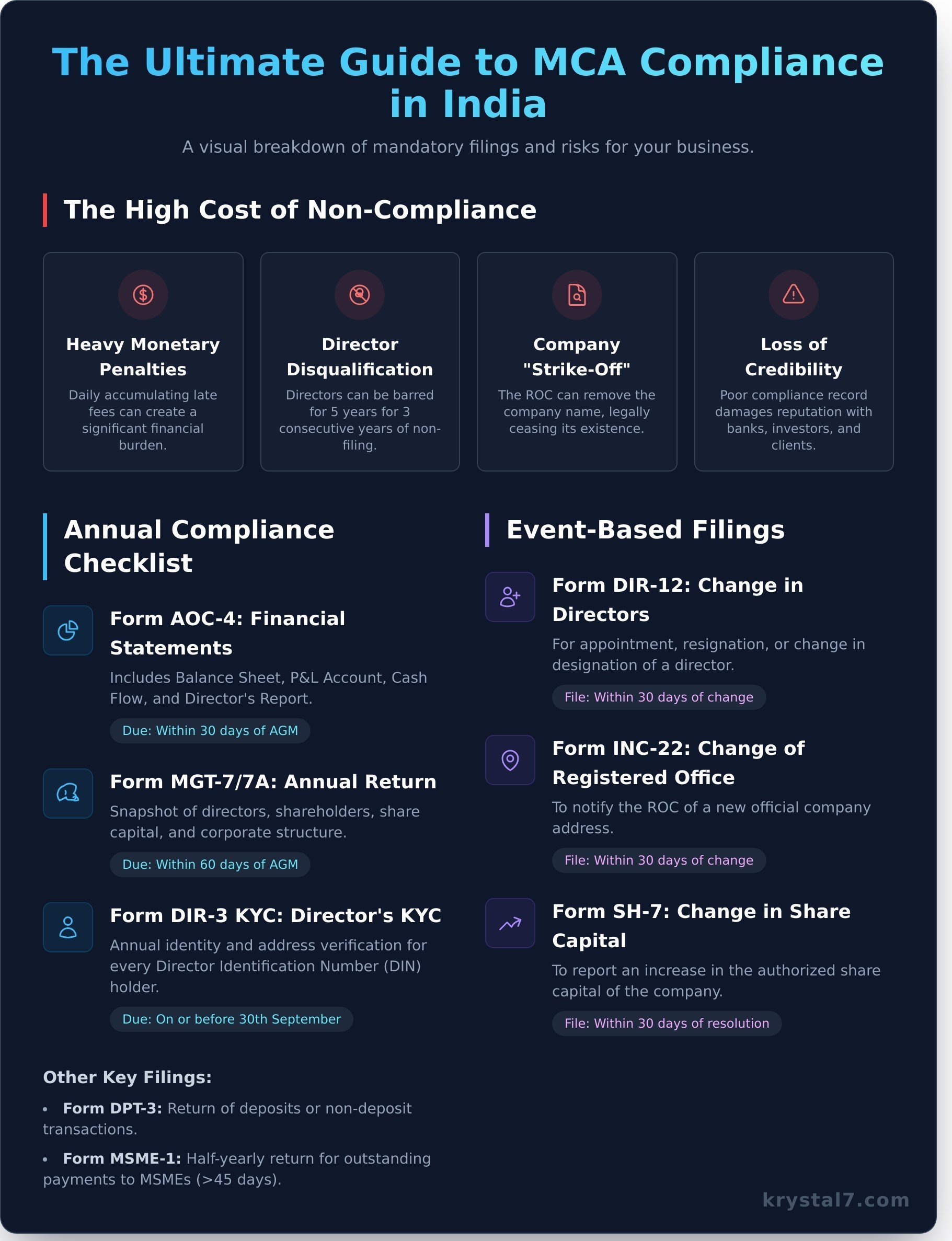
Failing to meet MCA compliance deadlines is more than just an administrative oversight; it carries significant financial and legal risks. The consequences are designed to be stringent to ensure accountability. Here’s what your business could face:
- Heavy Monetary Penalties: The MCA imposes substantial late fees for delayed filings. These penalties can accumulate daily, quickly turning a minor oversight into a significant financial burden.
- Director Disqualification: If a company fails to file its annual returns or financial statements for three consecutive years, its directors can be disqualified. A disqualified director cannot be appointed to any other company for a period of five years.
- Company “Strike-Off”: The Registrar of Companies (ROC) has the authority to strike the name of a non-compliant company from the register. This effectively means the company ceases to exist legally and cannot conduct business.
- Loss of Credibility: A poor compliance record damages your company’s reputation. It can make it difficult to secure loans from banks, attract investors, or win government tenders, as your compliance status is public information.
Your Annual MCA Compliance Checklist: Mandatory Yearly Filings
For every private limited company, a set of filings must be completed annually to maintain a compliant status. Think of this as your company’s yearly health check-up with the government. Here is a clear, scannable checklist of the most essential forms you need to know. For a comprehensive breakdown of all required filings and their specific deadlines, our detailed guide on ROC compliance for private limited company provides step-by-step instructions for each form. Additionally, for a complete overview of all mandatory tasks and deadlines, check out our comprehensive guide on annual compliance for private limited company requirements.
Form AOC-4: Filing Your Financial Statements
This is your company’s annual financial report card. Form AOC-4 is used to file your audited financial statements with the ROC. It provides a comprehensive view of your company’s financial position and performance over the past year.
- What it includes: The Balance Sheet, Profit & Loss Account, Cash Flow Statement, and the Director’s Report.
- Due Date: Must be filed within 30 days of your company’s Annual General Meeting (AGM).
Form MGT-7/MGT-7A: The Annual Return
The Annual Return is a yearly snapshot of your company’s corporate structure and management. It contains crucial information about the company’s directors, shareholders, share capital, and key management personnel.
- What it includes: Details of shareholders and their holdings, director information, meeting attendance, and overall corporate structure.
- Due Date: Must be filed within 60 days of your company’s Annual General Meeting (AGM).
Form DIR-3 KYC: Director’s KYC Verification
This is an annual identity and address verification for every individual who holds a Director Identification Number (DIN). The purpose is to ensure that the information on record with the MCA is current and accurate.
- Who it applies to: Every person holding a DIN as of 31st March of a financial year.
- Due Date: Must be filed on or before 30th September every year.
Other Important Annual Filings
Beyond the primary forms, some companies may need to file additional returns based on their specific activities:
- Form DPT-3: This form is for filing a return of deposits or particulars of transactions that are not considered deposits. It’s mandatory for all companies other than government companies.
- Form MSME-1: If your company has outstanding payments due to Micro, Small, and Medium Enterprises (MSMEs) for more than 45 days, you must file this half-yearly return.
Beyond the Annual Cycle: Event-Based MCA Filings
Compliance isn’t just an annual task. Certain filings are triggered by specific events or changes within your company. These event-based compliances are time-sensitive and just as critical as the annual ones. Failing to report these changes within the stipulated time can lead to penalties. Here are some of the most common examples.
When You Appoint or Remove a Director (Form DIR-12)
Any change on the company’s Board of Directors, whether it’s the appointment of a new director, the resignation of an existing one, or a change in their designation, must be reported to the ROC using Form DIR-12. This ensures that the official record of the company’s leadership is always up-to-date.
- When to file: This form must be filed within 30 days of the change taking effect.
When You Change Your Registered Office (Form INC-22)
Your company’s registered office is its official address for all communications from the MCA. If you move this office, even to a new location within the same city, you must notify the ROC. This is done by filing Form INC-22.
- When to file: This must be filed within 30 days of the address change.
When You Change Share Capital (Form SH-7)
If your company decides to increase its authorized share capital to issue more shares, this change must be formally recorded. Form SH-7 is used to notify the ROC about any alteration to the share capital structure as stated in the Memorandum of Association.
- When to file: This must be filed within 30 days of passing the shareholder resolution for the increase.
Achieve Effortless Compliance with Krystal7
Managing the complexities of MCA compliance can be a significant drain on your time and resources. The rules are intricate, the deadlines are strict, and even small mistakes can lead to penalties that disrupt your business’s growth. Partnering with a professional ensures that all your filings are handled accurately and on time, giving you the freedom to focus on what you do best: running your business.
The Krystal7 Advantage: Clarity and Freedom to Focus
We believe that every business dream deserves crystal clarity. Our team of experts is dedicated to removing the burden of compliance from your shoulders, providing you with peace of mind and a solid legal foundation.
- Expert Handling: Our team of top-tier Chartered Accountants and Company Secretaries handles all your MCA filings with precision and timeliness.
- Dedicated Advisor: You get a dedicated relationship manager who understands the unique needs of your business and is always just a call away.
- Krystal-Clear Transparency: We operate with upfront pricing and no hidden costs, so you always know exactly what you’re paying for.
- Let us handle the complexities so you can get back to building your vision. Explore Our Annual Compliance Package Today!
Frequently Asked Questions
What is the difference between MCA and ROC compliance?
MCA (Ministry of Corporate Affairs) is the governing body that sets the rules under the Companies Act. The ROC (Registrar of Companies) is the office under the MCA that handles the administration of these rules at the state level. ROC compliance refers to the act of filing the required documents with the local ROC office as per the MCA’s regulations. Essentially, you comply with MCA rules by filing with the ROC. Understanding the nuances of ROC compliance for private limited company requirements can help ensure your business meets all necessary obligations.
What happens if I miss an MCA filing deadline?
Missing a deadline results in an immediate additional fee, which is calculated on a per-day basis. Continued delays can lead to much larger penalties, director disqualification, and in severe cases, the company being struck off the register.
Is MCA compliance required for a dormant or new company?
Yes. Even a company with no business activity (a dormant company) or a newly incorporated one must fulfill its annual filing obligations. The only exception is if the company has officially applied for and received “dormant status” from the ROC.
How can I check my company’s compliance status on the MCA portal?
You can visit the official MCA portal (mca.gov.in) and use the “View Company/LLP Master Data” service. By entering your Company Identification Number (CIN), you can see your company’s details, including the dates of its last filed annual returns and financial statements.
Can a company be shut down for continuous non-compliance?
Yes. If a company fails to file its annual returns for a prolonged period, the ROC can assume the company is not operational and initiate the process of striking its name from the official register. This leads to the legal dissolution of the company.
Staying on top of your legal duties is fundamental to building a sustainable and successful business. By understanding your obligations and ensuring timely filings, you protect your company from risk and build a foundation of trust and credibility. Don’t let compliance become a source of stress. Let our team of top-tier Chartered Accountants and Company Secretaries provide the Krystal-clear support you need. With a dedicated relationship manager and transparent pricing, we make compliance effortless. Secure Your Business with Our All-in-One Annual Compliance Package.

Article by
Nihal Srivastava
Nihal Srivastava is the Co-Founder of Krystal7 Consultants, helping Indian entrepreneurs and startups navigate company registration, compliance, trademark protection, and regulatory requirements with clarity and confidence. With 6+ years of hands-on expertise in MCA filings, GST compliance, and corporate structuring, Nihal has guided 1000+ businesses across India through their legal and compliance journeys. He believes every business dream deserves crystal clear foundations, and that no founder should be held back by paperwork or red tape.