

The Complete TAN Surrender Process: A Step-by-Step Guide for 2026
Did you know that holding a duplicate TAN number in 2026 can trigger a penalty of up to 200,000 INR? Many Indian entrepreneurs feel overwhelmed by the transition from the old Form 49B to the new Form 135 for non-government entities. It’s natural to worry about pending TDS returns or conflicting advice regarding online Protean applications versus offline submissions to your Assessing Officer. This guide provides the crystal clarity you need to master the tan surrender process legally and efficiently.
We understand that you want a penalty-free closure and a formal acknowledgment from the IT Department. By following this structured approach, you can clear your statutory dues and resolve duplicate records without the stress of legal red tape. You’ll learn the exact steps to file the required forms, pay the 77 INR application fee, and ensure your compliance record stays clear. This clarity allows you to protect your business legacy and gives you the freedom to focus on your next big venture.
Key Takeaways
- Avoid the 200,000 INR penalty by identifying and cancelling duplicate TANs through official IT Department channels.
- Ensure a clean slate on the TRACES portal before starting the tan surrender process to prevent application rejection due to outstanding liabilities.
- Differentiate between online Protean applications for duplicate records and manual submissions to the Jurisdictional Assessing Officer for business closures.
- Follow a clear, step by step guide to filling out the Form for Changes or Correction in TAN data, specifically focusing on Item No. 10.
- Secure a formal acknowledgment from the Tax Department to protect your business legacy and gain the freedom to focus on your next vision.
What is the TAN Surrender Process and Why is it Necessary?
Every business entity in India that deducts or collects tax at source must possess a Tax Deduction and Collection Account Number (TAN). This 10 digit alphanumeric code is mandated by the Income Tax Act, 1961. The tan surrender process is the formal administrative procedure used to deactivate this number within the Income Tax Department (ITD) database. It’s not just a suggestion; it’s a statutory requirement to ensure your compliance profile remains accurate. Under Section 272BB of the Income Tax Act, 1961, possessing more than one TAN can lead to a penalty of 10,000 INR.
There are two primary triggers for this process. First, you might have accidentally obtained a duplicate number through an administrative oversight. Second, your business might be closing its doors or merging with another entity. In either case, leaving a TAN active when it’s not in use creates a trail of “non-filing” notices. These notices can haunt your business legacy and lead to unnecessary legal friction. By surrendering the number, you officially inform the tax authorities that no further TDS or TCS liabilities will arise under that specific account.
Scenario A: Surrendering a Duplicate TAN
Many founders discover duplicate TANs during the initial stages of company incorporation. This often happens because of a simple lack of coordination between different departments or multiple applications filed in error. The Income Tax Department tracks every TAN against a single Permanent Account Number (PAN). If their systems flag two numbers for one PAN, it triggers an immediate compliance alert. You must identify which number is actively being used for your monthly TDS payments and which one is the unused “extra.” Identifying the “active” TAN is the first step toward achieving crystal clarity in your tax records.
Scenario B: Cancellation Due to Business Closure or Merger
When you decide to close a Private Limited Company, your legal obligations don’t end with the MCA filing. You must systematically cancel all tax registrations to avoid future litigation. This applies to mergers and acquisitions too. If Company A merges into Company B, Company A’s TAN must be surrendered to prevent the system from expecting quarterly returns. Even for inactive businesses, the tan surrender process is vital. It stops the compliance clock and ensures you aren’t flagged for failing to file returns for a defunct entity. This proactive step provides you with the freedom to focus on your next venture without looking over your shoulder at old red tape.
The Pre-Surrender Audit: Achieving a Clean Slate on TRACES
The IT Department won’t allow you to walk away if there’s even a small discrepancy in your books. Before you initiate the tan surrender process, you must perform a comprehensive audit of your digital footprint on the TRACES portal. Any outstanding demand, whether it’s a 100 INR interest charge or a late filing fee, will lead to an immediate rejection of your application. Achieving a clean slate isn’t just about paperwork; it’s about ensuring your business reputation remains untarnished as you transition to your next venture.
To begin, log into the TDS Reconciliation Analysis and Correction Enabling System (TRACES) using your User ID, Password, and TAN. Navigate to the ‘Statements/Payments’ tab and download the ‘Justification Report’ for any financial year showing a default. This report acts as a roadmap, detailing exactly where your TDS filings fell short. You must also ensure that your final TDS return for the current financial year is filed and processed. Understanding how to surrender or cancel your TAN starts with this deep dive into your existing records.
Clearing Outstanding TDS Defaults
Outstanding defaults are the biggest hurdle in the surrender journey. If you’ve missed a filing deadline, you’ll likely see a penalty under Section 234E of the Income Tax Act, which accrues at 200 INR per day. Use Challan 281 to clear these dues immediately. You must also address any “Short Deduction” or “Short Payment” notices by filing correction returns and paying the balance tax. A “Nil” default status on TRACES is the green signal for surrender. If these calculations feel overwhelming, our expert compliance team can conduct this audit for you, ensuring every rupee is accounted for.
Notifying Deductors and Employees
Your TAN doesn’t exist in a vacuum; it impacts every vendor and employee you’ve paid. You must formally inform these stakeholders that you’re deactivating your TAN so they don’t expect future tax credits from your entity. Issue all pending Form 16 and Form 16A certificates before the account becomes inactive. This ensures your employees can file their personal income tax returns without hurdles. Most importantly, verify that every rupee deducted from their payments has been deposited with the Central Government. This final step protects your employees’ tax records and secures your professional legacy.
Comparing the Two Paths: Online Correction vs. Offline Application
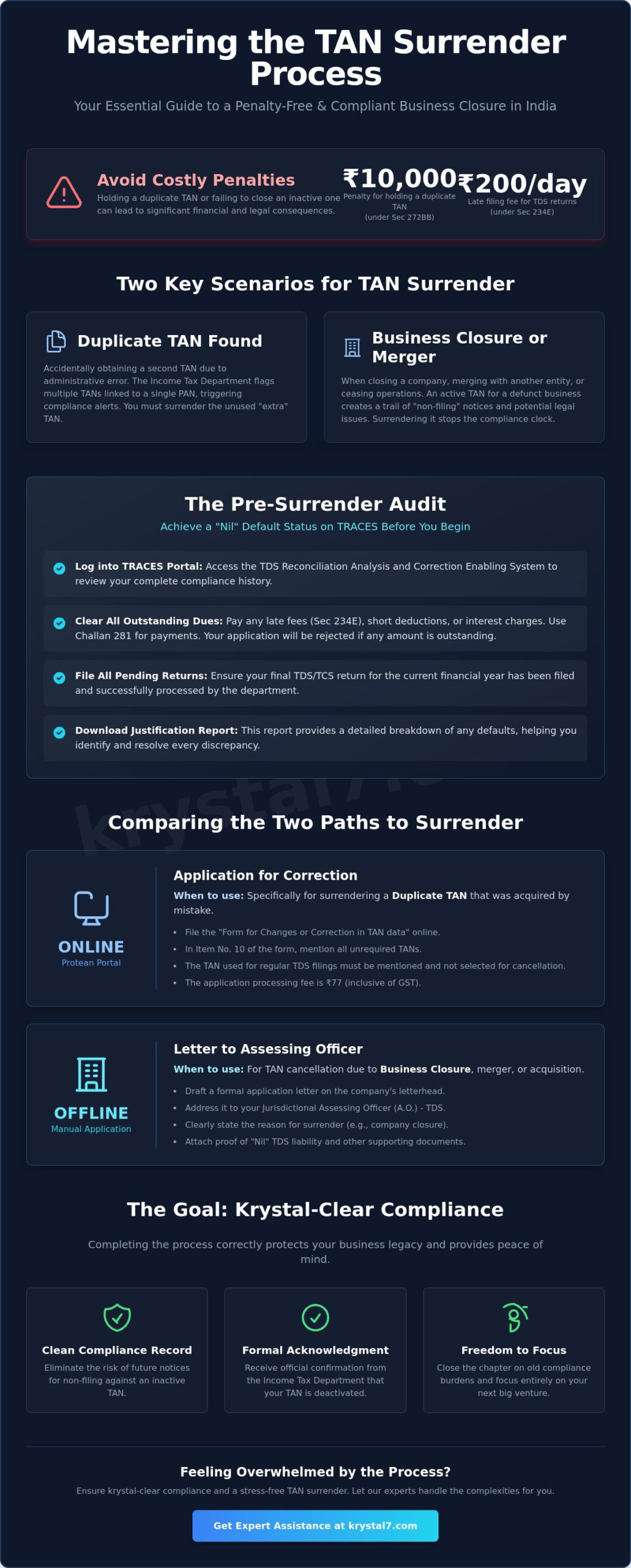
Choosing between the online and offline routes depends entirely on your specific situation. If you’ve accidentally obtained two numbers, the online Protean portal is your fastest solution. However, if you’re closing your entity, you must deal directly with the Income Tax Department. The tan surrender process varies in complexity and authority involvement based on these two distinct paths.
Online processing usually takes 15 to 30 days once your documents reach the facilitation center. Offline applications often require 30 to 60 days because they involve manual verification by tax officials. Regardless of the path, you’ll need your original TAN allotment letter, proof of identity, and evidence of business closure, such as an MCA dissolution order.
When to Use the NSDL/Protean Online Portal
This route is ideal for “Change or Correction” requests where you intend to keep one active record. You’ll use the official TAN correction form to list the specific numbers you want to cancel. This form includes a dedicated section for mentioning duplicate TANs that need to be deactivated. After you submit the digital form and pay the 77 INR fee, you’ll receive a 15 digit acknowledgment number. You must print this acknowledgment and mail it to the Protean office in Pune to complete the submission.
When an Offline Application to the AO is Mandatory
For companies completing their annual compliance and final closure, an offline application is necessary. You must draft a formal surrender letter on your company letterhead and submit it to your Jurisdictional TDS Assessing Officer. Don’t assume an online filing is enough for a business closure; the AO often requires a manual verification of your final TDS returns before granting a formal discharge. Use the “Know Your AO” tool on the Income Tax portal to find your specific officer based on your PAN. This manual path ensures you receive a stamped acknowledgment, which is the ultimate proof of your tan surrender process completion.
Step-by-Step Guide to the TAN Surrender Process
Executing the tan surrender process requires a methodical approach to ensure you don’t accidentally disrupt your active compliance. Start by identifying the specific TAN you intend to keep and the one you want to cancel. This prevents the common error of deactivating your primary tax record. Once you’ve confirmed the numbers, follow these five essential steps to secure your closure.
- Step 1: Log into the Protean TIN portal and select the “Form for Changes or Correction in TAN data.”
- Step 2: Fill in your basic details, ensuring the TAN you wish to retain is mentioned at the top of the form.
- Step 3: Navigate to Item No. 10 to list the duplicate or redundant TANs for cancellation.
- Step 4: Submit the form digitally or at a nearby TIN Facilitation Centre (TIN-FC) with the 77 INR processing fee.
- Step 5: For business closures, attach a physical copy of the ROC strike-off letter or your registered dissolution deed.
Always obtain the stamped acknowledgment or the 15 digit digital receipt. This document serves as your legal proof of surrender. It’s your only defense if the IT Department issues a notice for non-filing in the future. If you’re worried about navigating these portals, our legal strategists can manage the submission for you, ensuring every detail is meticulously handled.
Filling Item No. 10: The Critical Section
Item No. 10 is the most vital part of the correction form. You must enter the TAN you want to surrender in the designated boxes within this section. A common mistake is leaving this blank or entering your active TAN by mistake. The “Reason for Cancellation” must be clearly stated, such as “Duplicate Allotment” or “Cessation of Business Operations.” This clarity helps the tax officer process your request without raising additional queries.
Post-Submission: Verifying the Cancellation Status
Your job isn’t finished once you hit submit. Wait approximately three weeks for the system to update under the new Income Tax Rules, 2026. Visit the official Income Tax Department website and use the “Know Your TAN” tool to check the status. You’ll see the status listed as “Active,” “Inactive,” or “Cancelled.” If the status remains “Active” after 30 days, you must visit your Jurisdictional Assessing Officer with your acknowledgment receipt to resolve the delay.
Ensuring Krystal-Clear Compliance with Krystal7 Consultants
The tan surrender process shouldn’t be a source of anxiety for a visionary founder. While the technical steps involve navigating the Protean portal and coordinating with Jurisdictional Assessing Officers, the real challenge lies in the meticulous audit required before submission. Krystal7 Consultants acts as your dependable partner, handling the end to end compliance audit to ensure your business legacy remains untarnished. We manage the complex TRACES reconciliations and the filing of final TDS returns, providing you with the Freedom to Focus on your next big innovation.
Our team of legal strategists brings transparency to a process often clouded by red tape. We believe that every business dream deserves a clean slate, especially when one chapter ends and another begins. By choosing a dedicated relationship manager from Krystal7, you gain access to methodical expertise that eliminates guesswork. We ensure that your application is not just submitted, but successfully processed and acknowledged by the Income Tax Department without any hidden costs or administrative delays.
Beyond TAN: Comprehensive Closure Services
A clean exit involves more than just surrendering a tax number. Our elite expertise extends to GST registration cancellation and ensuring all final returns are filed to avoid future litigation. For those closing a Private Limited Company, we manage the entire ROC strike-off process, also known as the Fast Track Exit. This holistic approach ensures that no statutory loose ends remain. As you pivot to your next venture, we also provide trademark registration services to protect your new brand identity from day one.
Why Founders Trust Krystal7
Indian entrepreneurs trust us because we pair top tier Chartered Accountancy expertise with a supportive, human touch. We understand the high stakes involved in compliance. A single oversight can lead to the 10,000 INR penalty mandated under Section 272BB of the Income Tax Act. Our methodical approach to deadline management ensures you never face these unnecessary financial burdens. We aren’t just service providers; we are genuine partners invested in your long term growth and success.
Don’t let duplicate records or pending closures stall your entrepreneurial journey. Secure the clarity your business deserves today. Contact Krystal7 Consultants at business@krystal7.com or visit krystal7.com to start your tan surrender process with absolute confidence.
Secure Your Business Legacy with Compliance Clarity
Completing the tan surrender process is more than just a statutory tick box. It’s a strategic move to protect your future ventures from the ghost of old tax liabilities. You now have the roadmap to navigate the TRACES audit, clear the 77 INR fee on the Protean portal, and secure that vital stamped acknowledgment from your Assessing Officer. These steps ensure you stay clear of the 200,000 INR penalties associated with duplicate TANs while maintaining a pristine record with the Income Tax Department.
With over 500 successful company closures managed, our team of elite CAs and CSs brings 100% transparency and Krystal-clear pricing to every engagement. We handle the complexity so you can focus on the growth of your next vision. Don’t let compliance red tape slow you down. Contact Krystal7 Consultants at business@krystal7.com for a Krystal-clear TAN surrender process.
Your journey toward a penalty-free, streamlined exit starts with one simple step. We’re here to ensure your transition is smooth and your focus remains on what truly matters: your next big dream.
Frequently Asked Questions
Is it mandatory to surrender a duplicate TAN?
Yes, surrendering a duplicate TAN is mandatory under Section 272BB of the Income Tax Act, 1961. Holding multiple numbers for a single entity is a compliance violation that leads to a 10,000 INR penalty. The department tracks these records against your PAN to ensure tax consistency. By completing this process, you align your records and avoid automated compliance notices that could disrupt your daily operations.
Can I surrender my TAN online without visiting the Income Tax office?
You can initiate the process online for duplicate records, but business closures often require a physical submission to the Assessing Officer. The Protean portal handles digital corrections for a fee of 77 INR. However, for a full business closure, the Jurisdictional Assessing Officer usually needs to verify your physical dissolution documents. This dual approach ensures your closure is legally recorded and your liability is fully terminated.
What happens if I don’t surrender my TAN after closing my business?
Failing to surrender your TAN after a business closure leads to a cycle of non-compliance notices. The system expects quarterly filings as long as the account remains “Active” in the database. You’ll face late filing fees under Section 234E, which accrue at 200 INR for every day of delay. These liabilities can accumulate into thousands of rupees, making it difficult to obtain a clean exit or start a new venture.
How long does the TAN surrender process take in 2026?
In 2026, the timeline for deactivation depends on the route you choose for your application. Online applications via the Protean portal typically take 15 to 30 days for processing. If you’re following the manual path through your Assessing Officer for a business closure, expect a window of 30 to 60 days. This allows tax officials enough time to verify your final filings and clear any pending defaults on TRACES.
Do I need to file TDS returns if my business had no transactions before closure?
You must file your returns even if your business had zero transactions during the period before closure. The tan surrender process cannot proceed until the TRACES portal shows a “Nil” default status for all financial years. Filing these final returns proves to the department that no tax was deducted and no payments are due. This methodical step ensures your application isn’t rejected during the final audit phase.
What documents are required for TAN cancellation of a partnership firm?
Partnership firms must provide the original TAN allotment letter, the firm’s PAN card, and a certified copy of the dissolution deed. You must also submit a formal surrender request on the firm’s letterhead signed by the designated partners. These documents prove that the entity has officially ceased operations. Providing these specific records helps the Assessing Officer process your cancellation without requesting additional clarifications or evidence.
How do I find my Jurisdictional Assessing Officer (TDS)?
You can locate your Jurisdictional Assessing Officer by using the “Know Your AO” feature on the Income Tax e-filing portal. Simply enter your PAN and a valid mobile number to receive a secure OTP. Once verified, the system displays your AO code, the designation of your officer, and their office address. This information is crucial for sending physical surrender applications and tracking your cancellation status manually.
Can a surrendered TAN be reactivated in the future?
A surrendered TAN cannot be reactivated once the deactivation is finalized in the Income Tax database. If you decide to resume business operations or start a new Private Limited Company, you’ll need to apply for a fresh registration. This ensures that your new entity has a clean compliance history from the start. It’s always better to apply for a new number than to attempt to revive a closed record.

Article by
Nihal Srivastava
Nihal Srivastava is the Co-Founder of Krystal7 Consultants, helping Indian entrepreneurs and startups navigate company registration, compliance, trademark protection, and regulatory requirements with clarity and confidence. With 6+ years of hands-on expertise in MCA filings, GST compliance, and corporate structuring, Nihal has guided 1000+ businesses across India through their legal and compliance journeys. He believes every business dream deserves crystal clear foundations, and that no founder should be held back by paperwork or red tape.