

ROC Compliance for Private Limited Company: The Ultimate 2026 Guide
Is the thought of navigating the maze of ROC filings-with its confusing alphabet soup of forms like AOC-4 and MGT-7-keeping you up at night? You launched your venture to innovate and grow, not to get buried in complex paperwork. Yet, mastering the annual roc compliance for private limited company is a non-negotiable part of your journey, a crucial step to avoid heavy penalties and maintain your company’s good standing with the Ministry of Corporate Affairs.
That’s where this ultimate 2025 guide comes in. We’re cutting through the legal jargon and red tape to bring you Krystal-Clear clarity on your obligations. Inside, you will find a simple checklist of every essential filing, a plain-English explanation of each form’s purpose, and a definitive calendar of due dates to keep you ahead. Consider this your roadmap to mastering compliance confidently, giving you the freedom to focus on what truly matters: building your business vision.
What is ROC Compliance? The Foundation of Your Company’s Legal Health
Once you register your Private Limited Company, you bring a business vision to life. To protect and nurture that vision, you must maintain its good legal standing. This is where ROC compliance comes in. Think of the Registrar of Companies (ROC) as the official guardian of all corporate entities in India, operating under the Ministry of Corporate Affairs (MCA). ROC compliance is the non-negotiable process of filing your company’s essential financial and operational information with this authority, as mandated by the Companies Act, 2013.
More than just a legal formality, this process is the bedrock of corporate transparency. It creates a public record of your company’s health and management, building a legacy of trust with investors, lenders, clients, and employees. Consistent and accurate roc compliance for private limited company entities isn’t a burden; it’s a powerful statement of your commitment to ethical governance and long-term growth.
Why You Can’t Afford to Ignore ROC Filings
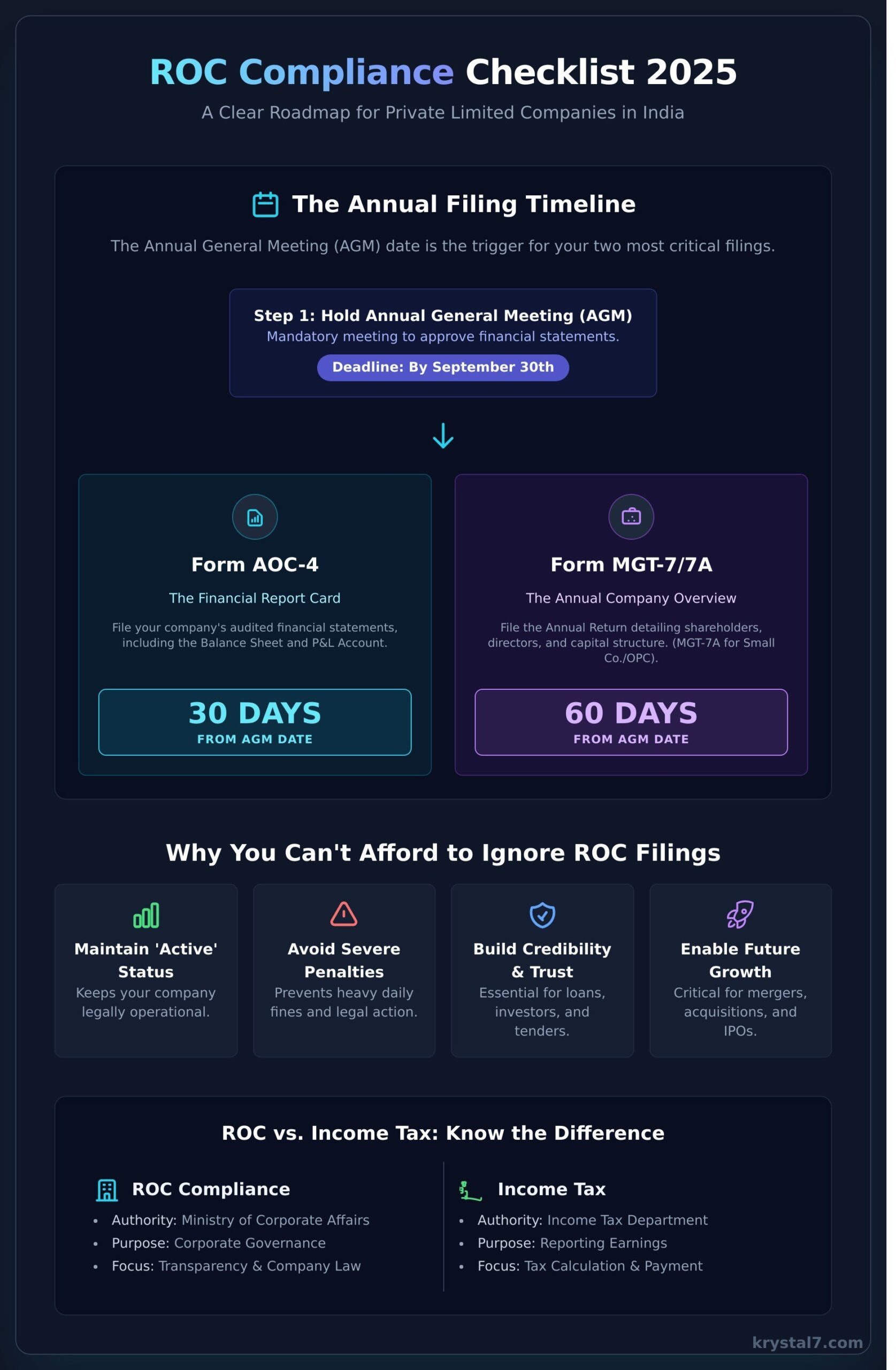
Overlooking your ROC filings can create significant roadblocks for your business. Staying compliant provides the clarity and freedom you need to focus on growth. Here’s why it’s critical:
- Maintains ‘Active’ Legal Status: Regular filings keep your company’s status ‘Active’ on the MCA portal, preventing it from being marked as ‘Defunct’ or struck off, which would halt all operations.
- Avoids Severe Financial Penalties: Non-compliance attracts heavy penalties that can accumulate daily, alongside potential legal action against the company’s directors.
- Builds Credibility and Trust: Banks, investors, and even government bodies review your ROC filing history before approving loans, offering funding, or awarding tenders. A clean record is a mark of reliability.
- Ensures a Clean Slate for the Future: A compliant history is essential for major business activities like mergers, acquisitions, stock market listings, or securing high-value contracts.
ROC vs. Other Compliances (Like Income Tax)
It’s a common point of confusion for new entrepreneurs. While both are mandatory, ROC and Income Tax filings serve different purposes and are managed by different government bodies. ROC compliance is a matter of corporate law under the Ministry of Corporate Affairs (MCA), focusing on governance and transparency. In contrast, Income Tax returns are filed with the Income Tax Department to report earnings and pay taxes. Both are separate, equally crucial obligations that ensure your company operates seamlessly within India’s legal framework. For a comprehensive understanding of the broader regulatory landscape, including MCA compliance requirements and how they interconnect with ROC filings, it’s essential to grasp the complete picture of your statutory obligations.
The Core Annual ROC Filings: A Deep Dive into Mandatory Forms
For every entrepreneur, understanding the annual filing process is the first step toward mastering statutory obligations. The foundation of roc compliance for private limited company rests on two critical annual filings with the Registrar of Companies (ROC). Think of these forms not as bureaucratic hurdles, but as a yearly health check-up for your business, providing a transparent snapshot of your financial and administrative standing to the government, investors, and stakeholders. These are the absolute, non-negotiable minimums every private limited company must fulfill annually to remain compliant and avoid heavy penalties. For a complete overview of all mandatory requirements, including detailed timelines and actionable checklists, our comprehensive guide on annual compliance for private limited company requirements provides the clarity you need to stay ahead of every deadline.
Form AOC-4: Your Company’s Financial Report Card
This form is the official submission of your company’s audited financial statements for the year. It’s like your business’s annual report card, detailing its financial performance and position. It provides a clear, evidence-backed picture of your company’s health.
- Purpose: To file the company’s financial statements, including the Balance Sheet, Profit & Loss Account, and Auditor’s Report.
- Who Signs It: The form must be digitally signed by a director and certified by a practicing Chartered Accountant.
- Deadline: Must be filed within 30 days of your company’s Annual General Meeting (AGM).
Form MGT-7/MGT-7A: The Annual Company Overview
If AOC-4 is the financial report card, Form MGT-7 is the company’s annual census. It provides the ROC with a comprehensive overview of the company’s non-financial details, such as its management and ownership structure. This ensures the ROC’s records are always up-to-date. These forms, along with other key documents, can be sourced from the Ministry of Corporate Affairs’ portal of Official ROC Compliance Forms, ensuring you are using the latest versions.
- Purpose: To submit the company’s Annual Return, detailing its shareholders, directors, and share capital structure.
- The Difference: Form MGT-7 is for most private limited companies. However, for a “Small Company” or a One-Person Company (OPC), the simplified Form MGT-7A is applicable, streamlining the process.
- Deadline: Must be filed within 60 days of the company’s Annual General Meeting (AGM).
The Annual General Meeting (AGM): The Event That Triggers Filings
The AGM is a mandatory annual meeting of a company’s shareholders. It is the cornerstone event from which the deadlines for your core ROC filings are calculated. During the AGM, the directors present the financial statements for approval. This formal event is a legal requirement under the Companies Act, 2013, and its date sets the compliance clock ticking.
- Legal Deadline: An AGM must be held within 6 months from the end of each financial year (i.e., by September 30th).
- The Trigger: The date on which the AGM is held determines the due dates for both AOC-4 (AGM date + 30 days) and MGT-7/7A (AGM date + 60 days).
Beyond Annual Returns: Other Critical ROC Compliances
Effective roc compliance for private limited company extends far beyond the once-a-year rush of filing annual returns. For visionary entrepreneurs, maintaining a continuous state of compliance is key to building a robust and trustworthy business foundation. It’s a dynamic responsibility that involves keeping the Registrar of Companies (ROC) updated on significant internal changes and fulfilling personal director-level obligations. Overlooking these ongoing duties can lead to unnecessary penalties and administrative hassles, distracting you from your core mission: business growth.
Understanding these additional requirements provides clarity on your full scope of duties and empowers you to manage your venture proactively. Let’s break down two critical areas of ongoing compliance.
Director’s KYC: Form DIR-3 KYC
This is a mandatory annual exercise for every individual holding a Director Identification Number (DIN). The purpose is to verify and update the director’s personal details-like phone number, email, and address-with the ROC, ensuring the official records are always current and accurate.
- Who Must File: Every person who has been allotted a DIN on or before 31st March of a financial year.
- Annual Deadline: On or before 30th September of the immediate next financial year.
- Consequences of Non-Compliance: Failure to file on time results in the deactivation of the DIN and a fixed penalty of ₹5,000 once the form is filed after the due date.
Event-Based Compliances: When to Inform the ROC
Your business is not static, and neither are your compliance duties. Significant changes in your company’s structure or operations trigger mandatory filings as stipulated by The Companies Act, 2013. These are not optional updates; they are time-sensitive legal requirements to ensure transparency. Missing the deadlines for these event-based filings attracts additional fees and penalties.
Common events that require immediate ROC intimation include:
- Change of Registered Office: Filing Form INC-22 within 30 days of the change.
- Appointment, Resignation, or Change in Director’s Designation: Filing Form DIR-12 within 30 days of the event.
- Increase in Authorized Share Capital: Filing Form SH-7 within 30 days of the shareholder resolution.
- Change in Statutory Auditors: Filing Form ADT-1 for appointment or ADT-3 for resignation.
Staying ahead of these crucial filings is a cornerstone of diligent roc compliance for a private limited company, preventing legal complications and ensuring your business operates smoothly.
ROC Compliance Calendar for FY 2024-25 (AY 2025-26)
Staying ahead of deadlines is the cornerstone of effective corporate governance. For entrepreneurs, navigating the maze of due dates can be overwhelming, but a clear calendar transforms this complexity into a manageable checklist. This timeline provides Krystal-clear visibility into the essential roc compliance for a private limited company, helping you plan ahead, avoid penalties, and maintain a flawless statutory record.
Missing these deadlines can lead to significant penalties and can impact your company’s good standing. Think of this calendar as your roadmap to a hassle-free and compliant financial year.
Timeline for Key Annual Filings
These are the most critical, non-negotiable deadlines tied to your company’s financial year-end. They revolve around the preparation of financial statements, holding the Annual General Meeting (AGM), and submitting the required annual forms to the Registrar of Companies.
| Compliance Activity / Event | Relevant Form | Due Date for FY 2024-25 |
|---|---|---|
| End of Financial Year | N/A | 31st March 2025 |
| Annual General Meeting (AGM) | N/A | Within 6 months of FY end (by 30th September 2025) |
| Filing of Financial Statements | Form AOC-4 | Within 30 days of AGM (by 29th October 2025*) |
| Filing of Annual Return | Form MGT-7 / MGT-7A | Within 60 days of AGM (by 28th November 2025*) |
*Note: These dates are calculated assuming the AGM is held on the last possible day (30th September). The actual due date depends on when your company’s AGM is conducted.
Other Important Due Dates
Beyond the core annual filings, several other forms must be submitted throughout the year to ensure complete roc compliance for a private limited company. These address specific aspects like director information, deposits, and dues to small enterprises.
| Compliance Form | Purpose of Filing | Due Date |
|---|---|---|
| Form DPT-3 | Return of Deposits or particulars of transactions not considered as deposits. | 30th June 2025 |
| Form DIR-3 KYC | Annual KYC for all individuals holding a Director Identification Number (DIN). | 30th September 2025 |
| Form MSME-1 | Half-yearly return on outstanding payments to Micro and Small Enterprises. | 30th April 2025 (for Oct-Mar) & 31st October 2025 (for Apr-Sep) |
This calendar is your guide to staying organised. By partnering with a compliance expert, you remove the guesswork, ensuring every deadline is met with precision and giving you the freedom to focus on what truly matters: growing your business vision.
Consequences of Non-Compliance: Penalties, Risks, and How to Avoid Them
Navigating the path of entrepreneurship is challenging enough without the added stress of statutory penalties. Forgetting or delaying your filings can seem like a minor oversight, but the consequences of non-compliance with the ROC can create significant and costly roadblocks for your business. Understanding these risks is the first step towards protecting the venture you’ve worked so hard to build.
The consequences of overlooking roc compliance for private limited company extend far beyond simple fines, impacting your finances, your directors’ reputations, and your company’s very existence.
The Financial Cost: Late Fees and Penalties
The most immediate consequence of missing a filing deadline is a direct financial penalty. The Ministry of Corporate Affairs (MCA) imposes a standard late fee of ₹100 per day, per form. Crucially, for many of these filings, there is no maximum limit, meaning the penalty accumulates indefinitely until the form is filed.
For example, if you delay filing your annual return (Form MGT-7) by 30 days, the basic penalty would be 30 days x ₹100/day = ₹3,000.
On top of this, an adjudicating officer can impose further penalties, which can be substantial. What starts as a small delay can quickly snowball into a significant financial burden.
Beyond the Fines: Severe Business Risks
While the financial penalties are steep, the non-monetary risks can be even more damaging to your company’s future. These operational and strategic threats can paralyze your business and jeopardize its long-term viability.
- Company ‘Struck Off’: If a company fails to file its annual returns for two consecutive financial years, the ROC can mark the company as ‘dormant’ and ultimately strike its name from the register. This means your company legally ceases to exist.
- Director Disqualification: The directors of a non-compliant company can be disqualified for a period of five years, preventing them from being appointed as a director in any other company.
- Frozen Bank Accounts: The ROC has the authority to instruct banks to freeze the company’s bank accounts, bringing all business operations to a complete halt.
- Difficulty in Fundraising: Investors, lenders, and potential partners conduct thorough due diligence. A poor compliance record is a major red flag, making it nearly impossible to secure funding or obtain loans.
Ensuring seamless roc compliance for private limited company operations is not just about avoiding penalties; it’s about protecting your legacy and maintaining the trust of your stakeholders. Don’t let compliance complexities derail your vision. Partner with experts who can provide the clarity and support you need to stay compliant and focused on growth. Safeguard your venture by visiting krystal7.com today.
Streamline Your Compliance: How to Achieve Peace of Mind
Navigating the intricate web of ROC compliance for a private limited company can feel like a constant battle against deadlines and complex regulations. The risk of penalties and the administrative burden can distract you from what truly matters: growing your business. But compliance doesn’t have to be a source of anxiety. By adopting a structured approach and leveraging professional expertise, you can achieve complete peace of mind and gain the freedom to focus on your vision.
The path to streamlined compliance involves two key strategies: building a robust internal system and partnering with a trusted expert.
Creating an Internal Compliance Checklist
A strong foundation starts from within. Proactive internal management can prevent last-minute chaos and ensure you are always prepared. This simple, methodical approach brings immediate clarity to your obligations.
- Maintain a Statutory Calendar: Keep a master register of all important due dates for filings, meetings, and other statutory requirements.
- Assign Clear Responsibility: Appoint a single, dedicated person within your team to own the compliance calendar and oversee the process.
- Set Advance Reminders: Use digital calendars to set multiple reminders for each deadline, starting at least 30-45 days in advance.
- Organize Your Documents: Keep all essential documents-like the MOA, AOA, incorporation certificates, and past filings-in a secure, centralized, and easily accessible digital folder.
Why Partnering with an Expert is the Smartest Move
While an internal checklist is a great first step, it cannot replace the strategic advantage of professional guidance. Engaging with a compliance expert is not a cost; it is a powerful investment in your company’s stability and growth. An expert partner transforms the management of ROC compliance for a private limited company from a complex liability into a seamless, background function.
This strategic partnership saves you invaluable time, ensures every filing is accurate to avoid costly errors, and provides you with top-tier advisory on complex corporate law matters. It eliminates the guesswork and replaces it with certainty. Instead of being buried in red tape, you can direct your energy towards innovation, strategy, and scaling your venture.
Get Krystal-Clear compliance support and focus on your vision.
Achieve Crystal-Clear Compliance and Peace of Mind
Navigating the landscape of corporate law in India can seem complex, but as we’ve explored, it boils down to a few core principles. Understanding the mandatory annual filings, adhering to the compliance calendar, and being aware of the significant risks of non-compliance are the foundational pillars of a legally sound and thriving business. Mastering roc compliance for private limited company isn’t just about avoiding penalties; it’s about building a sustainable legacy.
But you don’t have to manage this complexity alone. Your vision deserves your full attention-not hours lost in paperwork and regulatory guesswork. Let Krystal7 provide the clarity and expertise you need. Our team of top-tier Chartered Accountants and Company Secretaries is here to streamline the entire process. With a dedicated relationship manager for your business and Krystal-Clear pricing with absolutely no hidden costs, you gain more than just a service; you gain a partner dedicated to your growth.
Secure your company’s future. Explore our Annual Compliance Package today. Build your vision with confidence, knowing your compliance is in expert hands.
Frequently Asked Questions
What is the penalty for not filing ROC returns for a private limited company?
Failing to file ROC returns results in a significant penalty of ₹100 per day, per form, until the default is rectified. This amount can accumulate quickly. Beyond monetary fines, prolonged non-compliance can lead to severe consequences. The company may be marked as “inactive” or “struck off” from the register, and its directors may face disqualification, barring them from being appointed as a director in any other company for five years. Ensuring timely ROC compliance is crucial to avoid these harsh penalties.
Can I file ROC returns myself without a professional?
While it is technically possible to navigate the MCA portal yourself, it is strongly discouraged for entrepreneurs. Filing ROC returns requires in-depth knowledge of the Companies Act, 2013, and accounting standards. Moreover, key forms like AOC-4 and MGT-7 must be certified by a practicing professional such as a Chartered Accountant or Company Secretary. Partnering with an expert eliminates guesswork, ensures accuracy, and gives you the freedom to focus on growing your business with complete peace of mind.
What happens if a company fails to hold an Annual General Meeting (AGM)?
Failing to conduct the mandatory Annual General Meeting (AGM) within the stipulated time is a serious statutory default. The company and every officer in default are liable for a penalty which may extend up to ₹1 lakh. In case of continuing default, an additional fine may be levied for each day the default continues. This non-compliance is a red flag for regulators and can impact the company’s standing, making it vital to adhere to the AGM timelines prescribed by law.
What is the difference between ROC compliance and MCA compliance?
Think of the Ministry of Corporate Affairs (MCA) as the governing body that sets the rules for all companies in India. The Registrar of Companies (ROC) is the specific authority under the MCA, with offices in various states, that deals with the administration and regulation of companies. Therefore, ROC compliance is the practical act of filing documents and meeting the requirements set by the MCA. Essentially, when you fulfill your ROC compliance, you are satisfying the broader MCA compliance obligations that govern all corporate entities in India.
How do I check the compliance status of my company?
You can get a clear snapshot of your company’s compliance status directly from the government portal. Simply visit the official MCA website (mca.gov.in) and navigate to ‘MCA Services’. Under the ‘Master Data’ tab, select ‘View Company/LLP Master Data’ and enter your company’s CIN. The generated report will show key details, including the filing status of major forms and the date of the last AGM, giving you Krystal-clear visibility into your compliance record.
What are the ROC filing fees for forms like AOC-4 and MGT-7?
The government filing fees for annual returns are not fixed; they are based on your company’s authorised share capital. For a company with an authorised capital of up to ₹1,00,000, the fee for each form is typically ₹200. This fee increases progressively for companies with higher share capital. It’s important to remember that this is only the statutory government fee. It does not include professional fees for preparation and certification or any additional late filing penalties if deadlines are missed.

Article by
Nihal Srivastava
Nihal Srivastava is the Co-Founder of Krystal7 Consultants, helping Indian entrepreneurs and startups navigate company registration, compliance, trademark protection, and regulatory requirements with clarity and confidence. With 6+ years of hands-on expertise in MCA filings, GST compliance, and corporate structuring, Nihal has guided 1000+ businesses across India through their legal and compliance journeys. He believes every business dream deserves crystal clear foundations, and that no founder should be held back by paperwork or red tape.