

ROC Compliance for Private Limited Company: A Clear Guide for 2026
Navigating the world of business regulations can feel complex, but it doesn’t have to be. For directors of a Private Limited Company in India, understanding your obligations to the Registrar of Companies (ROC) is fundamental to your success and longevity. This guide is designed to bring you crystal clarity. Here, you will understand every ROC requirement, learn how to avoid costly penalties, and ensure your company stays in good legal standing with our simple, step-by-step instructions.
What is ROC Compliance and Why It’s Crucial for Your Business
Think of the Registrar of Companies (ROC) as your company’s official record keeper. It’s the government body, under the Ministry of Corporate Affairs (MCA), where your company’s identity, structure, and financial health are registered and maintained. ROC compliance for private limited company, therefore, is the act of regularly and accurately updating this record through mandatory filings. This isn’t just about following rules; it’s a powerful business advantage. Consistent compliance builds trust with banks, investors, and customers, proving that your business is transparent and reliable. Most importantly, it maintains the active legal status of your company, giving you the freedom to focus on growth.
The Core Purpose of ROC Filings
At its heart, ROC filing is about transparency. By submitting your annual financial and structural information, you create a public record that anyone can access. This ensures transparency in your company’s operations and provides a clear picture of its financial health. These filings also serve the critical function of keeping your director and shareholder information up-to-date, which is essential for legal and financial accountability.
Mandatory Annual ROC Compliances: A Simple Checklist
These are the non-negotiable filings that every Private Limited Company must complete each financial year. To make it simple, we’ve broken down the key forms by their purpose, helping you understand what you’re filing and why, not just the technical form names. For a comprehensive overview of all your yearly obligations beyond just ROC requirements, our detailed annual compliance for private limited company checklist covers everything you need to know.
Filing Financial Statements (Form AOC-4)
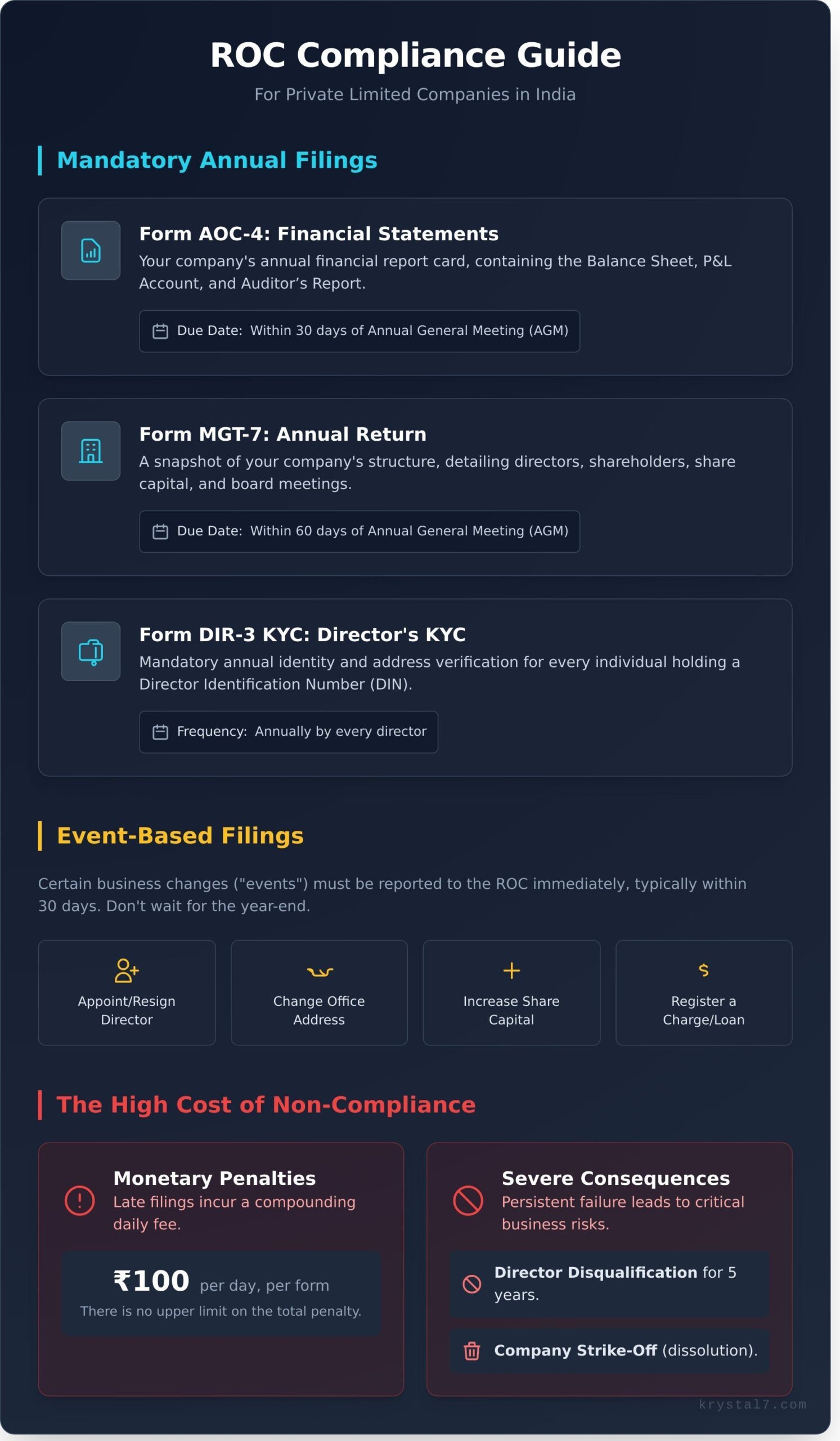
Form AOC-4 is your company’s annual financial report card. This crucial document contains your audited financial statements, including the Balance Sheet, Profit & Loss Account, and the Auditor’s Report. It provides the ROC with a comprehensive view of your company’s financial performance over the past year. The due date for filing Form AOC-4 is within 30 days of your Annual General Meeting (AGM).
Filing Annual Return (Form MGT-7)
While AOC-4 covers your financials, Form MGT-7 provides a detailed overview of your company’s structure and administration. This return includes key details about your directors, shareholders, share capital, and board meetings held during the year. It’s a snapshot of your company’s corporate governance. The due date for filing Form MGT-7 is within 60 days of your Annual General Meeting (AGM).
Director’s KYC Verification (Form DIR-3 KYC)
Transparency extends to the people running the company. Form DIR-3 KYC is a mandatory annual identity verification for every individual who holds a Director Identification Number (DIN). This simple process ensures that the ROC’s database has the current and correct contact details for all directors, maintaining accountability. This must be filed annually by every director.
Event-Based ROC Filings: When to Report Changes
Compliance isn’t just a once-a-year task. Your business is dynamic, and certain changes or "events" trigger an immediate duty to inform the ROC. Failing to report these changes in a timely manner can also lead to penalties. Here are the most common event-based filings you need to know about.
Changes in Company Leadership
Any change in your company’s board of directors must be reported. This includes the appointment of a new director, the resignation of an existing one, or any changes in their designations. These events must be reported to the ROC, typically through Form DIR-12, within 30 days of the change taking effect.
Changes to Company Structure
If your company undergoes structural changes, the ROC needs to be notified. This includes common events like changing the registered office address, increasing the company’s authorized share capital to bring in more investment, or altering the foundational documents of your company-the Memorandum of Association (MOA) or Articles of Association (AOA).
Financial Activities
Key financial activities also require ROC filings. When your company takes a loan and creates a charge on its assets (like mortgaging property), this must be registered with the ROC. Similarly, when you issue new shares to investors or existing owners through an allotment process, this must also be formally reported.
The Real Cost of Non-Compliance: Penalties & Risks
Ignoring or delaying your ROC filings can lead to serious consequences that go far beyond a simple warning. Understanding these risks is the first step in protecting your business, your directors, and your future growth potential.
Monetary Penalties and Late Fees
The most immediate consequence of missing a deadline is financial. Late filings incur a significant daily penalty that continues to accumulate until the form is submitted. What might start as a small oversight can quickly snowball into a substantial financial burden for your company due to these compounding fees.
Director Disqualification and Company Strike-Off
The consequences can become much more severe for persistent non-compliance. Directors of a defaulting company can be disqualified, barring them from holding directorships in any other company for a period of five years. In the most serious cases, the ROC can remove the company’s name from the official register, a process known as a "strike-off." This effectively dissolves the company, freezes its bank accounts, and makes it illegal to continue operations.
How Krystal7 Ensures You Never Miss a Deadline
The stakes are too high to leave compliance to chance. Our annual compliance packages are designed to provide you with total peace of mind. Our team of experts manages your compliance calendar, prepares all necessary documents, and ensures every filing is completed accurately and on time. We handle the complexities so you can focus on what you do best-running your business. Explore Our Hassle-Free Compliance Packages.
Frequently Asked Questions
-
What are the three main ROC compliances for a private limited company?
The three core annual compliances are: 1) Filing financial statements in Form AOC-4, 2) Filing the annual return in Form MGT-7, and 3) Completing the KYC for all directors using Form DIR-3 KYC. -
What is the penalty for late filing of Form AOC-4 and MGT-7?
The penalty for late filing is a daily fee of INR 100 for each day of delay, for each form. There is no upper limit, so the amount can become very significant over time. -
Is an audit mandatory for every private limited company in India?
Yes, every private limited company, regardless of its turnover or profit, is required to have its financial accounts audited by a qualified Chartered Accountant every financial year. -
How can I check my company’s ROC compliance status?
You can check your company’s status on the Ministry of Corporate Affairs (MCA) portal. By entering your Company Identification Number (CIN), you can view public documents and see the history of filings to determine if your company is compliant. -
What is the difference between ROC compliance and income tax compliance?
ROC compliance relates to corporate governance and is filed with the Ministry of Corporate Affairs under the Companies Act, 2013. Income tax compliance relates to your company’s tax obligations and is filed with the Income Tax Department. Both are mandatory but are separate legal requirements.
Staying compliant is the foundation of a healthy, trustworthy, and successful business. By understanding your obligations and partnering with the right experts, you can navigate the regulatory landscape with confidence. Don’t let paperwork and deadlines become a source of stress. For a comprehensive understanding of all your filing requirements and deadlines, check out our complete guide to ROC compliance for private limited company. Secure Your Company’s Future. Get a Free Compliance Consultation.

Article by
Nihal Srivastava
Nihal Srivastava is the Co-Founder of Krystal7 Consultants, helping Indian entrepreneurs and startups navigate company registration, compliance, trademark protection, and regulatory requirements with clarity and confidence. With 6+ years of hands-on expertise in MCA filings, GST compliance, and corporate structuring, Nihal has guided 1000+ businesses across India through their legal and compliance journeys. He believes every business dream deserves crystal clear foundations, and that no founder should be held back by paperwork or red tape.