

ITC Refund Under GST: The Complete 2026 Guide to Input Tax Credit Claims
Last updated on May 15, 2024.
Your blocked capital should be back in your bank account within 60 days of filing a claim under Rule 89 of the CGST Rules, 2017. For the thousands of businesses facing an inverted duty structure, a pending itc refund represents a significant portion of their operational cash flow. You likely felt the frustration of navigating the GST portal only to face a deficiency memo or a total rejection of your claim.
We understand that the fear of a GST audit or the complexity of Circular number 125 of 2019 can make the process feel overwhelming. Whether your claim is for INR 5,00,000 or INR 50,00,000, you deserve the freedom to focus on your growth without worrying about errors. This guide ensures your business dream maintains its momentum by providing a crystal clear roadmap to securing your legitimate dues.
We will master the complexities of three key areas: eligibility criteria, documentation requirements, and the step by step filing process for 2026. From calculating the maximum refund amount to avoiding common pitfalls that lead to litigation, this expert guide provides the clarity you need for a successful itc refund credit to your bank account.
Key Takeaways
- Understand the legal framework of Section 54 of the CGST Act to determine if your venture qualifies for refunds under zero rated supplies or inverted duty structures.
- Master the step by step process to file an itc refund claim on the GSTN portal while ensuring your purchase registers align perfectly with GSTR 2B records.
- Track mandatory compliance timelines and the two year limitation period to ensure your claims are filed before the statutory expiry date.
- Safeguard your business from interest and penalties by adhering to rigorous record keeping standards and statutory documentation requirements.
- Acquire the clarity needed to transform complex tax recovery into a streamlined process that gives you the freedom to focus on business growth.
Last updated on January 1, 2026.
Understanding ITC Refund under GST: Applicable Laws and Rules
An itc refund is a vital mechanism that allows businesses to reclaim excess tax paid on inputs when it cannot be offset against output tax liability. This process ensures that capital remains fluid for operational needs. It’s particularly relevant for exporters and businesses facing tax rate imbalances. The system prevents tax from becoming a permanent business cost.
Section 54 of the CGST Act, 2017 provides the primary legal authority for these claims. It mandates that any person claiming a refund must file an application before the expiry of two years from the relevant date. This timeline is strict and requires precise calculation based on the nature of the supply. Missing this window can lead to a permanent loss of funds.
Rule 89 of the CGST Rules, 2017 determines the actual itc refund amount through specific mathematical formulas. These formulas account for the turnover of zero rated supplies and adjusted total turnover. The GST portal facilitates the entire electronic filing process. This digital approach ensures that every claim is tracked with crystal clear transparency.
The Core Concept of Input Tax Credit
Input Tax Credit reduces the total tax liability on outward supplies by allowing a credit for taxes paid on business purchases. It’s a fundamental feature that prevents double taxation. However, an itc refund isn’t an automatic right for every business. It’s limited to specific scenarios defined by the statutes.
You can only claim these refunds if you hold a valid tax invoice issued under Section 31 of the CGST Act, 2017. The law requires that the supplier must have uploaded these invoices and paid the corresponding tax. Without this verified documentation, your claim for credit or refund will likely face rejection during departmental audits.
Statutory Framework for Refunds
The Central Board of Indirect Taxes and Customs acts as the administrative head for these regulations. They release notifications to simplify compliance for small and medium enterprises. Circular No. 125/44/2019 is a landmark document that established the fully electronic process for filing and processing refund claims across India.
The GST Council sets the overarching policies and eligibility criteria for every itc refund application. Their recommendations lead to amendments in the rules that govern how businesses calculate their claims. Staying aligned with these statutory changes is essential to avoid litigation. Proactive monitoring of these rules provides the freedom to focus on growth.
- Review your GSTR 2B to confirm that all input tax credits are reflected and eligible for a claim.
- Identify if your business falls under the inverted duty structure or zero rated supply category.
- Verify that the two year limitation period under Section 54 has not expired for your specific tax period.
Talk to Krystal7 today to secure your refund with professional precision. Book a call for a comprehensive compliance check to safeguard your cash flow.
Compliance is easy when it is systematic.
Eligibility and Applicability Thresholds for ITC Refund
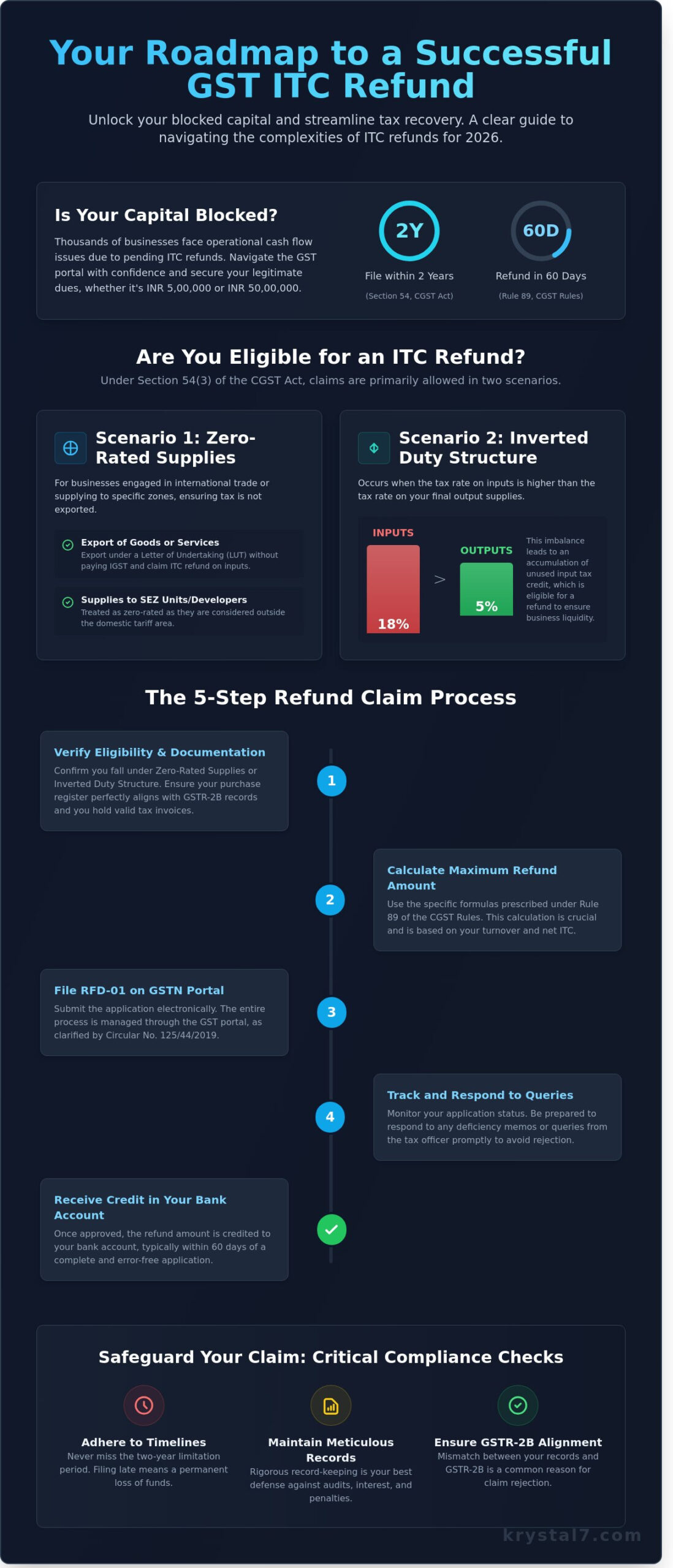
Understanding your eligibility is the first step toward reclaiming blocked capital and improving liquidity. Under Section 54(3) of the CGST Act, 2017, an itc refund is restricted to two specific legal scenarios. Securing an itc refund requires absolute adherence to these categories, as the GST portal validates claims against your filed returns. You cannot claim a refund if the goods exported are subject to export duty or if you avail of a drawback on the central tax.
Scenario 1: Zero Rated Supplies and Exports
Zero rated supplies are defined under Section 16 of the IGST Act, 2017. This category includes the export of goods or services and supplies made to a Special Economic Zone developer or unit. You have two distinct paths for these claims. You can export under a Letter of Undertaking without paying integrated tax and then claim an itc refund on your inputs. Alternatively, you can pay the tax at the time of export and claim a refund of that tax paid.
Supplies to Special Economic Zone units are treated as zero rated because they are considered outside the domestic tariff area for tax purposes. Deemed exports, as notified under Section 147, also qualify for specific benefits. These typically include supplies to Export Oriented Units or against Advance Authorisation. If you are unsure which path fits your current turnover, you can Get a compliance check to optimize your cash flow strategy.
Scenario 2: Inverted Duty Structure
An inverted duty structure occurs when the tax rate on your inputs is higher than the tax rate on your outward supplies. This often happens in industries like textiles, fertilizers, or footwear. For instance, if you purchase raw materials at 18 percent GST but sell the finished product at 5 percent, your credit accumulates indefinitely. Applying for an itc refund under this structure helps convert that ledger balance into actual bank funds.
The maximum refund amount is calculated using the specific formula in Rule 89(5) of the CGST Rules, 2017. This formula considers the net ITC and the proportion of inverted turnover to total turnover. Some items are specifically excluded from this benefit by the government. Notification No. 15/2017 Central Tax Rate prohibits refunds for certain construction materials and rail locomotive parts.
- Verify your eligibility by applying the Rule 89(5) inverted duty formula to your current tax period data.
- Ensure all export documents like Shipping Bills and Bills of Export are matched with your GSTR 1 and GSTR 3B returns.
- Consult with a GST consultant to validate your calculation before filing the RFD 01 form.
Compliance is easy when it is systematic.
Mandatory Compliance: Due Dates and Periodic Table
Section 54(1) of the CGST Act 2017 mandates that any person claiming a refund of tax or interest must file an application before the expiry of two years from the relevant date. This timeline is absolute and non negotiable. Missing this window leads to the permanent loss of your right to an itc refund. Krystal7 ensures your filings are precise and timely, providing the clarity you need to protect your working capital.
The relevant date acts as the trigger for this limitation period. For goods exported by sea or air, the date is when the ship or aircraft departs India. For exports via land, it is the date the goods pass the customs frontier. If you are claiming a refund under the inverted duty structure, the relevant date is the due date for furnishing the return under Section 39 for the period in which the claim arises.
Due Date and Periodicity Table
Filing for an itc refund requires a disciplined approach to the GST calendar. The following table outlines the statutory requirements for filing claims on the GSTN portal. Adhering to these cycles is essential to maintain liquidity and avoid the rejection of claims due to time bars.
| Compliance Type | Frequency | Due Date | Portal | Responsible Person |
|---|---|---|---|---|
| Refund Application (RFD 01) | Monthly or Quarterly | 2 years from Relevant Date | GSTN Official Website | Authorized Signatory |
| Acknowledgment (RFD 02) | Per Application | 15 days from filing RFD 01 | GSTN Official Website | Proper Officer |
| Deficiency Memo (RFD 03) | Per Application | 15 days from filing RFD 01 | GSTN Official Website | Proper Officer |
Forms and Portals Involved
Rule 89 of the CGST Rules 2017 governs the digital process for claims. Form GST RFD 01 is the primary application used to claim your itc refund. This form must be filed electronically on the GST common portal. It requires detailed attachments, including statements of invoices and declarations of non unjust enrichment. Precision at this stage prevents future disputes with the department.
Once you submit the application, the Proper Officer examines it for completeness. If the application is valid, you receive Form GST RFD 02 as an acknowledgment within 15 days. This acknowledgment is a critical milestone because it locks in the filing date for limitation purposes. It also starts the 60 day clock for the department to sanction the refund.
If the officer finds discrepancies or missing documents, they issue Form GST RFD 03. This is known as a deficiency memo. Receiving this memo means your current application is rejected and you must file a fresh one. It is vital to note that the time spent on a deficient application does not pause the two year limitation period. Filing a fresh application after the two year mark will result in a time barred claim.
- Identify the relevant date for every export shipment or inverted duty period in your books.
- Review your GSTR 2B to ensure all credits are reflected before filing the itc refund application.
- Monitor the GST portal daily after filing to respond to any RFD 03 deficiency memos within 48 hours.
Compliance is easy when it is systematic.
Step by Step Process for Claiming GST ITC Refund
The journey toward a successful itc refund begins long before you touch the GSTN portal. You must first ensure your internal purchase registers align perfectly with GSTR 2B data. Under Rule 36(4) of the CGST Rules 2017, credit is only available if the supplier has uploaded the invoice and it appears in your portal. This reconciliation prevents the 100 percent rejection of claims during subsequent departmental audits. Accuracy in your books provides the crystal clarity needed to face statutory scrutiny with confidence.
Once your data is verified, you move from accounting software to the official portal. This transition requires meticulous attention to detail. Any mismatch between your shipping bills and the invoices listed in your itc refund application will trigger a deficiency memo in Form RFD 03. Following a structured workflow ensures you maintain your freedom to focus on business growth while we handle the technical compliance. Precision at this stage is the difference between a swift disbursement and a long legal struggle.
The Practical Filing Workflow
Step 1: Access the GST portal using your credentials. Navigate to the Services tab, select Refunds, and click on Application for Refund. This starts the formal process under Section 54 of the CGST Act 2017.
Step 2: Choose the relevant refund type, such as refund of unutilized ITC on export of goods without payment of tax. Select the specific tax period. Ensure all GSTR 1 and GSTR 3B filings for that period are already filed and updated.
Step 3: Prepare and upload the mandatory JSON file. This file contains the Annexure 1 statement of invoices. This document is the backbone of your claim: it links your purchases to your outward supplies. Errors here lead to immediate system validation failures and rejection.
Step 4: Review the auto populated Form RFD 01. Authenticate the submission using a Class 3 Digital Signature Certificate. This final step legally binds the declaration of the taxpayer and submits the claim for officer review.
Documents Required Table
| Document | Provider | Format | Validity | Common Errors |
|---|---|---|---|---|
| Export Invoices | Taxpayer | JSON or PDF | Current Period | Mismatched invoice numbers or dates. |
| Shipping Bills | Customs Dept | ICEGATE Data | Linked to EGM | Port code errors or missing EGM numbers. |
| BRC or FIRC | Authorized Bank | Digital or Physical | Post realization | Value mismatch with invoice currency. |
| Purchase Invoices | Suppliers | GSTR 2B | Financial Year | Claims for blocked credit under Section 17(5). |
Annexure 1 is not just a list: it is a statutory requirement under Circular No. 125/44/2019 GST. It serves as the primary evidence for the tax officer to verify the eligibility of each invoice. Precise data entry in this statement eliminates the guesswork that often leads to delayed disbursements. When your documentation is methodical, the path to liquidity becomes streamlined and certain.
Penalties, Interest, and Mandatory Record Keeping
Claiming an itc refund requires surgical precision. Mistakes lead to more than just rejection: they trigger financial liabilities. The GST department views erroneous claims with high scrutiny. If you utilize a refund obtained through misstatement, you face recovery proceedings under Section 73 or Section 74 of the CGST Act. Financial consequences are immediate. You must repay the principal amount along with interest. This interest is calculated from the date of the refund receipt until the date of repayment.
The department isn’t always the one collecting interest. Under Section 56, if the government fails to process your itc refund within 60 days from the date of receiving the application, they must pay you interest. This provides a level of accountability for the authorities. However, to qualify for this, your application must be complete and free of discrepancies. Any deficiency memo issued by the officer pauses this 60 day clock.
Penalty and Interest Table
The following table outlines the statutory consequences for defaults and the compensation for delays as per the CGST Act 2017.
| Default Type | Penalty Amount | Interest Rate | Section Reference |
|---|---|---|---|
| Incorrect Claim (No Fraud) | 10% of tax or ₹ 10,000 (Higher) | 18% per annum | Section 122(2)(a) |
| Fraudulent Claim | 100% of tax or ₹ 10,000 (Higher) | 18% per annum | Section 122(2)(b) |
| Delayed Refund by Dept | Not Applicable | 6% per annum | Section 56 |
Record Keeping Requirements
Digital records are your best defense during audits. You must maintain these for at least five years from the annual return due date. This includes GSTR 1, GSTR 3B, and every tax invoice related to your claims. Service exporters must also secure Bank Realization Certificates or Foreign Inward Remittance Certificates. Your annual compliance for private limited company must integrate these documents to ensure audit readiness. Missing documents often lead to the reversal of credits during department reconciliations.
Final Action Plan
Examine your electronic credit ledger today. If you have unutilized credits exceeding ₹ 1,000, you are eligible to initiate the process. Schedule a company registration health check to ensure your entity structure supports maximum tax efficiency. Book a call with Krystal7 to streamline your refund filing and protect your cash flow from technical errors.
- Download your GSTR 2B and reconcile it with your purchase register to spot missing invoices.
- Verify that all export shipping bills are correctly integrated with the ICEGATE portal.
- Talk to Krystal7 to validate your refund eligibility before the two year limitation period expires.
Compliance is easy when it is systematic.
Secure Your Working Capital and Focus on Growth
Navigating the complexities of Section 54 of the CGST Act 2017 requires absolute precision. You’ve learned that an accurate itc refund claim depends on reconciling GSTR 2B with your purchase register and submitting Form GST RFD 01 within the two year statutory limit. Errors in documentation often lead to deficiency memos and delayed liquidity for your venture.
Don’t let your capital stay blocked in the electronic credit ledger. Our Gurugram based team of legal strategists brings a zero error track record in RFD 01 filings to your business. We provide the clarity you need to handle statutory requirements under Rule 89 and Rule 96. This allows you the freedom to focus on building your legacy while we manage the technical red tape.
Expertise in Section 54 compliance ensures your claims are processed without unnecessary hurdles. We’ve helped numerous businesses recover funds and maintain a healthy cash flow. Start your journey toward crystal clear transparency today.
Book a call with our GST experts today to unlock your blocked capital.
Compliance is easy when it is systematic.
Frequently Asked Questions
What is the maximum time limit to claim an itc refund under GST?
You must file your itc refund application within two years from the relevant date as prescribed under Section 54(1) of the CGST Act, 2017. This timeline is strict and missing the deadline usually leads to the permanent loss of your claim. The relevant date varies depending on whether you’re exporting goods or services.
It’s vital to track your filing dates carefully to ensure you don’t lose out on liquidity. Our team helps businesses maintain a compliance calendar to avoid these risks. Clarity in timing is the first step toward a successful claim.
Can I claim a refund of ITC on capital goods in an inverted duty structure?
No, you cannot claim a refund for tax paid on capital goods under the inverted duty structure. Section 54(3)(ii) of the CGST Act, 2017 explicitly limits this refund to the credit accumulated on inputs only. This means tax paid on input services and capital goods like machinery is excluded from the refund calculation.
Rule 89(5) of the CGST Rules, 2017 provides the specific formula for this calculation. You should ensure your accounting system separates these categories clearly to avoid errors in your application. We provide the expertise to help you categorise your expenses accurately.
What happens if my itc refund application is rejected with a deficiency memo?
You must file a fresh application if the tax officer issues a deficiency memo in Form GST RFD 03. Rule 90(3) of the CGST Rules, 2017 states that the original application is treated as if it was never filed. You’ll need to rectify all the errors mentioned in the memo before resubmitting.
The two year time limit still applies to your fresh submission. This means you must act quickly to ensure the new application is filed within the legal window. Systematic record keeping is the best way to prevent these administrative hurdles.
Is it mandatory to have a CA certificate for all itc refund claims?
A certificate from a Chartered Accountant or a Cost Accountant is mandatory only if your itc refund claim exceeds INR 2,00,000. This requirement is defined under Rule 89(2)(m) of the CGST Rules, 2017. For claims below this threshold, a simple self declaration is sufficient to prove that the tax burden hasn’t been passed to another person.
The certificate provides the department with an expert assurance of your claim’s validity. It’s a key part of maintaining transparency with the tax authorities. We offer the professional expertise needed to certify your claims with precision.
What is the relevant date for calculating the two year limit for exports?
The relevant date depends on the nature of your export as per Explanation 2 to Section 54 of the CGST Act, 2017. For goods exported by sea or air, it’s the date the vessel or aircraft leaves India. For services, it’s the date you receive payment in convertible foreign exchange.
If you receive an advance for services, the relevant date is the date of the invoice. Understanding these specific triggers is essential for calculating your filing window. We bring clarity to these complex rules so you can focus on your global growth.
Can a new business apply for an itc refund immediately after registration?
Yes, a new business can apply for a refund as soon as they meet the eligibility criteria for zero rated supplies or an inverted duty structure. There’s no minimum waiting period after obtaining your GST registration. You just need to ensure that your outward supplies and inward credits are properly reflected in your returns.
Your itc refund claim must be supported by valid invoices that appear in your GSTR 2B. Starting your compliance journey with the right processes ensures you don’t face cash flow issues early on. We partner with visionaries to build this foundation from day one.
How much interest does the government pay on delayed itc refunds?
The government is liable to pay interest at a rate of 6% per annum if your refund isn’t sanctioned within 60 days of receiving the application. This provision is governed by Section 56 of the CGST Act, 2017. The interest is calculated from the end of the 60 day period until the date the refund is actually credited.
If the refund is delayed due to an order from an appellate authority or court, the interest rate can increase to 9% per annum. While the government aims for efficiency, this interest provides a small financial cushion for businesses. We monitor your application status to ensure you receive every rupee you’re owed.
What is the minimum amount for which a GST refund can be claimed?
You cannot claim a refund if the amount is less than INR 1,000 as per Section 54(14) of the CGST Act, 2017. This limit applies to each tax head: CGST, SGST, UTGST, and IGST: individually. If your claim under a specific head is INR 999, the portal will not allow the filing.
This rule exists to reduce the administrative burden of processing very small amounts. It’s often better to let smaller credits accumulate until they surpass the threshold. Compliance is easy when it is systematic.

Article by
Nihal Srivastava
Nihal Srivastava is the Co-Founder of Krystal7 Consultants, helping Indian entrepreneurs and startups navigate company registration, compliance, trademark protection, and regulatory requirements with clarity and confidence. With 6+ years of hands-on expertise in MCA filings, GST compliance, and corporate structuring, Nihal has guided 1000+ businesses across India through their legal and compliance journeys. He believes every business dream deserves crystal clear foundations, and that no founder should be held back by paperwork or red tape.