

What is an ROC Compliance Checklist? A Guide to Staying Penalty-Free in 2026
The threat of steep daily penalties from various state and federal regulatory bodies is a real concern for every business owner. Add the complexities of ever-evolving compliance requirements and the looming risk of losing good standing, and it’s easy to feel overwhelmed. This constant compliance anxiety can pull your focus away from what truly matters: growing your business and realizing your vision.
This is precisely why a proactive approach is essential. Instead of reacting to notices, you can take control with a clear, methodical system. But what is an ROC compliance checklist, and how can it act as your shield against these risks? It’s the key to transforming compliance from a source of stress into a strategic advantage, giving you the freedom to focus on what you do best.
In this guide, Krystal7 Consultants provides the clarity you need. We will break down the essential annual and event-based filings required for your company, creating a straightforward roadmap to stay penalty-free in 2026. You’ll gain the confidence that comes from knowing your company’s legal standing is secure, attractive to investors, and free from unnecessary legal hassles.
Key Takeaways
- ROC compliance is a strategic tool for maintaining your company’s good standing with the MCA, not just a legal burden.
- Understanding what is a roc compliance checklist is the first step toward creating a clear, actionable plan to navigate your company’s statutory duties penalty-free.
- Your compliance duties extend beyond an annual cycle, as key business events can trigger immediate filing requirements you can’t afford to miss.
- Late filings incur steep, compounding per-day penalties, making proactive compliance essential for protecting your company’s financial health.
Understanding ROC Compliance and Its Strategic Value for Your Business
For any ambitious founder, the term “compliance” can often sound like a burden – a set of rules that distract from the real work of building a business. But what if you viewed it as a strategic asset? ROC (Registrar of Companies) compliance is the framework of statutory requirements mandated by the Companies Act, 2013. It’s not just about filing forms; it’s about creating a transparent, trustworthy, and scalable business from day one.
The Ministry of Corporate Affairs (MCA) uses these filings to monitor the operational and financial health of every registered company in India. For founders asking what is roc compliance checklist, the answer begins here: it is your roadmap to demonstrating stability and good governance. A clean compliance record builds Krystal-Clear transparency for stakeholders – from your customers and lenders to your employees. More importantly, during due diligence, it is often the very first thing potential investors scrutinize to validate your company’s integrity and potential for growth.
The Relationship Between MCA, ROC, and Your Company
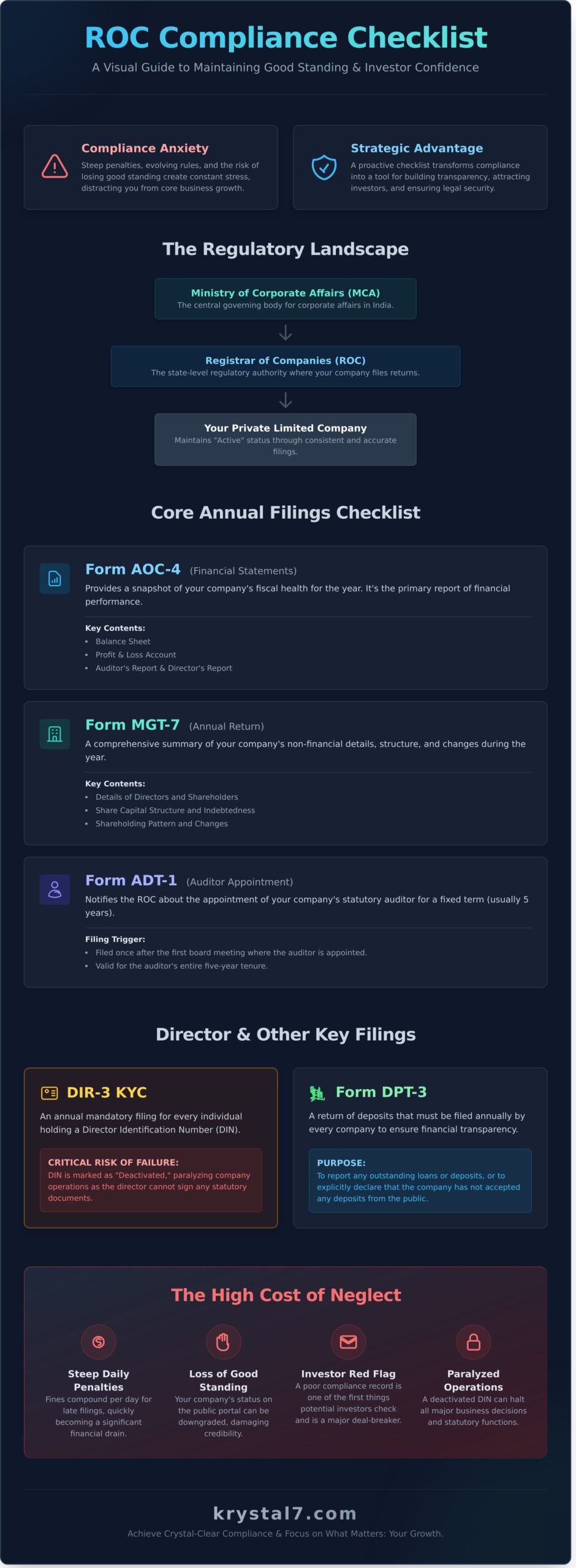
Think of the MCA as the central governing body for corporate affairs in India. Operating under it, each state has its own Registrar of Companies (ROC), which functions as the local regulatory authority. Your regular filings – from annual returns to financial statements – are submitted to your local ROC. This consistent communication is what maintains your company’s “Active” status on the public portal, ensuring your Certificate of Incorporation remains valid and your business is legally operational.
Why “Clarity” in Compliance Equals Freedom to Focus
Maintaining organized compliance records systematically reduces the mental load and anxiety for founders. Instead of reacting to deadlines and fearing penalties, you operate from a position of control. This disciplined approach forms the bedrock of strong corporate governance, setting the stage for ethical scaling. It marks the critical transition from a “startup” mindset, focused purely on survival, to a “compliant corporation” mindset, built for a lasting legacy and investor confidence.
The Core ROC Compliance Checklist: Mandatory Annual Filings
For any Private Limited Company, the end of the financial year signals the start of a critical compliance period. Understanding what is roc compliance checklist begins with mastering this annual cycle. Every company must adhere to a strict schedule of Mandatory Annual Filings as prescribed by the Ministry of Corporate Affairs. This is not optional; it is the foundation of your company’s legal standing. To avoid last-minute hassles and penalties, maintaining a compliance calendar is essential, especially for tracking deadlines that may shift in 2026. Before you begin, ensure you have key documents like the Audited Financial Statements and the Board’s Director Reports ready, as these form the basis for all annual filings.
Key Forms: AOC-4, MGT-7, and ADT-1
Three primary forms constitute the core of your annual ROC filing responsibility. Each serves a distinct purpose in providing a transparent overview of your company’s yearly performance and structure:
- Form AOC-4: This is the filing for your company’s financial statements. It includes the Balance Sheet, Profit & Loss Account, and other crucial financial documents that provide a snapshot of your fiscal health.
- Form MGT-7: The Annual Return is the comprehensive summary of a company’s share capital and indebtedness. This form also contains updated details about the company’s directors, shareholders, and shareholding patterns.
- Form ADT-1: Filed to notify the ROC about the appointment of a statutory auditor. This form is typically filed after the first board meeting and is valid for the auditor’s entire tenure, usually five years.
Navigating these forms can be complex, but getting them right is crucial for maintaining a clean compliance record. For a more detailed breakdown, see our complete Guide to Annual Compliance for a Private Limited Company.
Director-Specific Compliance: DIN and KYC
Beyond company-level filings, directors have individual responsibilities. Every individual holding a Director Identification Number (DIN) must complete the DIR-3 KYC filing annually. Failure to do so results in the DIN being marked as “Deactivated,” which can paralyze company operations, as the director will be unable to sign any statutory documents. Additionally, Form DPT-3 must be filed by every company to report any outstanding loans or declare that it has not accepted public deposits, ensuring financial transparency.
Beyond the Annual Cycle: Event-Based Compliance Triggers
While most entrepreneurs are aware of annual filing deadlines, a truly effective ROC compliance strategy looks beyond the calendar. Statutory compliance, like filing annual returns, follows a predictable rhythm. Event-based compliance, however, is dynamic and triggered by specific business activities. Understanding what is roc compliance checklist in its entirety means accounting for these crucial, time-sensitive filings that can arise at any point during the year.
The greatest compliance risk often lies not in the year-end rush, but in the unmonitored changes that happen mid-year. A simple business decision can trigger a mandatory ROC filing with a strict 15-30 day deadline. Overlooking these can lead to escalating penalties and legal complications that disrupt your growth.
Changes in Management and Capital Structure
As your venture evolves, so does its structure. Each significant change must be formally communicated to the Registrar of Companies. Key triggers include:
- Appointment or Resignation of a Director: Any change in the board composition must be filed using Form DIR-12 within 30 days.
- Altering Share Capital: Increasing authorized capital (Form SH-7) or issuing new shares (Form PAS-3) requires prompt notification.
- Changing the Registered Office: Moving your official business address must be reported via Form INC-22 within 15 days of the change.
Statutory Meetings and Documentation
Compliance is more than just submitting forms; it’s about maintaining a meticulous and legally sound internal record. This includes holding the Annual General Meeting (AGM) within the mandated timeline and diligently maintaining statutory records. Minute Books for Board and General Meetings, along with various Statutory Registers, must be accurately kept. A qualified Company Secretary plays a pivotal role in ensuring these records are correctly prepared and certified, providing an essential layer of governance.
Ignoring these event-based triggers is a common but costly mistake. The Ministry of Corporate Affairs frequently updates its framework around Penalties and Non-Compliance Risks, making it vital to stay current. This is where Krystal7’s “Dedicated Relationship” model provides crystal clarity. Your advisor knows your business inside and out, proactively identifying these triggers before deadlines loom. We ensure your response to what is roc compliance checklist is not just reactive, but a streamlined and strategic part of your business operations, giving you the freedom to focus on your vision.
The High Cost of Neglect: Penalties and Non-Compliance Risks
Understanding what is roc compliance checklist is not just about ticking boxes; it’s about safeguarding your business from severe, often escalating, consequences. Overlooking statutory duties can transform minor oversights into significant financial and legal liabilities, jeopardizing your company’s future and the personal standing of its directors. The cost of neglect far outweighs the effort of maintaining regular compliance.
The penalties are designed to be stringent, ensuring companies adhere to the principles of transparency and accountability. Let’s break down the real-world impact of non-compliance.
Financial Penalties and Additional Fees
The most immediate impact of a missed deadline is financial. For crucial annual filings like Form AOC-4 (Financial Statements) and Form MGT-7 (Annual Return), the Companies Act imposes a penalty of ₹100 for each day of default with no upper limit. This per-day penalty is compounded by “Additional Fees” that increase exponentially with the period of delay. A delay of a few months can quickly accumulate into tens of thousands of rupees. This financial drain is entirely avoidable but can cripple a small business. Furthermore, a poor compliance history negatively affects your company’s credit rating, making it significantly harder to secure loans or attract investment.
Director Disqualification and Legal Repercussions
The consequences extend beyond monetary fines to the individuals leading the company. A director can be disqualified for five years if the company has failed to file its financial statements or annual returns for three consecutive financial years. This action bars them from being a director in any other company, severely impacting their professional career.
In cases of continuous non-compliance, the Registrar of Companies (ROC) has the power to strike off the company’s name from its register, rendering the company defunct. Reversing this is a complex, time-consuming, and expensive legal battle through the National Company Law Tribunal (NCLT). Furthermore, under Section 92, failure to file the annual return can lead to penalties for the company and its officers, which may include both hefty fines and potential imprisonment for the defaulting officers. Proactive compliance is your best defense against such damaging outcomes.
Navigating this complex landscape requires clarity and expertise. Let Krystal7 Consultants provide you with the peace of mind to focus on your business growth.
Achieving Crystal-Clear Compliance with Krystal7 Consultants
Navigating the complexities of ROC filings can feel overwhelming, filled with confusing red tape and administrative guesswork. At Krystal7, we transform this burden into a streamlined, stress-free process. We take the question of what is roc compliance checklist and turn it into a managed, proactive strategy, ensuring your business remains perfectly aligned with all statutory requirements, year after year.
Our All-in-one Annual Compliance Package is designed to be the ultimate stress-reduction tool for entrepreneurs. It’s more than a service; it’s a partnership. We combine the elite expertise of top-tier Chartered Accountants and Company Secretaries with a dedicated, human touch. This powerful combination gives you the one thing you need most: the Freedom to Focus on your vision, your growth, and your success, while we handle the meticulous details of your compliance.
Our Streamlined Compliance Process
We believe in a methodical approach that guarantees accuracy and peace of mind. Our process is built on three core pillars:
- Step 1: Meticulous Audit & Gap Analysis: We begin with a thorough audit of your existing records to provide a “Crystal-Clear” gap analysis, identifying any potential compliance risks before they become problems.
- Step 2: Timely Preparation & Signing: Our experts prepare all mandatory MCA forms, resolutions, and minutes with precision, facilitating seamless digital signing for your convenience.
- Step 3: Guaranteed Filing & Acknowledgment: We manage the entire filing process from start to finish, tracking each submission to ensure you receive 100% successful acknowledgment from the ROC.
Why Transparency and Upfront Pricing Matter
For us, clarity isn’t just a goal-it’s a promise. We operate on a strict “No Hidden Costs” policy, providing you with a comprehensive quote so you know exactly what to expect. Every client is paired with a dedicated relationship manager who understands your business, ensuring you always have a trusted expert to turn to. This approach moves beyond a generic understanding of what is roc compliance checklist to provide tailored, proactive support.
Ready to experience compliance without the complexity? Get Your Krystal-Clear Compliance Quote Today.
Your Path to Krystal-Clear Compliance and Growth
Navigating the complexities of corporate governance begins with understanding what is roc compliance checklist is and its strategic importance. As we’ve explored, staying penalty-free involves mastering both mandatory annual filings and critical event-based submissions. Overlooking these statutory duties can expose your business to significant financial and reputational risks, hindering your growth and disrupting your vision.
But you don’t have to manage this intricate process alone. At Krystal7, we transform compliance from a source of anxiety into a streamlined pillar of your business. Our elite team of Chartered Accountants, Company Secretaries, and Legal Strategists acts as your dedicated partner, ensuring every detail is meticulously handled. With transparent pricing and a dedicated relationship manager, you gain absolute clarity and the freedom to focus on what truly matters: building your legacy.
Ready to eliminate guesswork and secure your venture’s future? Secure Your Business with our All-in-One Annual Compliance Package and build your company on a foundation of unshakeable confidence.
Frequently Asked Questions
What is the due date for ROC annual filing in 2026?
Navigating ROC deadlines brings clarity to your compliance calendar. For the financial year ending March 31, 2026, two key dates are crucial. Your Annual General Meeting (AGM) must be held by September 30, 2026. Following that, Form AOC-4 for financial statements is due by October 30, 2026, and Form MGT-7/7A for the annual return must be filed by November 29, 2026. Partnering with an expert ensures these deadlines are met seamlessly.
Can I file ROC forms myself without a professional?
While technically possible, it’s a path filled with complexities. The process requires a deep understanding of the Companies Act, correct form selection, and often, professional certification by a Chartered Accountant or Company Secretary. Attempting it yourself can lead to errors, rejections, and costly penalties. Our streamlined service removes the guesswork and ensures your filings are accurate and timely, providing you with complete peace of mind and professional assurance.
What happens if a company does not file its annual return for two years?
Failing to file annual returns for two consecutive financial years has severe consequences. The Registrar of Companies (ROC) can strike the company’s name from the register, marking it as defunct. More critically, all directors of that company will be disqualified from being appointed as a director in any other company for five years. This can halt your entrepreneurial journey and lead to frozen company bank accounts. Proactive compliance is essential to protect your business legacy.
Is ROC compliance mandatory for a dormant company?
Yes, even a dormant company must fulfill its ROC compliance obligations, although the process is simplified. Instead of standard annual returns, a dormant company must file Form MSC-3, the ‘Return of Dormant Company,’ once every financial year. This maintains your company’s legal status without the burden of full-scale filings. Neglecting this can lead to penalties and potential strike-off, so it’s a crucial step to keep your company in good standing for future ventures.
How much are the penalties for late ROC filing in 2026?
Late ROC filings attract a straightforward and potentially significant penalty. The additional fee is a flat INR 100 per day for each delayed form, such as AOC-4 or MGT-7. Since there is no upper limit, these penalties can accumulate rapidly, turning a minor oversight into a major financial burden. Our meticulous approach and proactive reminders ensure your filings are always on time, protecting your venture from these avoidable costs and giving you Krystal-Clear financial control.
What is the difference between MCA and ROC compliance?
Think of the Ministry of Corporate Affairs (MCA) as the central government body that sets all the rules for companies in India. The Registrar of Companies (ROC) is the local, state-level office that enforces these rules. Therefore, ROC compliance is the practical execution of MCA regulations. When you ask ‘what is roc compliance checklist’, you are essentially asking for the specific tasks required to meet the MCA’s legal standards at the ground level, ensuring your company operates lawfully.
Do LLPs need to follow the same ROC compliance checklist as Private Limited companies?
No, Limited Liability Partnerships (LLPs) and Private Limited Companies have distinct compliance requirements. While both file annual returns with the ROC, the specific forms and timelines differ. LLPs file Form 11 (Annual Return) and Form 8 (Statement of Account and Solvency). This is different from the AOC-4 and MGT-7 forms required for private companies. Understanding these nuances is key to avoiding errors, and our experts provide tailored guidance for your specific business structure.

Article by
Nihal Srivastava
Nihal Srivastava is the Co-Founder of Krystal7 Consultants, helping Indian entrepreneurs and startups navigate company registration, compliance, trademark protection, and regulatory requirements with clarity and confidence. With 6+ years of hands-on expertise in MCA filings, GST compliance, and corporate structuring, Nihal has guided 1000+ businesses across India through their legal and compliance journeys. He believes every business dream deserves crystal clear foundations, and that no founder should be held back by paperwork or red tape.