

Consequences of Late GST Filing in 2026: A Comprehensive Guide to Penalties and Compliance
Imagine the financial impact if delaying your GST return by just 24 hours cost your business more than the actual tax liability itself. For many entrepreneurs, GST compliance feels like a constantly shifting landscape, and the 2026 updates have only amplified the daily administrative burden. It’s natural to feel anxious about how the legal consequences of late GST filing might drain your cash flow or permanently block your access to vital Input Tax Credit (ITC). We understand that the apprehension of a ₹50 daily late fee or an unexpected notice from the department can feel like an unnecessary hurdle in your entrepreneurial journey.
We believe every entrepreneur deserves the freedom to focus on their growth without the shadow of statutory penalties hanging over their vision. This guide will help you understand the total financial impact
Key Takeaways
- Master the 2026 statutory timelines for Nil and active returns to ensure your business maintains a flawless compliance record from the start.
- Gain a clear financial breakdown of daily late fees and the 18% interest charge on net tax liability to protect your bottom line.
- Understand the hidden consequences of late gst filing, including how a dipping compliance rating can block Input Tax Credit and drive away valued customers.
- Follow a structured, step-by-step guide to rectifying overdue returns and navigating the Electronic Liability Register with absolute precision.
- Explore how Krystal7’s expert advisory brings crystal clarity to your tax obligations, giving you the freedom to focus on your business growth.
Understanding GST Filing Timelines and the High Cost of Delay
Every ambitious venture in India operates within a structured legal framework. By 2026, the digital ecosystem for tax has become tighter, making the consequences of late gst filing more immediate than ever before. Whether you are a startup or an established enterprise, your statutory obligation remains non-negotiable. Even if your business saw zero transactions this month, a Nil return is mandatory. Skipping this simple step triggers automated late fees that compound daily, creating a financial leak that’s easily avoided with the right discipline.
The Goods and Services Tax (GST) system relies on a chain of transparency. When one link breaks, the entire supply chain feels the friction. Moving from a state of being overwhelmed by deadlines to having crystal clarity over your ledger is the first step toward building a lasting legacy. Transparency isn’t just a regulatory hurdle. It’s the foundation of a healthy business. It signals to the market that your venture is built on solid ground. At Krystal7, we know that when your compliance is streamlined, your business vision can truly thrive.
The 2026 GST Calendar: Key Deadlines You Cannot Ignore
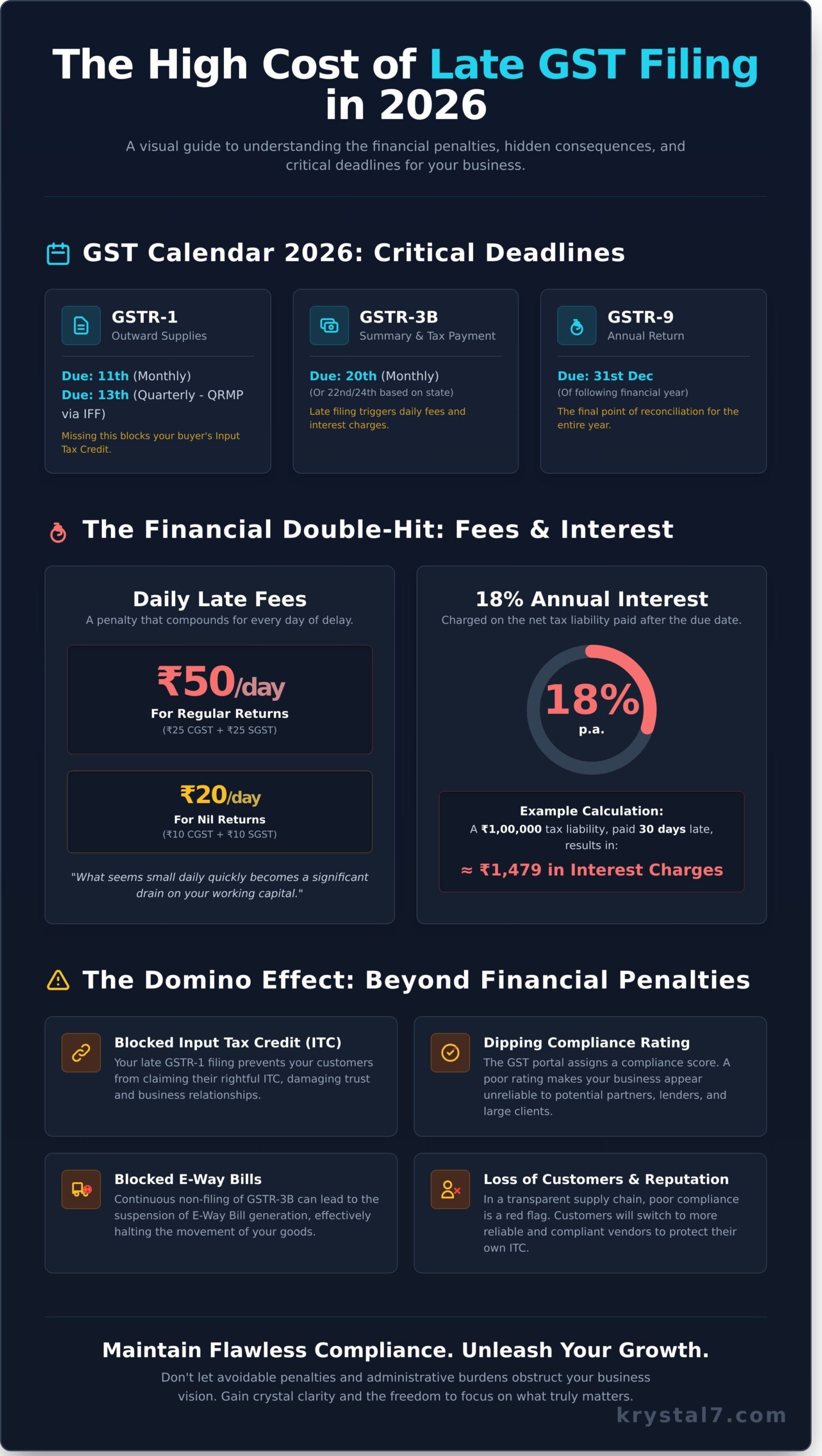
For the 2026 fiscal year, deadlines are split based on your aggregate turnover. If your turnover exceeds ₹5 Crores, monthly filing is your reality. GSTR-1, which details your outward supplies, is due by the 11th of every month. Your GSTR-3B, the summary return where tax is actually paid, falls on the 20th. Smaller taxpayers using the QRMP (Quarterly Return Monthly Payment) scheme must upload invoices via the Invoice Furnishing Facility (IFF) by the 13th. The GSTR-9 annual return remains the final reconciliation point, due by December 31st. Missing these specific dates leads to blocked E-way bills and restricted Input Tax Credit for your buyers, which can damage your professional relationships.
Why “Clarity” in Compliance Matters for Your Business Vision
Compliance is the silent engine of growth. When you file on time, you position your brand as a dependable expert. This reliability attracts elite partners and investors who value Krystal-Clear Transparency. Timely filing grants you the Freedom to Focus on scaling your venture rather than fighting administrative fires. Ignoring these dates causes red tape to accumulate quickly. You face an 18% interest rate on unpaid tax liabilities and a daily late fee that drains your working capital. Clear compliance ensures your business vision remains sharp and unobstructed by avoidable legal hurdles. It’s about moving from guesswork to a position of strength.
- GSTR-1: Due on the 11th (Monthly) or 13th (QRMP).
- GSTR-3B: Due on the 20th, 22nd, or 24th depending on your state and turnover.
- GSTR-9: The final annual audit due by December 31st of the following financial year.
- Interest: A fixed 18% per annum on the net tax liability paid after the due date.
Don’t let the consequences of late gst filing derail your momentum. Staying ahead of the 2026 calendar isn’t just about avoiding fees; it’s about maintaining the elite status your business deserves. When you manage your filings with precision, you eliminate the psychological burden of non-compliance. You gain the security of knowing your legal standing is impeccable. This methodical approach is what separates a temporary project from a true business legacy.
The Financial Breakdown: Late Fees and Interest Calculations
Delaying a GST return isn’t just a clerical oversight; it’s a direct drain on your business capital. The consequences of non-compliance with GST manifest as a two-pronged financial hit: fixed daily late fees and accruing interest. This structure ensures that the longer you wait, the deeper the financial hole becomes. Transparency is the bedrock of the current tax regime, and the portal leaves no room for ambiguity when these charges trigger.
Under Section 50 of the CGST Act, 18% interest per annum is charged on the net tax liability paid through the electronic cash ledger. This means if you owe ₹1,00,000 and pay it 30 days late, you’ll face an interest charge of roughly ₹1,479. It’s a steep price for a few weeks of delay. These costs accumulate silently until they’re settled, often surprising business owners who haven’t prioritized their monthly filing schedule.
Calculating Late Fees for GSTR-3B and GSTR-1
In 2026, the standard late fee for regular taxpayers stands at ₹50 per day for every day the return remains unfiled. This total is split equally between ₹25 for CGST and ₹25 for SGST. Nil filers aren’t exempt from the discipline of the calendar. Even with zero transactions, you must file to avoid a ₹20 per day charge. These daily amounts might seem small, but they quickly compound into significant liabilities for a growing venture.
To protect smaller ventures, the government maintains maximum penalty ceilings based on aggregate turnover slabs. For businesses with an annual turnover up to ₹1.5 crore, the total late fee is capped at ₹2,000 per return. For those with turnover between ₹1.5 crore and ₹5 crore, the cap increases to ₹5,000. Large enterprises exceeding ₹5 crore in turnover face a maximum penalty of ₹10,000. These caps provide a safety net, but they don’t negate the consequences of late gst filing on your credit rating and compliance score.
The Interest Trap: Net vs. Gross Tax Liability
One of the most significant wins for taxpayers was the shift to calculating interest on net tax liability. You only pay the 18% rate on the portion of tax settled in cash after exhausting your Input Tax Credit (ITC). The GST portal now automates this calculation in 2026, leaving zero room for manual errors or missed math. It’s a transparent system that rewards those who maintain a clean credit ledger and robust documentation. Section 50 interest is strictly applied at an 18% annual rate on the tax amount remaining unpaid after the due date.
Don’t expect the Income Tax Department to soften the blow. Penalties and late fees paid under GST laws are not deductible business expenses under Section 37 of the Income Tax Act. You’re paying these costs from your post-tax profits. This makes the consequences of late gst filing a permanent loss of wealth rather than a temporary cash flow hurdle. If you’re feeling overwhelmed by these deadlines, getting expert compliance support can provide the clarity you need to stay ahead and protect your bottom line.
Understanding these figures is about more than just avoiding costs; it’s about reclaiming your freedom to focus on growth. When you view compliance as a strategic asset rather than a chore, you build a business that is resilient and ready for scale. The clarity of a clean filing history is a powerful tool when seeking credit or bidding for major contracts.
Beyond the Fine: How Late Filing Impacts Your Business Reputation
Think of your GST compliance as a digital resume that’s visible to the entire market. Every time you miss a deadline, it’s not just a private matter between you and the tax department. The GST portal maintains a compliance rating for over 1.4 crore registered taxpayers. This rating is public. When a potential high-value client or a new vendor looks up your GSTIN, they see your filing history immediately. A string of late filings signals operational instability and financial distress. It’s a red flag that can kill a deal before the first meeting even starts.
One of the most severe consequences of late gst filing is the immediate financial strain it places on your customers. Your delay effectively freezes their money. If you don’t file your GSTR-1 by the 11th of the month, your buyers cannot see those invoices in their GSTR-2B. This means they can’t claim Input Tax Credit (ITC). You’re essentially forcing your partners to pay the tax twice, once to you and once to the government. This creates a massive trust deficit. Most professional firms won’t tolerate this more than once. They’ll simply move their business to a compliant competitor who offers Krystal-Clear Transparency.
Our legal strategists often see businesses hit a wall when they apply for expansion capital. Modern lenders like HDFC or ICICI Bank have moved toward GST-based lending models. They analyze your GSTR-3B filings to verify actual turnover and consistency. A single gap in your filing history can lower your internal credit score by 25% or more. Banks view non-compliance as a sign of poor management. If you can’t manage a monthly tax return, they won’t trust you with a 50-lakh rupee business loan.
Don’t fall into the trap of thinking, “I’ll just pay the fine later.” The late fee is the smallest part of the cost. You can’t buy back a lost reputation or a cancelled contract with a late fee payment. True business growth requires the Freedom to Focus on your vision, not the constant anxiety of hiding from creditors or tax officials.
The Domino Effect on Your Supply Chain
Large corporate entities now use automated compliance filters. If your GST filing status shows “Not Filed” for more than two months, their ERP systems may automatically blacklist your vendor code. This isn’t personal; it’s risk management. They need to ensure their own ITC flow remains uninterrupted. Maintaining a perfect filing record is the only way to stay in the elite supply chains of Tier-1 companies. It’s about showing your partners that you’re a professional, reliable link in their chain.
Legal Risks: Summons, Scrutiny, and Cancellations
The legal consequences of late gst filing escalate quickly after the 6-month mark. Under Section 29(2) of the CGST Act, the department has the authority to cancel your GST registration entirely if you fail to file returns for six consecutive months. Once cancelled, you can’t legally issue taxable invoices, effectively shutting down your business. Furthermore, discrepancies as small as 5% between your GSTR-1 and GSTR-3B can trigger an ASMT-10 notice. These notices often lead to full-scale audits and department scrutiny that can drain your time and resources for years. Professional advisory is essential to handle these department notices before they turn into a legal crisis.
Step-by-Step: How to Rectify Overdue GST Returns in 2026
Recovery starts with total visibility. You must first log in to the GST portal and access the Electronic Liability Register. This ledger acts as your financial mirror. It reflects every rupee owed in tax, interest, and late fees. In 2026, the portal’s real-time ledger updates within 30 seconds of any activity, providing the crystal clarity you need to move forward. Seeing the total amount helps you face the consequences of late gst filing with a structured plan rather than fear.
Sequence is your best ally during rectification. You must prioritize GSTR-1 to report outward supplies first. This step is vital because it allows your customers to claim their Input Tax Credit (ITC). Once GSTR-1 is settled, you can proceed to GSTR-3B. The portal’s sequential filing rule means you cannot jump to March 2026 returns if January remains pending. This structure ensures no gaps exist in your compliance history.
Authentication is the final gate for any filing. For companies and LLPs, a Class 3 Digital Signature Certificate (DSC) is mandatory in the 2026 landscape. Proprietorships often prefer the Electronic Verification Code (EVC) sent to Aadhaar-linked mobile numbers. Data from January 2026 shows that 14% of filing delays happen simply because a user’s DSC expired. Checking your certificate’s validity before you start the process saves hours of frustration.
Chartered expertise transforms this stressful process into a streamlined workflow. Professional advisors don’t just file forms; they audit your data to ensure you aren’t overpaying interest. They act as your legal strategists, handling the red tape so you can reclaim your freedom to focus. With a dedicated partner, the complexity of the law becomes a clear path to growth.
A Practical Roadmap to Restoring Compliance
Step 1 requires you to reconcile your sales and purchase registers for every missing month. You must match your internal books with the GSTR-2B generated by the portal to identify discrepancies. In Step 2, calculate your 18% per annum interest and daily late fees. Deposit these via the PMT-06 challan. Finally, Step 3 involves filing the GSTR-3B. This action clears your debt and unlocks the filing window for the subsequent period, effectively resetting your compliance status.
Leveraging Technology for Error-Free Filings
Modern compliance relies on AI-driven tools that spot data gaps before the 11th or 20th of the month. These systems flag missing invoices or mismatched tax rates with 99.9% accuracy. Setting up automated reminders ensures you never miss a deadline again, effectively removing guesswork from your calendar. A dedicated relationship with a compliance partner provides a human touch to these digital tools. This synergy helps mitigate the long-term consequences of late gst filing through proactive reconciliation and expert oversight.
Don’t let compliance hurdles slow down your business vision. Our experts bring transparency and precision to your tax journey, ensuring you stay ahead of every deadline.
Freedom to Focus: How Krystal7 Streamlines Your GST Obligations
Managing GST shouldn’t feel like a full-time job. We know the stress of tracking GSTR-1 and GSTR-3B deadlines while trying to grow a brand. The consequences of late gst filing go beyond simple monetary fines; they damage your GST compliance rating and disrupt your supply chain. Krystal7’s Annual Compliance Package for Companies acts as your dedicated regulatory department. We don’t just file forms. We provide meticulous support that anticipates changes in tax law before they impact your cash flow. Our team of top-tier Chartered Accountants manages the entire lifecycle of your tax obligations, turning a chaotic monthly hassle into clarity you can build on.
Our approach removes the guesswork from complex tax codes. In the 2023-24 fiscal year, 78% of small businesses reported feeling overwhelmed by changing GST notifications. Krystal7 eliminates this anxiety. You’ll work with experts who understand the nuances of input tax credit (ITC) optimization and reverse charge mechanisms. This professional oversight ensures you never pay more than necessary or miss a crucial deadline. By delegating these technical tasks, you reclaim the mental bandwidth needed to innovate and lead.
- Elite Expertise: Access top-tier Chartered Accountants and legal strategists without the cost of a full-time in-house team.
- Meticulous Support: Every invoice is verified to ensure 100% accuracy in your filings.
- Risk Mitigation: We proactively manage your compliance calendar to prevent the 18% interest penalties associated with delays.
- Strategic Advisory: Receive insights on how tax regulations impact your specific business model.
Why Krystal7 is the Genuine Partner for Your Growth
Transparency isn’t just a word for us; it’s how we work. Our pricing model features zero hidden costs, so you can budget for your annual compliance with total certainty. You won’t find surprise “processing fees” or “consultation charges” here. Instead, you get an advisor who knows your business inside out. We dive deep into your operations to identify potential red tape before it slows you down. This partnership allows you to move away from reactive firefighting and toward proactive legacy building. We handle the statutory details while you focus on the vision that started it all.
Get Started with Krystal-Clear GST Management
Transitioning your compliance to Krystal7 is a streamlined three-step process designed for busy founders. First, we conduct a comprehensive “Compliance Health Check” to identify any historical gaps or pending liabilities. Next, our onboarding team integrates your data into our secure systems within 48 hours. Finally, you’re assigned a dedicated relationship manager who serves as your single point of contact for all statutory needs. Our all-in-one packages cover everything from GST returns to annual filings and director KYC. It’s time to stop worrying about penalties and start focusing on your next big venture. Secure your business legacy with Krystal7 compliance services today.
Secure Your Business Growth Beyond 2026
The 18% annual interest and 50 rupee daily late fee are just the beginning of the financial burden. Missing a single GSTR-3B deadline in 2026 triggers immediate penalties and stains your official compliance rating. These consequences of late gst filing ripple through your supply chain, causing vendors to lose Input Tax Credit and damaging your professional credibility. You can rectify overdue returns by following a systematic filing process that prioritizes accuracy and statutory timelines. Don’t let administrative red tape stall your vision when proactive compliance is within reach.
Krystal7 provides the clarity you need to build a lasting legacy. Our team of elite Chartered Accountants and Legal Strategists manages every detail with Krystal-Clear Transparency. We’ve already helped over 5,000 entrepreneurs streamline their business incorporation and compliance without a single hidden cost. It’s time to reclaim your freedom to focus on what matters most. Our experts handle the complexity so your venture can thrive in a competitive market.
Get Started with Krystal7 Annual Compliance Package
Your business deserves a foundation built on precision and the confidence to scale without limits.
Frequently Asked Questions
What is the maximum late fee for GSTR-3B in 2026?
The maximum late fee for GSTR-3B in 2026 is capped at ₹5,000 per return for taxpayers with an annual aggregate turnover above ₹5 crores. For smaller taxpayers with turnover up to ₹1.5 crores, the government limits this penalty to ₹2,000. If you file a Nil return, the total cap stays at ₹500. These fixed limits provide financial predictability, but daily charges of ₹50 accumulate quickly until you hit these ceilings.
Can I file a current GST return if the previous month is pending?
You can’t file a current GST return if any previous month’s filing remains outstanding on the portal. Section 39(10) of the CGST Act strictly prohibits sequential filing gaps to ensure tax continuity. This restriction is one of the immediate consequences of late gst filing that can stall your entire business compliance cycle. Our team ensures your filing calendar stays synchronized so you never face these digital roadblocks.
Is interest on late GST payment mandatory even for Nil returns?
Interest on late GST payment isn’t mandatory for Nil returns because there’s no tax liability to generate an interest charge. Section 50 of the CGST Act calculates interest at 18% per annum only on the net tax liability paid through the electronic cash ledger. However, don’t confuse interest with late fees. You’ll still owe a daily late fee of ₹20 for a Nil return even if your interest liability is zero.
What happens if I don’t file GST for more than six months?
Your GST registration faces suo-moto cancellation by the proper officer if you fail to file returns for six consecutive months. This statutory action under Section 29 of the CGST Act effectively shuts down your legal ability to collect tax or claim input tax credits. This rank’s among the most severe consequences of late gst filing for any business. Regaining your status requires a complex revocation process and payment of all outstanding dues.
How is the GST Compliance Rating calculated for my business?
The GST Compliance Rating is a numerical score between 0 and 10 assigned by the government based on your history of timely filings and payment accuracy. Section 149 of the CGST Act manages this system to show your reliability to vendors and tax authorities. We help you maintain a perfect 10/10 rating by eliminating filing delays and reconciliation errors. A high rating ensures your partners can claim their input tax credits without any friction.
Can late GST filing lead to a prison sentence in India?
Late GST filing can lead to a prison sentence of up to 5 years if the default involves tax evasion exceeding ₹5 crores. Section 132 of the CGST Act classifies intentional non-payment and persistent filing defaults as cognizable and non-bailable offenses for high-value amounts. While minor delays only attract monetary fines, failing to pay collected tax over ₹100 lakhs carries significant criminal risk. Our legal strategists provide the elite expertise needed to keep your business safe.
How do I check my total outstanding GST penalties on the portal?
You check your total outstanding penalties by logging into the GST portal and selecting the Electronic Liability Register under the Ledgers tab. Part II of this register displays all secondary liabilities, including specific rows for late fees and interest accrued per period. This dashboard provides krystal-clear transparency for your business debts. Monitoring this register monthly prevents the tax department from initiating recovery actions against your bank accounts or physical assets.
Will Krystal7 help me respond to a GST notice for late filing?
Krystal7 provides dedicated professional support to draft and submit precise responses to any GST notice regarding filing delays or penalty demands. Our chartered experts analyze the specific notice, calculate your actual liability, and represent your interests before the tax authorities. We handle the complex red tape and statutory requirements on your behalf. This partnership gives you the freedom to focus on your business growth while we resolve your compliance hurdles.

Article by
Nihal Srivastava
Nihal Srivastava is the Co-Founder of Krystal7 Consultants, helping Indian entrepreneurs and startups navigate company registration, compliance, trademark protection, and regulatory requirements with clarity and confidence. With 6+ years of hands-on expertise in MCA filings, GST compliance, and corporate structuring, Nihal has guided 1000+ businesses across India through their legal and compliance journeys. He believes every business dream deserves crystal clear foundations, and that no founder should be held back by paperwork or red tape.
Similar Posts
Input Tax Credit Explained Simply: The 2026 Guide for Indian Business Owners
What if the GST your business pays on every purchase was actually a strategic asset rather than a sunk cost? With national GST collections reaching a…
Understanding HSN Codes for Services: A Guide to SAC and GST Compliance in 2026
What if a minor digit error on your invoice triggered an automated GST scrutiny notice? For many Indian founders, the line between an HSN and a SAC…
Section 80-IAC Tax Exemption: The Ultimate Startup Guide for 2026
Did you know that while over 114,000 startups hold DPIIT recognition, less than 1% have actually cleared the hurdle to secure the 80 iac tax holiday?…
Avoiding the Stress of Government Notices: A Proactive Guide for Businesses
The sight of an official government envelope can stop any entrepreneur in their tracks. Your focus instantly shifts from growth and vision to…
GST Registration Threshold for Services: A Complete 2026 Guide for Indian Entrepreneurs
Last Tuesday, a freelance software architect in Gurgaon realized his total billing had reached ₹19.5 lakhs, triggering a sudden panic about the…
ITC Refund Under GST: The Complete 2026 Guide to Input Tax Credit Claims
Last updated on May 15, 2024.
Your blocked capital should be back in your bank account within 60 days of filing a claim under Rule 89 of the CGST…