

Cost to Register a Pvt Ltd Company in India: A 2026 Price Breakdown
Dreaming of launching your venture but held back by the fear of hidden fees and confusing legal jargon? You’re not alone. Calculating the true cost to register a pvt ltd company in india can feel like navigating a maze of opaque pricing and government acronyms like DSC, DIN, and SPICe+. The worry that the final bill will be far higher than what was initially quoted is a major roadblock for many aspiring entrepreneurs, turning excitement into anxiety.
This 2025 guide is designed to eliminate that guesswork and provide absolute clarity. We pull back the curtain to give you a transparent, line-by-line breakdown of every single expense involved-from mandatory government charges to essential professional fees. You will gain a confident understanding of exactly where every rupee goes, empowering you to budget accurately, compare service providers intelligently, and begin your business journey on solid financial ground. No surprises, no hidden costs-just the freedom to focus on building your legacy.
The Complete Pvt Ltd Company Registration Cost: A Detailed Breakdown
Understanding the cost to register a pvt ltd company in india is the first step in turning your business vision into a legal reality. To bring you complete clarity, we’ve broken down the expenses into clear, manageable categories. While the final amount can vary based on your state of registration and authorized capital, most entrepreneurs can expect the total cost to fall within a predictable range.
Typical Cost Summary (2025 Estimates)
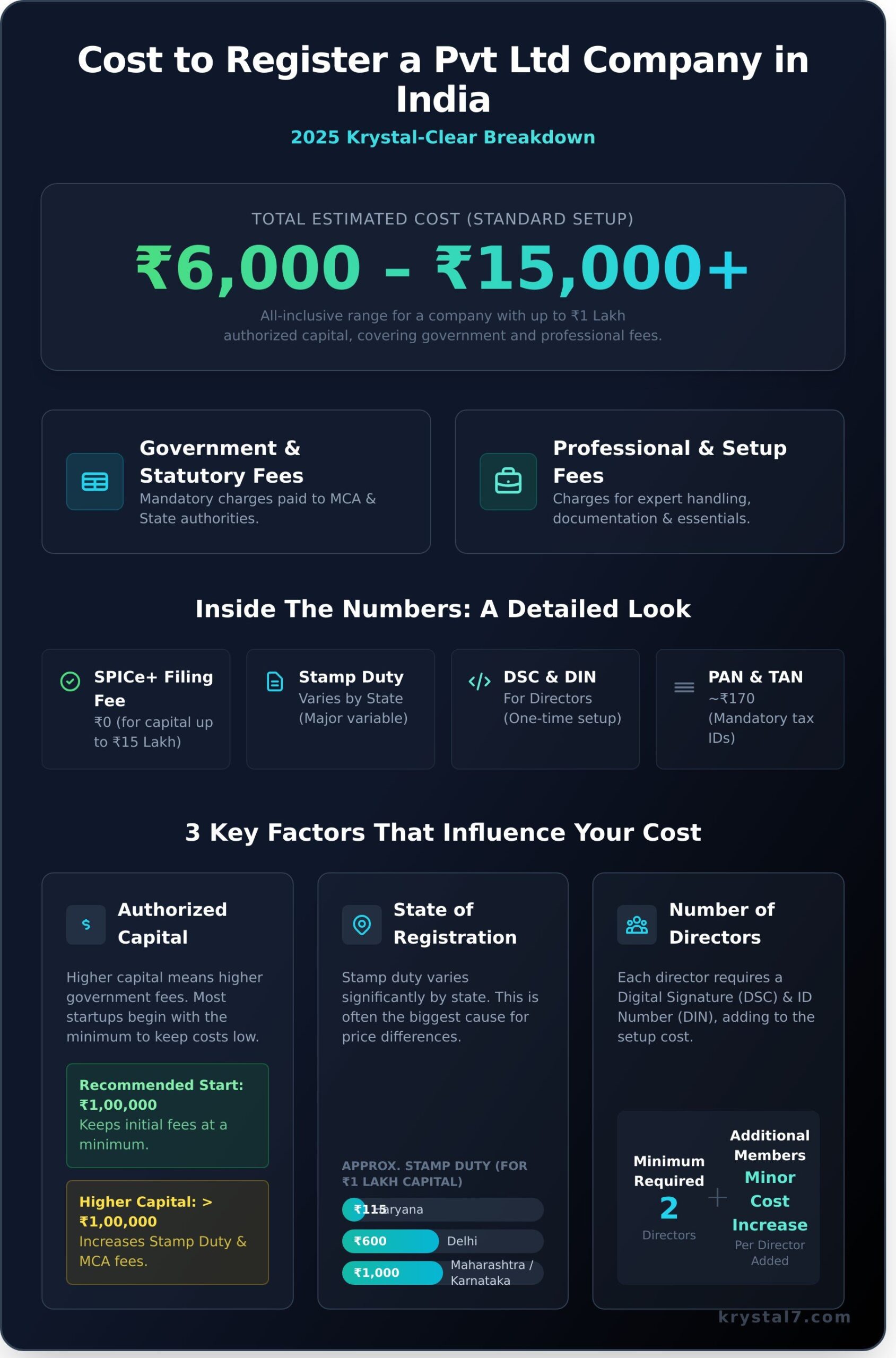
Total Estimated Cost: ₹6,000 – ₹15,000+
This all-inclusive range typically covers government fees, professional charges, and essential one-time setup costs for a company with standard authorized capital (e.g., up to ₹1 Lakh).
The total cost is broadly divided into two parts: mandatory government charges and the service fees for the professionals who navigate the process for you. Let’s examine each component.
Government & Statutory Fees (Mandatory Costs)
These are non-negotiable fees paid directly to the Ministry of Corporate Affairs (MCA) and state authorities. They form the foundational expense of your registration.
- SPICe+ Form Filing: This is the integrated web form for company incorporation. The government has streamlined the process, and for companies with an authorized capital up to ₹15 Lakh, the filing fee is zero, encouraging new ventures.
- Stamp Duty: This is the most significant variable. It is a state-level tax levied on the Memorandum of Association (MoA) and Articles of Association (AoA). Rates differ significantly from one state to another (e.g., Delhi has different rates than Maharashtra).
- Name Reservation (RUN): A nominal fee (typically ₹1,000) is charged for reserving your proposed company name through the MCA portal.
- PAN and TAN Application: Mandatory for tax purposes, the application fees for your company’s Permanent Account Number (PAN) and Tax Deduction and Collection Account Number (TAN) are included in the SPICe+ form, costing around ₹170.
Professional Fees (The Service Component)
This is what you pay a Chartered Accountant (CA), Company Secretary (CS), or a legal firm for their expertise and service. This fee is an investment in a smooth, error-free registration, saving you from costly delays and compliance issues. It typically covers:
- Expert consultation and advisory on company structure.
- Drafting of critical legal documents like the MoA and AoA, which define the scope and governance of your private limited company.
- Meticulous handling of the entire filing process and follow-ups with the MCA.
Initial Setup Costs (One-Time Essentials)
These are necessary prerequisites for completing the registration process online. Most all-inclusive packages bundle these costs for your convenience.
- Digital Signature Certificate (DSC): Required for all directors to digitally sign the electronic forms. The cost is per director and is typically valid for two years.
- Director Identification Number (DIN): A unique, lifetime identification number for each director, which is now integrated into the SPICe+ application process.
- Registered Office Address: While not a direct fee, you must have a registered office address. This can be a commercial or residential property, but proof of address is mandatory.
Key Factors That Influence Your Total Registration Cost
When you begin your entrepreneurial journey, one of the first questions you’ll ask is about the cost to register a pvt ltd company in india. The truth is, there’s no single, one-size-fits-all answer. The final price is a sum of several variable components, and understanding these factors is the first step toward a transparent, hassle-free process. At Krystal7, we believe in Krystal-Clear Transparency, ensuring you know exactly what you’re paying for.
Let’s break down the three primary variables that will shape your total investment.
Authorized Share Capital
Think of Authorized Capital as the maximum value of shares your company is legally permitted to issue to shareholders. While you might have ambitious growth plans, a higher initial authorized capital directly increases government fees and stamp duty. These fees are determined by the fee structures published by the Ministry of Corporate Affairs (MCA). To keep your initial costs low and manageable, we advise most startups to begin with the standard authorized capital of ₹1,00,000. You can always increase this later as your venture grows.
State of Registration
Where you register your company’s main office has a significant impact on the cost. This is because stamp duty-a state-levied tax on legal documents like the Memorandum of Association (MoA) and Articles of Association (AoA)-varies widely across India. A company registered in one state could pay thousands more in stamp duty than an identical company registered in another. This is often the biggest reason for differing quotes from service providers.
Here’s an illustrative comparison of approximate stamp duty for a company with ₹1 Lakh authorized capital:
- Delhi: Approximately ₹600
- Maharashtra (Mumbai): Approximately ₹1,000
- Karnataka (Bengaluru): Approximately ₹1,000
- Haryana: Approximately ₹115
Note: These figures are indicative and subject to change based on state regulations.
Number of Directors and Subscribers
By law, a private limited company must have a minimum of two directors and two subscribers (shareholders). Each director is required to obtain a Digital Signature Certificate (DSC) and a Director Identification Number (DIN). Therefore, the total number of directors you appoint at incorporation will influence the initial setup fees. While adding more directors increases the cost, it’s a relatively minor component compared to the impact of your authorized capital and state of registration.
Real-World Example: Calculating the Cost for a Tech Startup
Abstract figures can be overwhelming. To bring Krystal-Clear clarity to the process, let’s move from theory to a practical, real-world scenario. This step-by-step calculation eliminates the guesswork, providing you with a tangible budget and a clear understanding of the total cost to register a pvt ltd company in india.
By breaking down each component, you can see precisely where your investment goes, ensuring there are no hidden fees or last-minute surprises. This is the transparency you can build on.
The Scenario: ‘Innovatech Solutions Pvt. Ltd.’
Imagine two entrepreneurs launching a new tech venture. They have a brilliant idea and are ready to formalise their business structure to attract talent and funding. Here are their foundational details:
- Company Name: Innovatech Solutions Pvt. Ltd.
- Location: Gurugram, Haryana
- Number of Directors: 2 (both are Indian nationals requiring new Digital Signatures)
- Authorised Share Capital: ₹1,00,000 (the standard starting point for most startups)
- Service Provider: A comprehensive professional package that handles the entire process from start to finish.
Line-by-Line Cost Calculation Table
Here is a detailed breakdown of the estimated costs for incorporating ‘Innovatech Solutions Pvt. Ltd.’ in 2025. This table offers a transparent view of both government charges and professional service fees.
| Fee Component | Description | Approx. Cost (₹) |
|---|---|---|
| Digital Signature (DSC) | Required for 2 directors to digitally sign e-forms. (Class 3, 2-year validity) | ₹1,000 |
| Director Identification Number (DIN) | Lifetime unique ID for 2 directors, applied via the SPICe+ form. | ₹1,000 |
| Name Approval (RUN Fee) | MCA fee for reserving the unique company name via the SPICe+ Part A form. | ₹1,000 |
| Stamp Duty (Haryana) | State government fee for e-MoA & e-AoA. Varies by state; Haryana’s rates are competitive. | ₹200 |
| MCA Incorporation Fees | Central government fees for MoA, AoA, PAN, and TAN applications. Currently waived for companies with authorised capital up to ₹15 Lakhs. | ₹0 |
| Professional Fees | All-inclusive fee for expert consultation, document preparation, filings, and end-to-end process management. | ₹6,500 |
| Total Estimated Cost | The complete, one-time investment to get your company legally registered and fully compliant. | ₹9,700 |
As this example illustrates, the process is streamlined and affordable when handled by seasoned professionals. By opting for a transparent, all-inclusive package, the founders of ‘Innovatech Solutions’ can avoid bureaucratic hurdles and gain the freedom to focus on what truly matters: building their business legacy.
Beyond Registration: Hidden Costs & Ongoing Annual Fees
Securing your Certificate of Incorporation is a monumental first step, but the financial journey doesn’t end there. Many entrepreneurs focus solely on the initial setup fee, only to be surprised by post-registration expenses. At Krystal7, we believe in Krystal-Clear Transparency. These aren’t ‘hidden’ costs; they are the essential investments required to operate a compliant and successful business in India. Understanding these ongoing expenses is as crucial as knowing the initial cost to register a pvt ltd company in india, as it allows for robust financial planning and gives you the freedom to focus on growth.
Immediate Post-Incorporation Costs
Once your company is officially registered, a few critical actions must be taken immediately to ensure you are fully operational and compliant from day one. These are one-time costs that occur right after incorporation.
- Certificate of Commencement of Business (Form INC-20A): This filing is mandatory before your company can begin any business activities or borrow funds. It must be filed within 180 days of incorporation.
- Auditor Appointment: Your company’s first statutory auditor must be appointed by the Board of Directors within 30 days of incorporation.
- Company Bank Account Opening: A dedicated current account in the company’s name is essential. While opening the account is often free, most banks require a minimum average balance to be maintained.
Mandatory Annual Compliance Costs
To maintain your company’s active status and avoid heavy penalties, you must meet annual compliance deadlines set by the Ministry of Corporate Affairs (MCA) and the Income Tax Department. These are recurring annual expenses.
- Annual ROC Filings: This includes filing financial statements (Form AOC-4) and the annual return (Form MGT-7 or MGT-7A) with the Registrar of Companies.
- Statutory Audit Fees: Your appointed auditor must audit your company’s financial records annually. The auditor’s fee is a recurring professional expense.
- Annual Income Tax Return Filing: Every private limited company must file an income tax return (ITR) each year, regardless of profit or loss.
Navigating this complex compliance landscape can be overwhelming. Let our experts handle the red tape so you can focus on your vision. Stay compliant from day one. Explore our Annual Compliance Packages.
Optional (But Recommended) Business Costs
Beyond mandatory compliance, certain strategic investments can protect your brand and streamline your operations, contributing significantly to your long-term success.
- GST Registration: Mandatory if your annual turnover exceeds the prescribed threshold (₹40 lakh for goods, ₹20 lakh for services in most states), but can be obtained voluntarily to claim input tax credits.
- Trademark Registration: Crucial for protecting your brand name, logo, and slogan from being used by competitors. It’s a one-time investment in your business’s unique identity.
- Accounting Software: Subscriptions to platforms like Zoho Books, Tally, or QuickBooks simplify bookkeeping, invoicing, and financial tracking, saving you time and reducing errors.
DIY vs. Hiring a Professional: A True Cost-Benefit Analysis
As an entrepreneur, every rupee counts. It’s natural to look at the total cost to register a pvt ltd company in india and wonder, “Can I save money by doing this myself?” While the initial government fees are fixed, the true cost of registration goes far beyond the monetary transaction. It’s an investment in your company’s foundation, and cutting corners here can lead to expensive complications down the road.
Before you dive into the complexities of the MCA portal, let’s break down the real value proposition of partnering with an expert versus going it alone.
The True ‘Cost’ of DIY Registration
The do-it-yourself route might seem cheaper upfront, but it carries significant hidden costs that can impact your new venture’s momentum:
- Time Cost: Navigating legal jargon, understanding forms like SPICe+, and ensuring all documents are correctly prepared can consume dozens of hours-time that is invaluable during the launch phase of a business.
- Risk Cost: A single error in your application, from a mismatched name to an incorrect object clause, can lead to rejection by the Registrar of Companies. This means delays and additional re-filing fees, turning your attempt to save money into an unexpected expense.
- Opportunity Cost: This is the most critical cost. Every hour you spend deciphering compliance is an hour you are not spending on product development, talking to potential customers, or planning your market strategy. Your focus is your greatest asset; don’t dilute it.
The Value of an Expert Partner
Engaging a professional service transforms the registration process from a potential liability into a strategic advantage. It’s about buying back your time and securing your peace of mind.
- Speed & Efficiency: An experienced team streamlines the entire process, from document collection to final approval, often completing it in a matter of days, not weeks.
- Guaranteed Accuracy: Professionals eliminate the guesswork. They ensure your application is error-free, compliant with the latest regulations, and has the highest chance of first-time approval.
- Crystal Clarity: Instead of navigating a maze of government portals, you have a single, dedicated point of contact to answer every question, providing clarity and confidence at every step.
–
–
How to Choose the Right Service Provider
When evaluating the cost to register a pvt ltd company in india with a professional, look for a partner who offers more than just a transaction. A true partner provides clarity and support.
Ensure your chosen provider offers:
- Krystal-Clear Pricing: Look for transparent packages with no hidden fees. All costs, including government fees, stamp duty, and professional charges, should be stated upfront.
- Comprehensive Inclusions: A good package will include everything you need to get started, such as 2 Director Identification Numbers (DIN), 2 Digital Signature Certificates (DSC), Name Approval (RUN), MoA/AoA drafting, and the Certificate of Incorporation.
- Dedicated Support: Read reviews and confirm that you will have a dedicated relationship manager. Having an expert who is just a call away is invaluable.
Ultimately, the right professional service isn’t an expense; it’s your first investment in building a strong, compliant, and successful business. It grants you the most valuable asset of all: the Freedom to Focus on your vision. Find out how a trusted partner can streamline your journey from idea to incorporation.
Your Vision Deserves a Clear Start: Final Thoughts on Registration Costs
As we’ve explored, understanding the true cost to register a pvt ltd company in india goes far beyond a single number. It requires a clear view of government fees, professional charges, and the potential for hidden expenses and crucial ongoing compliance. Choosing the right professional partner is not just about cost; it’s an investment in a streamlined, error-free foundation for your business.
Navigating this complexity shouldn’t distract you from your core mission. At Krystal7, we provide the clarity you need to move forward with confidence. Trusted by over 500+ startups across India, we deliver Krystal-Clear Transparent Pricing and a Dedicated Expert for your business, ensuring you have the freedom to focus on growth.
Ready to turn your vision into a registered reality without the guesswork? Get a Krystal-Clear Quote for Your Company Registration and take the first confident step in your entrepreneurial journey.
Frequently Asked Questions (FAQs)
What is the absolute minimum cost to register a private limited company in India?
While government filing fees are waived for companies with authorized capital up to ₹15 Lakhs, the true minimum cost is not zero. You must factor in professional fees, Digital Signature Certificates (DSC), and state-specific stamp duty. The total cost to register a pvt ltd company in india realistically starts from ₹6,000 to ₹8,000 for a streamlined, error-free process. This investment ensures expert guidance and saves you from potential hassles and re-filing expenses.
How long does the entire company registration process take?
With all documents correctly prepared and prompt government processing, the entire company registration can be completed within 8 to 12 working days. This timeline covers key steps like name approval, obtaining Director Identification Numbers (DIN), and filing final incorporation forms. Partnering with a professional firm like Krystal7 provides clarity and helps accelerate this timeline by preventing common delays and ensuring a smooth, efficient journey from vision to venture.
Can I register a company without a physical office address?
Yes, you can. While a registered office address in India is mandatory for official communication, it does not have to be a traditional commercial space. You can legally use a residential address (with a No Objection Certificate from the owner) or opt for a virtual office address service. This provides a professional and cost-effective solution for entrepreneurs, allowing them to establish their business presence without the overhead of a physical office lease.
Are the government fees for company registration refundable if my application is rejected?
No, any fees paid to the Ministry of Corporate Affairs (MCA), including stamp duty and application fees, are strictly non-refundable. If your application is rejected due to errors, omissions, or non-compliance, the amount paid is forfeited. This is why meticulous preparation and expert oversight are critical. Getting it right the first time is not just about saving time; it’s about protecting your initial investment and ensuring a successful launch.
What are the key documents required for Pvt Ltd company registration?
For a hassle-free registration, directors and shareholders must provide their PAN card, identity proof (like Aadhaar card or Passport), and a recent address proof (such as a bank statement or utility bill). For the registered office address, proof of address (e.g., electricity bill) and a No Objection Certificate (NOC) from the property owner are required. Organizing these documents upfront brings clarity to the process and helps avoid any procedural delays.
What is the difference in cost between a Pvt Ltd Company and an LLP?
The initial registration cost for a Private Limited Company and a Limited Liability Partnership (LLP) is quite similar. The significant difference emerges in the annual compliance costs. A Pvt Ltd company has more stringent statutory obligations, including mandatory board meetings and audits, which makes its ongoing compliance more expensive than an LLP. Your choice should be guided by your long-term goals regarding funding, scalability, and management structure.
What happens if I fail to meet the annual compliance requirements after registration?
Failing to meet statutory annual compliance deadlines can lead to severe consequences. These include heavy, compounding financial penalties imposed by the MCA, disqualification of directors, and potentially having the company’s status changed to “struck off” from the official register. This can freeze bank account operations and destroy your business’s credibility. Consistent, expert-managed compliance is essential to safeguard your venture and ensure its long-term success.

Article by
Nihal Srivastava
Nihal Srivastava is the Co-Founder of Krystal7 Consultants, helping Indian entrepreneurs and startups navigate company registration, compliance, trademark protection, and regulatory requirements with clarity and confidence. With 6+ years of hands-on expertise in MCA filings, GST compliance, and corporate structuring, Nihal has guided 1000+ businesses across India through their legal and compliance journeys. He believes every business dream deserves crystal clear foundations, and that no founder should be held back by paperwork or red tape.