

Company Registration for Freelancers in India: The 2026 Complete Guide
What if your biggest global client asked for your corporate identification number tomorrow, and all you had to offer was a personal PAN card? For many of the 15 million independent professionals in our country, this realization is the moment where growth hits a legal ceiling. You’ve likely felt the weight of confusion over GST thresholds or the anxiety of personal liability while managing a 5,000 dollar project. We agree that the maze of MCA paperwork and potential tax penalties feels like a distraction from the work you actually love doing.
This guide is designed to give you the freedom to focus by providing krystal-clear insights into company registration for freelancers india. You’ll gain absolute clarity on choosing between an OPC or LLP, managing your GST filings without the guesswork, and automating your compliance for the 2026 fiscal year. We’ll show you how to protect your personal assets and lower your tax outgo using smart business deductions. From building a professional brand image to securing legal peace of mind, here is your streamlined path to a scalable freelance career.
Key Takeaways
- Identify the most advantageous legal structure for your vision, comparing the simplicity of Sole Proprietorships against the “Gold Standard” protection of a One Person Company.
- Navigate the streamlined 5-step roadmap for company registration for freelancers india to successfully transition from an individual creator to a recognized corporate entity.
- Unlock the “secret weapon” of presumptive taxation under Section 44ADA to legally reduce your taxable income by 50% while maximizing professional expense write-offs.
- Discover how to automate your annual compliance and ROC filings through a “Freedom to Focus” model, allowing you to scale your business without the burden of red tape.
Why Freelance Company Registration in India is Your Path to Clarity
Choosing company registration for freelancers india isn’t just about paperwork; it’s about shifting your identity from a solo worker to a recognized business leader. This transition creates a hard line between who you are and what you do. By the year 2026, the Indian government expects the gig economy to contribute 1.25% to the national GDP. This massive growth means formalization is becoming a requirement rather than a choice for those who want to survive the next decade. When you register, you move away from being a service provider and become a legal entity. This distinction is vital when reviewing the various Types of business entities in India, such as LLPs or Private Limited companies, which offer different levels of protection and tax benefits.
Clarity starts with your bank balance. Without a formal structure, your grocery bills and client payments live in the same account. This creates a financial fog that makes it impossible to track true profitability. Professional registration forces a separation that provides a clear view of your margins. It’s the first step toward scaling. Global enterprises like Google or Microsoft often require a Tax Identification Number or a registered entity to process payments exceeding $5,000. If you’re unregistered, you’re effectively locked out of the highest-paying segments of the global market.
The Limitations of Staying Unregistered
Staying unregistered carries heavy risks that most freelancers ignore until it’s too late. As a sole proprietor without a separate legal identity, your personal house, car, and savings are at stake if a client sues you for a breach of contract. There’s no corporate veil to protect you. Statistics from 2023 show that 40% of unregistered independent consultants face significant delays or outright rejections when trying to open business-grade current accounts. Banks view unregistered individuals as high-risk, which limits your access to credit. You also miss out on the Udyam registration benefits. These government-backed schemes provide collateral-free loans and 1% to 2% interest rate subventions that are exclusive to registered small ventures.
The “Freedom to Focus” Advantage
Formalization delivers a psychological breakthrough. There’s a profound shift when you stop calling yourself a gig worker and start identifying as a business owner. This change alone often leads to a 20% to 30% increase in quoted rates because you’re no longer selling your time; you’re selling a professional service. During tax season, a registered structure reduces anxiety by providing a streamlined audit trail. You won’t spend weeks digging through old emails to justify expenses. Instead, you have a Krystal-Clear record that satisfies compliance requirements instantly.
- Brand Authority: International clients perceive registered Indian firms as more stable and committed than individual hobbyists.
- Tax Efficiency: Registered entities can often claim more business deductions, potentially saving 15% to 20% on annual tax liabilities compared to individual slabs.
- Scalability: It’s easier to hire your first employee or contractor when you have a formal GST number and payroll structure in place.
Securing company registration for freelancers india creates the foundation for a legacy. It moves you out of the “struggling artist” phase and into a position of power. You gain the freedom to focus on your craft while the legal structure handles the weight of your professional reputation. This clarity isn’t just a luxury; it’s the engine that will drive your business growth through 2026 and beyond.
Choosing the Right Structure: Sole Proprietorship vs. OPC vs. LLP
Selecting the right business structure is the first step toward achieving professional clarity. It defines your tax liabilities and dictates how much personal risk you carry as a creator. For many, company registration for freelancers india begins with a simple question: how much protection do you actually need? Your choice provides the “freedom to focus” on your craft rather than administrative tangles. Each structure offers a different balance of ease and security, and choosing correctly now prevents expensive transitions later.
Sole Proprietorship for Beginners
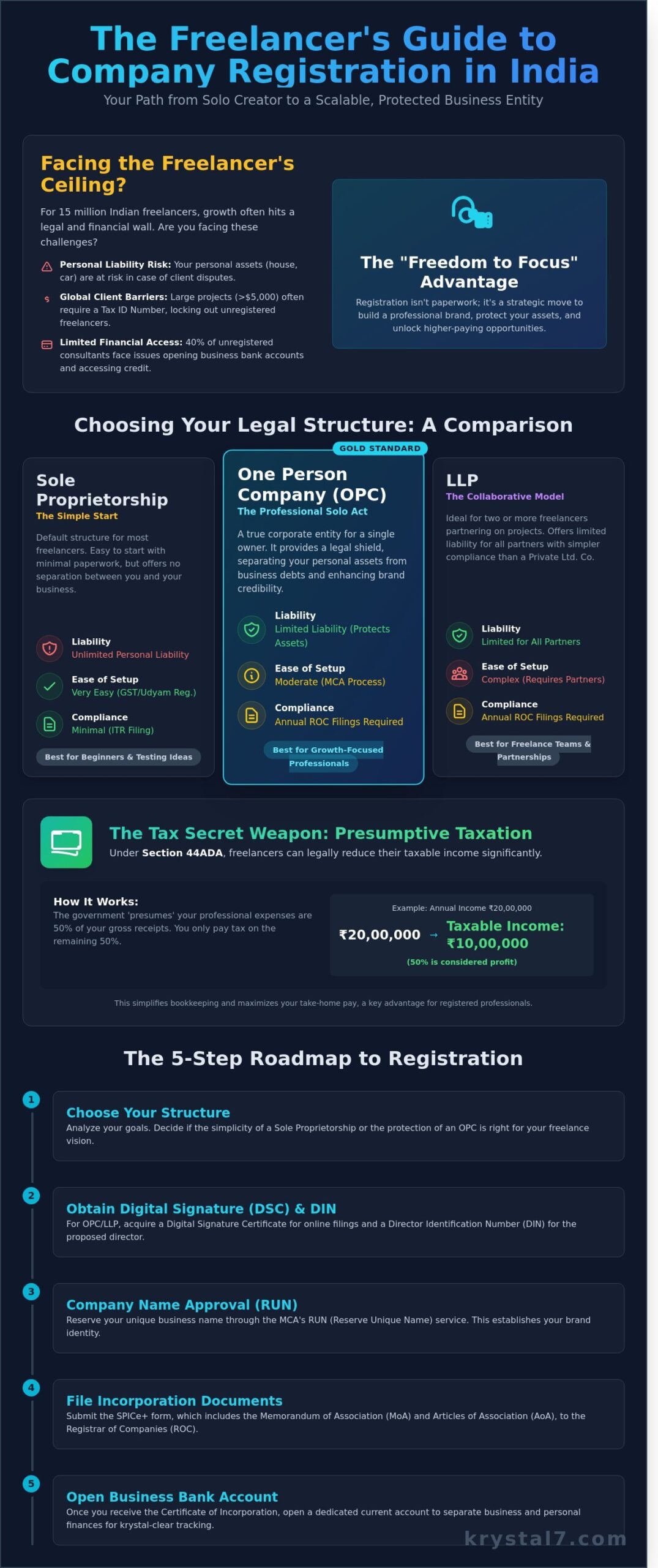
This is the most common entry point for 65% of Indian freelancers starting their journey. You don’t need a separate incorporation process to begin. Instead, you use a GST registration or an Startup India scheme recognized Udyam certificate as a de facto business license. It’s exceptionally cost-effective because you avoid heavy setup fees and recurring professional filings. You won’t face mandatory audits unless your turnover exceeds specific 2026 thresholds or your professional gross receipts cross ₹50 Lakhs under Section 44ADA. The downside is absolute. There’s no legal distinction between your bank account and your business debts. If a client sues for damages, your personal assets like your car or savings are at risk.
One Person Company (OPC) for the Serious Professional
If you want the “Gold Standard” of solo business, the OPC is your best bet. It provides a separate legal entity status, which means your personal assets remain safe if the business faces lawsuits or debt. An OPC offers perpetual succession; the company lives on even if the founder is incapacitated. You’ll need to appoint a nominee director, usually a family member, to satisfy the Companies Act 2013 requirements. While the compliance burden is higher than a proprietorship, the credibility it adds to your brand is immense. You’ll file annual returns with the Registrar of Companies (ROC), but this discipline builds a legacy of transparency and trust with international clients.
Limited Liability Partnership (LLP): This is the ideal choice if you plan to collaborate with other creators by 2025. If you’re a developer teaming up with a designer, an LLP offers the flexibility of a partnership with the protection of a company. It’s governed by the LLP Act 2008 and requires at least two partners. It’s often 30% cheaper to maintain than a Private Limited Company because there’s no requirement for a Dividend Distribution Tax, making it a favorite for small agencies.
Private Limited Company: This structure is for freelancers with high-growth visions. If you’re building a scalable platform or seeking venture capital, skip the smaller steps. It’s the most rigorous structure, requiring at least two directors and shareholders. While the compliance landscape is complex, it’s the only way to issue equity to investors or employees. It transforms your freelance work into a corporate venture that can exist independently of your daily labor.
At Krystal7, we believe every business dream deserves crystal clarity. If you’re unsure which path fits your unique vision, our expert legal strategists are ready to provide a personalized roadmap for your success.
The Tax Efficiency Framework: Saving More While Earning More
Tax planning isn’t just about compliance; it’s about retaining the capital you need to scale your vision. For many, the journey begins with Section 44ADA of the Income Tax Act. This presumptive taxation scheme is a powerful tool for professionals. It allows you to declare only 50% of your gross receipts as taxable income, provided your total turnover stays below ₹75 lakhs as per the 2023 budget amendments. You won’t need to maintain complex books of accounts under this scheme, giving you the freedom to focus on your craft rather than paperwork.
Choosing the right path for company registration for freelancers india requires understanding these fiscal levers. While the 50% rule is attractive, high-growth freelancers often find that itemizing expenses yields better results as they scale. To identify which specific approvals your structure requires, you can consult the Government of India’s business registration portal. This resource helps clarify the statutory requirements for different entities, ensuring your foundation is built on crystal-clear compliance from day one.
GST adds another layer of strategy. If your domestic turnover exceeds ₹20 lakhs, or ₹10 lakhs in specific states, registration is mandatory. However, voluntary registration is often a smart move for those seeking company registration for freelancers india. It signals professional maturity to corporate clients and unlocks the ability to claim taxes back on your business inputs. For those exporting services to international clients, the benefits are even greater. Under the “Zero Rated Supply” rules, you can provide services at 0% GST, making your rates more competitive globally while still claiming refunds on your domestic expenses.
Maximizing Deductions as a Registered Entity
When you move beyond presumptive tax, every rupee spent on your business becomes a shield against over-taxation. You can deduct these 10 common expenses: 1. Co-working space memberships, 2. Professional software like Adobe or GitHub, 3. High-speed internet, 4. Marketing and LinkedIn ads, 5. Client meeting meals, 6. Travel for conferences, 7. Repairs to your workstation, 8. Books and courses, 9. Legal consultancy fees, and 10. Electricity for your home office. To survive a tax audit in 2026, you must maintain a digital trail. Use cloud-based accounting to store invoices instantly. Don’t forget depreciation; the tax code allows a 40% depreciation rate on laptops and computers, significantly reducing your taxable profit in the year of purchase.
Understanding the GST Impact
The Input Tax Credit (ITC) is your primary tool for cost recovery. When you buy a ₹1,00,000 laptop, you pay ₹18,000 in GST. As a registered entity, you can offset this ₹18,000 against the GST you collect from clients, effectively lowering your equipment costs. For international work, the Letter of Undertaking (LUT) is essential. It’s a simple online filing that permits you to export services without paying IGST upfront. To manage your cash flow, consider the Quarterly Return Monthly Payment (QRMP) scheme. It reduces your filing frequency from 12 times a year to just four, giving you more time to build your legacy while staying fully compliant with the law.
The 5-Step Roadmap to Registering Your Freelance Business
Transforming your solo venture into a formal entity brings a sense of security and professional standing. The process for company registration for freelancers india is now more streamlined than ever, thanks to the Ministry of Corporate Affairs (MCA) digital initiatives. Following this structured path ensures you don’t miss critical legal milestones that protect your personal assets and brand identity.
Every digital filing requires a DSC to verify the authenticity of documents. Under the Information Technology Act, 2000, these certificates carry the same legal weight as physical signatures. Once you have your DSC, you’ll apply for a DIN. This unique eight-digit number is a lifetime requirement for anyone aspiring to be a director in an Indian company. Usually, this initial phase takes 1 to 2 working days to complete.
Step 2: Name Approval via the RUN Service
Choosing a name is where your vision meets regulatory reality. The Reserve Unique Name (RUN) service allows you to submit two preferred names in order of priority. The MCA checks these against existing trademarks and company names to prevent confusion. According to data from the Registrar of Companies, nearly 40% of initial name applications face queries or rejections because they are too generic or similar to established brands. A successful reservation stays valid for 20 days.
Step 3: Filing the SPICe+ Form for Incorporation
The SPICe+ (Simplified Proforma for Incorporating Company Electronically Plus) is an integrated web form that handles multiple requirements at once. This step includes drafting your Memorandum of Association (MOA) and Articles of Association (AOA). These documents define your business’s scope and internal rules. Since the introduction of this form in 2020, the time for company registration for freelancers india has dropped from weeks to just 5 to 7 working days.
Step 4: Obtaining PAN, TAN, and GSTIN
You don’t need to apply for tax IDs separately anymore. The SPICe+ form automatically triggers applications for your Permanent Account Number (PAN) and Tax Deduction and Collection Account Number (TAN). If your annual turnover exceeds Rs. 20 lakhs, or Rs. 10 lakhs in specific hilly states, you’ll also receive your Goods and Services Tax Identification Number (GSTIN) through this integrated process.
Step 5: Opening a Dedicated Business Current Account
Mixing personal and professional finances is a recipe for bookkeeping chaos. Once you receive your Certificate of Incorporation, you must open a business current account within 30 days. This separation provides 100% transparency for tax audits and simplifies your GST filings. Most leading Indian banks now offer instant account opening for newly incorporated entities through API integrations with the MCA portal.
Common Pitfalls in the Registration Process
Name rejection is the most frequent hurdle. Avoid using descriptive words like “Best” or “Global” without unique prefixes. Address proof is another sticking point. While you can use your home address, 65% of modern freelancers now opt for virtual offices. These provide a premium commercial address for registration while keeping your residential location private. Finally, selecting the wrong HSN or SAC codes can lead to paying 18% GST when your service might actually qualify for a 12% bracket.
State-Level Compliance: Don’t Forget These
Professional Tax (PT) is a state-level levy that many overlook. In states like Maharashtra or Karnataka, you must register for PT within 30 days of starting operations, with annual costs capped at Rs. 2,500. Additionally, the Shop and Establishment Act license is often a mandatory document for banks to verify your place of business. To unlock further benefits, complete the Udyam (MSME) Registration. This free, 10-minute process grants you priority sector lending and protection against delayed payments from corporate clients.
Ready to move from paperwork to profit? Get crystal clarity on your business setup by choosing our expert company registration services today.
Managing Your Legacy: Annual Compliance and Growth
Securing your certificate of incorporation is a massive milestone. However, registration is just the beginning of your journey as a corporate entity. Once the initial excitement of company registration for freelancers india fades, the reality of statutory obligations sets in. Maintaining a company requires discipline. It demands a clear understanding of the Companies Act 2013 to ensure your business remains in good standing with the Registrar of Companies (ROC).
Krystal7’s “Freedom to Focus” model exists because we know you didn’t start a business to become a part-time accountant. We take the burden of ROC filings and tax returns off your plate. Our team manages the technicalities while you focus on landing high-ticket clients. Statutory audits are a non-negotiable part of this process. Section 139 of the Companies Act requires every company to appoint an auditor within 30 days of incorporation. We help you prepare for these audits by maintaining meticulous digital records, ensuring 100% accuracy before the Chartered Accountant signs off on your balance sheet.
To streamline this, many professionals use platforms that integrate document management with electronic signatures and payments. For instance, Chaindoc provides a secure workflow to keep all your client contracts, agreements, and payment records centralized, which is invaluable for audit readiness.
Growth often leads to a natural transition. If you started as a One Person Company (OPC), you might find that your vision has outgrown a single-member structure. Transitioning to a Private Limited Company allows you to bring on co-founders or raise venture capital. Since the February 2021 budget updates, the mandatory conversion limits regarding turnover and capital were removed. This gives you the flexibility to scale on your own terms. Whether you’re moving from ₹50 lakhs in revenue to ₹5 crores, we ensure the legal migration is seamless and your company registration for freelancers india evolves with your ambition.
The Compliance Calendar for 2026
Staying ahead of the MCA is about timing. For the 2026 assessment year, Income Tax Returns for companies are typically due by October 31. Our “Krystal-Clear” checklist ensures you never miss the AOC-4 filing for financial statements or the MGT-7 for annual returns. Don’t forget the DIR-3 KYC update. Every director must verify their details by September 30 each year to keep their Director Identification Number active. Failing this simple step can lead to a deactivated DIN and a ₹5,000 reactivation fee.
Why a Dedicated Partner Matters
The cost of non-compliance is steep. Late MCA filings attract a penalty of ₹100 per day, per form. There’s no upper limit on these accumulated fines. If you miss three years of filings, the government can disqualify you from being a director in any company for five years. Krystal7 prevents these disasters by providing a dedicated relationship manager. This expert knows your business history and monitors your deadlines 24/7. You get elite expertise without the overhead of an in-house legal team. We provide the clarity you need to build a lasting legacy.
Ready to secure your future? Streamline your freelance journey with our All-in-one Incorporation Package
Secure Your Professional Legacy in 2026
Transitioning from a solo gig to a formal business entity is the most effective way to scale your income this year. By selecting a structure like an OPC or LLP, you protect personal assets and unlock tax deductions that can save you over 25% on annual liabilities. Following a 5-step roadmap ensures you move from paperwork to profit without the usual administrative headaches. Navigating company registration for freelancers india doesn’t have to be a source of anxiety when you have the right experts by your side.
Krystal7 brings crystal clarity to your incorporation journey. Our team of elite CAs and CSs handles every filing with precision, backed by a strict zero hidden costs policy. You’ll work with a dedicated relationship manager who understands your specific business goals from day one. It’s time to stop worrying about red tape and regain your freedom to focus on your craft.
Get Started with Krystal7 – Your All-in-one Company Incorporation Partner
Your vision deserves a foundation that’s as professional as the services you provide to your clients.
Frequently Asked Questions
Do I really need to register as a company to work as a freelancer in India?
You don’t legally need a formal company structure to start, but registration is vital for professional scaling. Most beginners operate as unregistered individuals, yet this limits your ability to open a business bank account or sign high-value corporate contracts. Securing a formal company registration for freelancers india provides you with a legitimate tax identity and builds immediate trust with international clients who require corporate credentials.
Which is better for a freelancer: Sole Proprietorship or One Person Company (OPC)?
Choose a Sole Proprietorship if you want the lowest setup cost and zero annual filing burdens. It’s ideal for low-risk services where personal liability isn’t a major concern. Pick an OPC if you want to protect your personal assets from business debts. An OPC offers a separate legal identity, which provides a professional shield and makes your venture look more established to global partners.
How much does it cost to register a company for a freelancer in 2026?
Expect to invest between ₹6,000 and ₹18,000 for registration in 2026 depending on the chosen structure. A basic Sole Proprietorship with GST and MSME certificates costs roughly ₹3,500. An OPC or LLP setup requires more capital, typically ranging from ₹12,000 to ₹18,000, covering government fees and professional advisory. We ensure krystal-clear transparency in pricing so you can plan your budget without hidden surprises.
Is GST registration mandatory for freelancers earning less than 20 Lakhs?
GST registration isn’t mandatory if your annual turnover is below ₹20 Lakhs, or ₹10 Lakhs in specific North-Eastern states. You must register the moment you anticipate crossing these specific revenue thresholds. Even if you earn less, voluntary registration is smart if you export services. It allows you to claim a 100 percent refund on input taxes paid for business tools like laptops or cloud subscriptions.
Can I register my freelance business using my home address?
Yes, you can absolutely use your residential address as your registered office location. You’ll need to provide a recent electricity bill and a No Objection Certificate from the property owner. This saves you at least ₹10,000 in monthly commercial rent during your early growth phase. It’s a streamlined way to gain a professional address while maintaining the freedom to focus on your creative output.
What are the annual compliance costs for an LLP vs. an OPC?
Annual compliance for an LLP usually costs between ₹8,000 and ₹15,000, while an OPC ranges from ₹20,000 to ₹35,000. LLPs benefit from fewer audit requirements until turnover exceeds ₹40 Lakhs or contribution exceeds ₹25 Lakhs. OPCs face stricter rules, including a mandatory statutory audit regardless of your revenue. Our legal strategists handle these complexities so your business stays compliant and audit-ready every year.
How long does the entire company registration process take for freelancers?
The entire process typically takes 10 to 15 working days from the date of document submission. Obtaining your Digital Signature Certificate takes 48 hours; name approval via the MCA portal takes another 3 days. The final incorporation certificate and PAN usually arrive within 7 days after that. We provide a methodical, step-by-step timeline so your company registration for freelancers india is completed without any stressful delays.
Can I change my business structure from a Proprietorship to an LLP later?
Yes, you can convert your business structure as your revenue and team size grow. This transition involves applying for a new PAN and drafting a formal succession agreement to transfer assets. Most freelancers make this move once their annual profit hits the ₹10 Lakh mark for better tax planning. It’s a strategic evolution that secures your legacy and provides the professional clarity needed for long-term expansion.

Article by
Nihal Srivastava
Nihal Srivastava is the Co-Founder of Krystal7 Consultants, helping Indian entrepreneurs and startups navigate company registration, compliance, trademark protection, and regulatory requirements with clarity and confidence. With 6+ years of hands-on expertise in MCA filings, GST compliance, and corporate structuring, Nihal has guided 1000+ businesses across India through their legal and compliance journeys. He believes every business dream deserves crystal clear foundations, and that no founder should be held back by paperwork or red tape.