

SH 4 Form for Private Limited Company: The Ultimate Guide to Share Transfers in 2026
What if a single missing signature or an outdated stamp rate on your share transfer deed triggered a penalty of ₹50,000 under Section 56 of the Companies Act 2013? It’s a stressful reality for many Indian founders who find the sh 4 form for private limited company more confusing than it needs to be. You shouldn’t have to worry about ROC notices or legal red tape while you’re trying to scale your vision.
We know that deciphering legal jargon and calculating varying state stamp duty rates feels like a full time job. You’ve likely felt the pressure of ensuring every decimal point is correct to avoid compliance defaults with the Ministry of Corporate Affairs. That’s why we’ve created this krystal-clear guide to help you master the share transfer process and ensure your company remains fully compliant with the latest regulations.
We’ll walk you through the exact steps to execute a successful transfer, from calculating the correct duty to filing with the Registrar of Companies without any defaults. You’ll get a detailed look at the 2026 requirements and the specific documentation you need to keep your records audit-ready. This guide provides the clarity you need to handle equity changes with total ease and professional confidence.
Key Takeaways
- Understand the legal framework of Section 56 of the Companies Act to ensure your share transfers are fully compliant with Indian law.
- Master the step-by-step execution of the sh 4 form for private limited company to avoid common filing errors and administrative delays.
- Learn how to correctly calculate and pay the 0.015% stamp duty rate required for share transfers in 2026.
- Identify the essential details needed for Form SH-4, including CIN and share descriptions, to maintain crystal-clear company records.
- Discover how expert support can streamline your MCA filings, giving you the freedom to focus on growing your business.
What is Form SH-4 and When Does a Private Limited Company Need It?
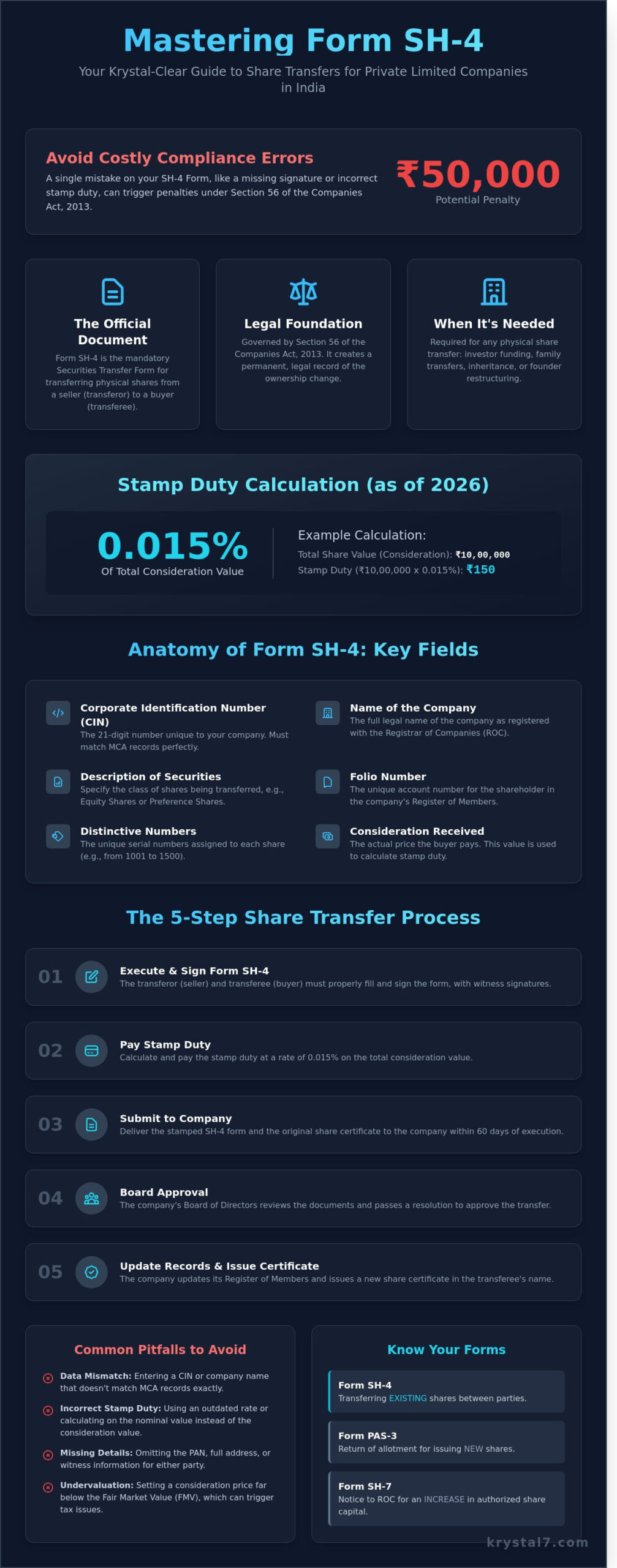
Form SH-4 is the official Securities Transfer Form used across India. It’s governed by Section 56 of the Companies Act, 2013. This document acts as the legal bridge between a person selling shares and the person buying them. For any sh 4 form for private limited company execution, the primary purpose is to create a permanent, legal record of the ownership change.
Private limited companies must use this form whenever they handle physical share transfers. While many large entities use demat accounts, thousands of Indian SMEs still hold shares in physical certificate form. You can’t just hand over a certificate and call it a day. The SH-4 is the mandatory instrument that makes the transition valid under law.
Don’t confuse SH-4 with other filings on the MCA portal. Form SH-7 is specifically for increasing authorized share capital. Form PAS-3 is used for the return of allotment when the company issues fresh shares. SH-4 handles the movement of existing shares from one hand to another, ensuring the company’s register of members stays accurate.
Legal Foundation Under the Companies Act, 2013
Section 56 of the Companies Act, 2013, and Rule 11 of the Companies (Share Capital and Debentures) Rules, 2014, provide the legal framework. Indian law is strict about documentation. Verbal agreements or simple letters of intent aren’t legally binding for share transfers. The Board of Directors must review the SH-4 and pass a resolution to approve the transfer before the register of members is updated. This process protects the company from unauthorized ownership changes.
Scenarios Requiring Form SH-4
You’ll need an sh 4 form for private limited company during several key business milestones. It’s not just for sales; it’s for any change in the physical title of the securities. Common scenarios include:
- Transferring shares from a founder to a new angel investor or venture capital firm.
- Moving shares between family members or existing promoters for internal restructuring.
- Processing the transmission of shares to legal heirs after a shareholder’s death.
- Executing a formal buyback of securities by the company.
The form must be duly stamped according to the Indian Stamp Act, 1899. Currently, the stamp duty rate for share transfers is 0.015% of the total market value. Failure to execute this form properly can lead to the transfer being declared void, leaving the buyer without legal rights to the shares.
The Anatomy of Form SH-4: A Field-by-Field Breakdown
Filing the sh 4 form for private limited company requires absolute precision. Even a minor mismatch with the Ministry of Corporate Affairs (MCA) records can lead to the board rejecting the transfer. You’ll start by entering the 21-digit Corporate Identification Number (CIN) and the exact name of the company as registered. Accuracy here is vital because this data links the transfer to the correct legal entity.
The form then asks for a description of securities. In most Indian startups, you’ll be transferring Equity shares, but you must specify if they are Preference shares instead. Two fields often confuse non-experts: the Folio Number and the Distinctive Number. These are essential for tracking ownership history.
- Folio Number: Think of this as your unique account number within the company’s Register of Members. It identifies your specific ledger entry.
- Distinctive Number: These are unique serial numbers assigned to each share. If you’re transferring 500 shares, the range might be 1001 to 1500.
You must also provide the Permanent Account Number (PAN), full address, and occupation of both the transferor and the transferee. These details ensure compliance with KYC norms under the Companies Act, 2013. Omitting a PAN or providing an outdated address will stall the process at the board level.
The Consideration and Nominal Value
Distinguishing between the nominal value and consideration is a common sticking point. The nominal value, or face value, is usually ₹1 or ₹10 per share. The “Consideration Received” is the actual price the buyer pays the seller. Since July 1, 2020, stamp duty is calculated at 0.015% of the total consideration value. If the sale price is significantly lower than the Fair Market Value (FMV) calculated under Rule 11UA of the Income Tax Rules, it may trigger tax liabilities for the transferee. It’s best to ensure the price per share aligns with a formal valuation report to avoid scrutiny from the Income Tax Department.
Witness and Signature Requirements
Both the transferor and transferee must sign the document. A witness must then sign to attest to these signatures. In the Indian context, a witness can be any person competent to contract, though having a professional perform compliance checks helps prevent future disputes. The company’s Board of Directors will eventually verify these signatures against the specimen signatures already on record. If the signatures don’t match the original records from the time of incorporation or previous transfers, the company will likely return the form for rectification. This step is the primary defense against unauthorized share transfers.
Stamp Duty and Legal Requirements for Share Transfers
Transferring ownership in a business requires more than a simple agreement. You must pay the mandatory stamp duty to make the sh 4 form for private limited company a legally binding document. Since the 2020 amendments to the Indian Stamp Act, the rate has been standardized across all states to ensure consistency for entrepreneurs. As of 2026, the stamp duty rate for share transfers remains fixed at 0.015% of the total market value or consideration amount.
You can procure physical share transfer stamps from authorized treasury offices or designated vendors. Many founders now prefer e-stamping through the Stock Holding Corporation of India (SHCIL) or state-specific portals like e-GRAS. Once you affix the physical stamps to the back of the SH-4 form, you must cancel them immediately. This involves drawing lines across the stamps or signing over them so they cannot be reused. If you fail to cancel the stamps, the law treats the instrument as “unstamped,” which can halt your entire transfer process.
Executing a transfer on an inadequately stamped instrument carries heavy risks. The company’s Board of Directors has the legal right to refuse the transfer if the stamp duty is incorrect. Furthermore, an unstamped SH-4 form cannot be produced as evidence in any legal proceeding or court of law if a dispute arises between the buyer and the seller.
Calculating the Stamp Duty Amount
To find the exact amount, use this formula: Total Consideration Value x 0.015%. For example, if you transfer shares worth INR 10,00,000, your stamp duty will be INR 150. Always round off the final amount to the nearest Rupee. Under Section 35 of the Indian Stamp Act, any instrument not duly stamped is subject to a penalty of up to ten times the original duty amount.
The Role of the Share Certificate
The original share certificate is the primary proof of ownership and must accompany the sh 4 form for private limited company during submission. The company cannot process the transfer without this physical document. If you’ve lost the original certificate, you must follow a specific legal route to obtain a duplicate. This involves filing an FIR at the local police station and providing an indemnity bond to the company. Once the Board approves the transfer, they will either endorse the existing certificate with the new owner’s name or issue a fresh certificate within 30 days. This step ensures the company’s Register of Members stays accurate and compliant with MCA guidelines.
Step-by-Step Process for Executing a Share Transfer in 2026
Executing a share transfer in 2026 requires meticulous attention to the Companies Act, 2013 guidelines. The process ensures that ownership changes are legally binding and transparent. Your journey begins with the sh 4 form for private limited company, which acts as the primary instrument of transfer for all physical shares.
To ensure a smooth transition, follow these critical steps:
- Execution of the Instrument: Both the transferor and the transferee must sign the SH-4 form. It’s vital that these signatures are witnessed by a third party to validate the intent of the transaction.
- Payment of Stamp Duty: You must pay stamp duty at the current rate of 0.015% of the consideration or market value, whichever is higher. Affix the physical share transfer stamps on the form and cancel them by writing across them so they cannot be reused.
- Document Submission: Deliver the executed SH-4 form along with the original share certificates to the registered office of the company. If no certificates exist, submit the letter of allotment instead.
- Board Approval: The company’s Board of Directors will review the transfer request during a formal meeting. They must pass a resolution to approve the transfer, provided it aligns with the Articles of Association (AoA).
- Register Update: After approval, the company secretary or authorized director makes an entry in the Register of Members (Form MGT-1). This step officially recognizes the transferee as the new shareholder.
Timelines and Deadlines to Remember
Precision is key when dealing with the MCA. You have a 60-day window from the date of execution to submit the sh 4 form for private limited company to the registered office. Once the company receives the documents, it’s their obligation to deliver the new or endorsed share certificates within 30 days. Missing these deadlines can lead to penalties under Section 56 of the Companies Act. The company may face a fine of INR 50,000, while defaulting officers can be fined INR 25,000 per default.
Common Pitfalls to Avoid
Small errors often lead to significant delays. A common mistake is a signature mismatch between the SH-4 form and the records previously filed with the MCA. Technical rejections also occur when distinctive numbers on the form don’t match the share certificates exactly. Finally, failing to update the Register of Members can create major hurdles during your annual compliance for private limited company filings, potentially leading to incorrect shareholding disclosures.
Don’t let paperwork slow down your business growth. Contact Krystal7 Consultants for seamless share transfer assistance.
Streamlining Your Compliance with Krystal7 Consultants
Managing a share transfer isn’t just about filling out a piece of paper. It’s about ensuring your company ownership remains legally sound and protected. Krystal7 provides “Crystal Clarity” to the often confusing steps involved with the sh 4 form for private limited company. Our team handles every detail from drafting the initial transfer deed to updating the final records on the MCA portal. We bridge the gap between complex legal requirements and your specific business goals.
Our share transfer support works in tandem with our specialized private limited company india advisory services. This ensures every change in your cap table aligns with your long term tax planning and corporate governance. Professional oversight prevents common errors that lead to litigation or unexpected tax notices from the Income Tax Department. We manage the paperwork so you have the “Freedom to Focus” on your business growth.
Expert Advisory for Startups and SMEs
Transfers at a premium or those involving cross border entities require precise valuation reports under Rule 11UA of the Income Tax Rules. We coordinate with registered valuers to ensure your share price stands up to regulatory scrutiny. Our experts review your Articles of Association (AOA) to confirm that no pre-emptive rights or transfer restrictions are violated during the process. This meticulous approach keeps your company compliant and investor ready.
- Drafting of SH-4 and supporting board resolutions.
- Verification of share certificates and stamp duty payments.
- Updating the Register of Members (MGT-1) accurately.
- Guidance on FEMA compliance for foreign direct investment (FDI) transfers.
Get Your Share Transfer Right Today
A single mistake in the sh 4 form for private limited company can lead to heavy penalties under Section 56 of the Companies Act, 2013. These fines can range from INR 25,000 to INR 5,00,000 for the company and its defaulting officers. Don’t leave your compliance to guesswork or outdated templates. Professional CA and CS support ensures your statutory registers are updated correctly and your filings are always timely.
The peace of mind that comes with expert oversight is invaluable for founders. We eliminate the stress of red tape and technical jargon. You get a dedicated partner who knows your business inside out and protects your interests at every step.
Ready to transfer shares without the hassle? Contact Krystal7 Consultants at business@krystal7.com or visit krystal7.com to schedule your expert consultation today.
Master Your Compliance and Protect Your Business Legacy
Navigating the complexities of the Companies Act 2013 doesn’t have to be a source of stress for your leadership team. Managing the sh 4 form for private limited company share transfers requires precise documentation and timely stamp duty payments to avoid unnecessary legal hurdles. Remember that missing the 60 day filing window can lead to significant delays in updating your register of members. By following the structured steps outlined in this guide, you ensure your startup or SME remains fully compliant with MCA regulations.
At Krystal7 Consultants, our team of top tier Chartered Accountants and Company Secretaries has already assisted over 500+ startups with their MCA compliance needs. We provide upfront, krystal clear pricing so you never deal with hidden costs or unexpected fees. We handle the technical red tape so you can maintain your freedom to focus on scaling your vision.
Need help with your share transfer? Contact Krystal7 Consultants at business@krystal7.com or visit krystal7.com for expert assistance. Let’s build your business on a foundation of total clarity.
Frequently Asked Questions
Is Form SH-4 mandatory for a Private Limited Company?
Yes, the sh 4 form for private limited company is mandatory under Section 56 of the Companies Act, 2013 whenever you transfer physical shares. You must execute this instrument of transfer to ensure the legal change of ownership. Without a properly filled and stamped SH-4, the company can’t legally register the transfer in its records or issue new certificates.
Can I transfer shares online without a physical SH-4 form?
You can’t transfer physical shares entirely online without a physical SH-4 form. While you might digitize the process for internal record-keeping, the law requires a physical instrument that’s signed and stamped. However, if your shares are held in a demat account, you don’t need Form SH-4. You’d use a Delivery Instruction Slip through your depository participant instead.
Who pays the stamp duty on a share transfer: the buyer or the seller?
The buyer typically pays the stamp duty, though the Indian Stamp Act doesn’t strictly mandate which party is responsible. It’s usually a matter of private agreement between the parties involved in the transaction. As of 2024, the uniform stamp duty rate for share transfers across India is 0.015% of the total consideration value paid for the shares.
What happens if the Board of Directors refuses to register the share transfer?
The Board must send a notice of refusal to the transferor and transferee within 30 days from the date the SH-4 was delivered. This notice must clearly state the specific reasons for the refusal. If you feel the refusal is unjustified, you can file an appeal with the National Company Law Tribunal (NCLT) under Section 58 of the Companies Act.
How much is the penalty for not filing share transfer details with the ROC?
Under Section 56(6) of the Companies Act, a company failing to comply with transfer provisions faces a penalty between INR 25,000 and INR 5,00,000. Every officer in default is liable for a penalty ranging from INR 10,000 to INR 1,00,000. These strict penalties ensure that the sh 4 form for private limited company is processed and recorded with crystal clarity.
Do I need a witness for Form SH-4 in India?
Yes, you must have a witness sign the SH-4 form to validate the signatures of both the transferor and the transferee. The witness must provide their name, address, and signature in the designated space on the form. This step adds a layer of security and authenticity to the document, preventing future disputes regarding the execution of the transfer.
Is Form SH-4 required if shares are held in demat form?
No, Form SH-4 isn’t required if your shares are held in demat form. Electronic transfers are governed by the Depositories Act, 1996 and handled through NSDL or CDSL. You only need to submit a Delivery Instruction Slip to your broker to initiate the transfer. This electronic process eliminates the need for physical paperwork and the payment of physical stamp duty.
How do I cancel a share transfer stamp on the SH-4 form?
You must cancel the adhesive share transfer stamp by writing your initials or the date across the stamp. Some people prefer to cross the stamp with a pen so it can’t be reused for another transaction. If you don’t cancel the stamp at the time of execution, the SH-4 form isn’t considered duly stamped and the transfer remains legally invalid.

Article by
Nihal Srivastava
Nihal Srivastava is the Co-Founder of Krystal7 Consultants, helping Indian entrepreneurs and startups navigate company registration, compliance, trademark protection, and regulatory requirements with clarity and confidence. With 6+ years of hands-on expertise in MCA filings, GST compliance, and corporate structuring, Nihal has guided 1000+ businesses across India through their legal and compliance journeys. He believes every business dream deserves crystal clear foundations, and that no founder should be held back by paperwork or red tape.