
IEC of Utah Registration: A Complete Guide for Indian Businesses Expanding to the USA (2026)
Last Tuesday, a tech founder in Bangalore discovered that his Indian Import Export Code wasn’t the golden ticket he needed to complete his iec of utah registration for a Salt Lake City expansion. He found himself overwhelmed by the ambiguity between Indian and US state laws, fearing that a single compliance mistake might derail his global vision for 2026.
You likely share this concern. It’s natural to feel anxious about the complexity of setting up a foreign subsidiary while trying to stay on the right side of Indian FEMA and RBI rules for outward investment.
We’re here to provide the crystal clarity you need to move forward. This guide simplifies your entry into the American market by outlining the essential steps for Indian entrepreneurs to establish a legal, thriving business presence in the Beehive State.
You’ll gain a clear understanding of the differences between Indian and US registrations. We’ll provide a step by step roadmap for your Utah subsidiary so you have the freedom to focus on your growth and global legacy.
Key Takeaways
- Clarify the distinction between India’s Import Export Code and the iec of utah registration to ensure your expansion targets the correct trade association.
- Identify the essential steps for forming a Utah business entity, from selecting a legal structure to obtaining a Certificate of Existence.
- Navigate specific licensing requirements for electrical contractors, including mandatory DOPL certifications and professional journeyman standards.
- Ensure full compliance with Indian FEMA regulations and Reserve Bank of India (RBI) reporting mandates for your new foreign subsidiary.
- Discover how Krystal7 streamlines your global growth by handling complex US state filings and cross-border statutory duties simultaneously.
What is the IEC of Utah Registration? Clearing the Confusion
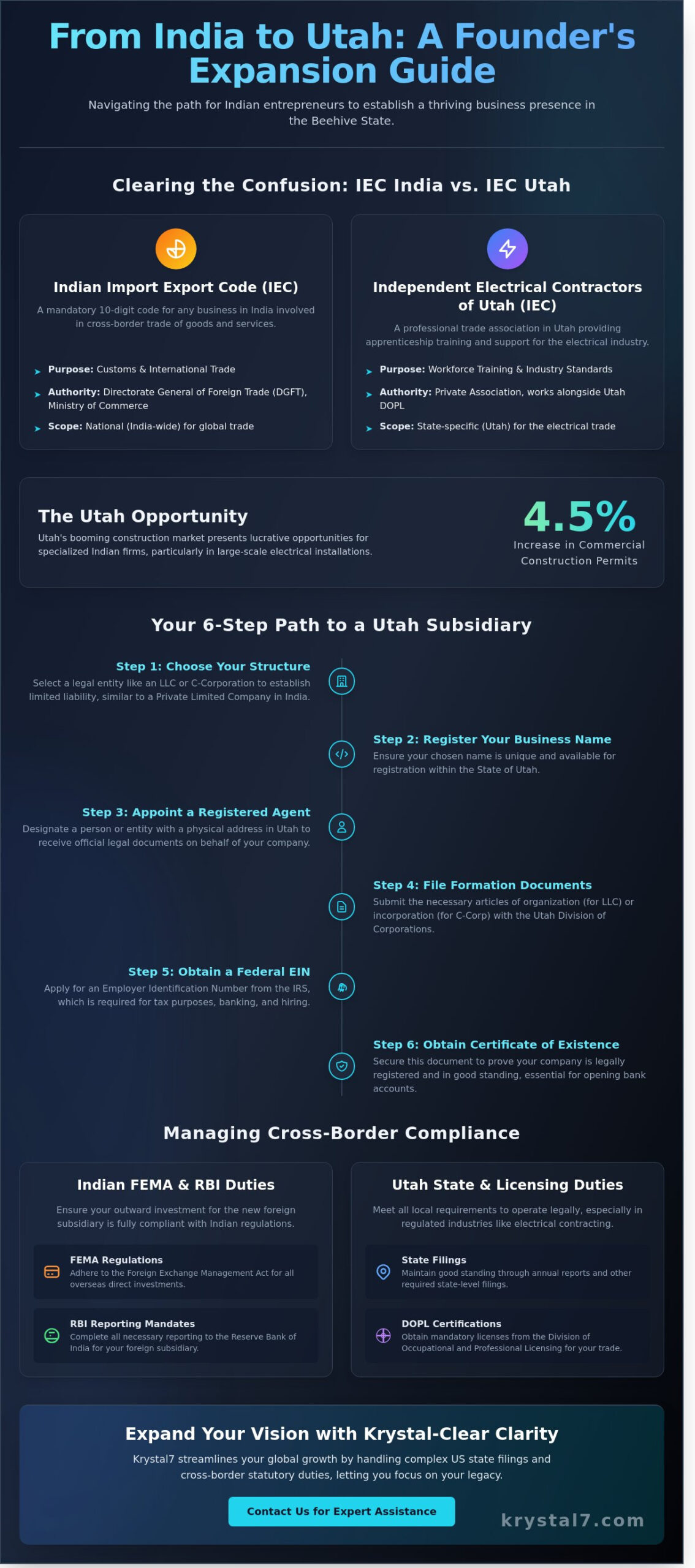
Indian business owners often associate the acronym “IEC” with the 10-digit Import Export Code issued by the Directorate General of Foreign Trade (DGFT). If you’re planning to expand your electrical firm from a hub like Bangalore or Gurgaon to the United States, you’ll encounter a different meaning. In the state of Utah, the iec of utah registration refers to the Independent Electrical Contractors of Utah. This is a powerful trade association and a primary provider of apprenticeship training for the electrical industry.
Expanding your operations to the US market requires a shift in how you view compliance. You aren’t just dealing with tax IDs or business licenses. You’re entering a highly regulated technical ecosystem. The Independent Electrical Contractors (IEC) of Utah acts as a bridge between your business and the skilled workforce you’ll need to succeed. It’s a membership-based body that ensures your technicians meet the rigorous safety and technical standards required by American law.
The Utah Division of Occupational and Professional Licensing (DOPL) oversees the legal right to practice as an electrician. While DOPL issues the actual licenses, the IEC of Utah provides the standardized training and networking infrastructure. For an Indian firm, recognizing this distinction is the first step toward building a legitimate presence in the American construction sector. It’s about moving beyond “getting a code” to “joining a professional community.”
IEC Utah vs. Indian Import Export Code
Mixing these two terms can lead to significant delays in your global expansion strategy. The Indian IEC is a mandatory requirement for any business in India looking to import or export goods. In contrast, the Utah IEC is a professional body focused on the electrical trade within a specific US state. Use the table below to gain krystal-clear clarity on these differences.
- Indian IEC (DGFT): A 10-digit identification number required for cross-border trade in India.
- IEC of Utah: A trade association and apprenticeship program for electrical contractors in Utah.
- Authority: Indian IEC is governed by the Ministry of Commerce; IEC Utah works alongside the Utah DOPL.
- Purpose: One is for customs and trade; the other is for workforce training and industry standards.
The Importance of the Electrical Trade in Utah
Utah’s construction market is one of the fastest-growing in the United States. As of early 2026, the state has seen a 4.5 percent increase in commercial construction permits compared to the previous year. This growth has created a massive demand for qualified electrical contractors who can handle complex infrastructure projects. Indian firms with expertise in large-scale electrical installations can find lucrative opportunities here if they follow the right path.
The iec of utah registration process allows your business to access a pipeline of certified apprentices and journeymen. This is vital because you cannot simply fly in a team from India and start wiring a building in Salt Lake City. Your staff must be trained through programs recognized by the DOPL. By joining the IEC, you gain the freedom to focus on your business growth while the association handles the complexities of standardized training and local industry networking.
If you’re feeling overwhelmed by the transition from Indian compliance to US trade requirements, we’re here to help. At Krystal7, we provide the clarity you need to scale your vision across borders without the guesswork. Contact Krystal7 Consultants at business@krystal7.com or visit krystal7.com for expert assistance in handling your international business compliance.
Step-by-Step Guide to Utah Business Registration for Indian Founders
Expanding your operations to Utah requires a methodical approach to ensure legal compliance. The process begins with selecting the right legal entity. Most founders transitioning from an Indian market prefer a structure that mirrors the protections they already enjoy at home. If you are currently managing a Private Limited Company in India, you understand the importance of limited liability. In Utah, you’ll typically choose between a Limited Liability Company (LLC) or a C-Corporation.
Choosing the Right Structure for Your US Subsidiary
An LLC is often the go-to for small to mid-sized Indian firms because it offers flexibility and avoids double taxation. However, if your vision involves raising capital from US investors, a C-Corp is the industry standard. Liability protection works across borders by creating a distinct legal “wall” between your Indian parent company and the Utah entity. This ensures that legal or financial obligations in the US don’t directly jeopardize your Indian assets. It’s a vital safety net for any international venture.
The Utah One-Stop Business Registration Portal
Utah provides a streamlined online system known as the One-Stop Business Registration portal. This digital interface allows you to file your Articles of Incorporation or Organization directly with the Utah Secretary of State. To complete this, you must appoint a Registered Agent with a physical address in Utah. By 2026, the typical turnaround time for state approval has been optimized to just 24 to 48 hours for online filings. This rapid processing makes the iec of utah registration a preferred route for agile Indian startups.
Once you receive your Certificate of Existence, your next priority is the Federal Employer Identification Number (EIN). You obtain this from the IRS, and it functions much like a PAN card for your business. It’s essential for opening a US business bank account and hiring employees. After securing your EIN, you must register with the Utah State Tax Commission. This step handles your state-level obligations, including sales tax and income tax withholding. If your business provides specialized services like construction or engineering, you must also complete a DOPL registration through the Division of Professional Licensing.
Managing these moving parts requires precision to avoid delays or penalties. If you’re feeling overwhelmed by the paperwork, our team provides expert advisory services to handle the heavy lifting for you.
- Entity Choice: Select LLC for simplicity or C-Corp for scalability.
- Registered Agent: Appoint a local representative for legal notices.
- Tax Registration: Secure your EIN and register with state tax authorities.
- DOPL Compliance: Verify if your specific trade requires professional licensing.
Following these steps correctly ensures your iec of utah registration remains valid and your business stays in good standing. This methodical setup allows you to move past the red tape and focus on your core growth strategies in the American market.
Licensing Requirements: DOPL and Electrical Contracting in Utah
Expanding your Indian electrical firm to the United States involves more than just a business visa. The Utah Division of Professional Licensing (DOPL) acts as the primary regulator for all construction trades in the state. You can’t simply operate under your Indian credentials. You must secure a specific Utah contractor license, typically the S200 (General Electrical) or S201 (Residential Electrical) classification. These licenses are granted based on the technical expertise of your leadership team.
Utah law requires every contracting firm to designate a Qualifying Individual (QI). This person must hold a Master Electrician or Residential Journeyman license. A Master Electrician requires 8,000 hours of documented work experience and four years of vocational schooling. For many Indian Private Limited companies, hiring a local US resident as a QI is the most efficient strategy. This individual must be a W-2 employee and takes legal responsibility for the technical integrity of your projects.
Financial protection is a non-negotiable part of the licensing process. You’re required to carry general liability insurance with a minimum coverage limit of $300,000. Utah also mandates Workers’ Compensation insurance for every employee, including those you might bring from India on specialized visas. Without these certificates of insurance, your DOPL application will be denied immediately.
Navigating the Utah DOPL Application
The application process is a structured sequence that begins with your business registration. You must first register your entity with the Utah Division of Corporations. Once registered, you’ll submit the contractor license application along with a fee, which usually falls between $210 and $500. Every owner with more than 10 percent ownership must undergo a criminal background check, costing roughly $50 per person. Your QI must also pass the Utah Business and Law exam to prove they understand local statutory requirements.
Leveraging IEC of Utah for Workforce Compliance
Managing labor ratios is one of the biggest hurdles for foreign firms. Utah strictly enforces a ratio of one licensed journeyman to every apprentice on a job site. Completing your iec of utah registration helps you manage this requirement effectively. The association provides a state-approved apprenticeship program that ensures your junior staff are legally recognized by DOPL while they gain their required hours.
The training curriculum offered through the IEC is a gold standard for safety and technical skill. By utilizing iec of utah registration, you ensure your team remains compliant with the National Electrical Code (NEC). The association also serves as a vital recruitment hub. If you’re struggling to find a local QI or certified supervisors, the IEC network provides direct access to the state’s most qualified electrical professionals. This support allows you to focus on growing your business while the association handles the complexities of workforce certification.
Managing Cross-Border Compliance: India-USA Tax and Legal Duties
Expanding your footprint through an iec of utah registration is a strategic milestone, but it triggers a complex web of regulatory duties in India. You aren’t just managing a US company; you’re managing an Indian Overseas Direct Investment (ODI). The Reserve Bank of India (RBI) monitors every rupee that leaves the country to ensure it aligns with the Foreign Exchange Management Act (FEMA).
Founders must remember that compliance doesn’t end once the Utah entity is active. You must report the formation of the subsidiary to the RBI through your Authorized Dealer (AD) bank. This transparency ensures your venture remains legal under Indian law. Ignoring these steps can lead to severe financial setbacks that jeopardize your entire expansion plan.
FEMA Compliance for Indian Entrepreneurs
The first step in your journey is obtaining a Unique Identification Number (UIN) from the RBI. This happens after you submit Form ODI through your bank. Without this UIN, any capital you send to Utah is considered unauthorized. You must also file an Annual Performance Report (APR) by December 31st each year. This report provides a clear snapshot of your Utah business’s financial health to Indian regulators.
While you focus on US growth, don’t ignore the parent entity in India. Maintaining your domestic standing is vital for seamless cross-border operations. You can find a detailed roadmap for your Indian duties in our guide on Annual Compliance for Private Limited Company operations.
Taxation and Transfer Pricing
Your Utah subsidiary will navigate a dual tax system. It faces a 21% US federal corporate tax and a Utah state tax of approximately 4.65%. To prevent your profits from being taxed twice, we utilize the Double Taxation Avoidance Agreement (DTAA) between India and the USA. This treaty allows you to claim credits in India for taxes already paid in the US, preserving your hard-earned capital.
- GST on Exports: When your Indian team provides services to the Utah branch, it’s classified as an export. You must follow GST export procedures, often using a Letter of Undertaking (LUT) to avoid upfront tax payments.
- Transfer Pricing: The price you charge your subsidiary must be at “arm’s length.” This means the price should match what you’d charge an unrelated third party.
- Record Keeping: We advocate for “Krystal-Clear” bookkeeping. Detailed documentation prevents the Income Tax Department from flagging your cross-border transactions as tax evasion.
The stakes for non-compliance are exceptionally high in 2026. If the Enforcement Directorate finds violations of FEMA rules, penalties can reach 300% of the total amount invested. For a startup investing ₹50 lakhs, a penalty could theoretically hit ₹1.5 crores. This makes professional oversight during your iec of utah registration and subsequent operations a necessity rather than an option.
Don’t let regulatory red tape stall your American dream. Get expert cross-border tax advice from Krystal7 Consultants today.
Expanding Your Vision: How Krystal7 Handles Your Foreign Subsidiary Registration
Expanding into the United States requires more than just a vision; it demands a partner who can bridge the regulatory gap between Gurgaon and Salt Lake City. Krystal7 provides a one-stop solution for Indian firms aiming to establish a presence in the American West. We manage the intricate red tape associated with Utah state filings while ensuring your business stays on the right side of Indian RBI regulations. Our elite expertise ensures your expansion remains streamlined and cost-effective from day one.
Our team understands that Indian entrepreneurs face unique hurdles, from managing FEMA regulations to understanding US tax nexus. We remove these barriers by acting as your single point of contact for cross-border growth. We don’t just file papers; we build the legal and financial infrastructure your business needs to thrive in a competitive global market.
Our Foreign Subsidiary Registration Package
We provide end-to-end support for Utah entity formation and EIN procurement. Our expert Company Secretaries handle all FEMA and RBI reporting, including the mandatory Overseas Direct Investment (ODI) filings required for Indian residents under the Foreign Exchange Management Act. We ensure your global business remains crystal clear by managing ongoing annual compliance and statutory filings. This comprehensive approach prevents the steep penalties often triggered by administrative oversights. Our package includes:
- Entity Formation: Professional handling of Utah Articles of Organization or Incorporation.
- Tax Identification: Expedited procurement of your Federal EIN for US banking and payroll.
- RBI Compliance: Expert filing of Form ODI and Annual FLA returns to satisfy Indian regulators.
- Statutory Audits: Regular checks to ensure your iec of utah registration remains in good standing.
Why Founders Trust Krystal7 for Global Growth
Founders trust us because we provide direct access to Chartered Accountants who understand the Indian tax psyche. We eliminate the guesswork by offering absolute transparency in our pricing; you won’t find hidden costs or surprise invoices here. This clarity gives you the freedom to focus on your Utah market entry while we handle the heavy lifting of international paperwork. We serve as your dedicated legal strategist, ensuring your venture is built on a foundation of compliance and trust.
By choosing Krystal7, you’re partnering with a team that treats your business dream with meticulous care. We bridge the distance between your Indian headquarters and your US subsidiary, providing a seamless advisory experience. As you move forward with your iec of utah registration, don’t let compliance hurdles slow your momentum. Let our team of professionals guide you through every step of your international journey.
Contact Krystal7 Consultants at business@krystal7.com or visit krystal7.com for expert assistance.
Scale Your Indian Venture into the Utah Market Today
Expanding your operations to the United States represents a massive growth milestone for any Indian founder. You’ve seen that navigating DOPL licensing and state-specific mandates requires absolute precision. Managing cross-border duties means staying aligned with both the MCA in India and American regulatory bodies. It’s a complex path where a single oversight in FEMA reporting can lead to significant compliance penalties.
Securing your iec of utah registration is the first step toward building a sustainable international presence. You don’t have to tackle the red tape alone. Our team brings elite expertise in cross-border compliance to ensure your transition is seamless. We’re already trusted by 500+ Indian entrepreneurs to navigate these global waters with krystal-clear transparency. We handle the statutory filings and comprehensive RBI and FEMA advisory so you can maintain your freedom to focus on scaling your vision.
Get Started with Your Foreign Subsidiary Registration Today
Your vision for a global legacy deserves a partner who understands the intricacies of both Indian and American law. Let’s turn your expansion goals into a reality with confidence and clarity.
Frequently Asked Questions
Is the IEC of Utah registration mandatory for all businesses?
No, there isn’t a specific document called an IEC issued by the state of Utah, but you must register your business with the Utah Division of Corporations to operate legally. If you’re an Indian entrepreneur shipping physical goods to the US, you’ll still need your Indian Import Export Code from the DGFT. You’ll also need a federal Employer Identification Number from the IRS to handle taxes and hiring.
Can an Indian citizen register a company in Utah without a US visa?
Yes, you can fully register and own a business in Utah without a US visa or residency status. US corporate law allows foreign nationals to form LLCs or Corporations from their home country. You’ll simply need to appoint a Registered Agent with a physical address in Utah to receive legal notices on your behalf.
How much does it cost to register a business in Utah in 2026?
In 2026, the state filing fee for a Domestic LLC in Utah is $54. If you’re registering an Indian company as a Foreign LLC to do business in the state, the fee is $100. You must also account for the $18 annual report fee required to keep your business in good standing with the state authorities.
What is the difference between a Utah LLC and an Indian Private Limited Company?
A Utah LLC offers much more operational flexibility and fewer compliance hurdles than an Indian Private Limited Company. While an Indian company must comply with the Companies Act 2013 through mandatory audits and board meetings, a Utah LLC doesn’t have these strict statutory requirements. Additionally, a Utah LLC allows for pass-through taxation, meaning profits are taxed only at the owner level rather than the corporate level.
Do I need an Indian Import Export Code if I am only providing services in Utah?
You don’t strictly need an Indian IEC for service exports unless you want to claim specific government incentives like the Service Exports from India Scheme. However, most Indian banks require an IEC to process foreign inward remittances smoothly. For your iec of utah registration strategy, it’s best to obtain one to avoid delays when moving service revenue back to your Indian bank account.
How long does the foreign subsidiary registration process take?
The Utah state registration part of the process is fast and usually takes 3 to 15 business days for online filings. The total timeline extends when you include Indian compliance tasks like reporting the investment to the RBI. You have exactly 30 days from the date of your foreign investment to file the necessary forms on the RBI’s FIRMS portal.
What are the penalties for not reporting a US business to the RBI?
Failing to report your US business venture to the RBI under FEMA rules can result in a penalty of up to 300 percent of the amount invested. If the breach isn’t quantifiable, the fine can be as high as ₹2,00,000. You’ll also face a recurring fine of ₹5,000 for every day the non-compliance continues after the deadline.
Can Krystal7 assist with Utah state tax filings?
Yes, our expert team manages your entire iec of utah registration process and your ongoing state tax obligations. We handle Utah Franchise Tax filings and ensure your business stays compliant with Indian Overseas Direct Investment rules. Krystal7 provides the clarity you need to manage cross-border taxes without the stress of missing deadlines.
Ready to take your business to the United States? Contact Krystal7 Consultants at business@krystal7.com or visit krystal7.com for expert assistance with your international expansion.

Article by
Nihal Srivastava
Nihal Srivastava is the Co-Founder of Krystal7 Consultants, helping Indian entrepreneurs and startups navigate company registration, compliance, trademark protection, and regulatory requirements with clarity and confidence. With 6+ years of hands-on expertise in MCA filings, GST compliance, and corporate structuring, Nihal has guided 1000+ businesses across India through their legal and compliance journeys. He believes every business dream deserves crystal clear foundations, and that no founder should be held back by paperwork or red tape.