

Avoiding Hidden Costs in Company Registration: A 2026 Guide for Indian Founders
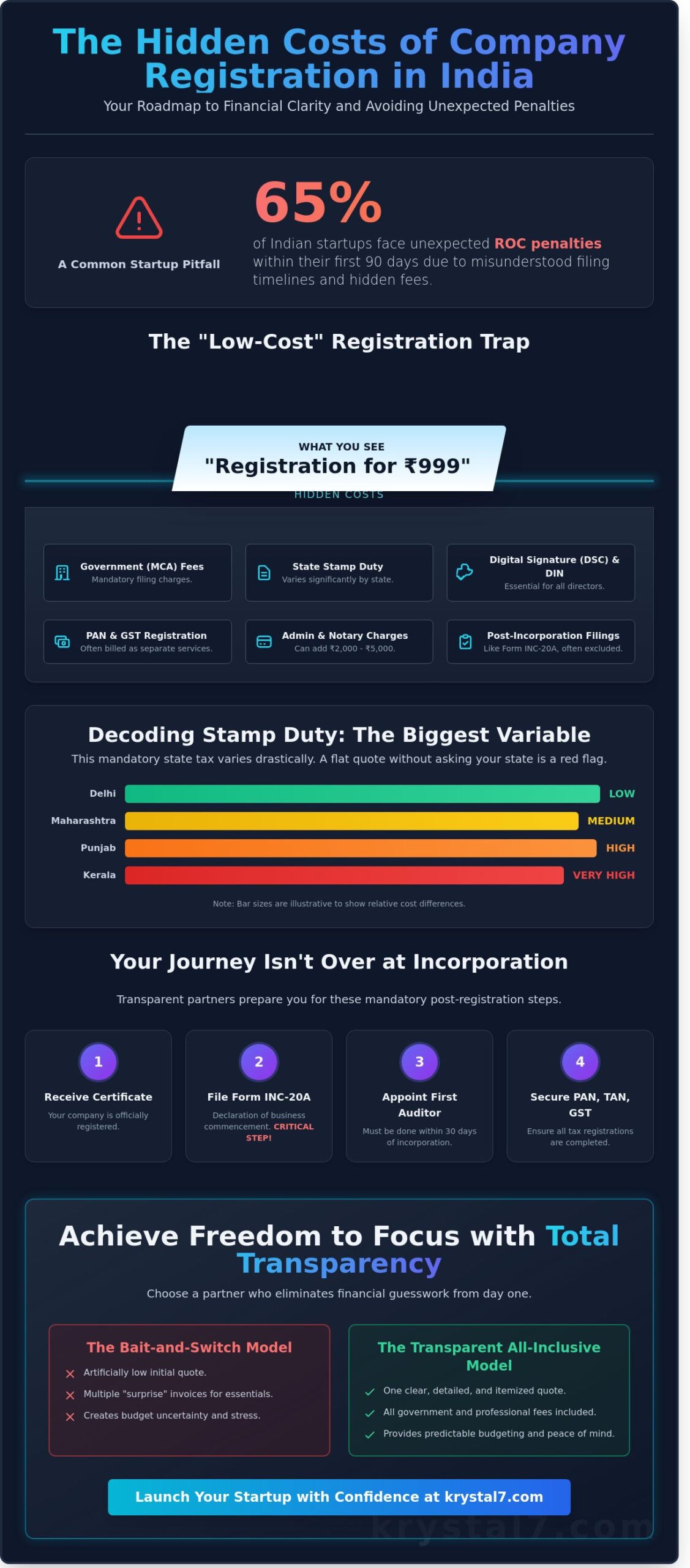
According to 2024 compliance audits, nearly 65% of Indian startups face unexpected ROC penalties within their first 90 days due to misunderstood filing timelines. This financial friction often happens because founders aren’t properly coached on avoiding hidden costs in company registration during the initial setup phase. You deserve a partner who provides crystal clarity from the very first consultation.
You likely feel that the legal path to starting a business in India is unnecessarily opaque. We agree that your focus should be on growth, not on deciphering complex fee schedules or hidden professional markups. This guide provides the roadmap you need to launch with total financial clarity and the freedom to focus on your vision.
We’ll break down the Ministry of Corporate Affairs (MCA) fee structures and state-specific stamp duty variations for 2026. You’ll also learn how to build a predictable budget and avoid the common statutory “gotchas” that often hit new Indian startups.
Key Takeaways
- Distinguish between statutory government fees and professional charges to see through “low-cost” packages that often exclude essential items like DSC and DIN.
- Understand how state-specific stamp duty variations and authorized capital levels can unexpectedly inflate your initial business setup budget.
- Master the strategy for avoiding hidden costs in company registration by accounting for mandatory post-incorporation steps like filing Form INC-20A and appointing a statutory auditor.
- Identify the “unbundled” services, such as PAN and GST registration, that consultants often bill separately to keep their initial quotes artificially low.
- Learn how a transparent, all-inclusive pricing model provides the crystal clarity needed to eliminate financial guesswork and focus on your business growth.
The ‘Low-Cost’ Trap: Why Initial Registration Quotes Are Often Misleading
Many Indian founders fall for the “registration for ₹999” advertisement. These eye-catching numbers usually cover only the professional fee of the consultant. They often hide the actual costs required by the Ministry of Corporate Affairs (MCA). Avoiding hidden costs in company registration starts with distinguishing between what you pay the expert and what you pay the government.
Statutory fees are mandatory payments made directly to the government. These include stamp duty, which varies significantly between states like Maharashtra and Telangana. Professional fees cover the expertise of your Chartered Accountant or Company Secretary. A transparent partner lists both clearly so you don’t face unexpected bills mid-process. Clarity at the start prevents your budget from spiraling out of control later.
Beyond the main fees, administrative expenses often slip through the cracks. Notary charges for affidavits, physical document couriers, and stamp paper costs add up quickly. These small amounts can total between ₹2,000 and ₹5,000 depending on your location. Reliable partners include these in their initial breakdown to ensure you have the freedom to focus on your business goals.
The DSC and DIN Surprise
Every director must have a Class 3 Digital Signature Certificate (DSC) to sign electronic forms. These certificates have a distinct market cost that consultants often leave out of base quotes. You’ll also need a Director Identification Number (DIN). While the SPICe+ form includes DIN for up to three directors, adding a fourth director requires additional government fees. Your company registration quote should also account for the unified PAN and TAN application process to avoid separate filing charges.
Name Reservation (RUN) vs. Integrated Incorporation
You can reserve a company name using the RUN service for a flat fee of ₹1,000. Alternatively, you can apply for the name directly through SPICe+ Part B to save this cost. However, this path is risky. If the name is rejected twice, the government fee for the entire incorporation is forfeited. You’ll have to pay the full amount again. Choosing a unique, compliant name is a strategic move for avoiding hidden costs in company registration and preventing expensive re-submissions.
Decoding Stamp Duty: The Variable Cost No One Talks About
Most founders focus on professional fees but forget the government’s share. Stamp duty on the Memorandum of Association (MoA) and Articles of Association (AoA) is a mandatory state tax. It’s a non-negotiable expense that varies significantly depending on your location. Understanding this variation is vital for avoiding hidden costs in company registration.
State-Specific Variations in India
Stamp duty rates aren’t uniform across the country. Each state government sets its own rates under the Indian Stamp Act, 1899. For example, a private limited company india registered in Delhi often enjoys lower stamp duty compared to one in Maharashtra or Punjab. In states like Madhya Pradesh or Kerala, the duty can be much higher for the same amount of capital. These differences mean that a startup in Gurgaon might face a different cost structure than one in Mumbai, even if their business models are identical.
This tax is mandatory. No service provider can “discount” it. If a consultant quotes a flat fee without asking for your proposed authorized capital, be careful. They’re likely not including the actual government duties in their initial quote. This lack of transparency often leads to “surprise” invoices later in the process. Seeking expert compliance guidance early on ensures you know exactly what the state treasury requires from the start.
Authorized vs. Paid-up Capital Nuances
You need to distinguish between what you “can” raise and what you “have” in the bank. Authorized capital is the maximum limit of share capital your company can issue. Paid-up capital is the actual amount shareholders have already invested. The MCA portal calculates registration fees and stamp duty based on the Authorized Capital, not the money you currently hold.
- The Slab Effect: Fees move in brackets. Crossing a specific threshold, such as moving from ₹10 lakh to ₹15 lakh, can trigger a sharp increase in statutory fees.
- Upfront Costs: Setting an unnecessarily high authorized capital on day one creates a heavy upfront cost that doesn’t benefit your immediate operations.
- Scalability: It’s often smarter to start with a lean authorized capital, such as ₹1 lakh or ₹10 lakh. You can increase this limit later by filing Form SH-7 with the MCA as your business grows.
Founders who over-commit on capital before they need it waste valuable resources. By aligning your capital structure with your immediate operational needs, you’re effectively avoiding hidden costs in company registration while maintaining the flexibility to scale. This methodical approach provides the crystal clarity needed to build a sustainable business foundation without draining your initial seed fund on unnecessary taxes.
Beyond the Certificate: Mandatory Post-Incorporation Compliance Costs
Receiving your Certificate of Incorporation (COI) is a milestone, but it’s not the finish line. Many founders celebrate the birth of their company only to face unexpected penalties weeks later. You must understand that avoiding hidden costs in company registration requires looking past the initial filing fees. The Ministry of Corporate Affairs (MCA) mandates several steps immediately after the Corporate Identity Number (CIN) is issued.
Your journey into annual compliance for private limited company begins the very hour your CIN is generated. If you don’t track these deadlines, the late fees can quickly exceed your original registration budget. Here are the immediate financial commitments you’ll face:
- Commencement of Business (Form INC-20A): You cannot start operations or exercise borrowing powers until you file this declaration. It’s mandatory within 180 days of incorporation. Missing this deadline results in a penalty of INR 50,000 for the company and INR 1,000 per day for every director.
- First Statutory Auditor Appointment: The Board of Directors must appoint the first auditor within 30 days of registration. This requires filing Form ADT-1. Professional fees for chartered accountants vary, so factor this into your early-stage cash flow.
- Corporate Banking Fees: Opening a current account isn’t always free. Most Indian banks require a minimum average balance ranging from INR 10,000 to INR 1,00,000. You’ll also encounter processing fees for document verification and corporate debit card issuance.
The First Board Meeting and Statutory Registers
The law requires you to hold your first board meeting within 30 days of incorporation. You’ll need to document this in a physical or electronic Minutes Book. You’re also legally obligated to maintain Statutory Registers, including the Register of Members and the Share Certificate Book. Drafting these documents professionally ensures you stay compliant. Don’t forget that you must issue share certificates to subscribers within 60 days. This involves paying share stamp duty, which is a state-specific cost that depends on your authorized capital.
Registered Office Verification
For expert guidance on navigating these post-incorporation hurdles without the stress, contact Krystal7 Consultants at business@krystal7.com or visit krystal7.com today.
The Professional Fee Bait-and-Switch: Avoiding Hidden Costs in Company Registration
Many founders choose the lowest quote they find without realizing they’re buying an incomplete service. Avoiding hidden costs in company registration starts with demanding a line-item breakdown of every deliverable. If your quote doesn’t explicitly mention PAN, TAN, and the drafting of your MoA and AoA, you’ll likely face “add-on” bills within weeks of starting the process.
You should always opt for a fixed-fee model over a success-fee structure. Fixed fees provide the crystal clarity you need to budget effectively. Cheap consultants often skip thorough documentation checks, which leads to rejected forms at the MCA portal. These errors result in resubmission fees and potential penalties under the Companies Act 2013 that far exceed any initial savings.
- Demand a breakdown of government fees versus professional charges.
- Confirm if post-incorporation documents like the first Board Resolution are included.
- Ask if the fee covers the mandatory INC-20A (Commencement of Business) filing.
GST Registration Nuances
The GST portal doesn’t charge a government fee for registration, but professional drafting is a billable service. A poorly filed application often triggers a “Notice for Clarification” in Form GST REG-03. Resolving these notices requires additional professional hours and expert intervention that most “budget” packages don’t cover.
Choosing the right HSN (Harmonized System of Nomenclature) or SAC (Services Accounting Code) is vital for your tax health. Incorrect codes lead to wrong tax rates or blocked input tax credits later. Our team ensures your registration is accurate from day one to prevent future tax liabilities and legal hurdles.
Trademark and Brand Protection
Incorporating a company like “Zenith Tech Private Limited” doesn’t give you the legal right to the “Zenith” brand name. You need a separate Trademark (TM) application to prevent competitors from stealing your identity. Budgeting for this early is a key strategy for avoiding hidden costs in company registration and long-term brand building.
Leverage the MSME/Udyam registration to save money. Small businesses and startups receive a 50% discount on government filing fees for trademarks under the Trade Marks Rules, 2017. This reduces the official government fee from ₹9,000 to ₹4,500 per class, making brand protection much more affordable for new ventures.
Achieving Freedom to Focus: The Krystal7 Approach to Transparent Incorporation
Starting a venture in India shouldn’t feel like a gamble. We believe avoiding hidden costs in company registration starts with Krystal-Clear pricing models that account for every government fee and professional charge upfront. You won’t find surprise line items for miscellaneous processing or incidental expenses in our quotes. Transparency isn’t just a word for us; it’s how we work.
Our dedicated Relationship Managers act as your personal bridge to the Indian regulatory landscape. These experts understand the nuances of the Companies Act, 2013, ensuring your application moves through the MCA portal without unnecessary delays. They handle the technical hurdles so you can build your product. You get an advisor who knows your business inside out, not a generic helpdesk.
Our support extends far beyond the initial SpicE+ form submission. We provide a comprehensive ecosystem covering GST registration, TDS compliance, and payroll management. This holistic approach prevents the common mistake of ignoring post-incorporation duties. Neglecting these can lead to heavy penalties under the Income Tax Act or the GST Act, often costing more than the registration itself.
One-Stop Solution for Startups
We manage the heavy lifting of MCA paperwork and digital signature certificates so you don’t have to. Our team specializes in Gurgaon-specific local compliance and Haryana state regulations, including Labour Department registrations and Professional Tax requirements. Building a compliance-first culture today makes your startup significantly more attractive to VC investors during future due diligence rounds. Investors love clean cap tables and flawless statutory records.
Your Launchpad for 2026
Your journey from name approval to your first annual filing is a roadmap we’ve perfected. Krystal7 serves as a strategic partner, ensuring you never miss a deadline or overlook a statutory requirement. We view compliance as a tool for growth that protects your business legacy rather than a hurdle to overcome. It’s about building a foundation that lasts.
Contact Krystal7 Consultants at business@krystal7.com or visit krystal7.com for expert assistance.
Launch Your Indian Venture with Absolute Financial Clarity
Registering your Private Limited company or LLP is the first step in a long journey. You’ve learned that low-cost registration quotes often hide mandatory expenses like state-specific stamp duty and MCA filing fees. True success comes from avoiding hidden costs in company registration by planning for post-incorporation compliance from day one.
This includes appointing your first auditor within 30 days and filing Form INC-20A to commence business operations as required by the Companies Act. Don’t let unexpected penalties or professional fee shifts stall your momentum. At Krystal7, our top-tier Chartered Accountants and Company Secretaries provide specialized startup and SME advisory. We stand by our No Hidden Costs Guarantee to ensure your budget remains predictable.
You deserve the freedom to focus on building your vision while we handle the regulatory red tape. Ready for Krystal-Clear business setup? Contact Krystal7 Consultants at business@krystal7.com or visit krystal7.com for expert assistance.
Your entrepreneurial dream deserves a foundation built on trust and precision. We’re here to help you scale with confidence.
Frequently Asked Questions
Is GST registration mandatory immediately after company incorporation?
GST registration isn’t mandatory immediately after incorporation unless your annual turnover exceeds ₹40 lakhs for goods or ₹20 lakhs for services. You must also register if you plan to sell products across state lines through e-commerce platforms. Many founders choose voluntary registration to claim Input Tax Credit on early expenses, effectively avoiding hidden costs in company registration by recovering taxes paid on office equipment.
What happens if I forget to file the Commencement of Business (INC-20A) form?
If you forget to file the Commencement of Business (INC-20A) form within 180 days, your company cannot start operations or exercise borrowing powers. The MCA imposes a one-time penalty of ₹50,000 on the company and ₹1,000 per day on every director, capped at ₹1,00,000. Failing to comply can eventually lead to the Registrar of Companies striking your company off the register entirely.
Can I change my Authorized Capital later, and what are the costs involved?
You can increase your Authorized Capital later by filing Form SH-7 on the MCA portal after passing an ordinary resolution. The costs involve government filing fees and state-specific stamp duty, which varies significantly between states like Delhi and Maharashtra. It’s often cheaper to set a realistic capital amount during the initial setup to streamline your growth without facing repeated filing expenses and administrative hurdles.
Are Digital Signature Certificates (DSC) a one-time cost or a recurring expense?
Digital Signature Certificates (DSC) are a recurring expense because they’re typically issued with a validity period of 2 years. You’ll need to renew them to sign statutory documents and tax filings on the MCA and GST portals. Keeping track of these expiry dates ensures you don’t face last-minute hurdles during peak compliance seasons when your signatures are required for annual returns.
Does the MCA refund registration fees if my company application is rejected?
The MCA doesn’t refund registration fees if your application is rejected after the allowed re-submission attempts. Most forms, like the SPICe+ (INC-32), provide two opportunities to correct errors or provide additional documents. If you fail to rectify the issues within the 15 day window provided for each re-submission, you’ll have to file a fresh application and pay the government fees again.
What are the penalties for late filing of annual returns in India?
Late filing of annual returns like Form MGT-7 or AOC-4 attracts a penalty of ₹100 per day for each form. There’s no upper limit on these additional fees, so delays can quickly become a heavy financial burden for a new startup. Staying ahead of these deadlines is a key strategy for avoiding hidden costs in company registration and maintaining a clean compliance record.
Is it cheaper to register an LLP instead of a Private Limited Company?
Registering an LLP is generally more cost-effective for smaller ventures because it has fewer compliance requirements than a Private Limited Company. You don’t need a statutory audit unless your turnover exceeds ₹40 lakhs or capital contribution exceeds ₹25 lakhs. This structure offers a streamlined path for founders who want limited liability without the higher administrative overhead and mandatory audit costs of a company.
Why do I need to appoint an auditor within 30 days of registration?
Section 139(6) of the Companies Act, 2013, requires the Board of Directors to appoint the first auditor within 30 days of registration. This auditor holds office until the conclusion of the first Annual General Meeting. If the Board fails to make this appointment, they must inform the members, who then have 90 days to appoint an auditor at an extraordinary general meeting to ensure compliance.
For expert assistance with your business journey, contact Krystal7 Consultants at business@krystal7.com or visit krystal7.com.

Article by
Nihal Srivastava
Nihal Srivastava is the Co-Founder of Krystal7 Consultants, helping Indian entrepreneurs and startups navigate company registration, compliance, trademark protection, and regulatory requirements with clarity and confidence. With 6+ years of hands-on expertise in MCA filings, GST compliance, and corporate structuring, Nihal has guided 1000+ businesses across India through their legal and compliance journeys. He believes every business dream deserves crystal clear foundations, and that no founder should be held back by paperwork or red tape.