

Maintaining Statutory Registers for Pvt Ltd Company: The 2026 Compliance Guide
What if the most dangerous gap in your compliance isn’t your tax return, but a set of registers you haven’t opened since your company was born? You likely feel that keeping up with every internal record is a secondary priority compared to hitting your revenue targets. It’s frustrating to juggle business growth while worrying about whether your internal paperwork meets the strict standards of the Companies Act 2013. Maintaining statutory registers for pvt ltd company is the essential foundation that ensures your business remains audit-ready and avoids fines that can reach ₹3 lakh under Section 88.
We’re here to turn that compliance anxiety into total confidence. This 2026 guide will show you exactly which books you must keep and how to manage them without the headache of red tape. You’ll get a clear checklist of mandatory registers, a look at the difference between physical and digital maintenance, and a roadmap to avoid the paperwork trap during due diligence. It’s time to get the crystal clarity you need so you can have the freedom to focus on scaling your business and building your legacy.
Key Takeaways
- Understand the vital legal distinction between your books of accounts and statutory registers to ensure your business meets every mandate of the Companies Act 2013.
- Identify the essential records your company must hold, from the Register of Members to Director details, to maintain total transparency with the MCA.
- Master the strict rules for maintaining statutory registers for pvt ltd company, including the 7-day update rule and the mandatory location requirements for your records.
- Learn how to properly authenticate and seal your entries to protect your leadership from the heavy penalties and legal risks of non-compliance.
- Discover how a streamlined approach to statutory record-keeping provides the “Freedom to Focus” on your business growth while expert consultants handle the complex red tape.
What are Statutory Registers and Why Do They Matter?
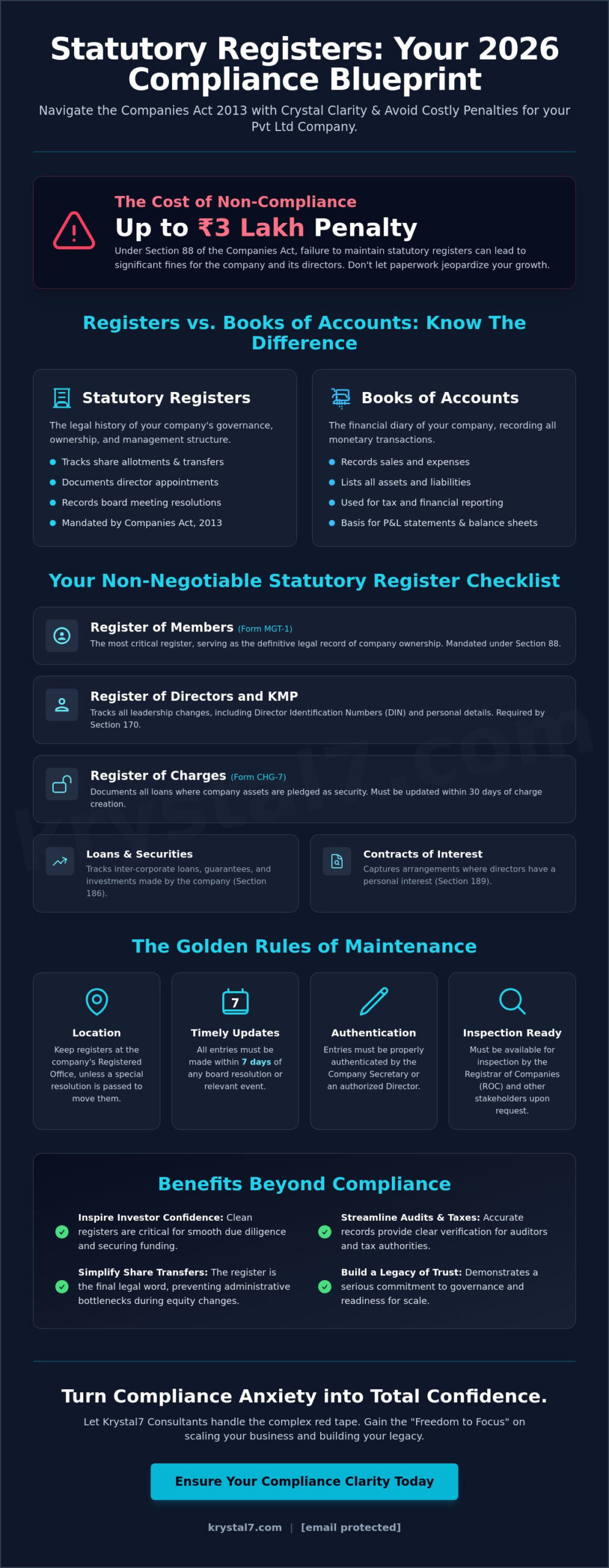
Maintaining statutory registers for pvt ltd company is a non-negotiable requirement under Indian law. These records act as the formal history of your business, capturing every vital change in ownership and management. While many founders focus on daily operations, these registers document the legal identity of your enterprise.
You must distinguish between “Books of Accounts” and “Statutory Registers” to ensure full compliance. Books of accounts record your financial transactions like sales, expenses, and assets. Statutory registers track governance events, such as share allotments, director appointments, and board meetings.
Investors prioritize these documents during due diligence. If your registers are messy or incomplete, it signals poor internal controls. These official business registers provide the proof of title that venture capitalists and banks require before committing capital.
The Legal Framework: Maintaining Statutory Registers for Pvt Ltd Company
Section 88 and Section 189 of the Companies Act 2013 set the ground rules for every Indian company. Section 88 mandates keeping a register of members, debenture holders, and other security holders. Section 189 requires a register of contracts or arrangements where directors have a personal interest.
These documents bring “Crystal Clarity” to your corporate structure. They prevent disputes over shareholding percentages or conflicting interests among partners. You must keep these records at your registered office unless you pass a special resolution to move them elsewhere.
The Registrar of Companies (ROC) oversees these documents and can demand an inspection at any time. Failing to produce updated registers can lead to significant fines for the company and its directors. We handle these complexities so you have the freedom to focus on your business goals.
Benefits Beyond Compliance
Updated registers make share transfers and allotments incredibly simple. When you issue new equity to a co-founder or employee, the register acts as the final legal word. It prevents the administrative bottlenecks that often delay critical growth milestones.
Accurate records also facilitate smooth annual audits and tax assessments. Auditors rely on these registers to verify your equity structure and any related party transactions. This transparency builds a professional legacy for your startup from day one.
Maintaining statutory registers for pvt ltd company creates a foundation of trust with stakeholders. It shows you’re serious about your vision and ready for scale. A well-maintained register is the hallmark of an investment-ready organization.
For expert assistance with your company compliance, contact Krystal7 Consultants at business@krystal7.com or visit krystal7.com.
Essential Statutory Registers Every Pvt Ltd Must Maintain
The Companies Act, 2013 mandates that every private limited company keep specific records at its registered office. These documents act as the “memory” of your corporation. Maintaining statutory registers for pvt ltd company isn’t just a clerical task; it’s a legal safeguard that protects your directors and shareholders from heavy penalties under Section 450. Without these, your business lacks the “crystal clarity” required for audits and due diligence.
The Register of Members (Form MGT-1) is the most critical document. It serves as the definitive record of who owns the company. Under Section 88, any person whose name appears here is legally considered a member. If you’re looking to scale or expand, you’ll find that the initial setup phase is a universal requirement. For instance, when you Register your company with Companies House in the UK or with the MCA in India, these registers become the foundation of your legal identity.
- Register of Directors and KMP: Required under Section 170, this tracks leadership changes, including Director Identification Numbers (DIN) and residential addresses.
- Register of Charges (Form CHG-7): This documents all loans where company assets are used as security. It must be updated within 30 days of creating or modifying a charge.
- Register of Loans and Securities: Compliance with Section 186 requires tracking all inter-corporate loans, guarantees, or investments.
- Register of Contracts: This captures arrangements where directors have a personal interest, ensuring transparency under Section 184 and 189.
Share-Related Registers
Equity tracking requires meticulous detail to avoid disputes during future funding rounds. You must maintain a Register of Share Transfers and Allotments to record every movement of capital. If a certificate is lost or damaged, the Register of Renewed and Duplicate Share Certificates becomes your legal backup. Companies offering employee incentives must also maintain a Register of ESOPs to track vested and exercised options accurately.
Meeting Minutes and Attendance
Minutes are the legal evidence of every decision made by your board. Section 118 requires that minutes of Board Meetings and General Meetings be recorded within 30 days of the conclusion of the meeting. An attendance register is equally vital to prove that a valid quorum was present. These records validate your company’s actions during tax audits or legal disputes. If you feel overwhelmed by these requirements, you can consult our legal strategists to streamline your record-keeping and gain the freedom to focus on growth.
Rules for Maintenance: Location, Inspection, and Digital Formats
The Companies Act, 2013, mandates that every company must keep its records at the registered office address provided during incorporation. This centralizes data for regulatory authorities and ensures transparency. If you’re maintaining statutory registers for pvt ltd company operations, you can’t simply store these documents at a director’s home or a secondary branch without following specific legal protocols.
If your board decides to move these registers to another location within the same city, a simple Board Resolution suffices. However, moving them to a different city within the same state requires a Special Resolution passed by shareholders. This change must be reported to the Registrar of Companies (ROC) via Form MGT-14 within 30 days. Keeping records in the wrong place can lead to penalties under Section 128, which often start at ₹50,000 and can scale higher for continued non-compliance.
Preservation timelines are equally strict. You must maintain the Register of Members and the Index of Members permanently. Minute books of all Board and General meetings also require permanent preservation. Other records, such as the Register of Debenture Holders or foreign registers, must be kept for 8 years from the date of redemption or last entry.
Transitioning to Digital Registers in 2026
The Ministry of Corporate Affairs (MCA) now encourages companies to move away from bulky physical ledgers. Under Rule 3 of the Companies (Management and Administration) Rules, 2014, you can maintain registers in electronic form. These digital records must be clear, legible, and stored in a format that prevents tampering.
Your electronic system must create an audit trail for every change made. It should also generate date and time stamps for every entry. Digital Signature Certificates (DSC) play a vital role here; they authenticate the entries and ensure the person making the update is authorized. We recommend keeping encrypted backups on Indian servers to ensure data remains accessible during MCA inspections.
Public Inspection and Transparency
Transparency is a cornerstone of Indian corporate law. Any member or shareholder has a legal right to inspect your statutory registers without paying a fee. However, if a non-member or a creditor wishes to inspect them, they may have to pay a small fee as specified in the company’s Articles of Association.
You must keep the registers open for inspection for at least two hours during business hours each working day. If a member requests a physical or electronic copy of the register, the company must provide it within seven days. The fee for these copies cannot exceed ₹10 per page. Managing these requests efficiently is part of maintaining statutory registers for pvt ltd company
Procedures, Timelines, and Penalties for Non-Compliance
Precision is the backbone of corporate governance. When maintaining statutory registers for pvt ltd company, you must follow the 7-day rule strictly. This means every entry, whether it’s a share allotment or a director’s appointment, must be recorded within seven days of the Board Meeting where the change was approved. Waiting until the end of the financial year creates unnecessary risk and invites scrutiny from the Ministry of Corporate Affairs (MCA).
Authentication ensures your records hold legal weight. A Company Secretary (CS) usually handles these entries. If your company isn’t required to have a whole-time CS, a Director authorized by the Board must sign and seal every new entry. During the annual filing of Form MGT-7, these registers undergo a final verification. A CS must certify that the information matches the company’s actual filings, providing that crystal clarity every founder needs.
Step-by-Step Maintenance Workflow
Compliance doesn’t have to be a burden. Follow this streamlined workflow to stay updated. First, pass a formal Board Resolution for the corporate action, such as a share transfer. Second, enter the data into the specific register within the seven-day deadline. Finally, ensure the authorized Director or CS signs the entry to validate the record. This methodical approach gives you the freedom to focus on your core business goals.
The High Cost of Neglect: Penalties in 2026
Ignoring these records leads to heavy financial and legal burdens. Under Section 88 of the Companies Act, 2013, a company that fails in maintaining statutory registers for pvt ltd company faces fines between INR 50,000 and INR 3,00,000. Every officer in default can also be fined INR 50,000. These aren’t just one-time costs; they damage your reputation with investors and banks.
The risks extend beyond just money. Repeated non-compliance can lead to the disqualification of directors under Section 164, barring them from boards for five years. The Registrar of Companies (ROC) may also initiate legal proceedings unless you opt for compounding of offences, which is a costly and time-consuming legal fix. Staying proactive is the only way to protect your business legacy.
Don’t let red tape slow down your growth. Reach out to our experts for professional compliance management and keep your registers audit-ready.
How Krystal7 Consultants Ensures Your Compliance Clarity
Manual record-keeping often feels like a heavy anchor slowing down your business growth. Between managing board resolutions and updating share transfer logs, founders frequently find themselves buried in paperwork. This administrative hassle distracts you from your core mission of scaling your venture. Maintaining statutory registers for pvt ltd company shouldn’t be a source of stress or late-night anxiety.
At Krystal7, we champion the “Freedom to Focus” approach. We believe entrepreneurs should spend their energy on innovation, not on tracking the latest MCA notification. Our team takes over the entire burden of statutory record-keeping, ensuring every entry is accurate and legally sound. We provide comprehensive support for your annual compliance for private limited company, covering everything from AOC-4 filings to MGT-7 submissions with precision.
Your Dedicated Compliance Partner
Our experienced Chartered Accountants and Company Secretaries act as your internal legal shield. We navigate the complex “red tape” of the Companies Act so you don’t have to. We perform regular health checks of your private limited company in India records to catch potential gaps before they become expensive penalties. This proactive stance ensures your business is always prepared for sudden inspections or audits.
This meticulous attention to detail keeps your business “investor-ready” at all times. When venture capitalists or banks request your registers for due diligence, you’ll provide krystal-clear documentation instantly. We also provide expert advisory on intricate share structures, rights issues, and cross-border compliance for companies with foreign directors or international shareholders. Our goal is to provide a streamlined experience that removes all compliance guesswork.
Get Started with Krystal7
Transitioning from messy physical folders to a secure, digital-first system is the first step toward clarity. We help you digitize your records while maintaining statutory registers for pvt ltd company in line with the latest 2026 standards. Our tailored compliance packages serve startups and SMEs in Gurgaon and across India, providing elite expertise at a transparent price point. We handle the complexity while you pursue your passion.
Don’t let compliance hurdles hold your vision back. Secure your company’s legacy with a partner who knows the Indian regulatory landscape inside out. We make maintaining statutory registers for pvt ltd company a seamless part of your operations. Contact us today at business@krystal7.com or visit krystal7.com to schedule a comprehensive compliance audit for your business.
Secure Your Venture with Proactive Compliance Clarity
Keeping your company’s records updated is more than an administrative chore; it’s a vital legal shield. Under the Companies Act 2013, failing to update your registers can lead to significant penalties, often starting at ₹50,000 per default. By maintaining statutory registers for pvt ltd company accurately, you ensure your business stays prepared for any MCA inspection or investor due diligence. Digital maintenance is now the gold standard for 2026, offering the security and instant accessibility your stakeholders expect.
Don’t let complex paperwork slow your growth or lead to legal friction. Our team of top-tier CAs and CSs provides the elite expertise you need to stay ahead of regulatory shifts. We operate with absolute transparency and no hidden costs, providing you with dedicated relationship management that truly understands your business goals. We handle the technicalities so you can enjoy the freedom to focus on your vision.
Stop worrying about MCA red tape. Contact Krystal7 Consultants at business@krystal7.com for expert assistance with your statutory registers and annual compliance. You’ve built a great business; let’s make sure it’s built to last.
Frequently Asked Questions
Is it mandatory for a small Private Limited company to maintain all statutory registers?
Yes, Section 88 and Section 189 of the Companies Act 2013 make it mandatory for every company to maintain these records regardless of its size or turnover. Even a startup with only two directors must keep updated registers at its registered office. Failure to comply can lead to a minimum penalty of INR 50,000, which can disrupt your business operations and reputation.
Can I maintain my statutory registers in Excel or a digital format?
You can maintain your records in electronic format as permitted by the Companies (Management and Administration) Rules, 2014. The digital system must ensure the data is tamper-proof and capable of being retrieved in a readable format. Maintaining statutory registers for pvt ltd company digitally provides crystal clarity and makes it much easier to update information during your annual audits.
What happens if we lose our physical statutory registers?
You must immediately file an FIR at the local police station and inform the Board of Directors about the loss. The company then needs to pass a formal board resolution to reconstruct the registers using previous MCA filings and share transfer records. It’s a complex process that requires meticulous attention to detail to ensure the new records match historical filings exactly.
Who is responsible for the maintenance of statutory registers in a company?
The Company Secretary or any Director specifically authorized by the Board is responsible for keeping these registers accurate and updated. Under the Companies Act, these individuals are known as “officers in default” and face personal liability if records are missing. We help founders manage these administrative burdens, giving you the freedom to focus on scaling your vision without compliance anxiety.
Do I need to file these registers with the MCA every year?
You don’t need to file the actual registers with the MCA annually; they stay at your registered office. However, you must use the information in these registers to file your Annual Return via Form MGT-7. Government authorities or shareholders can request an inspection of these documents at any time, so they must always be ready and fully updated to avoid legal friction.
What is the penalty for not updating the Register of Members on time?
Section 88 of the Companies Act 2013 imposes a flat penalty of INR 50,000 on the company and every officer who fails to update the register. If the non-compliance continues, you’ll face an additional fine of INR 1,000 per day, capped at INR 5 lakh. Maintaining statutory registers for pvt ltd company diligently is the most cost-effective way to protect your business from these heavy fines.
Can a shareholder demand to see the Register of Directors’ Interests?
Yes, Section 189(3) of the Act grants every member the right to inspect this register during standard business hours. Shareholders can also request extracts or copies by paying the specific fee mentioned in the company’s Articles of Association. Providing this access is a legal requirement that builds trust with your investors and demonstrates your commitment to transparent corporate governance.
How long do I need to preserve the minutes of Board Meetings?
You must preserve the minutes of all Board Meetings and Committee Meetings permanently in physical or electronic form. While some registers only require an eight year retention period, Section 118 mandates that minutes books stay in the company’s custody forever. These documents serve as the ultimate legal evidence of the decisions made by your leadership team since the company’s incorporation.

Article by
Nihal Srivastava
Nihal Srivastava is the Co-Founder of Krystal7 Consultants, helping Indian entrepreneurs and startups navigate company registration, compliance, trademark protection, and regulatory requirements with clarity and confidence. With 6+ years of hands-on expertise in MCA filings, GST compliance, and corporate structuring, Nihal has guided 1000+ businesses across India through their legal and compliance journeys. He believes every business dream deserves crystal clear foundations, and that no founder should be held back by paperwork or red tape.