

GST Registration Threshold for Services: A Complete 2026 Guide for Indian Entrepreneurs
Last Tuesday, a freelance software architect in Gurgaon realized his total billing had reached ₹19.5 lakhs, triggering a sudden panic about the mandatory 20-lakh limit. You’ve likely felt that same knot in your stomach while trying to distinguish between the 40-lakh limit for goods and the gst registration threshold for services. It’s frustrating when you’re juggling client deadlines and trying to decode complex tax rules at the same time.
We understand that the fear of a ₹10,000 penalty or a 100% tax fine for late registration feels overwhelming. You deserve the freedom to focus on your vision without worrying about the guesswork of the GST portal. This guide helps you master the gst registration threshold for services and provides a precise method to calculate your aggregate turnover with absolute accuracy.
You’ll get a clear “Yes” or “No” on your registration requirements for the 2026 fiscal year. We’ll also explore how these limits affect your service pricing and your overall profit margins. Let’s bring crystal clarity to your compliance journey so you can build your business with confidence.
Key Takeaways
- Understand why the ₹20 Lakh limit remains the primary gst registration threshold for services and how it applies to your specific business model in 2026.
- Learn the precise logic for calculating your PAN-based aggregate turnover under Section 2(6) to ensure compliance across all your Indian branches.
- Identify the critical Section 24 triggers where mandatory registration is required regardless of your annual income or the standard threshold “safety net.”
- Discover the strategic advantages of voluntary registration, including how it unlocks elite corporate contracts and provides the “Freedom to Focus” on scaling your venture.
- Find out how to streamline your compliance journey with Chartered expertise that removes the guesswork from document collection and GSTIN generation.
Understanding the GST Registration Threshold for Services in 2026
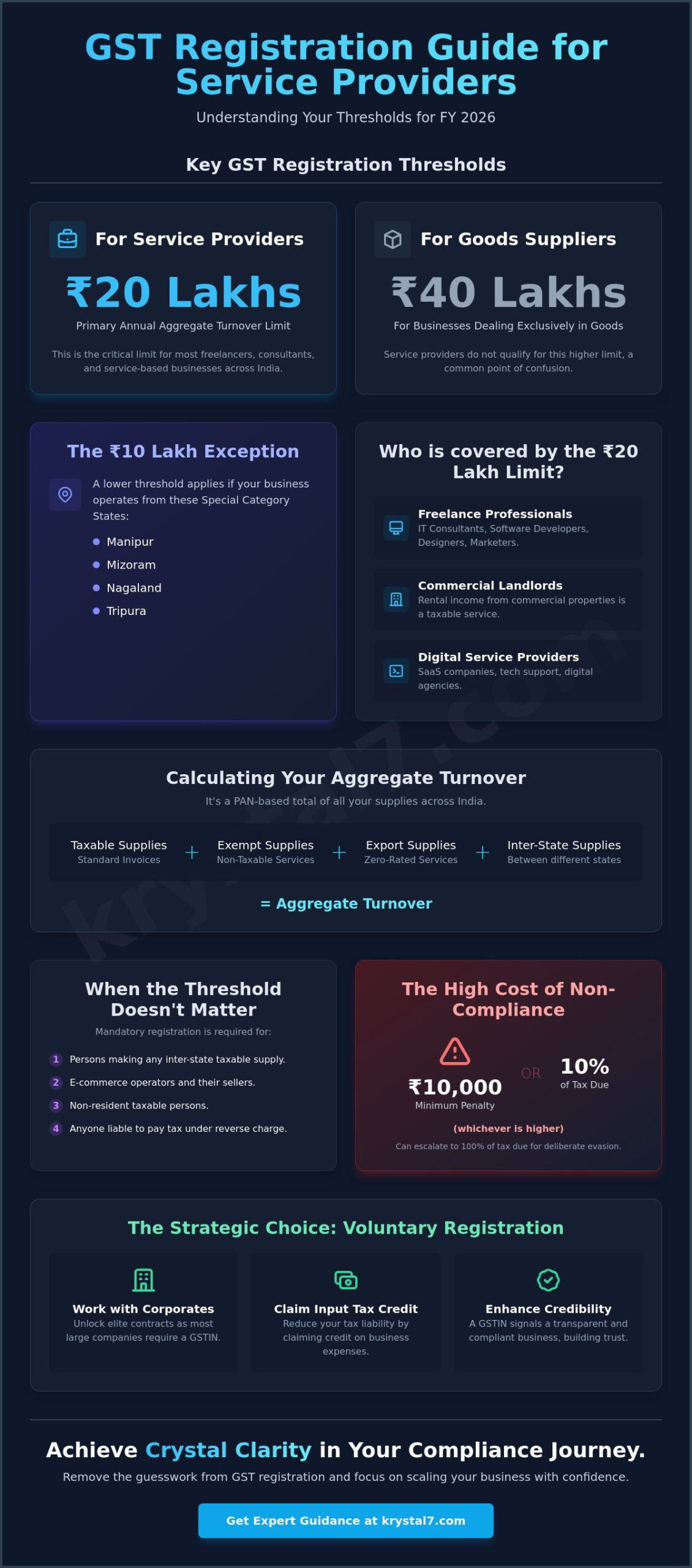
The Goods and Services Tax (India) framework, established under the GST Act of 2017, creates a clear entry point for businesses into the formal tax system. For most service providers, the gst registration threshold for services remains fixed at an aggregate annual turnover of ₹20 Lakh. This figure represents the total value of all taxable, exempt, and export supplies made by a professional or entity. Monitoring this limit is the first step toward achieving the freedom to focus on your core business goals.
It’s vital to distinguish between the rules for goods and services to avoid expensive compliance errors. While many traders dealing exclusively in goods benefit from a higher ₹40 Lakh limit, service providers must act once they reach the ₹20 Lakh mark. Failing to register on time can lead to penalties starting at ₹10,000 or 10% of the tax due, whichever is higher. We bring crystal clarity to this process, ensuring you never face the “hassle” of backdated tax liabilities or legal notices.
Knowing your threshold early in the financial year prevents the guesswork that often leads to last-minute panic. As you plan for the 2026 fiscal cycle, having a streamlined view of your projected earnings allows you to register voluntarily or exactly when required. This proactive approach builds a foundation of transparency that investors and clients value in a growing venture.
The ₹20 Lakh Limit: Who Does It Apply To?
This primary threshold applies to a vast majority of Indian professionals and service-based entities. It covers freelance IT consultants, digital marketers, architects, and healthcare professionals. If you’re an influencer or a coach, this is the magic number you need to track throughout the 2026 financial year. It’s not just about active service fees; even rental income from commercial properties contributes to your aggregate turnover.
- Freelance Consultants: Software developers and designers must track all domestic and export invoices.
- Commercial Landlords: Rental income from shops or offices is considered a service under GST law.
- IT Service Providers: Startups offering SaaS or tech support fall under this ₹20 Lakh requirement.
Special Category States: The ₹10 Lakh Exception
Your business location or “Place of Supply” significantly impacts your gst registration threshold for services. In certain North-Eastern and hill states, the government maintains a lower limit of ₹10 Lakh to broaden the tax base. If your business operates from Manipur, Mizoram, Nagaland, or Tripura, you must register for GST much earlier than your counterparts in Delhi or Maharashtra.
Some states that previously had lower limits, such as Uttarakhand and Meghalaya, have now opted for the standard ₹20 Lakh threshold for services. This distinction is critical because registering under the wrong limit can lead to statutory defaults. Our experts ensure your registration strategy aligns perfectly with your specific state regulations, giving you a clear path to compliance without the red tape.
How to Calculate Aggregate Turnover for Service Providers
Calculating your turnover correctly is the first step toward achieving crystal clarity in your compliance journey. Aggregate Turnover is the sum of all taxable, exempt, and export supplies under one PAN. Under Section 2(6) of the CGST Act, your turnover isn’t just your profit or your taxable sales. Since the notification issued on April 1, 2019, the GST registration threshold for services has remained at ₹20 lakhs for most Indian states, with a ₹10 lakh limit for special category states.
The GST portal tracks your business activity based on your Permanent Account Number (PAN). If your Private Limited company operates branches in Gurgaon, Bengaluru, and Hyderabad, you must combine the sales from all three locations. You can’t treat each branch as a separate entity for threshold purposes. This Pan-India approach ensures transparency and prevents businesses from splitting operations to avoid tax obligations. Our experts provide the freedom to focus on your growth while we manage these multi-state calculations.
What to Include in Your Calculation
You must look beyond your standard invoices to get an accurate figure. Include all taxable service supplies and zero-rated services like exports to international clients. Exempt services, such as specific healthcare or educational offerings, also count toward the total. Even inter-state supplies made between your own branches must be added to your aggregate total. Keeping a meticulous record of these figures gives you the confidence to scale your venture without legal surprises.
- Taxable Supplies: All services where you’d normally charge GST at 5%, 12%, or 18%.
- Exempt Supplies: Services that have a nil rate of tax or are specifically exempt by government notification.
- Export Services: Services provided to clients outside India, even if they’re zero-rated under GST.
- Inter-state Branch Transfers: Services provided from one branch to another under the same PAN located in different states.
What to Exclude from Your Calculation
Don’t inflate your numbers by including taxes or specific costs that don’t belong. You must exclude Central Tax (CGST), State Tax (SGST), and Integrated Tax (IGST) that you’ve collected from clients. Another pitfall is including inward supplies where you pay tax on a Reverse Charge (RCM) basis. These are expenses, not sales; they don’t count toward your registration limit. If your entity deals in non-taxable items like petrol or alcohol for human consumption, these are excluded from the GST turnover calculation as well.
- Taxes: Any GST amount mentioned on your invoices is not part of your turnover.
- Inward RCM Supplies: Services you purchased where you’re responsible for paying the tax directly to the government.
- Non-taxable Supplies: Items specifically outside the scope of GST legislation, such as high-speed diesel.
Miscalculating these figures can lead to missed deadlines and unnecessary penalties. Our team of legal strategists can help you review your books to ensure you’re staying compliant with the latest 2026 regulations. We handle the complexity so you can build your legacy with confidence.
Mandatory GST Registration: When the Threshold Does Not Matter
Section 24 of the CGST Act 2017 serves as a vital override to the standard rules. While most entrepreneurs look for the gst registration threshold for services to hit ₹20 Lakh, this section lists specific scenarios where you must register immediately. Your turnover could be just ₹1,000, but the law requires a GSTIN from day one.
The myth of the ₹20 Lakh safety net often leads to heavy penalties for small businesses. If you fall under “Compulsory Registration,” the standard exemption limits simply do not apply to you. This ensures that certain business models remain within the tax net to maintain transparency across the supply chain.
E-commerce service providers often face confusion here. If you provide services through platforms like Urban Company or Zomato, you generally enjoy the threshold benefit due to Notification No. 65/2017. However, if you are an aggregator or a platform owner yourself, or if you provide specific services like radio-taxi or housekeeping under Section 9(5), your compliance requirements change instantly. We help you identify these nuances so you can focus on your growth without legal hurdles.
Consider a practical example of a Gurgaon-based IT consultant. If this consultant provides software services to a client in Dubai, this is classified as an “Export of Services.” Under the law, exports are inter-state supplies. While goods exporters must register for any inter-state sale, the gst registration threshold for services still protects this consultant. Thanks to Notification No. 10/2017, they don’t need a GSTIN until their total turnover exceeds the ₹20 Lakh mark, even with international clients.
Inter-State Service Providers vs. Goods Suppliers
There is a massive difference between selling a laptop and selling a software license across state lines. Goods suppliers must register the moment they sell outside their home state. Service providers are lucky; Notification No. 10/2017 grants them the full ₹20 Lakh exemption for inter-state supplies. This allows digital creators and consultants to work with clients across India without rushing into GST filings prematurely.
Casual Taxable Persons and Non-Resident Suppliers
If you run a temporary business, such as a stall at a 10-day trade exhibition in another state, you are a “Casual Taxable Person.” You must register five days before starting, regardless of your expected sales. Similarly, foreign entities setting up shop in India must comply immediately. For international companies, our Foreign Subsidiary Registration service ensures that compliance is streamlined from the very first day of operations. We remove the guesswork so your global venture can thrive in the Indian market.
For expert guidance on your specific business model or to handle your GST filings with crystal clarity, contact Krystal7 Consultants at business@krystal7.com or visit krystal7.com today.
Voluntary Registration: Strategic Growth vs. Compliance Burden
Many founders believe they should wait until they hit the ₹20 Lakh gst registration threshold for services before applying for a GSTIN. While this keeps you away from the GST portal temporarily, it often stunts your business growth. Choosing voluntary registration isn’t just about following rules; it’s a strategic move to build a scalable foundation early on.
The biggest financial advantage is the Input Tax Credit (ITC). When you start a service business, you spend heavily on laptops, high-end software, office rent, and professional fees. These expenses usually carry an 18% GST rate. If you aren’t registered, this tax becomes a sunk cost. By registering before reaching the gst registration threshold for services, you can recover these taxes and use them to offset your future tax liability.
We often hear entrepreneurs worry about the monthly filing “hassle.” While compliance requires discipline, the actual cost of filing is minimal compared to the tax savings you unlock. It’s about trading a small administrative task for significant cash flow benefits and professional standing.
The Credibility Factor in B2B Services
In the Indian B2B ecosystem, a GSTIN acts as a digital trust mark. Large corporate clients rarely work with unregistered vendors because they cannot claim ITC on payments made to them. If you aren’t registered, your services effectively cost your corporate clients 18% more than a registered competitor. Early registration ensures you don’t lose out on high-value contracts. This forward-thinking approach is especially vital for businesses managing Annual Compliance for a Private Limited Company as they scale toward enterprise-level operations.
Deadlines and Penalties for Late Registration
If you choose to wait, you must be extremely vigilant. The law mandates that you apply for GST registration within 30 days from the date you cross the threshold. Missing this window leads to severe consequences that can drain your startup’s capital. The penalty for non-registration is ₹10,000 or 10% of the tax due, whichever is higher.
- Invoice Validity: You cannot issue valid tax invoices for the period between crossing the threshold and receiving your GSTIN.
- Backdated Liability: You’ll still be liable to pay tax on all sales made after crossing the limit, even if you didn’t collect it from clients.
- Credit Loss: You might lose the ability to claim ITC on stock held on the date of registration if you delay the process.
Don’t let compliance debt slow down your vision. You can get your GST registration handled by experts to ensure you’re ready for growth from day one.
Streamlining Your GST Compliance with Krystal7 Consultants
Calculating the gst registration threshold for services shouldn’t keep you awake at night. Our chartered expertise removes the guesswork from your compliance journey. We know that as a service provider, your focus is on delivering value to clients, not wrestling with the GST portal. Krystal7 provides the clarity you need to scale without the fear of tax notices. You gain the freedom to focus on your vision while we handle the statutory heavy lifting.
Our process is meticulous and designed for speed. We start by gathering your essential documents like PAN, Aadhaar, and proof of business premises. Our team then handles the entire filing process on the official GST portal. We monitor the application status daily until your GSTIN is generated. This methodical approach ensures your registration is accurate the first time, preventing delays that could halt your business operations.
Compliance doesn’t end with a registration number. We manage your monthly GSTR-1 and GSTR-3B filings with absolute precision. Missing the 20th of the month deadline for GSTR-3B can lead to interest penalties of 18% per annum. We ensure you never face these unnecessary costs. Your dedicated advisor learns your service business inside out. They provide a level of support that goes beyond simple data entry, acting as a genuine partner in your growth.
Why Gurgaon Startups Choose Krystal7
Being based in Gurgaon gives us a unique edge in the Haryana tax jurisdiction. We understand the specific nuances of local tax offices and the frequent updates to the GST portal. Our pricing model is built on transparency with no hidden costs. You’ll always know exactly what you’re paying for upfront. If you’re still in the early stages of your journey, we also offer expert support for Company Registration in India to ensure your legal foundation is solid from day one.
Get Your GSTIN Today
Ready to take your service business to the next level? Don’t let uncertainty about the gst registration threshold for services hold back your growth. We invite you to book a consultation for a complete threshold assessment today. Our experts will analyze your turnover and inter-state supply needs to provide a clear roadmap for your business. Contact Krystal7 Consultants at business@krystal7.com or visit krystal7.com to secure your compliance.
Clarity you can build on.
Take Control of Your GST Compliance Strategy for 2026
Navigating the gst registration threshold for services requires more than just monitoring your bank balance. You must accurately calculate your aggregate turnover against the ₹20 Lakh or ₹10 Lakh limits while watching for mandatory triggers like inter-state supplies. Missing these statutory deadlines leads to heavy penalties under the GST Act.
Voluntary registration often provides a competitive edge for startups aiming for B2B contracts. Whether you’re a Private Limited company or an LLP, staying ahead of the GST portal requirements ensures your venture remains scalable. Don’t let compliance hurdles stall your vision or disrupt your momentum.
Stop the guesswork and get your GST registration handled by experts. Krystal7 Consultants provides elite expertise through top-tier Chartered Accountants and legal strategists. We’ve earned the trust of 500+ startups and SMEs across India by offering transparent, upfront pricing with no hidden red tape. Contact Krystal7 Consultants today at business@krystal7.com to give your business the freedom to focus on what matters most. Your dream deserves krystal-clear clarity.
Frequently Asked Questions
Is GST registration mandatory for services below 20 lakhs in 2026?
GST registration isn’t mandatory for service providers with an annual aggregate turnover below INR 20 lakhs in 2026. If you operate in Special Category states like Manipur or Mizoram, this limit drops to INR 10 lakhs. You only need to register if you provide inter-state taxable services or use e-commerce platforms, regardless of your total turnover. This clear boundary gives you the freedom to focus on growth without immediate compliance pressure.
How is the GST registration threshold for services calculated for a digital marketer?
For a digital marketer, the gst registration threshold for services is calculated based on your total aggregate turnover across India. This includes your taxable service fees, exempt income, and export of services under one PAN. If your total billings for SEO, ads, and consulting reach INR 20 lakhs between April 1st and March 31st, registration becomes mandatory. We help you track these numbers to ensure Krystal-clear transparency in your compliance journey.
Do I need separate GST registration for services provided in different states?
You need separate GST registrations if you have business offices or fixed establishments in multiple states. GST is a destination-based tax, so each state where you maintain a physical presence requires a distinct GSTIN. If you only operate from one office in Gurgaon but serve clients in Bangalore, a single registration in Haryana is usually sufficient. This streamlined approach keeps your administrative burden low while staying fully compliant with the CGST Act.
What happens if I cross the GST threshold mid-year?
You must apply for registration within 30 days of the date your turnover exceeds the INR 20 lakh limit. Once you cross this mark, you’re liable to collect and remit GST on all subsequent invoices. Failing to register within this window can lead to penalties under Section 122 of the CGST Act, starting at INR 10,000 or the tax amount due. We recommend monitoring your monthly receipts to avoid any last-minute rush or legal hurdles.
Can I cancel my GST registration if my turnover falls below the threshold next year?
You can apply for the cancellation of your GST registration through the official GST portal if your turnover falls below the threshold. This process is available to businesses that no longer meet the mandatory requirements or are closing operations. You must file a final return in Form GSTR-10 within three months of the cancellation order. Our legal strategists can guide you through this transition to ensure no pending liabilities remain.
Does the threshold for services include export of services to foreign countries?
The gst registration threshold for services includes the value of all exports to foreign countries. Even though exports are zero-rated supplies, they contribute to your aggregate turnover calculation. If your combined domestic and international service revenue exceeds INR 20 lakhs, you must register. This ensures you can claim Input Tax Credits (ITC) on your business expenses, turning compliance into a strategic financial advantage.
What are the documents required for GST registration for a service-based LLP?
To register a service-based LLP, you need the LLP’s PAN card, the partnership deed, and the incorporation certificate from the MCA. Each designated partner must provide their PAN, Aadhaar, and a photograph. You also require proof of your principal place of business, such as a recent utility bill or a rent agreement with a No Objection Certificate. We handle the documentation meticulously to provide you with a hassle-free registration experience.
Is the GST registration threshold the same for all types of services in India?
The standard threshold of INR 20 lakhs applies to most service providers across India, but exceptions exist for specific categories. E-commerce service providers and OIDAR services often face different rules under the GST Act. For instance, if you provide services through an e-commerce aggregator, you might need registration regardless of your turnover. Our advisors ensure you understand these nuances so your business dream stays protected from unexpected statutory risks.
For expert assistance with your compliance needs, contact Krystal7 Consultants at business@krystal7.com or visit krystal7.com.

Article by
Nihal Srivastava
Nihal Srivastava is the Co-Founder of Krystal7 Consultants, helping Indian entrepreneurs and startups navigate company registration, compliance, trademark protection, and regulatory requirements with clarity and confidence. With 6+ years of hands-on expertise in MCA filings, GST compliance, and corporate structuring, Nihal has guided 1000+ businesses across India through their legal and compliance journeys. He believes every business dream deserves crystal clear foundations, and that no founder should be held back by paperwork or red tape.