
FSSAI Regulations for Home Kitchens in India: The Ultimate 2026 Compliance Guide
What if the secret ingredient to your home food business isn’t a spice, but a 14-digit registration number? As of April 1, 2026, the FSSAI has overhauled the rules; making compliance a non-negotiable step for every home-based entrepreneur. Understanding the fssai regulations for home kitchens in india is no longer just about avoiding a ₹50,000 penalty. It’s about building a brand that customers and delivery platforms like Zomato or Swiggy trust.
We know that navigating the FoSCoS portal can feel like a technical nightmare when you want to focus on your craft. You’ve likely felt the anxiety of choosing between a Basic Registration and a State License, especially with the new ₹1.5 crore turnover threshold. This guide brings crystal clarity to your legal obligations, ensuring you meet every hygiene standard without the guesswork.
You’ll master the registration process, understand the specific 2026 fees, and feel empowered to scale your venture. We’ll break down everything from geo-tagging requirements to the exact documents needed for Form A and Form B. Let’s turn your culinary vision into a compliant, thriving reality.
Key Takeaways
- Identify whether your business requires a Basic Registration or a State License based on the updated 2026 turnover threshold of ₹1.5 crore.
- Master the specific fssai regulations for home kitchens in india to ensure your residential cooking space meets mandatory Schedule 4 hygiene and sanitary standards.
- Navigate the FoSCoS portal with confidence by learning how to select the correct “Kind of Business” and avoid common application rejection reasons.
- Protect your venture from heavy penalties by understanding the 30-day renewal rule and the May 31st deadline for filing Form D1 annual returns.
- Unlock professional growth opportunities by securing the mandatory 14-digit FSSAI number required to onboard your brand on Zomato and Swiggy.
Understanding FSSAI Regulations for Home Kitchens in India: Why Compliance Matters
Every culinary journey starting from a domestic stove is legally classified as a Food Business Operation. Under the Food Safety and Standards Act, 2006, you’re considered a Food Business Operator (FBO) the moment you sell food for profit. This means the fssai regulations for home kitchens in india aren’t just suggestions; they’re statutory requirements. Compliance ensures your kitchen meets the national safety benchmarks established by the Food Safety and Standards Authority of India (FSSAI). Whether you’re baking cakes for neighbors or running a full-scale cloud kitchen, the law requires you to be registered.
Operating without this legal shield invites severe risks that can derail your vision before it takes flight. Food Safety Officers have the authority to impose penalties ranging from ₹50,000 to ₹5 lakh for running an unlicensed venture. Beyond the financial sting, non-compliance can lead to permanent business closure notices and legal litigation. However, viewing these rules as a burden misses the Trust Dividend. A valid 14-digit FSSAI number acts as a krystal-clear badge of quality. It tells your customers that your home kitchen follows the same rigorous safety protocols as established commercial outlets like Kurrywalah.
The Role of FSSAI in the Indian Food Ecosystem
The FSSAI serves as the single point of reference for all food-related matters across the country. It replaced the outdated Prevention of Food Adulteration (PFA) Act to create a science-based regulatory framework. In 2026, the focus has shifted toward digital traceability and real-time hygiene monitoring. This ensures every meal, whether cooked in a commercial hub or a residential flat, is safe for consumption. These modern standards help streamline the industry, making it easier for small entrepreneurs to compete with larger brands by proving their commitment to safety.
Home Kitchens and Online Aggregators (Zomato/Swiggy)
If you plan to scale your business through Zomato or Swiggy, a valid license is your entry ticket. These platforms mandate FSSAI registration to protect themselves and their users from health risks. Adhering to the fssai regulations for home kitchens in india is the only way to unlock these massive digital marketplaces. This legal standing also safeguards you during customer disputes or health-related complaints. Remember that food licensing is often the second step after completing your initial business registration. Having both in place provides the freedom to focus on your recipes while your legal foundation remains rock solid.
Determining Your License Type: Basic Registration vs. State License in 2026
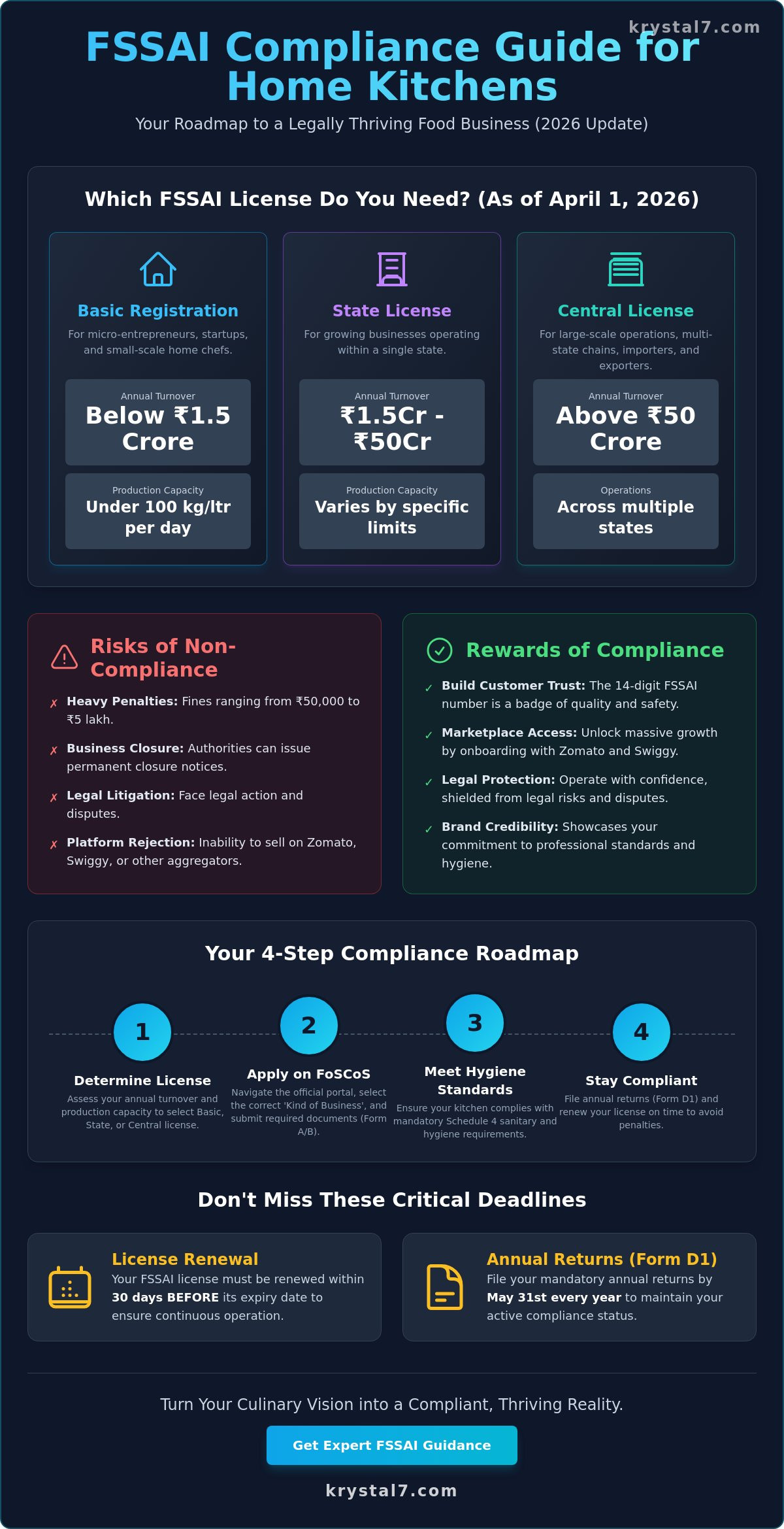
Choosing the right license type is the first step toward achieving crystal clarity in your business operations. As of April 1, 2026, the fssai regulations for home kitchens in india have shifted to favor small businesses by significantly raising the Basic Registration threshold. You must determine your category based on either your annual revenue or your daily production capacity. For many home chefs, the financial limit is the primary guide; however, your kitchen’s output volume can trigger a higher licensing requirement even if your sales are low.
If your annual turnover stays below ₹1.5 crore, you qualify for Basic Registration. This is the most common path for hobbyists and startup caterers. If your business exceeds ₹1.5 crore but remains under ₹50 crore, a State License is mandatory. For visionaries operating across multiple states or crossing the ₹50 crore mark, a Central License becomes the legal standard. You can verify your specific category on the official FoSCoS portal to ensure you don’t apply for the wrong type, which often leads to application rejection.
FSSAI Basic Registration for Micro-Entrepreneurs
This category supports small-scale home bakers and home-cooked meal services. If your daily production is under 100 kg or 100 liters, you fit here. The application is straightforward and cost-effective; requiring only basic identity proof and a kitchen layout. You can choose a validity period between 1 to 5 years. Selecting a longer duration provides the freedom to focus on your recipes without worrying about annual renewals. If you’re unsure about your specific category, the advisors at Krystal7 Consultants can help you map out the most efficient compliance path.
FSSAI State License: When Your Business Grows
Once your passion project scales past the ₹1.5 crore turnover mark, you must transition to a State License. This transition involves more detailed documentation, including a list of food categories and a technical plant layout. This level of licensing is often required by premium corporate clients or large-scale event planners. If you have structured your venture as a corporate entity, you must also stay updated on annual compliance for private limited company rules. Managing both food safety and corporate statutory filings ensures your brand remains reputable and legally sound in the eyes of investors. Adhering to the fssai regulations for home kitchens in india at this stage is critical for maintaining your professional standing.
Essential Hygiene and Sanitary Standards: Meeting Schedule 4 Requirements
Schedule 4 of the Food Safety and Standards Act serves as the technical blueprint for every food business in the country. While the document contains pages of complex jargon, its application within fssai regulations for home kitchens in india is surprisingly practical. It essentially demands that your domestic cooking space functions with the same safety precision as a commercial plant. Achieving this standard provides you with the freedom to focus on your recipes while ensuring every meal you serve is biologically and chemically safe.
Personal hygiene is the first pillar of compliance. You must ensure that every person handling food wears clean aprons, hairnets, and gloves. FSSAI mandates that food handlers possess a basic health certificate from a registered medical practitioner to prove they are free from infectious diseases. Additionally, your kitchen must only use potable water for cooking and cleaning. Relying on certified RO or filtered water systems is a non-negotiable requirement to prevent water-borne contamination in your products.
Storage protocols in a residential environment require meticulous organization. You must strictly separate raw materials from cooked food within your refrigerator to prevent cross-contamination. Use airtight, food-grade containers and ensure your fridge maintains a temperature below 5 degrees Celsius. For more technical guidance on these standards, you can refer to the resources on FSSAI’s Food Safety Compliance System (FoSCoS) portal. This level of detail transforms a simple hobby into a professional, audit-ready venture.
Infrastructure and Equipment Maintenance
Your kitchen must remain a pest-free zone at all times. You should maintain a contract with a professional pest control service and keep records of their visits, ideally every 90 days. Cleaning schedules are equally vital. You must document the daily cleaning of ovens, mixers, and all preparation surfaces using food-safe disinfectants. Proper waste management is the final step; ensure you use bins with lids and dispose of kitchen waste daily to prevent attracting rodents or insects.
Record Keeping and Traceability
Traceability is a core focus of the 2026 fssai regulations for home kitchens in india. You must maintain a “Purchase Log” that records the source, batch number, and expiry date of every ingredient you buy. If a customer reports an issue, these records allow you to trace the problem back to a specific supplier. Every item you sell must also carry a clear label. These labels must include the date of manufacture, the expiry date, the green or red veg/non-veg symbol, and your 14-digit FSSAI registration number. This transparency builds immense trust with your customers and delivery partners.
Step-by-Step Guide to Obtaining Your FSSAI License via FoSCoS
Starting your application on the Food Safety Compliance System (FoSCoS) portal is the moment your culinary vision meets legal reality. This digital platform streamlines the fssai regulations for home kitchens in india by removing the need for physical paperwork. To begin, you must create an FBO profile using a valid email and mobile number. This profile serves as your permanent dashboard for all future renewals and compliance filings.
Selecting the correct “Kind of Business” (KoB) is the most critical part of the process. Most home-based ventures fall under “Petty Food Business Operator” for registration or “Food Services” for a State License. Rejection rates for applications often stem from incorrect KoB selection. Once you choose your category, the system generates a specific list of documents tailored to your business size and food type. If you find the portal navigation confusing, reach out to Krystal7 Consultants for expert filing assistance to ensure a smooth approval process.
After you submit your application and pay the fee, a Food Safety Officer (FSO) may visit your home. They will verify if your setup matches the hygiene standards we discussed in the previous section. While inspections aren’t mandatory for every Basic Registration, they’re common for State Licenses. The officer will check your storage areas, water source, and general cleanliness before granting the final approval.
Mandatory Documents for Home Kitchens
You must upload a clear photograph and a government-issued ID proof like your Aadhar card or PAN card. Proof of possession of your premises is equally vital. If you own your home, a recent electricity bill or water bill works perfectly. If you’re operating from a rented flat, you must provide a notarized rent agreement along with a No Objection Certificate (NOC) from the landlord. Ensure your declaration of food categories is precise, as adding new categories later requires a formal modification fee.
Fee Structure and Payment Modes
The government fee for Basic Registration is ₹100 per year, while State License fees range from ₹2,000 to ₹5,000 annually. You can choose to pay for a period of 1 to 5 years. Paying for 5 years upfront provides the freedom to focus on your growth without worrying about annual deadlines. The FoSCoS portal accepts payments via credit cards, debit cards, and UPI. If your application is marked for “Clarification” or “Modification” by the FSO, you must respond within 30 days to prevent your application from being rejected and your fee forfeited.
Post-Registration Compliance: Renewals, Annual Returns, and Avoiding Penalties
Securing your 14-digit number is a significant milestone, but consistent maintenance is where true business longevity begins. Adhering to the fssai regulations for home kitchens in india requires a proactive approach to statutory deadlines. If you treat compliance as a one-time task, you risk heavy fines that can drain your hard-earned startup capital.
The 30-day rule is your most important calendar entry. You must apply for renewal at least 30 days before your current license expires to avoid a late fee of ₹100 per day. If you fail to renew before the expiry date, your license becomes void, and you’ll need to stop operations immediately to avoid legal prosecution.
Filing Annual Returns (Form D1) is mandatory for all State and Central license holders. This return must be submitted via the FoSCoS portal by May 31st every year, detailing your previous year’s sales and production volume. While Basic Registration holders don’t file Form D1, they should maintain meticulous records of their ingredient purchases and supplier invoices for at least one year.
Your business will naturally evolve as your menu expands. If you decide to add new food categories, like moving from bakery items to prepared meals, you must modify your license. This ensures your legal standing remains krystal-clear and reflects your actual operations without risking a mismatch during a surprise audit.
Handling FSSAI Inspections and Audits
A Food Safety Officer (FSO) has the legal right to inspect your home kitchen to verify hygiene standards. Don’t let this cause anxiety; instead, maintain a dedicated compliance folder with your license, water test reports, and pest control receipts. If you receive an Improvement Notice, you typically have 15 to 30 days to rectify the observations and report back to the department.
The Krystal7 Consultants Advantage: Freedom to Focus on Your Passion
Managing the complexities of fssai regulations for home kitchens in india shouldn’t take time away from your culinary craft. Our team of legal strategists and chartered experts provides a streamlined path to total compliance, handling the red tape so you don’t have to. We help you integrate your food safety mandates with other requirements, such as annual compliance for private limited company if you’ve incorporated your brand.
Building a legacy in the food industry requires a foundation of trust and transparency. By staying ahead of renewals and returns, you protect your brand and your customers. Krystal-clear compliance with fssai regulations for home kitchens in india isn’t just about following rules; it’s about the freedom to grow your dream without fear.
For expert assistance with your FSSAI registration or any other business compliance, contact Krystal7 Consultants at business@krystal7.com or visit krystal7.com.
Empowering Your Culinary Legacy Through Compliance
Success in the food industry starts with a foundation of trust. By mastering the fssai regulations for home kitchens in india, you transform your passion from a domestic hobby into a scalable, professional brand. Remember that the 2026 rules prioritize digital monitoring and strict adherence to the ₹1.5 crore turnover threshold for Basic Registration. Staying ahead of the May 31st deadline for annual returns ensures your business remains audit-ready and reputable.
You don’t have to navigate the technicalities of the FoSCoS portal alone. Krystal7 Consultants offers chartered expertise in Indian compliance to handle the red tape while you focus on your craft. Our dedicated relationship managers support every startup with a policy of no hidden costs. We provide the krystal-clear transparency you need to build a lasting venture. Your culinary dream is just one compliant step away from reality.
Ready to turn your home kitchen into a certified brand? Contact Krystal7 Consultants at business@krystal7.com for krystal-clear FSSAI assistance. Your growth starts with the freedom to focus on what you love most.
Frequently Asked Questions
Do I need an FSSAI license if I only sell food through Instagram or WhatsApp?
Yes, any individual selling food for profit through social media platforms must have a valid FSSAI registration. The law treats digital sales the same as physical storefronts to ensure consumer safety. Obtaining this registration provides you with the legal standing to grow your brand across any online channel.
Can I use my residential electricity bill as proof of address for an FSSAI license?
You can use a recent residential electricity bill or water bill as valid proof of possession for your home kitchen. If you’re a tenant, you must also provide a notarized rent agreement and a No Objection Certificate from the landlord. Having these documents ready brings crystal clarity to your application process on the FoSCoS portal.
What is the difference between an FSSAI Registration and an FSSAI License?
The primary difference is based on your annual turnover and production volume. A Basic Registration is for micro-entrepreneurs earning up to ₹1.5 crore annually. Once your revenue exceeds this ₹1.5 crore threshold, you must upgrade to a State License to remain compliant with the law.
How much time does it take to get an FSSAI Basic Registration in 2026?
It typically takes between 7 to 30 working days to receive your registration after submitting a complete application. The exact time depends on the accuracy of your uploaded documents and the local department’s processing speed. Our expert advisors can help you file correctly to avoid any unnecessary delays.
Is a separate kitchen required for a home-based food business under FSSAI rules?
A separate commercial kitchen isn’t mandatory, but you must follow the fssai regulations for home kitchens in india regarding hygiene. Your domestic kitchen must meet Schedule 4 standards, which include using potable water and keeping raw materials separate from cooked food. These rules ensure that home-cooked meals meet the same safety benchmarks as large restaurants.
What happens if I forget to renew my FSSAI license on time?
If you miss the renewal deadline, the FSSAI imposes a penalty of ₹100 for every day of delay. If the license expires entirely, your 14-digit number becomes invalid, and you must stop all food operations immediately. You’ll then need to apply for a fresh registration to restart your business.
Do I need a health certificate for myself if I am the only cook in my home kitchen?
Yes, every food handler, including solo home chefs, must possess a medical fitness certificate from a registered practitioner. This certificate confirms you don’t have any infectious diseases that could contaminate the food. It’s a vital part of the fssai regulations for home kitchens in india that protects both you and your customers.
Is FSSAI mandatory for home-based cloud kitchens selling on Swiggy and Zomato?
FSSAI registration is absolutely mandatory for onboarding on aggregators like Swiggy and Zomato. These platforms require a verified 14-digit FSSAI number to activate your restaurant listing. Without this legal proof, you cannot reach the millions of customers using these food delivery apps.

Article by
Nihal Srivastava
Nihal Srivastava is the Co-Founder of Krystal7 Consultants, helping Indian entrepreneurs and startups navigate company registration, compliance, trademark protection, and regulatory requirements with clarity and confidence. With 6+ years of hands-on expertise in MCA filings, GST compliance, and corporate structuring, Nihal has guided 1000+ businesses across India through their legal and compliance journeys. He believes every business dream deserves crystal clear foundations, and that no founder should be held back by paperwork or red tape.