

Alternatives to a Private Limited Company: Choosing the Right Indian Business Structure in 2026
The “Private Limited” tag might be the most expensive vanity metric your startup ever pays for in 2026. While it offers prestige, many founders are discovering that alternatives to a private limited company provide the same legal protection without the crushing weight of MCA filings and mandatory audit fees. You shouldn’t have to sacrifice your seed capital just to maintain a complex corporate structure that your business hasn’t outgrown yet.
We understand that you want to focus on product-market fit rather than bureaucratic hurdles. This article promises to reveal the most tax-efficient and low-compliance structures currently available to Indian SMEs. You’ll learn how to secure your personal assets while keeping your operational overheads at an absolute minimum.
We’ll preview the benefits of Limited Liability Partnerships (LLPs) and One Person Companies (OPCs) under the latest 2026 regulations. We’ll also provide a comparison framework to help you decide which structure fits your five-year growth plan.
Key Takeaways
- Identify the most efficient alternatives to a private limited company to liberate your schedule from excessive MCA filings and audit requirements.
- Master the tax differences between individual income tax slab rates and the flat 31.2% effective tax rate applicable to LLPs and partnership firms.
- Leverage the latest 2026 regulatory updates to simplify your board meetings and reduce procedural penalties for small business entities.
- Balance the need for limited liability protection with the desire for lower registration costs and faster setup times in the Indian market.
- Access a clear framework for choosing between unincorporated firms and corporate hybrids based on your specific long-term growth trajectory.
Why Founders Seek Alternatives to a Private Limited Company
Founders often view the Private Limited Company (Pvt Ltd) as the gold standard for Indian startups. While Venture Capitalists prefer this structure for its equity-sharing capabilities, it demands high maintenance. Many entrepreneurs now explore alternatives to a private limited company to escape the heavy administrative price tag that overwhelms small teams.
The Companies Act, 2013 mandates a statutory audit for every Pvt Ltd, even if the entity generates zero revenue. This requirement forces bootstrapped ventures to pay recurring professional fees to a Chartered Accountant. Furthermore, the law requires at least two directors and two shareholders, creating a barrier for solo innovators who want to maintain absolute control.
The Compliance Trap: Hidden Costs of a Pvt Ltd
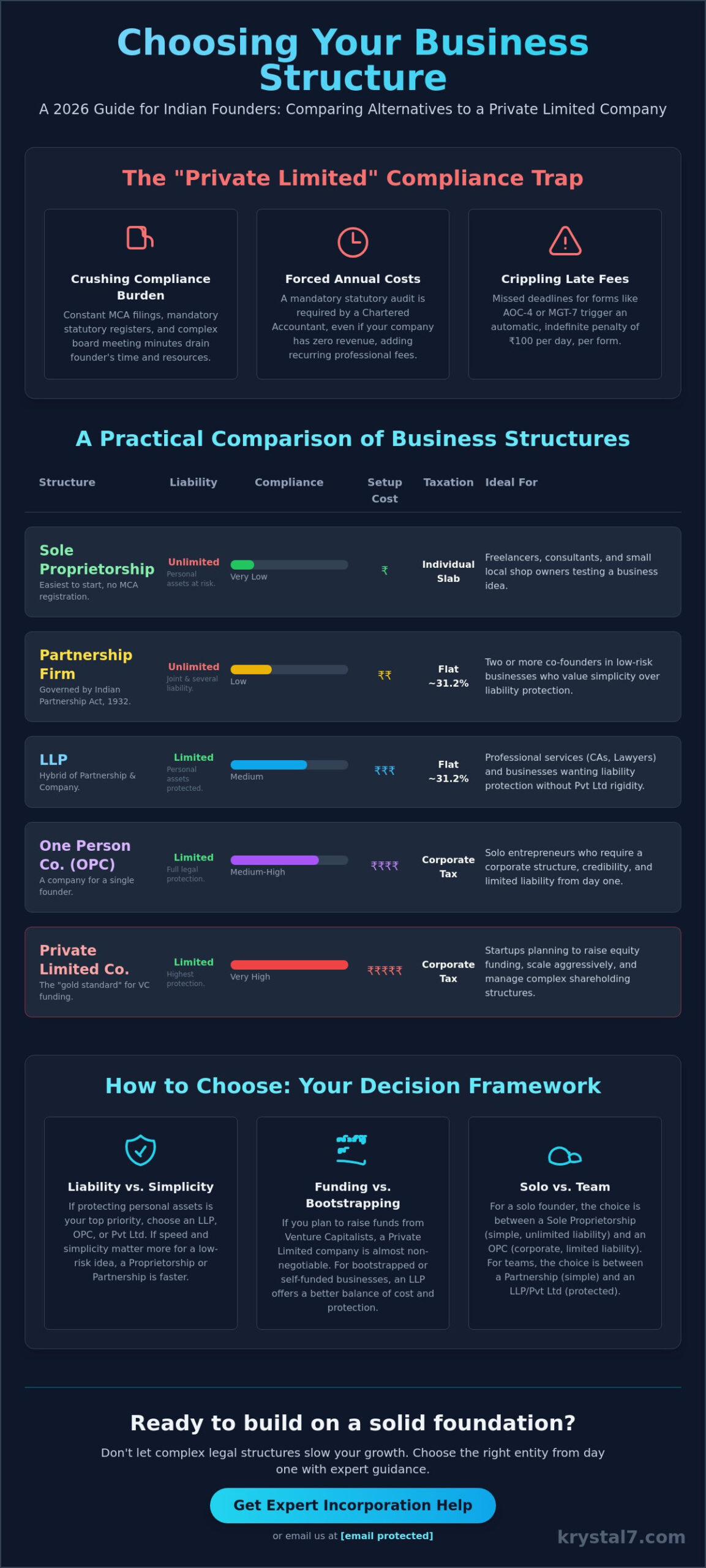
Running a Pvt Ltd involves meticulous record-keeping beyond simple accounting. You must maintain statutory registers and record minutes for every board meeting to satisfy the Ministry of Corporate Affairs (MCA). You can review the full scope of these tasks in our guide to annual compliance for private limited company requirements.
Missing a filing deadline triggers an automatic penalty of ₹100 per day for each form, such as AOC-4 or MGT-7. These costs accumulate indefinitely, which can cripple a startup’s cash flow within weeks. This constant pressure to stay compliant often feels like a trap that stifles innovation and drains resources.
When a Pvt Ltd is Overkill
A full corporate structure often hinders small, lean businesses like local retail shops or freelance consultancies. These founders prioritize operational liberty and lower overheads over complex fundraising capabilities. They seek alternatives to a private limited company that provide limited liability without the rigid formalities of a full corporation.
Modern founders want a balance where their legal entity supports growth instead of complicating daily operations. Choosing a lean structure allows you to pivot quickly as you find your market fit. We aim to bring clarity to these choices so you can move forward with confidence.
Unincorporated Alternatives: Sole Proprietorship and Partnership Firms
If you’re looking for the fastest route to start selling, unincorporated structures are the most accessible alternatives to a private limited company. These models don’t create a separate legal entity. This means you and your business are legally the same. While this simplicity is refreshing, it also means your personal assets are at risk if the business faces debt.
These structures are ideal for low-risk, small-scale local businesses. They allow you to test your business idea without committing to heavy compliance from day one. You won’t have to deal with the Ministry of Corporate Affairs (MCA) for daily operations. This freedom lets you pivot quickly as you find your market fit.
Sole Proprietorship: Accessible Alternatives to a Private Limited Company
A sole proprietorship is the easiest way to begin. There’s no formal registration with the MCA. Instead, you use your GST registration or an MSME/Udyam certificate as proof of business. This structure is perfect for freelancers or small shop owners who want to avoid the higher startup costs of corporate entities.
You’ll pay taxes based on individual income tax slab rates. This is often beneficial if your initial profits are below the higher tax brackets. There’s no need for a mandatory audit unless your turnover crosses the ₹1 crore threshold. This limit increases to ₹10 crore if your cash transactions stay below 5% of total transactions. You can focus entirely on your customers without worrying about filing annual returns with the Registrar of Companies.
General Partnership: The Traditional Collective
For those starting with a co-founder, a partnership firm governed by the Indian Partnership Act, 1932, is a common choice. You’ll need a Partnership Deed drafted on stamp paper to define profit sharing and roles. It’s much cheaper than a Private Limited Company, with registration costs typically ranging from ₹6,000 to ₹13,000.
However, partners face “joint and several liability.” If the firm can’t pay its creditors, they can legally claim your personal property. As you weigh various alternatives to a private limited company, consider the trust level between your partners. If you need help deciding which path fits your risk profile, you can explore our company incorporation package for tailored advice.
Taxation for partnership firms is a flat 30% plus a 4% cess, making the effective rate 31.2%. This is higher than the individual slabs used by proprietors. It’s vital to calculate your projected margins before choosing this path. These structures provide the ultimate operational liberty, but they require a careful look at your long-term liability.
Corporate Alternatives: Limited Liability Partnership (LLP) and One Person Company (OPC)
For founders who need the protection of a corporate shield without the rigid structure of a traditional firm, there are two primary alternatives to a private limited company. These models provide limited liability. This means your personal savings and property remain safe even if the business incurs losses or legal liabilities. They bridge the gap between the simplicity of a partnership and the professional standing of a full corporation.
Registration costs for these entities are generally lower than a standard company. An LLP typically requires an investment between ₹8,000 and ₹25,000 for setup. An OPC falls in a similar range of ₹9,000 to ₹28,000. These figures include government fees, Digital Signature Certificates (DSC), and state-specific stamp duties. They offer a sophisticated image to clients and vendors while keeping your initial burn rate manageable.
Limited Liability Partnership (LLP): The Balanced Choice
The LLP structure, governed by the Limited Liability Partnership Act, 2008, is a favorite for service-based startups. It functions like a partnership but protects partners from the negligence of others. One major advantage is the absence of Dividend Distribution Tax (DDT). Profits are taxed at the entity level, and then distributed to partners without further tax leakage.
Compliance is significantly lighter here. You don’t need to hold four board meetings a year or maintain heavy statutory registers. An audit only becomes mandatory if your contributions exceed ₹25 lakh or your annual turnover crosses ₹40 lakh. This threshold provides a long runway for early-stage businesses to grow before facing high professional audit fees.
One Person Company (OPC): For the Solopreneur
If you’re a solo founder who wants 100% control, the OPC is your best fit. Introduced through a 2013 amendment to the Companies Act, it allows a single individual to act as both director and shareholder. You must appoint a “Nominee” director who would take over in case of your absence, ensuring the company’s perpetual existence.
The OPC is often more tax-efficient for high-earning founders. Under Section 115BAA of the Income Tax Act, an OPC can opt for a concessional tax rate of 25.17%, including surcharge and cess. This is much lower than the 31.2% effective rate for LLPs. However, if your turnover exceeds specific limits, you may be required to convert into a private limited company india to accommodate larger operations. The Corporate Laws (Amendment) Bill, 2026, further simplifies life for OPCs by requiring only one board meeting per year.
How to Choose: A Practical Comparison Framework
Selecting the right path requires balancing tax efficiency against your growth ambitions. If you don’t plan to raise external equity, looking at alternatives to a private limited company can save you significant capital in the long run. Your choice should depend on your risk appetite and how much time you want to spend on administrative tasks.
Liability protection is often the deciding factor for many founders. We can rank the structures from the highest to lowest protection:
- Total Shield: Pvt Ltd, OPC, and LLP. These create a legal wall between your personal wealth and business debts.
- No Protection: Sole Proprietorship and General Partnership. Your personal assets are at risk if the business fails.
If you aim for venture capital, the Pvt Ltd remains the only real choice. VCs require the ability to issue and transfer shares easily, which isn’t possible in an LLP. However, for bootstrapped founders, the lower compliance fatigue of an LLP or OPC is a massive advantage. You’ll deal with fewer annual forms and lower professional fees while maintaining a corporate identity.
Taxation and Audit Requirements
Proprietorships are taxed at individual income tax slab rates. This can be more beneficial for smaller profits compared to the flat 31.2% effective tax rate applied to LLPs and partnership firms. Under Section 44AB of the Income Tax Act, a tax audit is mandatory if your business turnover exceeds ₹1 crore. This limit increases to ₹10 crore if your cash transactions are not more than 5% of your total transactions.
When planning your budget, remember to look beyond just the tax rates. You should also consider essential protective measures like trademark registration fees to secure your brand identity from day one. These secondary costs are vital for long-term stability in the Indian market.
Scalability vs. Stability
Are you building a lifestyle business or a future unicorn? Adding partners in an LLP is straightforward through a modified partnership deed. In a company, you must manage share certificates and comply with strict valuation reports. This makes the LLP one of the most flexible alternatives to a private limited company for service-based ventures.
The “Trust Factor” also plays a role in your decision. Banks and high-value vendors often perceive registered corporate bodies as more stable than unregistered firms. If you’re ready to secure your business future with a structure that fits your vision, you can explore our company incorporation package for expert guidance. We help you navigate these choices with complete transparency.
Seamless Business Incorporation with Krystal7 Consultants
Choosing between various alternatives to a private limited company is only the first step toward business freedom. Attempting a DIY registration often leads to frustrating ROC queries and unnecessary delays. We bring order to these complicated regulatory processes so you can launch your vision without friction.
Our team provides a transparent roadmap with clear pricing and no hidden professional fees. We handle the intricate paperwork so you can dedicate your energy to scaling your enterprise. This operational liberty allows you to build a legacy while we manage the bureaucratic hurdles.
Our Step-by-Step Registration Process
We begin with a methodical consultation to identify the perfect structure for your specific industry. Our experts manage everything from Digital Signature Certificate (DSC) processing to the final submission of SPICe+ or LLP Form 1. You receive a complete incorporation kit, including your PAN and TAN, without ever dealing with the MCA portal yourself.
Beyond Registration: Long-term Compliance Partnership
Staying compliant requires strict adherence to monthly deadlines to avoid heavy interest and penalties. You must deposit TDS by the 7th of every month and file your GSTR-3B returns by the 20th of the following month. We handle these recurring filings and your annual returns to keep your business status “Active” and your cash flow secure.
Our Gurgaon-based advisors offer deep institutional knowledge to support your growth from day one. We combine elite expertise with a human touch to ensure your startup remains on the right side of the law. Ready to launch? Contact Krystal7 Consultants at business@krystal7.com or visit krystal7.com for expert guidance on your company incorporation package.
Secure Your Business Future with the Right Structure
Choosing between the various alternatives to a private limited company is a pivotal moment for any founder. You’ve seen how structures like the LLP or OPC can provide the protection you need without the heavy audit fees and director requirements of a traditional firm. By aligning your legal entity with your specific revenue goals and risk appetite, you grant yourself the operational liberty to focus on innovation. The 2026 regulatory updates further simplify this path for small businesses, making it easier than ever to maintain compliance.
Our Gurgaon-based CA team has guided over 500+ founders through successful incorporations with transparent INR pricing and meticulous attention to detail. We handle the administrative complexity so you can pursue your primary vision with absolute clarity. Get Expert Advice on Your Business Structure at krystal7.com. Your journey toward a scalable, compliant, and thriving business starts with a single, well-informed decision. We’re here to ensure you move forward with confidence.
Frequently Asked Questions
Can I convert a Sole Proprietorship into a Private Limited Company later?
Yes, you can convert a Sole Proprietorship into a corporate entity under the provisions of the Companies Act, 2013. This transition is common for founders who start lean and later require external equity funding. You’ll need to execute a succession agreement to transfer all assets and liabilities to the new company while ensuring the proprietor holds at least 50% of the voting power for five years to claim tax benefits.
Is an LLP better than a Private Limited Company for a small startup?
An LLP is often the superior choice for bootstrapped service startups because it offers limited liability with significantly lower compliance costs. It doesn’t require four board meetings annually or a mandatory audit until your turnover crosses ₹40 lakh or contributions exceed ₹25 lakh. However, if your long-term goal is to raise Venture Capital, a Private Limited Company remains the necessary structure for issuing equity shares.
How much does it cost to register an LLP in India in 2026?
The total cost for LLP registration in 2026 generally ranges between ₹8,000 and ₹25,000. This estimate covers government filing fees, Digital Signature Certificate (DSC) charges for partners, and state-specific stamp duty. These costs fluctuate based on your total capital contribution and the state where your registered office is located. It remains one of the most affordable alternatives to a private limited company for small teams.
Does an OPC require a mandatory statutory audit every year?
Yes, a One Person Company must undergo a mandatory statutory audit by a Chartered Accountant every financial year. Despite having only one shareholder, the law treats an OPC as a private company under the Companies Act, 2013. While the Corporate Laws (Amendment) Bill, 2026, has reduced the board meeting requirement to just one per year, the audit remains a non-negotiable annual compliance task.
Can a foreigner be a partner in an Indian LLP or a director in an OPC?
Foreign nationals can become partners in an Indian LLP as long as at least one “Designated Partner” is a resident of India. In contrast, the OPC structure is more restrictive. Only a natural person who is an Indian citizen, whether resident in India or otherwise, is eligible to incorporate an OPC. This makes the LLP a better fit for cross-border collaborations when exploring alternatives to a private limited company.
What are the penalties for not filing annual returns for an LLP?
Failing to file Form 11 (Annual Return) or Form 8 (Statement of Accounts) results in a penalty of ₹100 per day for each form. This fine accumulates without an upper limit, which can quickly drain a startup’s cash flow. Beyond financial penalties, consistent defaults may lead to the Registrar of Companies (ROC) striking off your entity or initiating legal proceedings against the designated partners.
Is GST registration mandatory for all types of business structures?
GST registration is not mandatory for all businesses; it depends on your annual turnover. For 2026, the threshold is ₹40 lakh for suppliers of goods and ₹20 lakh for service providers in most states. However, you must register regardless of turnover if you engage in inter-state sales or e-commerce. Always check the specific limits for your state to ensure you stay compliant with the GST Act.

Article by
Nihal Srivastava
Nihal Srivastava is the Co-Founder of Krystal7 Consultants, helping Indian entrepreneurs and startups navigate company registration, compliance, trademark protection, and regulatory requirements with clarity and confidence. With 6+ years of hands-on expertise in MCA filings, GST compliance, and corporate structuring, Nihal has guided 1000+ businesses across India through their legal and compliance journeys. He believes every business dream deserves crystal clear foundations, and that no founder should be held back by paperwork or red tape.