

DTAA India US Benefits: A Strategic Guide for Indian Entrepreneurs (2026)
Why would you let 30% of your hard-earned US revenue vanish before it even hits your Indian bank account? Many Indian entrepreneurs view international tax as a “cost of doing business,” but ignoring the DTAA India US benefits means you’re leaving significant profit on the table. It’s time to stop feeling overwhelmed by the Income Tax Department’s complex rules and start using them to your advantage.
You’ve likely felt the anxiety of staring at confusing IRS forms or worrying about non-compliance penalties back home in India. We understand that your focus should be on scaling your Private Limited company or LLP, not deciphering legal jargon. This guide provides a clear roadmap to help you claim your rightful tax credits and simplify your global paperwork.
You’ll learn exactly how to utilize Section 90 of the Income Tax Act to avoid double taxation on your US projects. We’ll break down essential requirements like the Tax Residency Certificate (TRC) and Form 10F so you can maximize your take-home pay with total confidence. By the end of this article, you’ll have a strategic plan to ensure 100% compliance while protecting your global margins.
Key Takeaways
- Understand how Section 90 of the Income Tax Act prevents the IRS and the Indian Income Tax Department from taxing the same income twice.
- Unlock specific DTAA India US benefits that lower withholding tax rates on your dividends, interest, and technical service fees.
- Master the “Tax Credit” method to use taxes paid in the US as a direct offset against your tax liability in India.
- Follow a clear compliance checklist to electronically file Form 10F and secure your Tax Residency Certificate without administrative stress.
- Explore how the 183-day rule allows Indian startups and professionals to operate efficiently in the US market while maintaining 100% compliance.
What is the India-US DTAA and Why Does It Matter in 2026?
The Double Taxation Avoidance Agreement (DTAA) is a formal treaty between two nations designed to protect taxpayers from being taxed twice on the same income. In India, this protection is legally anchored under Section 90 of the Income Tax Act, 1961. It ensures that if you earn revenue from a US client, you don’t lose a massive chunk to the IRS in America only to be taxed again by the Income Tax Department in India.
The treaty identifies India and the US as ‘Contracting States’ that have agreed to specific rules for sharing taxing rights. This framework is vital because the US remains a primary destination for Indian tech and service exports. Strengthening India-US economic relations has made this treaty a cornerstone for any founder looking to scale internationally without financial friction.
For a private limited company india, the DTAA functions as a strategic tax shield. It provides a competitive edge by keeping your global tax rate predictable and manageable. By understanding the DTAA India US benefits, you can structure your contracts to maximize your net profit margins rather than losing them to administrative overlaps.
Determining Your Residential Status
Article 4 of the treaty sets the criteria for being a ‘Resident’ of India. If your business operations span both countries, the ‘Tie-Breaker’ rule settles which nation has the primary right to tax your global income. Typically, if your core management and decision-making happen at your Gurgaon headquarters, that office qualifies as a Permanent Establishment (PE), securing your status as an Indian resident for tax purposes.
Types of Taxes Covered Under the Treaty
On the Indian side, the treaty applies to Income Tax, which includes any applicable surcharge or cess. For the US, it covers Federal income taxes governed by the Internal Revenue Code (IRC). You should note that certain levies aren’t included in this agreement. The DTAA does not cover US Social Security taxes or the Accumulated Earnings Tax, so those must be handled separately in your financial planning.
Top DTAA India US Benefits for Business Owners
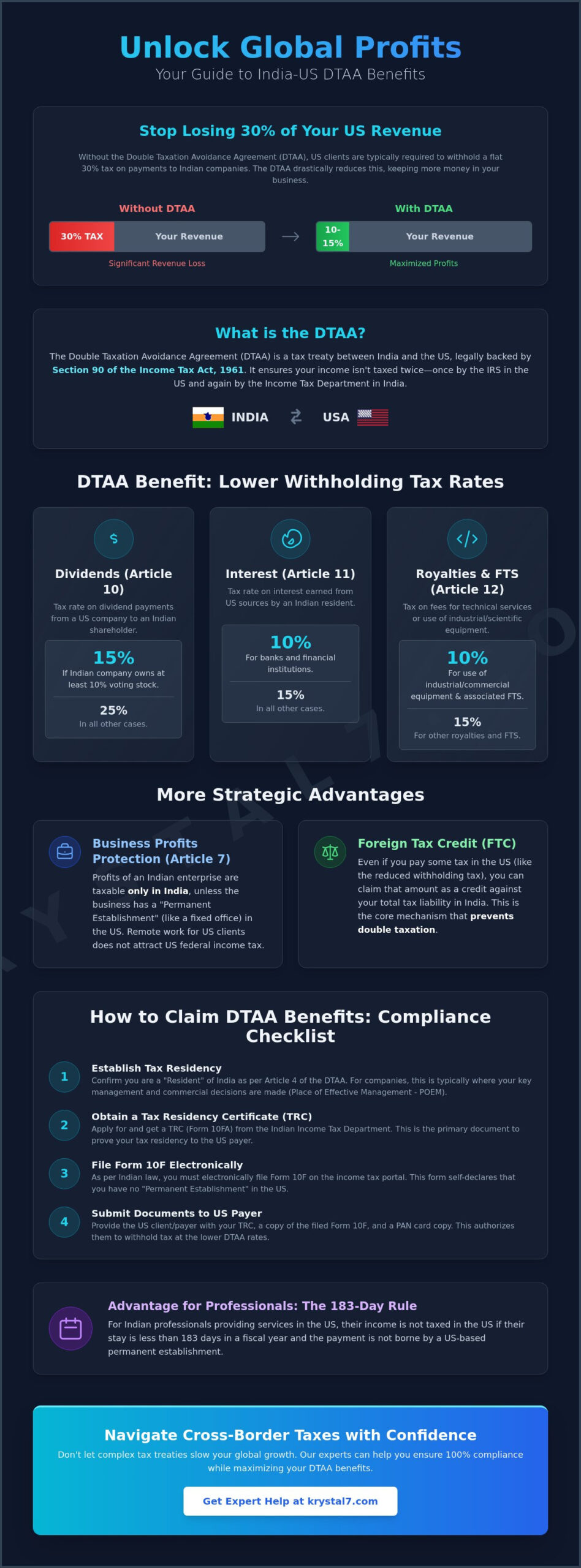
The primary advantage of the DTAA India US benefits is the dramatic reduction in Withholding Tax (WHT) rates. Without this treaty, the IRS typically mandates a 30% deduction on payments sent to non-resident entities. For an Indian Private Limited company, this could mean losing nearly a third of your gross revenue before it even leaves the US. By applying the treaty provisions, you can slash these rates significantly, ensuring more capital remains available for your business growth.
Another critical pillar is the Foreign Tax Credit (FTC) mechanism. When you pay tax in the US, the Indian Income Tax Department allows you to offset that amount against your domestic tax liability. This ensures your profits aren’t eroded by double taxation. If you’re unsure how to structure your US contracts to take advantage of these credits, seeking expert cross-border compliance support can prevent costly mistakes during your ITR filing.
Lower Tax Rates on Passive Income
The official DTAA treaty text outlines specific reduced rates for passive income streams. These rates are far more favorable than standard domestic US tax laws. For 2026, the applicable rates include:
- Dividends (Article 10): A rate of 15% applies if your Indian company owns at least 10% of the US entity’s voting stock. In other cases, the rate is 25%.
- Interest (Article 11): Payments to Indian banks or financial institutions are taxed at 10%. All other interest payments attract a 15% rate.
- Royalties and FTS (Article 12): Fees for technical services or the use of industrial equipment are taxed at 10%. Other royalties generally face a 15% rate.
Capital Gains and Business Profits
Article 7 of the treaty provides massive relief for Indian service providers. It states that business profits are only taxable in India unless the business has a Permanent Establishment (PE) in the US. For example, if your Gurgaon-based software firm bills a New York client for remote development work, you don’t owe US federal income tax because you don’t maintain a physical office or fixed base in America. This allows your Private Limited company or LLP to retain 100% of the billed amount, subject only to Indian taxation.
Article 13 handles capital gains, specifically regarding the sale of shares. While the US generally taxes gains on the sale of US real property interests, many other forms of capital gains for Indian residents may be exempt or taxed at preferential rates. This protection ensures that your investment in US subsidiaries remains tax-efficient, allowing you to fully realize the DTAA India US benefits throughout your business lifecycle.
Strategic Advantages for Startups and Professionals
Startups today thrive on global talent. One of the overlooked DTAA India US benefits is how it facilitates the movement of expertise between the two nations. Whether you’re an Indian founder hiring a US consultant or a research-heavy biotech firm collaborating with American scholars, the treaty provides a clear framework to manage these costs without tax surprises.
Article 15 of the India-US tax treaty introduces the “183-day rule” for independent personal services. This rule allows US-based professionals to provide services to your Indian company without their income being taxed in India, provided they don’t stay in the country for more than 183 days in a fiscal year. It simplifies the hiring process for short-term experts and specialized consultants.
Article 17 clarifies how you tax director’s fees for cross-border boards. If your Private Limited company has US-based directors, their fees are generally taxable in the country where the company is a resident. This clarity prevents the administrative headache of trying to determine where to deposit TDS for international board members.
Hiring US Talent and Researchers
High-end R&D firms gain a unique advantage through Article 22. Visiting professors and researchers from the US can receive tax exemptions on their income for up to two years while working in India. This provision effectively reduces the cost of bringing top-tier academic talent to your startup, giving you a competitive edge in innovation without the burden of heavy payroll taxes.
Special provisions for students and apprentices appear in Article 21. Payments they receive from abroad for their maintenance or education aren’t taxed in the US. This encourages your Indian team members to pursue specialized training in America, knowing their stipends remain protected from local tax deductions.
Avoiding the Permanent Establishment Trap
Protecting your cash flow means staying alert to the “Permanent Establishment” (PE) trap defined in Article 5. A PE is essentially a fixed place of business like an office, branch, or factory that triggers local taxation. However, the treaty also includes a “Service PE” clause that you must watch carefully.
Sending Indian employees to the US for more than 90 days can trigger a PE for your company. If this happens, your business profits become subject to US federal tax. By carefully monitoring your team’s travel and duration of stay, you can leverage the DTAA India US benefits to keep your tax residency firmly rooted in India.
How to Claim DTAA Benefits: 2026 Compliance Checklist
Securing DTAA India US benefits isn’t a passive process. You must proactively demonstrate your eligibility to both the IRS and the Indian Income Tax Department. Failing to provide the right paperwork often results in a 30% withholding tax on your US invoices, which can cripple a growing startup’s cash flow. By following a structured compliance checklist, you ensure your profits remain protected and your global operations stay transparent.
One of the first steps involves providing a “No Permanent Establishment” (No PE) declaration to your US clients. This document assures them that your business doesn’t have a taxable presence in the US, allowing them to apply the treaty’s lower withholding rates. If you need help drafting these declarations or navigating cross-border paperwork, you can consult our tax advisory team for personalized guidance.
Mandatory Documentation
Your primary shield against double taxation is the Tax Residency Certificate (TRC). You must apply for this certificate through your jurisdictional Assessing Officer (AO) using Form 10FA. The TRC serves as official proof that you’re a resident of India and entitled to treaty relief. Along with the TRC, you must maintain a self-declaration of your residential status and ensure your PAN is correctly linked to all international transactions.
It’s critical to remember that Form 10F is now mandatory in an electronic format. You must file this form on the Indian Income Tax portal if your TRC doesn’t contain all the details required under the Income Tax Act. Paper submissions are no longer accepted, and failing to file electronically can lead to the denial of treaty benefits during an audit.
Deadlines and Penalties for 2026
Claiming a Foreign Tax Credit (FTC) requires filing Form 67 before you submit your Income Tax Return. For the 2026 filing season, the deadline is usually July 31st for individuals or October 31st for companies subject to audit. If you miss this filing, you lose the ability to offset US taxes against your Indian liability, effectively paying tax twice on the same income.
Your cross-border filings must align perfectly with your annual compliance for a private limited company. Discrepancies between your US income declarations and your Indian tax returns can trigger scrutiny from the Income Tax Department. Missing these deadlines doesn’t just lead to interest penalties; it drains liquid capital that your business needs to scale globally.
Conclusion: Maximizing Your DTAA India US Benefits with Krystal7
Mastering the DTAA India US benefits is the difference between a profitable global venture and one burdened by unnecessary tax leakage. This treaty acts as your primary defense against the standard 30% US withholding tax on cross-border payments. Proactive planning ensures your Private Limited company or LLP keeps its competitive edge in the American market by protecting every rupee of your hard-earned revenue.
You shouldn’t wait until you’ve signed a contract to consider the tax implications. Strategic planning must happen before the first invoice is raised to ensure your business structure aligns with Section 90 of the Income Tax Act. By leveraging the DTAA India US benefits, you transform a complex regulatory hurdle into a clear financial advantage that supports your long-term growth objectives.
The Krystal7 Advantage
Navigating portals like TRACES, MCA, and the Income Tax e-filing site requires precision and deep institutional knowledge. Our Gurgaon-based team provides a methodical approach to Foreign Subsidiary Registration and end-to-end cross-border compliance. We take the weight of administrative complexity off your shoulders, handling everything from obtaining your Tax Residency Certificate to filing Form 67 with total accuracy.
Our goal is to grant you the operational liberty to focus on your primary business vision. We bring order to the complicated process of claiming international tax credits and ensuring 100% compliance with Indian legislation. This partnership allows you to pursue your global ambitions with a sense of relief, security, and optimism, knowing your financial interests are protected by dependable experts.
Take the Next Step Toward Global Growth
Don’t let bureaucratic obstacles or the fear of double taxation stall your expansion into the US market. A krystal-clear tax strategy is essential for any visionary entrepreneur looking to scale without friction. We invite you to experience a partnership built on financial openness and meticulous attention to detail. Contact Krystal7 Consultants today at business@krystal7.com or visit krystal7.com to secure your global profits and simplify your international compliance journey.
Secure Your Global Profits Today
You’ve built a vision that spans borders; now it’s time to protect the revenue it generates. Understanding the DTAA India US benefits isn’t just about tax savings. It’s about ensuring your Private Limited company or LLP has the liquid capital to scale without losing 30% of its gross income to withholding tax. By mastering Section 90 of the Income Tax Act and filing Form 67 before your ITR deadline, you eliminate the risk of double taxation.
Compliance shouldn’t be a source of anxiety. As a Gurgaon-based Chartered Accountancy firm, Krystal7 Consultants specializes in cross-border compliance for tech startups and expert Foreign Subsidiary Registration. We handle the meticulous details of TRC applications and electronic Form 10F filings so you can stay focused on your primary business goals. We’re here to bring order to complex processes through transparent, methodical guidance.
Ready to optimize your global tax strategy? Contact Krystal7 Consultants at business@krystal7.com to build a krystal-clear financial future. Your journey toward global expansion deserves a dependable partner who understands the intricacies of international trade. Let’s work together to turn your cross-border ambitions into a secure, profitable reality.
Frequently Asked Questions
What is the standard withholding tax rate under the India-US DTAA for royalties?
The standard withholding tax rate for most royalties and Fees for Technical Services (FTS) is 15% under the treaty. However, a lower rate of 10% applies specifically to payments made for the use of industrial, commercial, or scientific equipment. These rates represent a major saving compared to the 30% rate typically applied to non-residents under US domestic law.
Can an Indian LLP also claim benefits under the India-US DTAA?
Yes, an Indian LLP can claim DTAA India US benefits as long as it qualifies as a resident of India under Article 4. Since an LLP is a taxable entity under the Indian Income Tax Act, it’s eligible to obtain a Tax Residency Certificate. This allows the LLP to provide the necessary documentation to US clients for reduced withholding on service payments.
What happens if I forget to file Form 67 before the ITR deadline in 2026?
Missing the deadline for Form 67 generally leads to the denial of your Foreign Tax Credit (FTC) for that year. This means you lose the ability to offset the taxes paid to the IRS against your Indian tax liability. You effectively face double taxation, which can significantly drain the liquid capital of your Private Limited company.
Is a Tax Residency Certificate (TRC) mandatory for every financial year?
Yes, you must obtain a fresh Tax Residency Certificate for every financial year in which you intend to claim treaty benefits. Residency status can change based on your physical presence or where your business is managed. Applying annually through Form 10FA ensures you have valid proof to share with your US customers and the tax authorities.
How does the ‘Limitation of Benefits’ (LOB) clause affect my claim?
The Limitation of Benefits clause acts as a safeguard to prevent “treaty shopping” by residents of third-party countries. It ensures that only genuine Indian or US entities with real business substance can access the treaty’s advantages. To satisfy this clause, your Gurgaon-based business must demonstrate that it wasn’t established primarily to exploit the tax treaty.
Can I claim DTAA benefits if I don’t have a PAN card in India?
No, you cannot claim DTAA benefits without a valid PAN card. The PAN is a mandatory requirement for generating a Tax Residency Certificate and for filing Form 10F electronically on the Income Tax portal. Without a PAN, the IRS will likely apply the maximum withholding rate of 30% on any payments sent to your business.
Does the India-US DTAA cover GST or state-level taxes in the US?
No, the treaty only covers Federal income taxes in the US and the Income Tax (including surcharge and cess) in India. It doesn’t provide relief for Indian GST or US state-level income taxes and sales taxes. You’ll need to manage these state-level obligations separately when calculating the total tax impact of your US projects.
What is a ‘No PE’ declaration and why do US clients ask for it?
A ‘No PE’ declaration is a formal document where you state that your Indian business has no Permanent Establishment in the US. US clients require this to justify why they’re withholding tax at the lower treaty rate instead of the standard 30%. It protects them from penalties by proving they’ve followed the correct treaty guidelines for your specific business status.

Article by
Nihal Srivastava
Nihal Srivastava is the Co-Founder of Krystal7 Consultants, helping Indian entrepreneurs and startups navigate company registration, compliance, trademark protection, and regulatory requirements with clarity and confidence. With 6+ years of hands-on expertise in MCA filings, GST compliance, and corporate structuring, Nihal has guided 1000+ businesses across India through their legal and compliance journeys. He believes every business dream deserves crystal clear foundations, and that no founder should be held back by paperwork or red tape.