

Foreign Company India Tax Implications: A Krystal-Clear Guide for 2026
What if that 40% tax rate you’ve heard about isn’t the final word on your Indian venture’s profitability? You likely feel that the high base tax and the maze of Permanent Establishment rules are designed to be obstacles rather than manageable steps. Understanding foreign company India tax implications doesn’t have to be an overwhelming struggle, even when you’re worried about heavy penalties for a missed filing or complex cross border compliance.
We believe that clarity is the first step toward operational liberty and long term growth. This guide provides a transparent roadmap through the 2026 tax landscape, helping you unlock benefits like Double Taxation Avoidance Agreements (DTAA) to protect your margins. We’ll break down the latest tax slabs, explain how to stay compliant with MCA and Income Tax filings, and show you why your choice of entry mode is the most important decision you’ll make this year.
Key Takeaways
- Learn the critical distinction between a branch office and a foreign subsidiary to choose the most tax-efficient entry mode for your business.
- Gain a crystal-clear understanding of foreign company India tax implications, including the 40% base tax rate and surcharges for the 2026-27 assessment year.
- Discover how to leverage Double Taxation Avoidance Agreements (DTAA) to reduce tax leakage and navigate the complexities of Permanent Establishment rules.
- Stay ahead of the compliance calendar by mastering ITR-6 deadlines and Transfer Pricing reports to avoid heavy penalties and maintain operational liberty.
- Understand how professional support for MCA and Income Tax filings can liberate you to focus on your primary business goals.
Defining a Foreign Company and Entry Modes in India
Under Section 2(23A) of the Income Tax Act, a foreign company is defined as any company that isn’t a domestic entity. This essentially means the business is incorporated outside Indian borders. The Companies Act 2013 further clarifies this by identifying a “place of business” as any physical or electronic location where business activities occur, whether conducted directly or through an agent. Understanding these legal definitions is the first step toward gaining clarity on foreign company India tax implications for your specific business model.
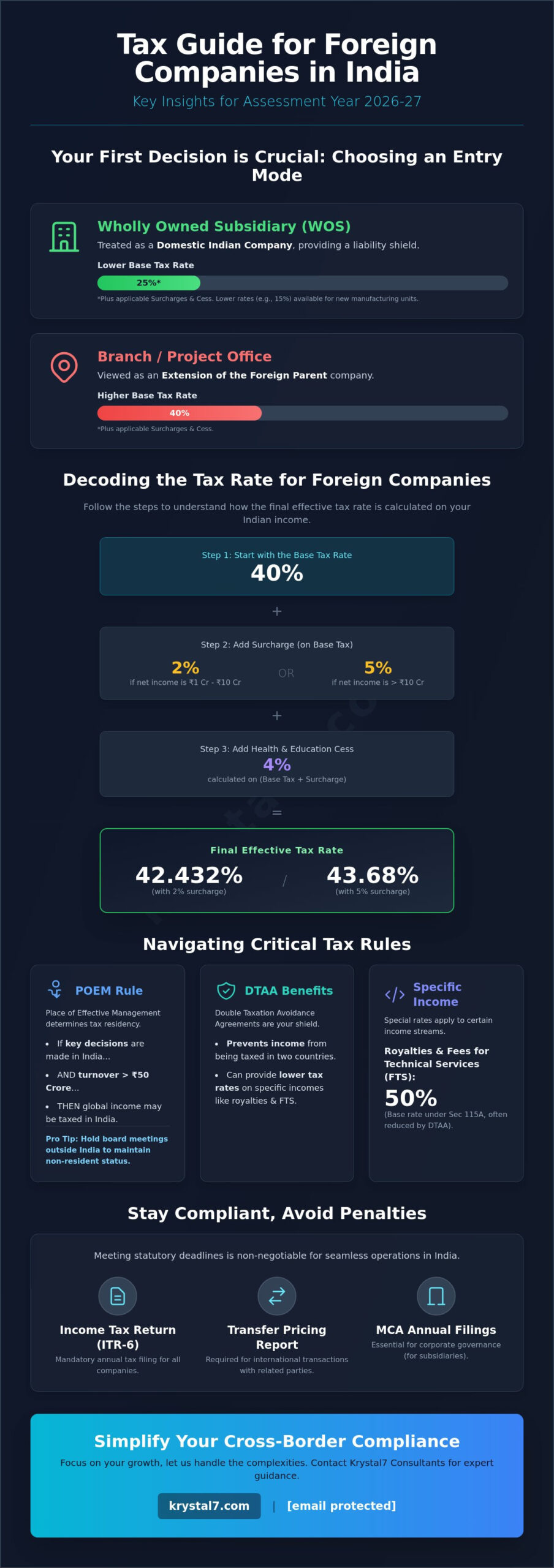
Your choice of business structure is the single most important factor in determining your base tax rate. A Branch Office is viewed as an extension of the parent entity and is subject to a base tax rate of 40%. In contrast, a foreign subsidiary registration creates a separate Indian legal entity. This domestic status allows the business to benefit from lower tax rates of 25% or even 15% for certain new manufacturing units, plus applicable surcharges.
Wholly Owned Subsidiaries (WOS) vs Branch Offices
A Wholly Owned Subsidiary is treated as a domestic company even if 100% of its shareholding is held by a foreign parent. This structure offers a protective shield, as the Indian entity’s liability is limited to its own assets. It’s a popular choice for those looking at long term growth, as Foreign direct investment (FDI) in India has become increasingly streamlined for such entities.
Other entry modes serve more specific roles. A Liaison Office acts solely as a communication channel and cannot earn any income in India, making it tax free but limited in scope. A Project Office is established to execute specific, fixed term contracts. Because it earns income within India, it’s taxed at the 40% rate applicable to foreign companies. By choosing the right structure, you can effectively manage foreign company India tax implications while maintaining the operational liberty required for growth.
The “Place of Effective Management” (POEM) Rule
The POEM rule is a transparency standard used by the IT Department to determine if a foreign incorporated company should be taxed as an Indian resident. If key management and commercial decisions are made within India, the company’s global income becomes taxable here. This rule generally applies to entities with a turnover exceeding INR 50 Crore in a financial year.
To ensure your foreign entity retains its non resident status, it’s essential to keep management functions distinct. Board meetings should be held outside India, and high level executive decisions should be documented as occurring at the home office. Maintaining this separation provides the security you need to grow without unexpected tax burdens.
Corporate Tax Rates for Foreign Entities in 2026
Understanding the corporate tax structure is essential for any international business looking to thrive in the Indian market. For the Assessment Year 2026-27, foreign companies face a flat base tax rate of 40% on their Indian income. While this headline figure might seem daunting compared to domestic rates, knowing the full math provides the operational liberty to plan effectively. Surcharges add another layer to this calculation based on your annual earnings.
If your net income falls between INR 1 Crore and INR 10 Crore, a 2% surcharge applies to the base tax. For income exceeding INR 10 Crore, the surcharge increases to 5%. Finally, a mandatory 4% Health and Education Cess is calculated on the total tax plus surcharge. This results in an effective tax rate of 42.432% or 43.68%, depending on your specific revenue bracket. Planning for foreign company India tax implications requires a meticulous look at these tiered numbers to avoid surprises during filing season.
Domestic companies enjoy significantly lower base rates, often 25% or even 15% for new manufacturing units. This gap is why choosing the right entry mode, such as a subsidiary versus a branch, is a vital part of your financial strategy. You can find more insights on Forbes on India’s direct tax system to see how these corporate levies fit into the broader national framework. If you’re unsure how these tiers apply to your specific revenue model, our team can help you structure your tax strategy for maximum efficiency.
Taxation on Specific Income Streams
Specific income streams like royalties or fees for technical services (FTS) are governed by Section 115A of the Income Tax Act. These are typically taxed at a 50% base rate, though Double Taxation Avoidance Agreements often provide significant relief. Dividends are now taxed in the hands of the recipient, and capital gains vary based on whether you’re transferring shares or physical assets located in India. It’s important to document these transactions clearly to ensure you only pay what’s legally required.
Minimum Alternate Tax (MAT) Applicability
If your business has a Permanent Establishment (PE) in India, you might fall under Section 115JB regarding Minimum Alternate Tax. This ensures a 15% tax on book profits for companies whose normal tax liability is lower than this threshold. The 2026 Union Budget has scheduled a reduction of this rate to 14% starting April 1, 2026. Many foreign entities from countries with active tax treaties are exempt from MAT if they don’t have a physical presence in India, providing a layer of relief for digital or service-based enterprises.
Navigating Permanent Establishment (PE) and DTAA Benefits
Taxation for international entities isn’t just about the headline rates. It’s about the physical and economic footprint you leave in India. Understanding foreign company India tax implications involves mastering the concept of Permanent Establishment (PE), which acts as a trigger for Indian tax liability. If your business is found to have a PE, your profits attributable to that presence are taxed at the standard 40% rate plus applicable surcharges.
India has signed Double Taxation Avoidance Agreements (DTAA) with over 90 countries to prevent you from being taxed twice on the same income. These treaties are powerful tools that can lower withholding tax rates on royalties, interest, and fees for technical services. However, tax planning now requires even more precision due to the Multilateral Instrument (MLI). The MLI introduces the Principal Purpose Test, ensuring that treaty benefits are only granted for genuine business structures rather than purely for tax avoidance.
Types of PE: Service, Agency, and Fixed Place
A Fixed Place PE is the most common, triggered by having a branch, office, or factory in India. You can also accidentally create a Service PE if your employees or consultants stay in India for a specific duration, often exceeding 90 days within a 12 month period. An Agency PE arises when a local representative habitually exercises the authority to conclude contracts on your behalf. To minimize these risks, many founders find that incorporating a private limited company india provides a cleaner separation between the parent entity and Indian operations.
Essential Documentation for Treaty Benefits
Claiming lower tax rates under a DTAA isn’t automatic. You must obtain a Tax Residency Certificate (TRC) from the tax authorities in your home country as proof of residency. Additionally, you’re required to file Form 10F electronically on the Indian Income Tax portal if the TRC doesn’t contain all the details required by Indian law. For service providers without a physical presence, a “No PE” declaration is a vital document that reassures Indian payers they don’t need to withhold tax at the higher 40% rate. These methodical steps protect your margins and ensure your foreign company India tax implications remain manageable.
Compliance Calendar: Deadlines and Penalties for 2026
Missing a critical deadline can disrupt your business’s operational liberty and lead to unnecessary administrative burdens. Staying ahead of foreign company India tax implications requires a methodical approach to the 2026 calendar. For entities incorporated outside India, compliance is a year-round commitment involving both the Income Tax Department and the Ministry of Corporate Affairs (MCA). We handle these complexities so you can focus on your primary business goals with confidence.
Managing cash flow is simpler when you follow the advance tax schedule. You must pay your estimated tax liability in four installments: 15% by June 15, 45% by September 15, 75% by December 15, and the final 100% by March 15, 2027. Timely payments prevent the accumulation of interest under Sections 234B and 234C of the Income Tax Act. The Income Tax Return (ITR-6) for foreign companies subject to audit is due by October 31, 2026.
If you operate through a branch office, you must also complete annual MCA filings via Form FC-3 within six months of the financial year-end. Additionally, the Tax Audit Report (Form 3CA/3CB and 3CD) must be furnished by September 30, 2026. This audit acts as a vital validation of your financial health before the final return is submitted.
Transfer Pricing and Form 3CEB
Any transactions between an Indian entity and its foreign parent must occur at an “Arm’s Length Price.” This means the pricing should mirror what independent parties would agree upon in an open market. You’re required to file Form 3CEB by October 31, 2026, to report these cross-border transactions. Failure to file this report carries a stiff penalty of INR 1,00,000 under Section 271BA. Larger entities must also monitor specific thresholds for Master File and Country-by-Country (CbC) reporting to maintain elite professional standing.
Consequences of Non-Compliance
Delays in filing attract immediate financial consequences that can impact your bottom line. Under Section 234F, late filing fees reach up to INR 5,000. Beyond flat fees, interest on tax defaults under Sections 234A, 234B, and 234C accrues at 1% per month. Neglecting these duties also risks being blacklisted by the MCA, which is a serious setback for annual compliance for private limited company entities. Our team provides a comprehensive Annual Compliance Package to ensure you never miss a deadline and remain in good standing with Indian authorities.
Simplifying Cross-Border Compliance with Krystal7 Consultants
Entering a new market shouldn’t feel like a constant battle with bureaucracy. We understand that the weight of foreign company India tax implications can often distract visionaries from their core expansion goals. Our mission is to bring order to these complicated processes, providing the visual clarity you need to move forward with confidence. We act as your dependable partner, ensuring every regulatory detail is handled with precision.
We manage the entire foreign subsidiary registration journey from start to finish. This methodical approach ensures your business is built on a foundation of total compliance from day one. You gain the freedom to lead while we handle the intricate filings required by the MCA and the Income Tax Department. By delegating these tasks to experts, you grant yourself the liberty to focus on growth.
Our One-Stop Solution for Foreign Entities
Compliance involves more than just an annual return; it’s a series of monthly and quarterly commitments. We provide expert assistance with GST registration and ensure your monthly filings are accurate and on time. Our team meticulously manages TDS on international payments, including the mandatory 15CA and 15CB certifications for every remittance through the TRACES portal.
- Accurate GST registration and monthly return filing to maintain your input tax credits.
- Meticulous TDS management on cross-border payments with valid 15CA/CB certifications.
- Full payroll processing and EPFO compliance for your local Indian workforce.
- Strategic tax advisory to leverage DTAA benefits and optimize your global tax position.
We also take the administrative burden of human resources off your plate. Our payroll management services ensure your Indian team is paid correctly while staying fully compliant with EPFO and professional tax regulations. This end-to-end support transforms a complex legal landscape into a streamlined operational advantage for your brand.
The Krystal7 Advantage: Transparency and Liberty
You deserve a partner who values financial openness as much as you do. Our transparent pricing models eliminate the fear of hidden costs or bureaucratic surprises. You’ll have direct access to experienced Chartered Accountants in Gurugram who understand the nuances of the local regulatory environment. We combine elite professional designations with a human touch to provide genuine partnership.
We provide proactive alerts for every upcoming deadline to protect you from interest or penalties. This constant vigilance ensures that your foreign company India tax implications are handled with calm competence. Reach out to us at business@krystal7.com or visit krystal7.com to start your Indian journey with a partner who’s truly invested in your success.
Mastering Your Strategic Entry into India
Navigating the Indian market requires more than just capital; it demands a clear understanding of foreign company India tax implications to protect your global margins. Choosing between a branch office and a subsidiary is the first step in a strategy that includes leveraging DTAA benefits and mastering Permanent Establishment rules. Staying ahead of the 2026 compliance calendar for ITR-6 and Form 3CEB ensures you avoid heavy penalties. This foresight maintains the operational liberty you need to scale your vision without administrative friction.
Krystal7 Consultants is a Gurugram-based CA firm specializing in Foreign Subsidiary Registration and cross-border tax advisory. We bring order to complex MCA and IT filings through our transparent, fixed-fee compliance packages that eliminate surprises. Our methodical approach allows you to delegate administrative burdens to a trusted partner. We handle the technicalities so you can focus on building your brand in one of the world’s fastest-growing economies.
Secure your business growth with Krystal7’s expert tax advisory—contact us today or email us at business@krystal7.com to discuss your expansion. Your entrepreneurial journey in India is a bold step toward the future, and we’re here to ensure every regulatory milestone is met with precision and confidence.
Frequently Asked Questions
What is the corporate tax rate for a foreign company in India in 2026?
A foreign company is subject to a flat base tax rate of 40% for the 2026-27 assessment year. This rate increases with a surcharge of either 2% or 5% depending on whether your income exceeds INR 1 Crore or INR 10 Crore. A mandatory 4% Health and Education Cess is then applied to the total. This results in an effective tax rate of 42.432% or 43.68% for most international entities.
Does a foreign company need to pay GST in India?
Yes, a foreign entity must register for and pay GST if it provides taxable goods or services within Indian borders and exceeds the registration threshold. For digital service providers, the OIDAR rules require registration regardless of a physical presence in India. We help you manage these monthly filings through the GST portal to ensure your operational liberty and prevent any disruptions to your supply chain.
What is the penalty for missing the ITR filing deadline for a foreign entity?
Missing the October 31st deadline results in a late filing fee of INR 5,000 under Section 234F of the Income Tax Act. If your total income is below INR 5 Lakhs, the fee is reduced to INR 1,000. You’ll also be liable for interest at 1% per month on any unpaid tax under Section 234A. Staying ahead of these dates is vital to avoiding administrative burdens and unnecessary costs.
Can a foreign company claim credit for taxes paid in India in its home country?
Most foreign entities can claim a Foreign Tax Credit (FTC) in their home jurisdiction for taxes paid to the Indian government. This relief is typically granted under the specific Double Taxation Avoidance Agreement (DTAA) between India and your home country. Proper documentation of Indian tax payments and filings is essential to provide the visual transparency required by your home tax authority during their review process.
Is a Tax Residency Certificate (TRC) mandatory for DTAA benefits?
A Tax Residency Certificate is absolutely mandatory if you intend to claim lower withholding tax rates under a DTAA. You must also file Form 10F electronically on the Income Tax portal if the TRC doesn’t include all the details required by Indian law. These documents are the primary tools used to navigate foreign company India tax implications and protect your margins from higher domestic tax rates.
What is the difference between a Foreign Company and a Foreign Subsidiary for tax purposes?
The term “Foreign Company” usually refers to a branch or project office, which is taxed at a base rate of 40%. A “Foreign Subsidiary” is an Indian Private Limited company owned by a foreign parent, making it a domestic entity for tax purposes. This distinction allows a subsidiary to access lower tax rates of 25% or 15%, providing a significant structural advantage for long term growth.
What is the Equalization Levy and when does it apply to foreign e-commerce players?
The Equalization Levy is a 2% tax on the revenue received by non-resident e-commerce operators from online sales or services provided to Indian residents. It applies to companies that don’t have a physical Permanent Establishment in India but have a significant economic presence. This levy ensures that digital businesses contribute to the Indian tax base, even when operating entirely through electronic portals and remote servers.
How much is the surcharge for foreign companies with income exceeding INR 10 Crore?
Foreign companies with a total income exceeding INR 10 Crore must pay a 5% surcharge on their base tax. If your income falls between INR 1 Crore and INR 10 Crore, the surcharge is reduced to 2%. Our methodical approach to tax planning helps you calculate these tiered obligations accurately. This clarity ensures your business remains compliant while you pursue your primary goals in the Indian market.

Article by
Nihal Srivastava
Nihal Srivastava is the Co-Founder of Krystal7 Consultants, helping Indian entrepreneurs and startups navigate company registration, compliance, trademark protection, and regulatory requirements with clarity and confidence. With 6+ years of hands-on expertise in MCA filings, GST compliance, and corporate structuring, Nihal has guided 1000+ businesses across India through their legal and compliance journeys. He believes every business dream deserves crystal clear foundations, and that no founder should be held back by paperwork or red tape.