

Setting Up a US Company India Subsidiary: The Comprehensive 2026 Guide
Did you know that foreign subsidiary registrations in India surged by 34% in the 2024-25 fiscal year? While the opportunity is vast, setting up a US company India subsidiary often feels like a daunting trek through bureaucratic fog. You might be worried about MCA registration delays or the complexity of RBI reporting, but these hurdles shouldn’t stall your vision.
We understand that you want to focus on your product and sales, not local director requirements or filing deadlines. It’s common to feel a sense of anxiety when faced with the intricate maze of the Companies Act and FEMA regulations. We believe in replacing that uncertainty with methodical transparency and operational liberty.
This comprehensive 2026 guide provides the exact roadmap you need to establish and manage your Indian presence successfully. You’ll master the latest regulatory frameworks, from the updated GST 2.0 slabs to the streamlined SPICe+ incorporation process. We’re going to break down every legal and tax requirement so you can lead your expansion with absolute confidence.
Key Takeaways
- Identify why a Private Limited Company remains the superior structure for a US company India subsidiary to ensure regulatory compliance and ease of investment.
- Master the step-by-step registration process, from securing Digital Signature Certificates to navigating the MCA’s SPICe+ and RUN services.
- Avoid heavy penalties by understanding mandatory reporting timelines, including filing Form FC-GPR with the RBI within 30 days of receiving foreign capital.
- Gain clarity on the post-incorporation landscape, including GST 2.0 registration and the essential requirements for resident directors.
- Learn how a single point of contact for accounting and legal needs provides the operational liberty you need to scale your Indian operations.
Why Establish a US Company India Subsidiary in 2026?
India has transformed into a global powerhouse for innovation and high-value services. US tech and service firms now view the country as a primary Global Capability Center (GCC) rather than just an outsourcing destination. By establishing a US company India subsidiary, you gain direct access to a massive consumer base and a deep talent pool of millions of skilled professionals. With over 15,000 foreign subsidiaries already operating in the country, the momentum for cross-border expansion is at an all-time high.
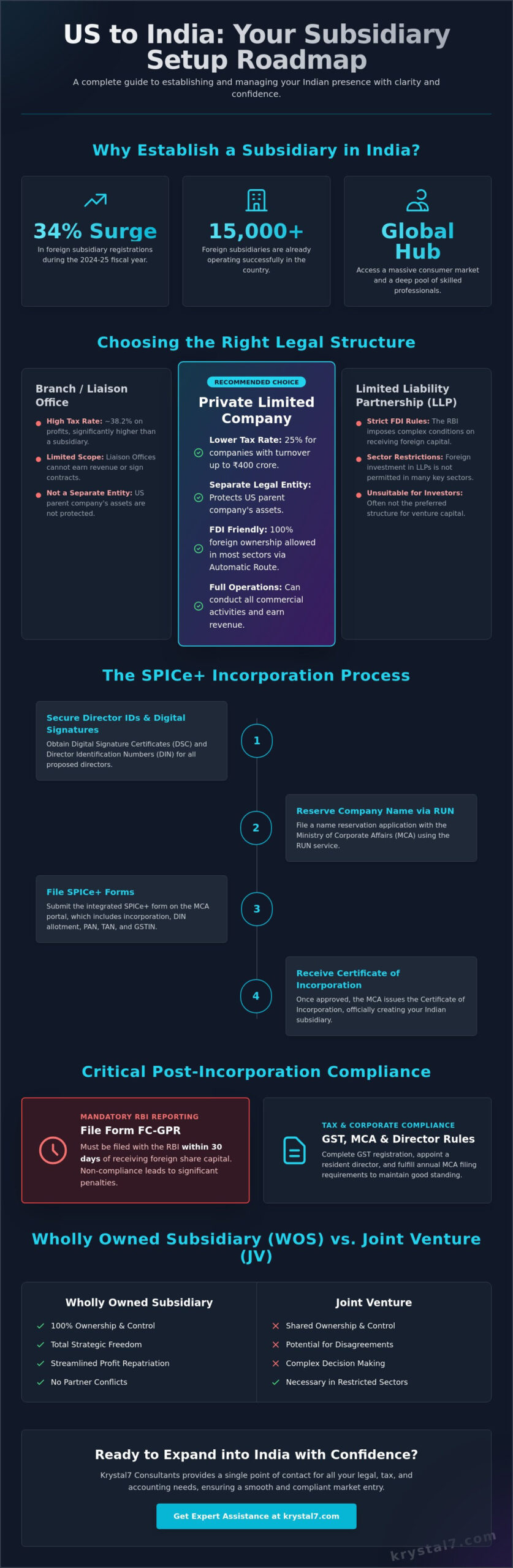
Under the Companies Act, 2013, a foreign subsidiary is a company where the foreign parent holds more than 50% of the share capital. Most US founders choose to incorporate as a Private Limited Company to ensure maximum flexibility. This structure allows for full commercial operations, unlike a Liaison Office which is restricted to promotional activities and cannot earn income in India. The steady liberalization of Foreign Direct Investment in India has simplified these pathways, making it easier to move capital and scale your team quickly.
Wholly Owned Subsidiary (WOS) vs. Joint Venture
A Wholly Owned Subsidiary gives the US parent company 100% ownership and total control over every strategic decision. You don’t have to navigate the potential friction of a local partner’s conflicting interests. In a WOS, profit repatriation is straightforward once you’ve met your local tax obligations. While a Joint Venture might be necessary in specific restricted sectors, the Private Limited WOS remains the preferred choice for tech startups and service-based firms seeking operational liberty.
The ‘Liberation’ from Bureaucracy through Proper Planning
Setting up your Indian presence shouldn’t feel like an endless climb through administrative fog. It’s a strategic tool designed to grant you freedom. Proper planning removes the heavy administrative weight that often distracts US founders from their primary goals. When you establish a clean compliance record from day one, you build a foundation of trust with Indian regulators. Krystal7 handles the meticulous details of MCA filings and local director requirements; this allows you to focus on building your product while we manage the complexity of the Indian regulatory framework.
Choosing the Right Legal Structure for Your Indian Operations
Selecting the right vehicle for your entry into the Indian market is the most critical decision you’ll make. Most founders find that the Private Limited Company is the gold standard for a US company India subsidiary. Unlike a Branch Office, which the Indian government taxes at a base rate of 35% (effectively around 38.2% with surcharges), a domestic subsidiary enjoys a lower base tax rate of 25% for companies with turnover up to ₹400 crore. This financial openness allows you to reinvest more of your capital into local growth and innovation.
You might consider a Limited Liability Partnership (LLP), but it’s often unsuitable for foreign investors. The Reserve Bank of India (RBI) imposes strict conditions on LLPs receiving foreign capital. These rules often limit the sectors you can enter and how you manage your investment. Similarly, Liaison Offices are restricted to non-commercial activities. They can’t sign contracts or earn revenue; this severely limits your operational liberty if you intend to scale a business.
The Private Limited Company Advantage
This structure creates a clear wall between your US parent company and the Indian entity. Your US assets remain protected because the subsidiary exists as a separate legal entity under the Companies Act, 2013. It also makes raising capital much simpler. Indian law provides a structured framework for transferring shares and issuing new equity to investors. If you’re looking for a deep dive into this structure, check out our guide on the Private Limited Company in India: The Ultimate Guide for Founders.
FDI Policy and Sectoral Caps
Most sectors fall under the “Automatic Route,” meaning you don’t need prior approval from the central government to start. However, certain strategic industries require a green light from the Department for Promotion of Industry and Internal Trade (DPIIT). You can find more details on these specific regulations in the Invest India FDI Guide. Once you’ve brought in capital, staying compliant with the Foreign Exchange Management Act (FEMA) is mandatory. You must report the share issuance to the RBI through the FIRMS portal within 30 days to avoid heavy penalties. Our team provides the visual clarity you need to navigate these choices without the stress of administrative complexity. You can explore our foreign subsidiary registration services to see how we simplify this journey.
Step-by-Step Process for Registering a US Company India Subsidiary
The journey to incorporate your US company India subsidiary is now almost entirely digital. The Ministry of Corporate Affairs (MCA) has streamlined the process through the V3 portal to reduce administrative friction. Every director, whether based in the US or India, must first obtain a Digital Signature Certificate (DSC). This serves as your electronic identity for signing all incorporation documents securely.
Once you have your DSC, you’ll use the Reserve Unique Name (RUN) service. It’s vital to choose a name that reflects your brand while complying with the Trademark Act to avoid rejection. After name approval, you’ll file the SPICe+ (Simplified Proforma for Incorporating Company Electronically Plus) form. This single window integrates the application for your Director Identification Number (DIN), company incorporation, and essential tax IDs.
You’ll also draft the electronic Memorandum of Association (e-MoA) and electronic Articles of Association (e-AoA). These digital documents define your company’s objectives and internal governance rules. Since these are the foundation of your legal presence, precision here ensures long-term operational liberty.
Meeting the Resident Director Requirement
Section 149(3) of the Companies Act, 2013, mandates that every company must have at least one director who has stayed in India for a total period of not less than 182 days in the previous calendar year. For US firms, this often creates a hurdle during the initial setup phase. You can appoint a local nominee director to satisfy this requirement immediately. Krystal7 facilitates these compliant board structures, ensuring you don’t face delays or legal friction due to residency gaps.
The Final Mile: COI and PAN/TAN
After the Registrar of Companies (RoC) reviews and approves your submission, you’ll receive the Certificate of Incorporation (COI). This document serves as your subsidiary’s official birth certificate in India. The SPICe+ process is efficient because it automatically allots your Permanent Account Number (PAN) and Tax Deduction Account Number (TAN) alongside the COI. You won’t need to file separate applications for these tax IDs on other portals.
With these documents in hand, you can refer to the FDI Policy in India to open a capital account. This must be done with an Authorized Dealer (AD) Category-I bank in India. This account is essential for receiving the initial share capital from the US parent company in INR. Our methodical approach ensures this entire sequence remains transparent, removing the administrative weight of local filings from your shoulders.
Post-Incorporation Compliance: FEMA, GST, and MCA Requirements
Receiving your Certificate of Incorporation is a major milestone for your US company India subsidiary. However, the real work begins with a methodical approach to “Day 2” compliance to ensure your business remains in good standing. You must report any foreign direct investment inflow to the Reserve Bank of India through the FIRMS portal within 30 days. Filing Form FC-GPR is mandatory for the issuance of shares to the US parent company; missing this window can lead to compounding fines that disrupt your operational liberty.
If your subsidiary provides services or sells goods within India, GST registration is a legal necessity. Under the GST 2.0 framework, most service-based firms operate within the 18% tax slab. You can find a full breakdown of these recurring requirements in our Annual Compliance for Private Limited Company: The Ultimate 2026 Checklist.
Monthly and Quarterly Tax Compliance
You must manage Tax Deducted at Source (TDS) under the Income Tax Act, 1961. This involves deducting tax from payments like rent or professional fees and filing quarterly returns on the TRACES portal. Regular GST return filing through GSTR-1 and GSTR-3B is also essential to utilize input tax credit effectively. If you’re hiring a local team, registrations for the Employees’ Provident Fund Organization (EPFO) and ESIC are mandatory once you hit specific headcount thresholds.
Annual MCA and Audit Obligations
Your company must hold its first Board Meeting within 30 days of incorporation. You’re also required to conduct an Annual General Meeting (AGM) within six months of the financial year’s end. Filing Form AOC-4 for financial statements and MGT-7 for annual returns with the MCA is a critical year-end task. Late filings for these MCA forms incur a penalty of ₹100 per day of delay.
You also need to file Form DIR-3 KYC for your directors annually. Filing this after the due date results in a deactivated Director Identification Number (DIN) and a late fee of ₹5,000. Additionally, every Indian company must undergo a Statutory Audit by an independent Indian Chartered Accountant. Our team provides the visual transparency needed to handle these tasks through our Annual Compliance Package, letting you focus on your primary business goals.
Navigating Cross-Border Complexities with Krystal7 Consultants
Expanding your vision across borders shouldn’t lead to a state of administrative paralysis. At Krystal7, we believe in providing visual transparency throughout the entire journey of establishing your US company India subsidiary. We move beyond being a service provider; we act as a dedicated partner invested in your long-term growth. By acting as a single point of contact for your accounting, legal, and tax needs, we bring order to the complicated processes that often overwhelm founders.
Our team understands the weight of bureaucratic obstacles like MCA registration and FEMA reporting. We manage these complexities with methodical precision, ensuring you maintain a clean compliance record from day one. This proactive approach grants you the operational liberty to focus on what matters most: scaling your product and driving sales. We treat every filing as a step toward your security and optimism in the Indian market.
Our Methodical Approach to Foreign Subsidiaries
We start with an initial consultation to ensure your Indian corporate structure aligns perfectly with your US parent company’s goals. This isn’t a one-size-fits-all service. We navigate the MCA and RBI reporting maze on your behalf, handling everything from DSC procurement to filing Form FC-GPR on the FIRMS portal. Our advisors also provide ongoing guidance on transfer pricing under the Income Tax Act, 1961, to ensure your cross-border transactions are compliant and tax-efficient.
Start Your Indian Journey Today
Waiting to enter the Indian market increases the risk of being caught in sudden regulatory shifts. By starting now, you secure your position in one of the world’s most dynamic economies with the support of elite professionals. We handle the administrative burdens so you don’t have to worry about the ₹100 per day penalties for late MCA filings or the deactivation of Director Identification Numbers. Our goal is to replace your administrative anxiety with a feeling of calm competence.
Establishing a US company India subsidiary is a strategic move that requires a dependable expert on the ground. Let Krystal7 be your guide in turning this expansion vision into a compliant reality. Contact Krystal7 Consultants today at business@krystal7.com or visit krystal7.com for expert assistance with your foreign subsidiary registration and annual compliance needs.
Your Roadmap to Indian Market Success
Establishing an Indian presence is a transformative step that demands a meticulous approach to the Companies Act, 2013 and FEMA regulations. You’ve learned that choosing a Private Limited structure and meeting the 182-day residency rule for directors are essential for long-term stability. Success depends on staying ahead of 30-day RBI reporting windows and monthly GST filings.
We provide a one-stop solution for all MCA, GST, and RBI compliance needs so you don’t have to handle the administrative weight alone. Our transparent, fixed-fee pricing models ensure you have visual clarity on every cost from the start. We handle the complexity so you can pursue your primary business goals with calm competence.
Ready to expand? Contact Krystal7 Consultants at business@krystal7.com or visit krystal7.com for expert assistance with your US company India subsidiary. Your vision for expansion is within reach. We’re here to help you turn that vision into a compliant, thriving reality.
Frequently Asked Questions
Can a US company own 100% of an Indian subsidiary?
Yes, a US parent company can own 100% of the shares in an Indian entity. This is commonly referred to as a Wholly Owned Subsidiary (WOS). Most sectors in India allow this under the “Automatic Route,” meaning you don’t need prior approval from the central government or the RBI to start your operations.
What is the minimum capital requirement for a US company India subsidiary?
There is no longer a minimum paid-up capital requirement under the Companies Act, 2013. Most founders typically start with an authorized capital of ₹1,00,000 to manage initial filing fees and administrative costs. This allows you to establish your US company India subsidiary with a capital structure that fits your specific business goals.
Is it mandatory to have an Indian director for an Indian subsidiary?
Yes, Section 149(3) of the Companies Act requires at least one director to be a resident of India. This means the individual must have stayed in India for a total period of 182 days or more during the previous calendar year. If your US team doesn’t have a local presence, you can appoint a nominee director to ensure immediate compliance.
How long does it take to register a US company India subsidiary in 2026?
The entire registration process generally takes between 3 to 4 weeks. This timeline includes obtaining Digital Signature Certificates (DSC), securing name approval via the RUN service, and receiving the Certificate of Incorporation. The speed often depends on how quickly you can provide notarized and apostilled documents from the US parent company.
What are the ongoing compliance costs for an Indian subsidiary?
Ongoing costs include mandatory annual filings with the MCA, such as Form AOC-4 for financial statements and MGT-7 for annual returns. You’ll also need to account for statutory audits by an independent Chartered Accountant and recurring GST or TDS filings. Remember that late filings for MCA forms incur a penalty of ₹100 per day, so staying organized is vital.
Can an Indian subsidiary repatriate profits back to the US parent company?
Yes, your Indian subsidiary can repatriate profits to the US parent company through dividends. Once the subsidiary pays its corporate income tax in India, the remaining profits can be distributed to shareholders. You must ensure that these transfers comply with FEMA regulations and any applicable double taxation avoidance agreements (DTAA).
What are the tax implications of a US company India subsidiary?
Domestic subsidiaries are taxed at a base rate of 25% if their annual turnover is up to ₹400 crore. You may also opt for a concessional rate of 22% under Section 115BAA of the Income Tax Act if you don’t claim specific deductions. This is a significant advantage over foreign branch offices, which face a higher base tax rate of 35%.
Do I need a physical office address to register the company in India?
Yes, you must provide a registered physical office address within India during the incorporation process. This address is used by the MCA and tax authorities for all official correspondence and legal notices. You’ll need to submit a utility bill or a no-objection certificate (NOC) from the property owner as proof of this address.

Article by
Nihal Srivastava
Nihal Srivastava is the Co-Founder of Krystal7 Consultants, helping Indian entrepreneurs and startups navigate company registration, compliance, trademark protection, and regulatory requirements with clarity and confidence. With 6+ years of hands-on expertise in MCA filings, GST compliance, and corporate structuring, Nihal has guided 1000+ businesses across India through their legal and compliance journeys. He believes every business dream deserves crystal clear foundations, and that no founder should be held back by paperwork or red tape.