

Financial Reporting for Foreign Subsidiaries in India: The 2026 Founder”s Guide
In 2026, a single error in reporting an international transaction can trigger a penalty of 2% of the total transaction value. For a founder, this isn’t just a financial drain; it’s a difficult conversation with a global board that expects seamless transparency. You’ve likely felt the exhaustion of balancing the Companies Act, Income Tax Act, and FEMA regulations while trying to scale your business in a complex regulatory environment.
We understand that the administrative burden of financial reporting for foreign subsidiaries in India can feel like a barrier to your vision. This guide offers a clear, methodical roadmap to master your mandatory filings and secure total operational liberty. You’ll gain the confidence that your Indian operations are legally bulletproof and fully compliant with the latest 2026 standards.
We’ll examine the specific MCA deadlines, the new safe harbour thresholds for IT services, and how the 2026 Companies Compliance Facilitation Scheme can simplify your path to success. By the end of this article, you’ll have the clarity needed to transform compliance from a hurdle into a strategic advantage for your global brand.
Key Takeaways
- Balance your Indian statutory obligations with global parent company requirements without doubling your administrative workload.
- Navigate the MCA V3 portal with precision to handle mandatory financial reporting for foreign subsidiaries in India, including the critical Form FC-4.
- Implement the Arm’s Length Principle under Section 92 of the Income Tax Act to protect your inter-company transactions from regulatory scrutiny.
- Use a structured 2026 compliance calendar to track essential deadlines and avoid the heavy penalties associated with reporting delays.
- Leverage Safe Harbour Rules and Advance Pricing Agreements to gain long-term tax certainty and focus your energy on market growth.
Understanding Financial Reporting for Foreign Subsidiaries in India
Establishing an Indian presence usually involves incorporating a Private Limited company. A foreign subsidiary exists when a parent body corporate outside India holds more than 50% of the share capital. You must balance strict local requirements with the global board’s need for consolidated data.
Two primary pillars govern your entity: the Companies Act, 2013 and the Income Tax Act, 1961. We view financial reporting for foreign subsidiaries in India as a tool for operational liberty. Meticulous books eliminate the friction that often slows down market expansion.
Precise reporting builds a bridge of trust between your Indian operations and global stakeholders. It ensures your growth stems from clarity rather than administrative confusion.
The Legal Definition: Section 2(42) and Beyond
You must distinguish between a “Foreign Company” and an “Indian Subsidiary.” Under Section 2(42) of the Companies Act, a foreign company incorporates outside India but maintains a place of business here. Your subsidiary, however, remains a domestic Indian company.
The entity requires at least one resident director who stays in India for 182 days or more during the financial year. The Registrar of Companies (ROC) maintains oversight to ensure every transaction remains transparent and legally sound.
Why Visual Transparency Matters for Global Parents
Global boards demand visual precision to simplify the repatriation of profits and dividends. If your Indian accounts don’t align with global standards like IFRS or US GAAP, management fees can face regulatory bottlenecks. This mismatch often triggers unnecessary delays during year-end consolidation.
The National Financial Reporting Authority (NFRA) monitors these accounting standards to maintain high-quality auditing. Clear, harmonized books prevent the Central Board of Direct Taxes (CBDT) from initiating intrusive audits. This openness ensures capital flows freely across borders without attracting unnecessary scrutiny.
Mandatory MCA Filings: Navigating Form FC-1 to FC-4
The Ministry of Corporate Affairs (MCA) serves as the primary regulator for your corporate existence in India. You must submit all filings through the MCA V3 portal to maintain your legal standing. This digital process demands technical precision to prevent “resubmission” flags that delay your compliance status. Managing the financial reporting for foreign subsidiaries in India requires specific forms that differ from standard domestic company requirements.
You must engage a practicing Chartered Accountant to certify your financial statements and annual returns. This certification validates that your data reflects the actual ground reality of your business. If the portal’s technicalities feel overwhelming, our Annual Compliance Package brings methodical order to your administrative workflow.
Form FC-1 and FC-3: The Foundation of Reporting
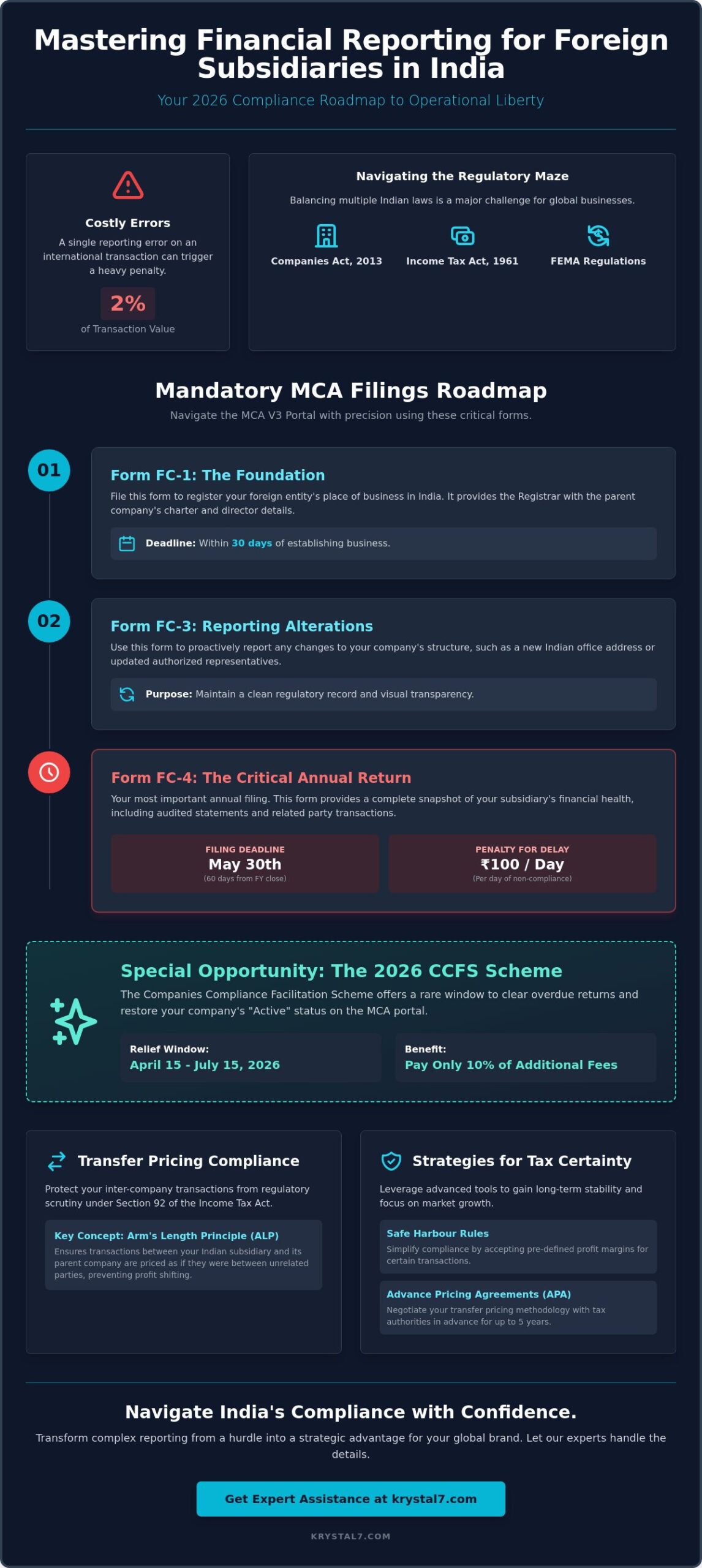
File Form FC-1 within 30 days of establishing your place of business in India. This form registers the foreign entity and provides the parent company’s charter and director details to the Registrar. You must translate and authenticate any parent company documents originally written in languages other than English.
Use Form FC-3 to report any subsequent alterations to your company structure. You must update the MCA through this form if you change your Indian office address or authorized representatives. This proactive reporting maintains the visual transparency necessary for a clean regulatory record.
Form FC-4: The Annual Return of Foreign Entities
Prioritize Form FC-4 as your most critical document in the annual compliance calendar. This comprehensive annual return provides the MCA with a snapshot of your subsidiary’s financial health. You must file this return within 60 days from the close of the financial year, typically by May 30.
Include audited financial statements and detailed records of related party transactions in your submission. Missing this deadline triggers a daily penalty of INR 100. For companies with older pending filings, the Companies Compliance Facilitation Scheme (CCFS), 2026, offers a significant window of relief from April 15 to July 15, 2026.
This scheme allows you to clear overdue returns by paying only 10% of the additional fees. Use this rare opportunity to restore your company’s “Active” status on the MCA portal. Successful financial reporting for foreign subsidiaries in India depends on your ability to respect these statutory windows.
Transfer Pricing Compliance: Navigating Section 92 and ALP
The Income Tax Department monitors transactions between your Indian entity and its global parent to prevent profit shifting. This scrutiny falls under Section 92 to 92F of the Income Tax Act, 1961. These regulations represent a vital layer of financial reporting for foreign subsidiaries in India.
These rules apply to transactions between “Associated Enterprises,” including your subsidiary and its parent or group affiliates. Absolute precision in these records is non-negotiable for maintaining compliance and securing your entity’s reputation. Clean data here ensures your global board remains confident in the Indian operation.
The Arm’s Length Principle (ALP) sits at the heart of these regulations. It requires you to price inter-company transactions as if you were dealing with an independent stranger. For example, software services provided to your parent must match market rates charged to unrelated third parties.
Proving this fairness is essential for maintaining investor trust and regulatory peace. If the aggregate value of these international transactions exceeds INR 1 Crore, you must maintain detailed documentation. This threshold triggers the need for a methodical benchmarking process.
The Three-Tier Documentation Shield
India uses a three-tier documentation system that scales with your business size. The Local File serves as your primary defense, containing specific transaction records and benchmarking data. This ensures every transaction remains transparent under regulatory review.
Groups with consolidated revenue exceeding INR 500 Crore must also maintain a Master File. Multi-national enterprises with turnover above INR 6,400 Crore face additional Country-by-Country Reporting (CbCR) requirements. This structure provides the visual precision required for global tax compliance.
Form 3CEB: The Accountant’s Report
Form 3CEB acts as the formal certification for all your international transactions. A Chartered Accountant must audit these dealings and sign the report to verify adherence to the ALP. This certification provides the final layer of security for your tax filings.
You must file this form on the Income Tax e-filing portal by October 31st each year. Missing this deadline can trigger a penalty of INR 1 Lakh or 2% of the transaction value if documentation is absent. We use professional databases for benchmarking to ensure your filings remain legally bulletproof.
The 2026 Compliance Calendar: Deadlines and Penalties
Your journey through financial reporting for foreign subsidiaries in India follows a strict, calendar-driven rhythm. In India, we distinguish between the Financial Year (FY) and the Assessment Year (AY). The FY 2025-26, which ended on March 31, 2026, was your period of earning and transacting. We’ve now entered the Assessment Year 2026-27, the critical window where you report those earnings and justify your tax positions to the authorities.
The Indian regulatory system is binary; you’re either compliant or you’re facing significant financial friction. There’s no middle ground for “late but well-intentioned” filings. Maintaining a clean record through annual compliance for a private limited company is a strategic investment in your global reputation. It ensures that your focus remains on capturing a share of India’s growing FDI inflows, which reached US$58.85 billion in the last financial year, rather than defending administrative lapses.
Key Dates for Your 2026 Checklist
Success in financial reporting for foreign subsidiaries in India depends on meeting these three non-negotiable milestones in 2026:
- July 15, 2026: You must file the Foreign Liabilities and Assets (FLA) Return on the Reserve Bank of India (RBI) portal. This report captures your foreign direct investment details and is mandatory even if no fresh capital was infused during the year.
- October 31, 2026: This is the deadline for filing Form 3CEB. As we discussed in the transfer pricing section, this form certifies that your international transactions meet the Arm’s Length Principle.
- November 30, 2026: You must submit the Income Tax Return (ITR-6) for your subsidiary. This is the final consolidation of your tax liability for the previous financial year.
The Cost of Non-Disclosure: INR Penalties
The price of administrative oversight is high. Failure to file Form 3CEB by the October deadline triggers a flat penalty of INR 1,00,000. If you fail to maintain the required transfer pricing documentation, the penalty escalates to 2% of the value of each international transaction. These aren’t just numbers; they’re direct hits to your subsidiary’s profitability and your board’s confidence.
Late fees on the MCA portal also accumulate daily. These can eventually lead to penalties as high as INR 5,00,000 for directors, alongside the risk of disqualification. We provide a methodical approach to these deadlines to ensure your operations remain secure. If you’re ready to automate your regulatory peace of mind, explore our Annual Compliance Package today.
Advanced Strategies: Safe Harbour and Operational Liberty
Mastering the financial reporting for foreign subsidiaries in India is about more than just avoiding fines. It’s about achieving operational liberty through proactive tax planning. Safe Harbour Rules act as a liberation strategy, allowing you to declare a pre-determined profit margin that the tax authorities agree not to challenge. This approach removes the uncertainty of future audits and provides a clear roadmap for your global parent board.
For even greater security, you might consider an Advance Pricing Agreement (APA). This is a formal contract with the Central Board of Direct Taxes (CBDT) that fixes your transfer pricing methodology for up to nine years. It covers five future years and can include four “rollback” years for past transactions. We encourage founders to integrate these strategies during their initial foreign subsidiary registration to ensure their Indian venture starts on a legally bulletproof foundation.
Safe Harbour Rules for IT and ITeS Sectors
The Safe Harbour route is a “no-questions-asked” path for companies providing software development or knowledge process services. Under the Union Budget 2026, the turnover threshold for this eligibility has increased to INR 20 billion. A uniform safe harbour margin of 15.50% now applies to the IT services category. Choosing this route eliminates the risk of long-drawn litigation and intensive transfer pricing audits. It offers a transparent framework that aligns perfectly with global corporate governance standards.
The Krystal7 Advantage: Beyond Basic Bookkeeping
Our partnership provides a methodical shield that goes far beyond basic bookkeeping. We offer personalized advisory to help you manage the technical nuances of the TRACES, GST, and MCA portals. Dealing with Indian “red tape” becomes much simpler when you have a Gurgaon-based partner for local representation. We possess the deep institutional knowledge required to explain Indian compliance requirements to your global headquarters in a language they understand.
Our team handles the administrative complexity of financial reporting for foreign subsidiaries in India so you can focus on your primary goal: market growth. We bring visual precision to your books and order to your processes. You can pursue your visionary goals with the confidence that your Indian operations are secure, transparent, and fully compliant. We handle the complexity so you can lead with operational liberty.
Securing Your Indian Growth for 2026 and Beyond
Navigating the dual-reporting burden requires a methodical approach to both local and global standards. You’ve seen how Form FC-4 and the Arm’s Length Principle under Section 92 create a complex regulatory landscape. You’ve also learned that advanced strategies like Safe Harbour rules can liberate your business from audit anxiety. Mastering financial reporting for foreign subsidiaries in India isn’t just about ticking boxes; it’s about building a foundation of visual transparency that your global board can trust.
Our team of trusted Chartered Accountants in Gurgaon provides specialised expertise in foreign subsidiary compliance. We offer meticulous management of the MCA, GST, and Income Tax portals to ensure your operations remain legally bulletproof. We handle the administrative “red tape” so you can focus on capturing your share of India’s vibrant market. For expert assistance with transfer pricing and financial reporting for your Indian subsidiary, contact Krystal7 Consultants at business@krystal7.com or visit krystal7.com.
Your journey in the Indian market is a bold, visionary step. With the right partner managing your compliance calendar, you can lead your subsidiary with absolute confidence and operational liberty. Let’s work together to make your 2026 expansion a seamless success.
Frequently Asked Questions
Is financial reporting mandatory for dormant foreign subsidiaries in India?
Yes, compliance remains mandatory even if your subsidiary has no active business operations. You must still file annual returns and audited financial statements with the Registrar of Companies (ROC) every year. While you can apply for “Dormant” status under the Companies Act to reduce some administrative tasks, basic financial reporting for foreign subsidiaries in India cannot be ignored without risking a strike-off by the regulator.
What is the threshold for a transfer pricing audit in India for 2026?
A transfer pricing audit is mandatory if the aggregate value of your international transactions with associated enterprises exceeds INR 1 Crore in a financial year. Additionally, the threshold for specified domestic transactions is INR 20 Crore. Crossing these limits requires you to maintain formal documentation and file Form 3CEB, certified by a Chartered Accountant, on the Income Tax e-filing portal by the October 31 deadline.
Can an Indian subsidiary use its parent company’s auditors for local reporting?
No, the statutory audit for an Indian entity must be conducted by a Chartered Accountant holding a valid Certificate of Practice from the Institute of Chartered Accountants of India (ICAI). While global accounting networks often have Indian member firms, the local firm must be the one to sign the audit report. This ensures that the financial reporting for foreign subsidiaries in India adheres strictly to local standards and legislation.
What is the penalty for late filing of Form FC-4 with the ROC?
The late filing fee for Form FC-4 is INR 100 per day of delay. This penalty is cumulative and applies until the form is successfully uploaded to the MCA V3 portal. Beyond the daily fees, persistent non-compliance can lead to additional penalties for directors, which may reach INR 5,00,000. It’s vital to respect the 60-day window following the close of the financial year to avoid these costs.
Do I need to report transactions with the parent company if no money changed hands?
Yes, all international transactions must be reported regardless of whether a cash payment occurred. Indian transfer pricing rules cover the provision of services, cost-sharing arrangements, and the use of intellectual property even if they are provided “free of charge.” These transactions must be recorded at their Arm’s Length Price to ensure your books remain transparent and reflect the true economic value of the support received from the parent.
How long must a foreign subsidiary maintain its financial records under the Companies Act?
You must maintain your financial records and books of accounts for at least eight financial years. These records include all vouchers, receipts, and ledgers that support your filings. If the subsidiary is involved in an ongoing tax investigation or litigation, the authorities may require you to preserve these documents for a longer period. Methodical record-keeping is the best defense against future regulatory inquiries.
What is the difference between IFRS and Indian AS for subsidiary reporting?
Indian Accounting Standards (Ind AS) are converged with IFRS but include specific “carve-outs” and “carve-ins” to align with the Indian legal environment. While they are broadly similar, your Indian accounts must follow Ind AS for local statutory filings. Your accounting team will then perform a reconciliation to bridge any gaps when the parent company consolidates these figures into their global IFRS or US GAAP financial statements.
Is GST registration mandatory for a 100% export-oriented subsidiary?
Yes, registration is mandatory once your turnover exceeds the state-specific threshold, which is typically INR 20 Lakhs or INR 40 Lakhs. Even though exports are “zero-rated” and you don’t pay tax on your sales, you need a GSTIN to operate legally. Having a registration allows you to claim refunds for the GST paid on input services like office rent, software subscriptions, and professional consulting fees.

Article by
Nihal Srivastava
Nihal Srivastava is the Co-Founder of Krystal7 Consultants, helping Indian entrepreneurs and startups navigate company registration, compliance, trademark protection, and regulatory requirements with clarity and confidence. With 6+ years of hands-on expertise in MCA filings, GST compliance, and corporate structuring, Nihal has guided 1000+ businesses across India through their legal and compliance journeys. He believes every business dream deserves crystal clear foundations, and that no founder should be held back by paperwork or red tape.