

Wholly Owned Subsidiary India Registration: The Ultimate 2026 Guide for Foreign Companies
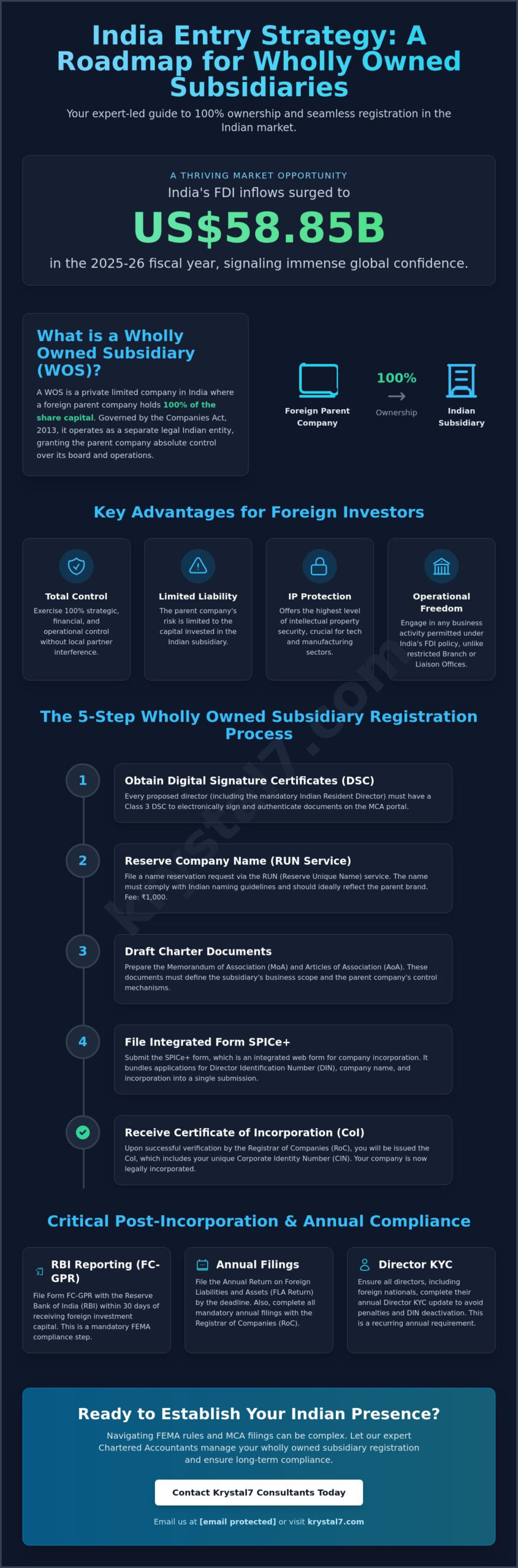
With India’s FDI inflows surging to US$58.85 billion in the 2025-26 fiscal year, it’s clear that global visionaries see the Indian market as a non-negotiable priority. Achieving full operational liberty starts with a successful wholly owned subsidiary India registration, which grants your foreign parent company 100% ownership and absolute legal control over its local branch.
You’re likely excited about this growth potential but feel anxious about hidden compliance costs or the complex overlap between the Companies Act and FEMA rules. It’s common to feel overwhelmed by the mandatory Indian Resident Director requirement or the pressure of meeting strict RBI reporting deadlines. We understand that you need a partner who handles the administrative burden so you can focus on your primary business goals.
We’ve designed this expert-led 2026 roadmap to replace that uncertainty with a clear, predictable path to incorporation. You’ll master everything from initial MCA filings to the critical filing of Form FC-GPR. This guide ensures your Indian operations are built on a foundation of total transparency and long-term security.
Key Takeaways
- Discover how the Section 2(87) structure under the Companies Act 2013 provides the operational liberty and 100% control needed for your tech or manufacturing venture.
- Navigate the five-step roadmap for wholly owned subsidiary India registration, ensuring a seamless flow from name reservation to final MCA approval.
- Simplify the complex documentation process, including the mandatory Resident Director requirement and specific KYC standards for foreign directors.
- Secure your investment by mastering post-incorporation compliance, focusing on RBI reporting via Form FC-GPR and FEMA-regulated capital accounts.
- Avoid costly penalties by tracking essential 2026 deadlines for annual filings, including the FLA return and mandatory Director KYC updates.
Understanding the Wholly Owned Subsidiary (WOS) Structure in India
A Wholly Owned Subsidiary (WOS) is an entity where 100% of the share capital is held by a foreign parent company. Under Section 2(87) of the Companies Act 2013, this structure allows the parent company to exercise complete control over the Board of Directors and voting power. Understanding the Wholly Owned Subsidiary (WOS) Structure is the first step for any global business looking to establish a permanent, scalable presence in the Indian market. Unlike a joint venture, you don’t have to manage the complexities of a local partner’s conflicting interests.
Your Indian WOS is a separate legal entity. This means it’s treated as a domestic Indian company for all regulatory and tax purposes, even though the ownership is entirely foreign. Tech and manufacturing sectors prefer this route because it provides the highest level of intellectual property protection and operational freedom. While a Liaison Office only serves as a communication channel and a Branch Office is restricted to specific activities, a WOS can engage in any business activity permitted under India’s FDI policy.
Choosing a wholly owned subsidiary India registration gives you a competitive edge. You’ll have the power to sign local contracts, hire a dedicated workforce, and build long-term assets. It’s the most robust way to signal your commitment to Indian customers and vendors while maintaining a clear line of sight on your global objectives.
Key Advantages of a WOS for Foreign Investors
The primary benefit is total strategic and financial control. You decide the growth pace, the reinvestment strategy, and the management structure without external interference. This structure also offers limited liability protection. The foreign parent company’s risk is limited to the capital it has invested in the Indian entity. Additionally, transferring shares or repatriating profits after tax is a transparent, regulated process that ensures your capital remains mobile and accessible.
FDI Policy and Sectoral Caps in 2026
India’s Foreign Direct Investment (FDI) policy is designed to be welcoming. Most sectors now fall under the “Automatic Route,” which means you can proceed with the wholly owned subsidiary India registration without waiting for government or RBI clearance. However, some sensitive sectors still require the “Government Route,” involving a more detailed approval process. You must correctly identify your National Industrial Classification (NIC) code during registration. Choosing the wrong code can lead to compliance delays or penalties under FEMA. Our team of Chartered Accountants ensures your business activity aligns perfectly with the latest 2026 FDI regulations to prevent these setbacks.
The 5-Step Process for Wholly Owned Subsidiary India Registration
The Ministry of Corporate Affairs (MCA) has transformed the incorporation journey into a streamlined, digital experience. The 5-Step Process for Wholly Owned Subsidiary India Registration ensures you can move from a vision to a legal reality with precision. Each phase requires meticulous attention to detail to avoid the bureaucratic friction that often stalls international expansion.
- Step 1: Digital Signature Certificates (DSC): Obtaining a Class 3 DSC is the first milestone. Every proposed director needs one to sign electronic documents and authenticate filings on the MCA portal.
- Step 2: Name Reservation: You’ll use the RUN (Reserve Unique Name) service for a fee of ₹1,000 per application. It’s vital to choose a name that reflects your global brand while adhering to Indian naming guidelines.
- Step 3: Drafting Charter Documents: The Memorandum of Association (MoA) and Articles of Association (AoA) aren’t just templates. They must include specific clauses that define the foreign parent’s control and the subsidiary’s operational scope.
- Step 4: Filing SPICe+: This is the core of your wholly owned subsidiary India registration. This integrated form bundles multiple applications, including your DIN and company incorporation request, into one digital submission.
- Step 5: Certificate of Incorporation (CoI): Once the Registrar of Companies (RoC) verifies your data, they’ll issue the CoI. This document contains your Corporate Identity Number (CIN), confirming your business is officially active.
The SPICe+ Portal: A One-Stop Registration Hub
The SPICe+ portal is a game changer for efficiency. It doesn’t just register your company; it simultaneously handles your PAN, TAN, and GSTIN applications. It even integrates registrations for EPFO and ESIC to ensure you’re compliant from day one. For a broader look at how these pieces fit together, you can explore our how to register guide. Professional drafting of your MoA is essential here to ensure your business objects are broad enough for future growth.
Timelines and Expectations for 2026
In 2026, you can generally expect the entire process to take 10 to 15 business days. Rejections usually happen because of minor discrepancies in document proofs or name similarities. A major bottleneck is often the registered office address proof. The MCA requires utility bills that are less than two months old. If you’re looking for a stress-free experience, our foreign subsidiary registration experts can manage these meticulous details for you.
Essential Documentation and the Resident Director Mandate
Precision in documentation is the bridge between your global strategy and local operations. For a successful wholly owned subsidiary India registration, you must gather a specific set of documents that satisfy both the Ministry of Corporate Affairs (MCA) and the Reserve Bank of India (RBI). The process requires more than just standard identity proofs; it demands a high level of legal validation through notarization and apostille.
Your foreign parent company must provide its Certificate of Incorporation and a formal Board Resolution. This resolution should clearly state the intention to incorporate an Indian subsidiary and authorize a specific individual to sign the incorporation forms. Each foreign director must also submit individual KYC documents, including a valid passport, a recent bank statement, and a utility bill as proof of residence. To establish your physical presence, you’ll need a lease deed for your Indian office, a No Objection Certificate (NOC) from the landlord, and a utility bill not older than two months.
The “Apostille” requirement is a critical step for documents originating outside India. This international certification makes your foreign documents legally valid for use within Indian jurisdictions. Skipping this step or providing incomplete documentation is the most common reason for application delays. Meticulous preparation here ensures your wholly owned subsidiary India registration moves forward without unnecessary hurdles.
The Resident Director Requirement Explained
Section 149(3) of the Companies Act 2013 mandates that every Indian company must have at least one director who has stayed in India for a total period of not less than 182 days in the previous financial year. This individual doesn’t need to be a shareholder, but they must hold a valid Director Identification Number (DIN). They serve as a vital link between your company and Indian regulatory bodies. Their duties include ensuring the subsidiary remains compliant with local laws, including FEMA Regulations and FDI Routes. This requirement ensures that there is always a responsible officer present within the country to handle statutory obligations.
Document Legalization for Foreign Entities
If your home country is a member of the Hague Convention, you’ll need to apostille your documents after notarization. For countries not part of this convention, embassy legalization is mandatory. If your original documents are not in English, you must provide certified translations. This ensures your private limited company india structure is recognized legally and mirrors the professional standing of your global parent entity. Handling these administrative formalities correctly from the start prevents the anxiety of last-minute rejections by the Registrar of Companies (RoC).
Post-Incorporation Compliance: RBI Reporting and FEMA Regulations
Securing your Certificate of Incorporation is a major milestone, but it’s just the beginning of your journey. The first 30 days after your wholly owned subsidiary India registration are the most critical for long-term legal safety. You must move quickly to bridge the gap between Ministry of Corporate Affairs (MCA) filings and Reserve Bank of India (RBI) reporting requirements. Failing to meet these tight windows can lead to heavy compounding fees and regulatory scrutiny.
The most vital task is reporting the Foreign Direct Investment (FDI) through the FIRMS portal. You must file Form FC-GPR within 30 days of issuing shares to the foreign parent company. This form tells the RBI exactly who is investing and how many shares they hold. Before this, you must open a specialized Capital Account and ensure the inward remittance of the share capital. Once the funds arrive, your Authorized Dealer (AD) bank will issue a Foreign Inward Remittance Certificate (FIRC). This certificate is the single most important document you’ll need; without it, the RBI won’t recognize your investment as legitimate equity.
- Statutory Auditor: You must appoint your first auditor within 30 days of incorporation to ensure financial transparency.
- Share Certificates: These must be issued to the parent company within 60 days of the incorporation date.
- Stamp Duty: Pay the state-specific stamp duty on share certificates to avoid legal invalidity of your ownership documents.
Opening a Business Bank Account in India
Setting up a bank account for a foreign-owned entity requires meticulous KYC verification for all directors. Banks will scrutinize the apostilled documents you prepared during the wholly owned subsidiary India registration process. It’s helpful to establish your annual compliance for private limited company framework during this phase. This proactive approach ensures that your inward remittances are handled correctly and your FIRC is issued without delays.
Statutory Registrations: GST, Professional Tax, and MSME
Depending on your business model, you’ll need additional registrations to operate legally. GST registration is mandatory if your turnover exceeds the threshold or if you’re making inter-state supplies. Trading subsidiaries must obtain an Import-Export Code (IEC) to move goods across borders. If you’re hiring local talent, you must register with the EPFO and ESIC for mandatory social security contributions. You should also consider registering as an MSME to access specific government incentives. If you want to ensure every deadline is met with precision, our team can manage your Foreign Subsidiary Registration and post-incorporation setup to give you total peace of mind.
Managing Annual Compliance and Penalties for Non-Compliance
Completing your wholly owned subsidiary India registration is a landmark achievement, but protecting that investment requires a methodical approach to annual maintenance. Indian regulations are strict, and the Ministry of Corporate Affairs (MCA) monitors every deadline with digital precision. You must prioritize the annual filing of financial statements via Form AOC-4 and your Annual Return through Form MGT-7. In 2026, the penalty for missing these deadlines is a fixed ₹100 per day per form. These costs escalate quickly, turning a simple oversight into a significant financial burden.
Beyond company-level filings, your board must stay active in the eyes of the law. Every director must complete their DIR-3 KYC annually by September 30th to keep their Director Identification Number (DIN) active. If a director fails to file, their DIN becomes “Deactivated,” and the company cannot file any other statutory forms. Reactivating a DIN involves a ₹5,000 penalty and unnecessary administrative friction. We handle these recurring tasks so you can maintain your focus on scaling your Indian operations without bureaucratic interruptions.
Tax compliance is equally vital. You must file your Income Tax Return (ITR-6) by October 31st and the Annual Foreign Liabilities and Assets (FLA) return by July 15th. These filings ensure the RBI and the Tax Department have a transparent view of your subsidiary’s financial health. Precision here isn’t just about avoiding fines; it’s about building a foundation of trust with Indian regulators.
Transfer Pricing and Cross-Border Compliance
Transactions between your foreign parent and the Indian subsidiary must follow the “Arm’s Length” principle. This ensures that pricing reflects fair market value, preventing tax scrutiny regarding profit shifting. Under the Income Tax Act, you must maintain robust documentation and file Form 3CEB if your international transactions exceed specific thresholds. Our expertise in cross border compliances ensures your transfer pricing study stands up to rigorous audits.
Consequences of Compliance Lapses
The risks of ignoring these statutory duties go beyond mere fines. If a company fails to file annual returns for three consecutive years, its directors face disqualification for five years. Even more severe is the risk of the Registrar of Companies (ROC) “Striking Off” your company name from the register. This effectively shuts down your legal existence in India and freezes your bank accounts. You can protect your vision by delegating these complexities to us.
Maintaining a wholly owned subsidiary India registration requires a commitment to transparency and meticulous record-keeping. By staying ahead of AOC-4, MGT-7, and ITR-6 filings, you safeguard your operational liberty and long-term growth. Our team provides the calm competence you need to navigate these legal formalities with ease. Reach out to Krystal7 Consultants today at business@krystal7.com or visit krystal7.com to secure your 2026 compliance roadmap.
Empower Your Global Vision in the Indian Market
Establishing a presence in India is a bold strategic move that requires both a visionary mindset and meticulous execution. A successful wholly owned subsidiary India registration acts as your gateway to total operational liberty and absolute legal control. By navigating the SPICe+ process with precision and staying ahead of RBI reporting, you build a business founded on transparency and long-term security.
Your success depends on more than just the initial setup. You must manage the mandatory Resident Director requirement and meet critical post-incorporation deadlines like Form FC-GPR and annual MCA filings. Our dedicated Gurugram-based compliance team brings deep expertise in FEMA and RBI reporting to handle these administrative burdens for you. We provide transparent fixed-fee registration packages so you can focus on scaling your core operations.
Secure your Indian market entry with Krystal7—Contact our experts today at business@krystal7.com or visit krystal7.com to automate your compliance. Your expansion into the vibrant Indian economy is a journey worth taking; we’re ready to be your trusted partner every step of the way.
Frequently Asked Questions
Can a foreign individual be the 100% owner of an Indian company?
Yes, a foreign individual can be the 100% owner of an Indian company under the current FDI policy. Since a Private Limited Company requires at least two shareholders, the individual usually holds 99.9% of shares and appoints a nominee for the remaining 0.1%. This structure ensures complete beneficial ownership while meeting the legal requirements of the Companies Act 2013.
What is the minimum capital required for wholly owned subsidiary India registration?
There is no mandatory minimum paid-up capital for a wholly owned subsidiary India registration in most sectors. While you can incorporate with a small amount like ₹10,000, your authorized capital should reflect your actual business needs. You’ll need to pay state-specific stamp duty on the Memorandum of Association based on the capital amount you choose during the application.
Is it mandatory for a foreign subsidiary to have an office in India?
Yes, having a physical registered office in India is a mandatory requirement for every incorporated entity. You must provide a utility bill and a No Objection Certificate from the owner during the MCA filing process. This office serves as the official point of contact for the Income Tax Department, GST authorities, and the Registrar of Companies.
How long does the entire registration process take in 2026?
The entire process typically takes between 10 and 15 business days in 2026. This timeline assumes all foreign documents are apostilled and notarized correctly before submission to the ROC. Delays usually happen only if the MCA requests additional clarification on the company’s proposed name or the specific nature of its business activities.
Do I need a separate GST registration for my subsidiary?
Yes, your subsidiary must obtain its own GST registration because it’s a distinct legal entity from the foreign parent company. You can apply for GST, PAN, and TAN simultaneously through the integrated SPICe+ form during the incorporation process. This ensures you’re ready to issue tax invoices and claim input tax credits as soon as you start operations.
What happens if we do not report the foreign investment to the RBI?
Failing to report foreign investment to the RBI is a serious FEMA violation that attracts significant compounding penalties. If you don’t file Form FC-GPR within 30 days of share allotment, the investment isn’t officially recognized. This oversight makes it nearly impossible to repatriate profits or exit the Indian market legally in the future.
Can a WOS in India buy immovable property?
Yes, a WOS can acquire immovable property in India for its legitimate business use. Since the subsidiary is incorporated in India, it enjoys the same rights as a domestic company under the Companies Act. However, you must ensure the purchase follows FEMA guidelines and isn’t related to agricultural land, farmhouse property, or plantation activities.
What is the difference between an Indian Subsidiary and a WOS?
The main difference lies in the percentage of ownership and control held by the parent entity. An Indian subsidiary is any entity where a foreign parent company holds more than 50% of the voting shares. A wholly owned subsidiary India registration specifically refers to an entity where the parent company holds 100% of the equity, providing them with total strategic and financial liberty.

Article by
Nihal Srivastava
Nihal Srivastava is the Co-Founder of Krystal7 Consultants, helping Indian entrepreneurs and startups navigate company registration, compliance, trademark protection, and regulatory requirements with clarity and confidence. With 6+ years of hands-on expertise in MCA filings, GST compliance, and corporate structuring, Nihal has guided 1000+ businesses across India through their legal and compliance journeys. He believes every business dream deserves crystal clear foundations, and that no founder should be held back by paperwork or red tape.