

FLA Return Filing India: A Complete 2026 Compliance Guide for Businesses
A single oversight on the RBI’s FLAIR portal can trigger penalties up to three times the value of your foreign investment. You’ve worked hard to attract international capital to your Indian company, but the administrative weight of FEMA compliance often feels like a barrier to your growth. Managing the specifics of FLA return filing India shouldn’t be a source of anxiety for visionary founders.
We understand that coordinating audited financials with rigid government deadlines is a significant challenge for busy entrepreneurs. This guide provides a clear roadmap to mastering the complexities of the Reserve Bank of India’s reporting requirements for 2026. You’ll gain the peace of mind that comes from knowing your business is fully compliant and protected from heavy fines.
We’ll explore the mandatory July 15th deadline, step-by-step registration on the FLAIR portal, and the process for filing revised returns by September 30th. This expert-led breakdown ensures you can navigate the compliance landscape with total confidence and operational liberty.
Key Takeaways
- Identify whether your Private Limited company or LLP falls under the mandatory RBI reporting requirements for the 2026 cycle.
- Navigate the FLAIR portal registration process with confidence, including how to generate the required verification and board authority letters.
- Secure your business against the ₹7,500 late fee by mastering the critical July 15th deadline for FLA return filing India.
- Understand the severe financial implications of non-compliance and how to avoid penalties under the Foreign Exchange Management Act (FEMA).
- Discover how delegating complex reporting to meticulous experts can grant you the operational liberty to focus on your primary business goals.
What is FLA Return Filing in India and Why is it Mandatory?
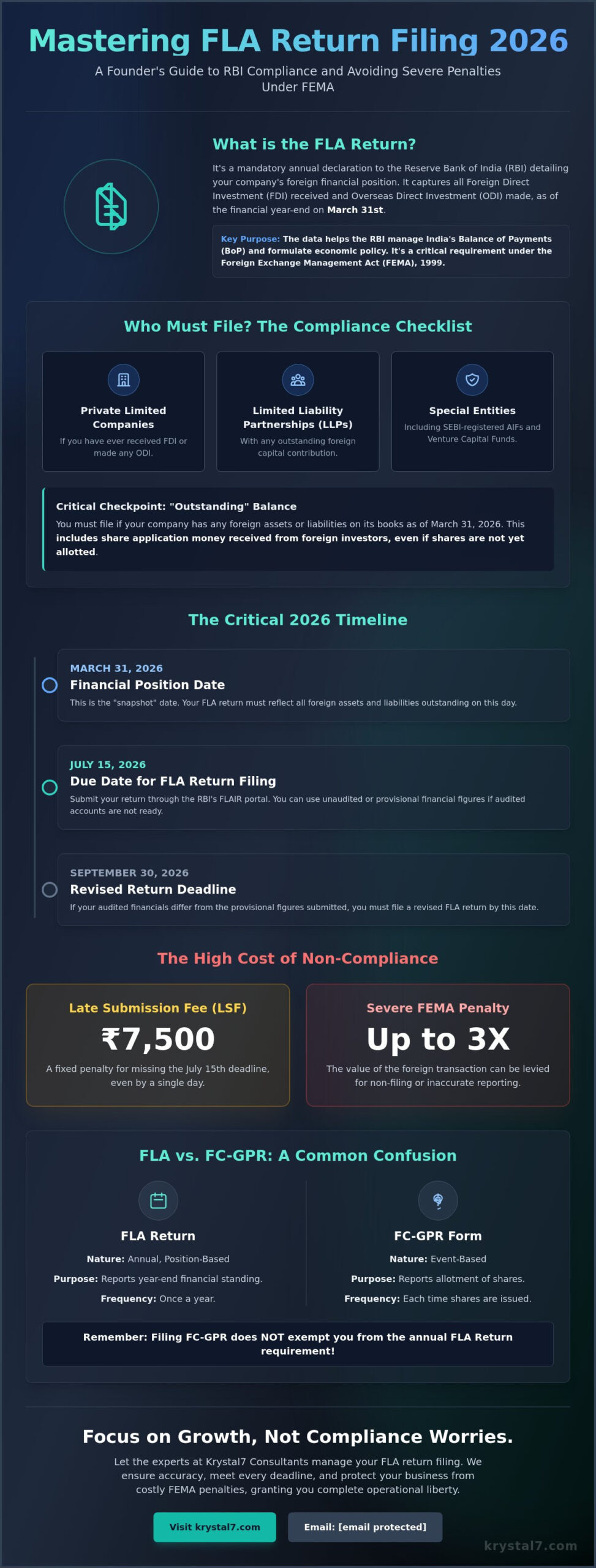
FLA return filing India is a mandatory annual requirement for any Indian entity that has received Foreign Direct Investment (FDI) or made an Overseas Direct Investment (ODI). Think of it as a comprehensive health check for your company’s global financial position. It captures the total outstanding volume of foreign liabilities and assets as of March 31st each year. This reporting is a statutory obligation for Private Limited companies, LLPs, and SEBI-registered Alternative Investment Funds (AIFs).
Compliance is strictly governed under the Foreign Exchange Management Act (FEMA), 1999. You must file this return even if your business didn’t receive any fresh capital during the current financial year. As long as there are outstanding foreign assets or liabilities on your balance sheet, the RBI requires this transparency. Failing to report these figures can lead to significant penalties that disrupt your operational liberty.
The Role of the Reserve Bank of India (RBI)
The RBI doesn’t collect this data for mere record-keeping; they use it to manage India’s Balance of Payments (BoP). This information helps the government track the country’s international investment position and formulate economic policies. The shift from physical form submissions to the digital FLAIR portal has streamlined the process. Maintaining meticulous transparency through these filings builds immense credibility for your foreign subsidiary. It signals to the regulator that your venture is a compliant and trustworthy player in the Indian market.
FLA vs. FC-GPR: Understanding the Difference
Many founders mistakenly believe that filing an FC-GPR form covers all their reporting needs. The FC-GPR is an event-based filing that you trigger only when you allot shares to a foreign investor. In contrast, the FLA is a position-based annual requirement that reflects your financial status at the end of the year. Filing your FC-GPR doesn’t exempt you from the annual FLA requirement. Even if you’ve reported every share allotment correctly, you still need to complete your FLA return filing India to show the RBI your year-end financial standing. Distinguishing between these two is vital for maintaining a clean compliance record and avoiding unnecessary queries from the regulator.
Applicability: Who Must File the FLA Return in 2026?
Determining whether your business needs to complete the FLA return filing India depends on your balance sheet’s international exposure. The requirement isn’t limited to large corporations. It applies to every Indian company registered under the Companies Act, 2013, and all Limited Liability Partnerships (LLPs) that have received foreign capital. If your entity has outstanding Foreign Direct Investment (FDI) or has made an Overseas Direct Investment (ODI) at any point in the past, you must report your status as of March 31, 2026.
There’s a specific exemption for companies that only have non-repatriable shares held by Non-Resident Indians (NRIs). If your foreign capital is strictly on a non-repatriation basis, the RBI generally doesn’t require this specific filing. For a more detailed breakdown of complex scenarios, the RBI FAQs on FLA Return provide definitive guidance on specific edge cases. Understanding these nuances ensures you don’t waste resources on unnecessary filings or, worse, miss a mandatory one.
Criteria for FDI and ODI Reporting
The term ‘outstanding’ is the most critical factor in your compliance checklist. It refers to the total volume of foreign investment sitting in your books at the close of the financial year. This includes share application money pending allotment. Many founders assume that if shares haven’t been issued yet, the money doesn’t count as a liability. However, the RBI views this pending allotment as a reportable foreign liability that must be disclosed to maintain a transparent financial trail. If your company holds assets abroad, such as equity in a foreign subsidiary, these must also be declared under the ODI section of the return.
Special Entities: AIFs and SEBI Registered Firms
Reporting isn’t just for standard private limited companies. SEBI-registered Alternative Investment Funds (AIFs) and venture capital funds have their own set of rules. While they use the FLAIR portal for registration, their actual FLA return filing India process often involves specific Excel-based formats requested via email from the RBI. Partnership firms and branch offices of foreign entities also fall under this umbrella if they have foreign assets or liabilities. If you’re unsure how your specific entity structure impacts your reporting obligations, consulting with a professional compliance partner can help clarify your path forward.
Step-by-Step Guide to Filing on the FLAIR Portal
The RBI’s Foreign Liabilities and Assets Information Reporting (FLAIR) portal is the only gateway for your annual submission. It replaces the older email-based system with a more secure, web-based interface. Successful FLA return filing India begins with a meticulous registration process on this platform. You’ll need to ensure your company’s records are updated before you even attempt to log in.
Portal Registration and Verification
First-time users must register as an ‘Entity User’ to establish their company’s profile. You’ll need your company’s PAN, Corporate Identity Number (CIN), and a signed authority letter from the board. This letter is a critical document that grants specific individuals the right to file on behalf of the company. A common mistake is confusing ‘Entity User’ with ‘Business User’; the former is for the reporting entity itself, while the latter is for authorized representatives like your CA. If you encounter login errors, clear your browser cache or ensure you’re using the latest version of Chrome or Firefox.
Accurate Data Entry for Foreign Assets
Once logged in, you’ll navigate through multiple sections. Section II requires audited or provisional financial data, including your paid-up capital and total net worth in INR. It’s essential that these figures align with your Annual Compliance for Private Limited Company to avoid regulatory queries. Net worth should include all reserves and surplus, but don’t include revaluation reserves in this specific calculation.
Section III demands a country-wise breakdown of all foreign investments. For entities with Overseas Direct Investment (ODI), you must calculate the market value of these investments accurately. Distinguish clearly between equity instruments and debt instruments, as misclassification is a frequent trigger for RBI follow-ups. Following the Reserve Bank of India (RBI) FLA Guidelines ensures your data entry meets the strict standards of the regulator.
After filling all fields, perform a final validation check before hitting the submit button. The system will flag any mathematical inconsistencies, so take your time with the data entry. Always download the system-generated acknowledgement receipt once the submission is successful. This receipt is your primary evidence of successful FLA return filing India and will be required during future audits or if you plan to repatriate funds. Keeping a digital copy of the submitted form alongside your board resolution creates a clear and transparent compliance trail for your business.
Deadlines, Late Submission Fees (LSF), and Penalties
Missing the July 15th deadline for your FLA return filing India can be a costly mistake that lingers on your company’s regulatory record. The RBI enforces a flat Late Submission Fee (LSF) of ₹7,500 for delayed submissions. While this fee might seem manageable, the real danger lies in FEMA Section 13. Serious or continued defaults can lead to penalties up to 300% of the amount involved. If the contravention amount isn’t quantifiable, you could face a fine of up to ₹2,00,000. Beyond financial loss, the RBI can restrict your company’s ability to make future foreign remittances. This essentially ‘blacklists’ your entity from global transactions until the default is regularized. It’s a heavy price for a simple administrative delay.
Filing with Provisional vs. Audited Accounts
Many companies struggle because their statutory audit isn’t ready by mid-July. You don’t have to wait for the final sign-off from your auditors. The RBI allows you to file using provisional figures by the July 15th deadline. You then have until September 30th to submit a revised return with audited figures. Filing a provisional return is always safer than missing the deadline. It demonstrates your commitment to transparency and keeps you clear of the LSF. This dual-deadline approach ensures that even companies with complex year-end closures can remain compliant without stress.
Common Mistakes That Trigger RBI Queries
Regulatory scrutiny often stems from subtle data mismatches. One frequent error is providing FLA data that contradicts your previously filed FC-GPR forms. The RBI cross-references these submissions meticulously. Another common pitfall involves the incorrect calculation of net worth or ignoring ‘Other Capital’ such as inter-company loans and trade credits. These items are often overlooked by founders but are vital for a complete filing. Even small discrepancies in share premium accounts can trigger a query that delays your operations. Secure your business by opting for a professional annual compliance package to ensure every figure is verified before submission.
Precision is your best defense against bureaucratic hurdles. When you report trade credits or inter-company loans, ensure they match your ledger exactly. The RBI looks for consistency across all your financial disclosures. A methodical approach to your FLA return filing India prevents the anxiety of unexpected legal notices. By keeping your records krystal-clear, you protect your company’s global reputation and maintain the operational liberty needed to scale.
Streamlining Compliance with Krystal7 Consultants
Managing the intersection of foreign investment and local regulation requires more than just filling out forms. Krystal7 provides a krystal-clear approach to the complexities of FLA return filing India. We believe that compliance should be a source of security, not a source of stress. Our team handles everything from the initial FLAIR portal registration to the final RBI acknowledgement receipt with meticulous precision.
We integrate your annual reporting with your broader Foreign Subsidiary Registration needs. This holistic view ensures that your capital structure, share allotments, and annual returns remain perfectly synchronized across all government portals. You won’t have to worry about the July 15th deadline because our proactive alert system keeps your filing schedule on track. Delegation grants you the operational liberty to scale your business while we manage the bureaucratic details.
Our methodical process eliminates the anxiety of potential FEMA queries. We cross-verify your current year’s data with your previous filings to ensure total consistency. This visual transparency builds a foundation of reliability for your international investors and the RBI alike. By choosing a partner who understands the phonetic qualities of precision, you secure your company’s standing in the Indian market.
Why Founders Trust Krystal7 for FEMA Compliance
Our Gurgaon-based experts possess deep institutional knowledge of the RBI’s evolving digital landscape. We handle the technical data entry and financial calculations, ensuring your net worth and foreign liability figures are accurate to the last decimal. You get direct access to Chartered Accountants for complex cross-border advisory whenever you need it. We don’t just file forms; we provide a supportive partnership that grows with your venture.
We offer transparent pricing models with no hidden costs for revised filings or portal troubleshooting. This professional commitment to openness is why startups and SMEs across India trust us with their annual compliance. Our polish and confidence come from years of handling elite-level consulting for global subsidiaries. We describe handling complexity so you can focus on pursuing your visionary goals.
Ready to Secure Your Compliance?
Getting started with our FLA filing package is a straightforward and empowering process. We simply need your latest audited or provisional balance sheet, PAN details, and a copy of your previous year’s return. Our team will draft the necessary board authority letters and manage the entire registration process on your behalf. We transform a bureaucratic obstacle into a streamlined workflow that protects your global reputation and financial health.
Don’t let the fear of FEMA penalties slow down your vision or disrupt your peace of mind. Contact our team at business@krystal7.com or visit krystal7.com to receive a customized compliance calendar for your business. Mastering your FLA return filing India is the first step toward long-term growth and complete regulatory freedom.
Secure Your Global Growth with Confident Compliance
Mastering your annual reporting is a vital step in protecting your company’s international reputation. You’ve learned that the July 15th deadline is non-negotiable and that even provisional filings can save you from the ₹7,500 Late Submission Fee. Precision on the FLAIR portal ensures your business remains krystal-clear in the eyes of the RBI. Maintaining this level of transparency safeguards your ability to make future foreign remittances without bureaucratic delays.
Our Gurgaon-based experts are ready to handle the meticulous data entry and technical complexities on your behalf. We offer transparent INR-based pricing models and a 100% success rate in FEMA filings for our clients. Delegate your FLA return filing India to the experts at Krystal7 Consultants today and reclaim the operational liberty you need to lead your venture. We’ll manage the administrative burden while you focus on scaling your vision. Your journey toward seamless compliance starts with a single, empowered decision.
Frequently Asked Questions
What is the last date for FLA return filing for the financial year 2025-26?
July 15, 2026, is the mandatory deadline for FLA return filing India for the financial year ending March 31, 2026. You must submit your return through the FLAIR portal by this date to avoid the Late Submission Fee. Plan your data collection in June to ensure a smooth filing process and maintain your company’s regulatory health.
Can I file the FLA return without an audited balance sheet?
You can file your return using provisional or unaudited figures if your statutory audit isn’t finished by the July 15th deadline. However, you must submit a revised return with the final audited figures by September 30, 2026. This two-step process helps you maintain compliance while your auditors finalize the books for the year.
Is FLA return filing mandatory if there was no foreign investment this year?
Filing is mandatory even if you received no new foreign capital during the current financial year. As long as your company has any outstanding foreign assets or liabilities on its balance sheet as of March 31, the RBI requires an annual update. This ensures the regulator has a transparent view of India’s international investment position.
What is the penalty for late filing of the FLA return under FEMA?
The RBI charges a flat Late Submission Fee (LSF) of ₹7,500 for delayed FLA return filing India. Under FEMA, 1999, more serious defaults can attract penalties up to three times the amount involved in the contravention. If the amount isn’t quantifiable, the fine can reach ₹2,00,000, along with potential daily fines for continuing defaults.
Do LLPs need to file the FLA return to the RBI?
Limited Liability Partnerships (LLPs) must file the FLA return if they have received foreign capital contributions. The rule applies to any LLP that has outstanding foreign liabilities or assets at the close of the financial year. LLPs register on the FLAIR portal using their specific identification numbers just like Private Limited companies.
How do I revise a previously submitted FLA return on the FLAIR portal?
You can revise a submitted return by logging back into the FLAIR portal and selecting the revision option for the relevant year. This is a common practice when your audited financials become available after an initial provisional filing. The statutory deadline for submitting these revised figures to the RBI is September 30th of the same year.
Is a Digital Signature Certificate (DSC) required for FLA filing?
A Digital Signature Certificate (DSC) is not required for filing on the RBI’s FLAIR portal. The system uses a login-based verification method involving an authorized person’s email address and mobile number. You only need to upload a scanned copy of the signed authority letter from your board during the initial registration process.
What happens if I forget to file the FLA return for multiple years?
If you’ve missed filings for several years, you must regularize the default through a compounding process with the Reserve Bank of India. Non-compliance over multiple years is a serious FEMA violation that can lead to your company being restricted from making further foreign remittances. It’s best to consult a professional to handle the voluntary disclosure and minimize penalty risks.

Article by
Nihal Srivastava
Nihal Srivastava is the Co-Founder of Krystal7 Consultants, helping Indian entrepreneurs and startups navigate company registration, compliance, trademark protection, and regulatory requirements with clarity and confidence. With 6+ years of hands-on expertise in MCA filings, GST compliance, and corporate structuring, Nihal has guided 1000+ businesses across India through their legal and compliance journeys. He believes every business dream deserves crystal clear foundations, and that no founder should be held back by paperwork or red tape.