

Repatriation of Profits from India to a Foreign Parent: The 2026 Strategic Guide
Scaling your business in India is a major achievement, but seeing those hard-earned funds trapped in a local bank account can feel like a setback. Many global leaders view the repatriation profits India foreign parent process as a bureaucratic maze filled with steep withholding taxes and rigid RBI regulations. It’s true that the 2026 tax landscape requires precision, especially with the new Income-tax Rules reducing forms but tightening treaty interpretations. However, moving capital to your global headquarters doesn’t have to be a source of anxiety.
We understand that the complexity of FEMA compliance and the fear of “treaty shopping” audits can make even seasoned entrepreneurs hesitate. This guide provides the clarity you need to master legal remittance methods, from dividend distributions to royalty payments. You’ll learn how to leverage Double Taxation Avoidance Agreements (DTAA) to minimize tax liability and handle Form 15CA and 15CB filings with absolute confidence. We’ll map out a structured roadmap to ensure your international growth is fueled by your Indian subsidiary’s success without the risk of penalties.
Key Takeaways
- Identify the most efficient legal avenues for moving funds, including post-tax dividend distributions and royalty payments for intellectual property.
- Learn how to execute the repatriation profits India foreign parent process with minimal tax leakage by leveraging updated DTAA benefits and 2026 tax rules.
- Simplify your compliance journey with a clear checklist for mandatory FEMA and RBI requirements, including the filing of Form 15CA and 15CB.
- Discover why keeping your annual filings and board resolutions up to date is the essential first step for seamless cross-border transfers.
- Gain a strategic roadmap to move earnings to your global headquarters while avoiding regulatory penalties and maximizing your operational liberty.
Understanding the Landscape of Repatriation of Profits from India to a Foreign Parent
Building a successful subsidiary in India is a major milestone for any global company. However, the journey isn’t complete until you can move those earnings back to your headquarters. In technical terms, Understanding Repatriation involves the legal transfer of post-tax profits from an Indian entity to its global owner. For a foreign entity, mastering the repatriation profits India foreign parent process is about more than just moving money; it’s about achieving operational liberty. When you can move capital freely, you can reinvest in global R&D or reward your shareholders without delay.
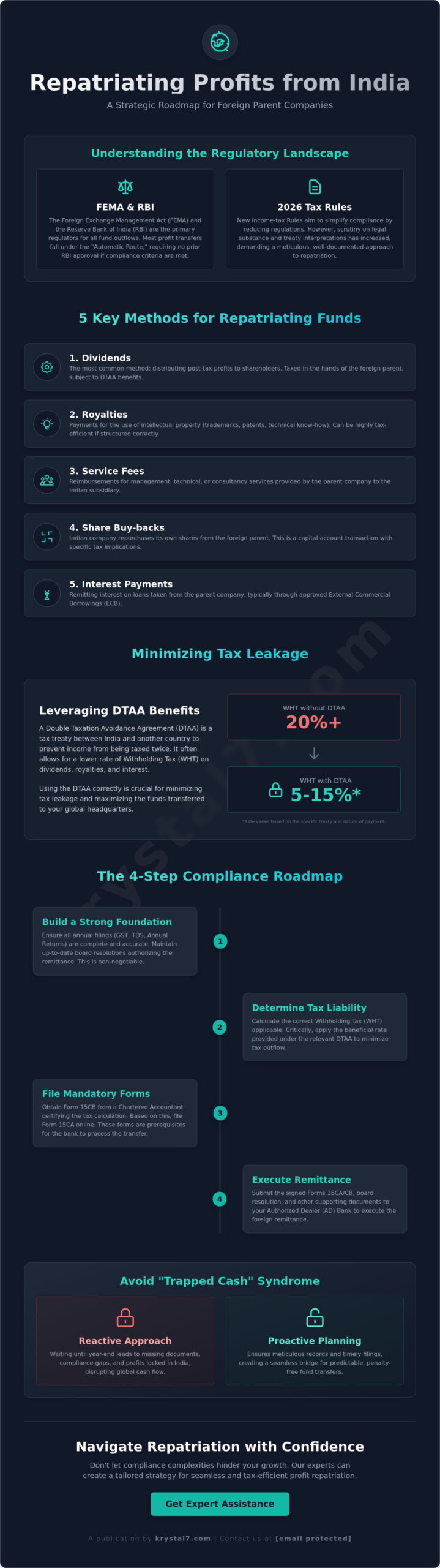
The year 2026 stands as a turning point for cross-border finance in India. With the introduction of the Income-tax Rules 2026, the government has slashed the number of rules from 511 to 333. This regulatory simplification aims to attract more foreign direct investment by making compliance less of a burden. Most profit transfers now fall under the “Automatic Route,” meaning you don’t need prior RBI approval if you meet specific criteria. While the paperwork has decreased, the scrutiny on legal substance has increased. Efficient fund movement now requires a methodical approach that balances speed with strict adherence to Indian law.
The Legal Framework: FEMA and the RBI
The Foreign Exchange Management Act (FEMA), 1999, serves as the primary legislation governing all foreign exchange outflows. Under FEMA, the Reserve Bank of India (RBI) oversees current account transactions, which include dividend payments and service fees. It’s vital to distinguish between repatriable and non-repatriable investments at the very beginning. Your rights to move funds are often cemented during the Foreign Subsidiary Registration phase. If the initial capital was brought in through proper banking channels and reported via the FIRMS portal, the path to repatriation remains clear. However, you must still navigate the procedural requirements of the Income Tax Act, including obtaining certifications like Form 15CB to verify that the correct withholding tax was applied.
Why Proactive Planning Matters for Foreign Parents
Waiting until the end of the financial year to think about remissions often leads to “trapped cash” syndrome. This happens when profits are sitting in an Indian bank account but cannot be moved due to missing documentation or non-compliance with the Companies Act. Proactive planning ensures that your Indian financial health is visible and transparent to the parent company. By maintaining meticulous records and ensuring all GST and TDS filings are accurate, you create a seamless bridge for future transfers. This foresight protects your global cash flow and simplifies the consolidation of financial statements across different jurisdictions. It turns a complex regulatory requirement into a predictable business process.
Key Methods for Repatriating Funds to Your Global Headquarters
Choosing the right path for the repatriation profits India foreign parent process depends on your corporate structure and long term tax strategy. While dividends remain the most frequent choice, alternative routes like royalties or service fees can offer significant tax efficiency. Each method carries unique compliance weights under the Income Tax Act and FEMA. Selecting the wrong vehicle can lead to trapped capital or unnecessary tax leakage, so a methodical approach is essential.
The primary methods for moving funds out of India include:
- Dividends: The distribution of post-tax profits to shareholders.
- Royalties: Payments for the use of intellectual property, trademarks, or technical know-how.
- Service Fees: Reimbursements for management, consultancy, or technical services provided by the parent.
- Share Buy-backs: Returning capital to the parent by purchasing shares back from them.
- Interest: Remitting interest on loans taken through External Commercial Borrowings (ECB).
Dividend Distribution under the Companies Act 2013
Under the Companies Act 2013, an Indian subsidiary can declare dividends from current year profits or accumulated reserves after providing for depreciation. Since the abolition of Dividend Distribution Tax (DDT), the tax liability has shifted directly to the recipient. This change allows foreign parent companies to often claim a foreign tax credit in their home country, reducing global tax costs. For a private limited company in India, the board must pass a resolution and ensure that the dividend is paid out of surplus cash within 30 days of declaration.
Royalties and Technical Service Fees
If your Indian entity utilizes proprietary technology or branding, you can remit royalties or technical service fees. These payments must adhere to the “arm’s length” principle to ensure they reflect fair market value. Navigating FEMA and RBI Regulations is critical here, as remitting these fees requires a robust inter-company agreement. When licensing your brand, remember that initial trademark registration fees are a small investment compared to the long term benefit of secure royalty outflows. If you are unsure which method suits your current cash flow, our team at krystal7.com can help you evaluate the most efficient route.
Share Buy-backs and Interest Payments
As of the 2026-27 tax year, proceeds from share buy-backs are treated as capital gains rather than dividend income. This creates a specific tax advantage for certain corporate promoters, with effective rates hovering around 22%. On the other hand, interest payments on ECBs must stay within the “all-in-cost” ceilings set by the RBI. Both methods require meticulous documentation to prove the legitimacy of the transaction to Indian tax authorities.
Navigating Tax Liabilities: Withholding Tax and DTAA Benefits
Moving money across borders isn’t just a banking task; it’s a tax strategy. When you initiate the repatriation profits India foreign parent process, Withholding Tax (WHT) becomes your biggest concern. This tax is deducted at the source in India before the funds ever leave your subsidiary’s bank account. Without a plan, you might see 20% or more of your remitted royalties or dividends vanish into local tax coffers. However, India’s extensive network of over 90 tax treaties offers a legal way to plug this leakage.
You must also ensure your inter-company payments meet Transfer Pricing (TP) standards. Indian tax authorities expect service fees and royalties to reflect fair market value, often referred to as the “arm’s length” price. To access lower treaty rates, the foreign parent must provide a valid Tax Residency Certificate (TRC) from its home country. Failing to secure this document usually forces the Indian subsidiary to apply higher domestic tax rates. These Challenges in Repatriation often stem from misinterpreting complex clauses or missing documentation deadlines.
Leveraging DTAA for Lower Tax Rates
Double Taxation Avoidance Agreements (DTAA) are the most powerful tools for global entities. These treaties ensure you don’t pay tax on the same income in both Gurgaon and your home city. While domestic rates on dividends are now taxed in the hands of the recipient, many treaties cap this at 5% or 15%. Some treaties even include a “Most Favoured Nation” (MFN) clause. This clause can automatically lower Indian tax rates if India signs a more favorable deal with another country. It’s a technical area, but getting it right can save your business millions in INR over the long term.
The Compliance Duo: Form 15CA and Form 15CB
You can’t simply wire funds from your Indian bank account to the parent company without two critical documents. Form 15CB is a certificate issued by a Chartered Accountant that verifies the correct tax rate and compliance with the Income Tax Act. Once the 15CB is ready, the remitter uploads Form 15CA to the Income Tax portal. This serves as a formal undertaking that all taxes have been paid. For any remittance exceeding INR 5,00,000 in a financial year, these forms are mandatory. Banks will strictly refuse to process the transfer until these are filed and verified through the TRACES portal.
Compliance Roadmap: FEMA Guidelines and Documentation Requirements
Executing the repatriation profits India foreign parent process requires a methodical sequence of actions to satisfy both the RBI and the Income Tax Department. You can’t treat a cross-border transfer like a domestic vendor payment. It’s a regulated movement of capital that demands a clear paper trail. Following a structured roadmap ensures your funds reach the global headquarters without being flagged for non-compliance.
To ensure a seamless transfer, follow these five essential steps:
- Step 1: Verify that all annual compliance for private limited company filings are complete. If your MGT-7 or AOC-4 forms are pending on the MCA portal, your bank will likely stall the remittance.
- Step 2: Pass a formal Board Resolution. This document must specifically approve the dividend declaration or the service fee payment to the foreign parent.
- Step 3: Obtain a Statutory Auditor’s certificate. This certificate confirms that the profits are available for distribution after accounting for depreciation and statutory reserves.
- Step 4: Submit Form 15CA and 15CB along with the A2 Form to your bank. These certify that the correct withholding tax was paid via the TRACES portal.
- Step 5: Execute the final remission. Ensure any subsequent reporting required on the RBI’s FIRMS portal is updated to reflect the outflow if it involves capital reduction.
The Role of the Authorized Dealer Bank
Your Indian bank, known as the Authorized Dealer (AD), acts as the primary gatekeeper for FEMA compliance. They won’t process a wire transfer until they’ve scrutinized your inter-company agreements and underlying invoices. The bank is also responsible for the actual conversion of INR into your desired foreign currency like USD or EUR. Providing them with a clean set of documents well in advance of your deadline prevents the “trapped cash” syndrome mentioned earlier.
Penalties for Non-Compliance
Ignoring these procedural steps can lead to heavy financial burdens. Under FEMA, penalties for quantifiable violations can reach up to three times the amount being remitted. Additionally, late filing of MCA annual returns carries a penalty of INR 100 per day, which can accumulate and block your repatriation rights. Our experts at Krystal7 provide a reassuring hand by managing these bureaucratic traps for you. To secure your global cash flow and maintain zero-penalty status, contact us for our annual compliance package today.
Strategic Repatriation Planning with Krystal7 Consultants
Successful fund movement begins long before you click “send” on a wire transfer. At Krystal7, we integrate repatriation strategy into your initial subsidiary setup phase. This foresight ensures the repatriation profits India foreign parent process remains a transparent and predictable part of your business model. We provide clear visibility into your Indian financial health, removing the fog of administrative uncertainty that often surrounds cross-border transactions.
Our goal is to grant you the operational liberty to focus on your primary vision. We take the weight of the MCA, TRACES, and GST portals off your shoulders, allowing you to lead with confidence. By delegating these meticulous tasks to our team, you secure the freedom to pursue global growth without being tethered to local bureaucratic obstacles. Our partnership is built on a foundation of methodical precision and genuine dedication to your long term success.
Our Comprehensive Remittance Support
Moving capital requires more than just a bank account; it requires a robust legal and tax framework. Our expert Chartered Accountants handle the preparation of Form 15CB, ensuring every tax deduction is accurate and compliant with the 2026 rules. We also assist in drafting the inter-company agreements necessary for legitimate royalty and service fee outflows. By liaising directly with your Authorized Dealer bank, we prevent the typical delays that plague unmanaged foreign remittances.
Moving Forward with Confidence
The journey from your initial India entry to seamless profit remission is a path we have mapped many times. As your dedicated compliance partner in Gurgaon, we provide ongoing advisory on changing tax laws and updated DTAA treaties. This proactive approach ensures your subsidiary remains a high-performing asset for your global headquarters. We turn complex regulatory requirements into a structured roadmap for your success.
Mastering the repatriation profits India foreign parent process is essential for any visionary entrepreneur operating in the Indian market. Don’t let administrative complexity or the fear of penalties slow your global momentum. Contact Krystal7 Consultants today at business@krystal7.com or visit krystal7.com to schedule a consultation with our expert advisors and secure your financial future.
Securing Your Global Growth Through Methodical Compliance
Mastering the repatriation profits India foreign parent process is a vital step in your international expansion journey. By aligning your subsidiary’s operations with the 2026 tax rules and FEMA guidelines, you transform a complex regulatory hurdle into a predictable financial workflow. You now have the roadmap to utilize DTAA benefits effectively and manage mandatory filings like Form 15CA and 15CB without the fear of heavy penalties or unnecessary delays.
At Krystal7 Consultants, our Gurgaon-based team brings elite expertise in Foreign Subsidiary Registration and deep knowledge of FEMA protocols to ensure your capital moves with precision. We handle the intricacies of the MCA and TRACES portals so you can focus on scaling your vision. Ready to repatriate your profits with zero compliance stress? Contact Krystal7 Consultants at business@krystal7.com or visit krystal7.com for expert assistance.
Your Indian success story deserves a partner who values your operational liberty as much as you do. Let’s build your global future with confidence and clarity.
Frequently Asked Questions
Can an Indian subsidiary repatriate 100% of its profits to the foreign parent?
Yes, you can repatriate 100% of your subsidiary’s net profits after fulfilling all tax obligations in India. This means paying the corporate income tax, which is 30% for most large companies or 25% for those with a turnover below INR 400 crore. You must also ensure that all statutory reserves are met according to the Companies Act, 2013. This ensures your global headquarters receives the maximum possible return on its Indian investment.
What is the current withholding tax rate on dividends in India for 2026?
The standard withholding tax rate on dividends for 2026 is 20% plus applicable surcharge and a 4% health and education cess. However, many foreign parents can reduce this rate to 5% or 15% by leveraging Double Taxation Avoidance Agreements (DTAA). For example, the amended India-France DTAA now specifies a 5% rate for qualifying investments. You must provide a Tax Residency Certificate to claim these lower treaty rates effectively.
Is RBI approval required for every profit remittance from India?
Prior RBI approval isn’t necessary for most profit remittances because they fall under the Automatic Route. As long as your transaction complies with the Foreign Exchange Management Act (FEMA), you only need to deal with your Authorized Dealer bank. The bank will verify your documentation, including the inter-company agreements and tax certificates, before releasing the funds. This streamlined process is designed to support the ease of doing business in India.
What happens if I remit money without filing Form 15CA or 15CB?
Your bank won’t execute a foreign remittance if you don’t provide Form 15CA and 15CB. These documents are mandatory under Section 195 of the Income Tax Act for payments to non-residents. Failure to file these forms can result in a penalty of INR 1,00,000 per default. It’s essential to have a Chartered Accountant certify the tax deductions to ensure your transfer remains compliant and penalty free during the entire process.
Can I repatriate profits if my Indian company is making a book loss?
You generally can’t declare dividends if your Indian subsidiary is currently making a book loss. The Companies Act, 2013, requires dividends to be paid out of current profits or accumulated reserves after providing for depreciation. If you plan to use reserves, you must follow specific rules regarding the rate of dividend and the amount withdrawn. This ensures that the company’s capital remains protected while still rewarding the vision of the foreign parent.
How does Transfer Pricing affect the repatriation of service fees?
Transfer Pricing ensures that any service fees or royalties paid for the repatriation profits India foreign parent process are at arm’s length. This means the price must be what two unrelated parties would agree upon in an open market. If the Indian tax authorities find the fees are artificially high to move profits, they may reject the deduction. Proper documentation and a robust transfer pricing study are your best defenses against such audits.
What are the deadlines for filing repatriation-related tax documents?
You must file Form 15CA and 15CB electronically on the Income Tax portal before the bank processes the wire transfer. Once the remittance is made, the withheld TDS must be deposited by the 7th of the following month. For example, if you remit profits in June, the tax must reach the government by July 7th. Missing these deadlines can lead to interest charges of 1.5% per month on the tax amount according to the Income Tax Act.

Article by
Nihal Srivastava
Nihal Srivastava is the Co-Founder of Krystal7 Consultants, helping Indian entrepreneurs and startups navigate company registration, compliance, trademark protection, and regulatory requirements with clarity and confidence. With 6+ years of hands-on expertise in MCA filings, GST compliance, and corporate structuring, Nihal has guided 1000+ businesses across India through their legal and compliance journeys. He believes every business dream deserves crystal clear foundations, and that no founder should be held back by paperwork or red tape.