

UK Founder India Entity: The Complete 2026 Guide to Company Registration
You can establish a UK-owned business in India without ever boarding a flight to Delhi; however, a single oversight in director residency rules can trigger penalties up to ₹3,00,000. It’s a paradox where digital ease meets strict regulatory oversight. If you’re looking to establish a UK founder India entity, you likely feel the weight of complex MCA paperwork and the uncertainty of FEMA regulations. We understand that your vision for growth shouldn’t be stalled by bureaucratic hurdles or the fear of non-compliance.
This guide provides the strategic roadmap you need to navigate the 2026 company registration landscape with confidence. You’ll learn how to leverage the automatic FDI route for 100% ownership, meet the mandatory 182-day resident director criteria, and manage your tax obligations under the Companies Act. We’ll break down the essential steps to transform your UK business into a fully compliant Indian Private Limited company. This ensures your cross-border fund transfers remain seamless and your focus stays on scaling your vision.
Key Takeaways
- Master the legal landscape by understanding how FEMA 1999 and RBI regulations govern foreign equity inflows for UK-owned businesses.
- Discover why a Wholly Owned Subsidiary (WOS) is the preferred structure for a UK founder India entity seeking maximum operational liberty.
- Streamline your MCA registration by securing mandatory Class 3 Digital Signature Certificates and Director Identification Numbers for your international board.
- Ensure full compliance with Section 149(3) of the Companies Act by appointing at least one resident director who meets the 182-day stay requirement.
- Avoid costly penalties by meeting critical post-incorporation deadlines, including the 30-day RBI reporting window and filing Form FC-GPR.
Legal Framework for a UK Founder Setting Up an India Entity
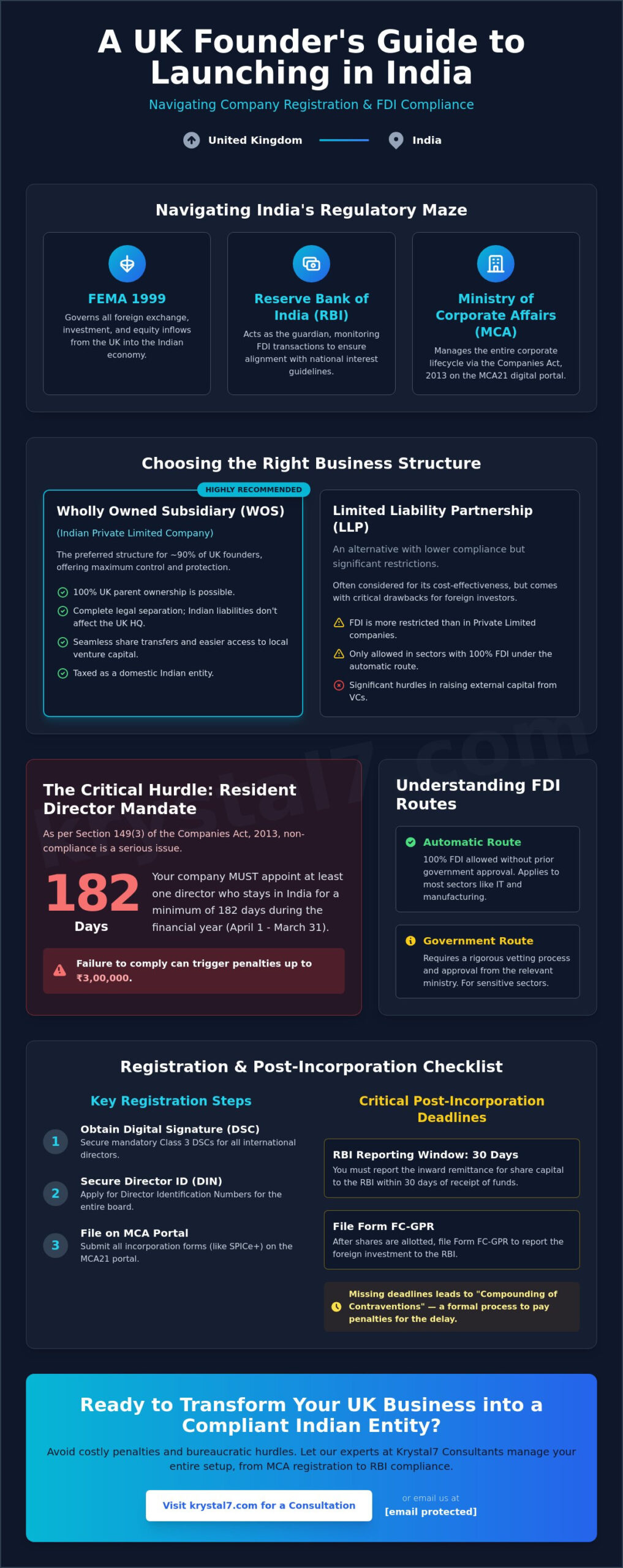
Launching a UK founder India entity requires more than just a business plan; it demands a clear understanding of the legal pillars that support foreign capital. While the UK offers corporate agility, the Indian regulatory environment prioritizes transparency and meticulous reporting. The Foreign Exchange Management Act (FEMA) 1999 serves as the primary legislation governing how UK pounds enter the Indian economy. The Reserve Bank of India (RBI) acts as the vigilant guardian of these equity inflows, ensuring every transaction aligns with national interest and security guidelines.
Most UK-based investments fall under the broad umbrella of Foreign Direct Investment in India, which is strictly regulated to ensure economic stability. For the majority of sectors, such as IT services and manufacturing, founders can utilize the “Automatic Route.” This allows for 100% foreign ownership without prior government approval. However, certain sensitive sectors still require the “Government Route,” involving a rigorous vetting process through the relevant ministry. Transparency in your shareholding structure isn’t just a legal requirement; it’s the foundation of your operational liberty in India.
FEMA Compliance for Foreign Direct Investment (FDI)
UK founders must treat every pound invested as a formal FDI transaction. Under the Master Direction on Foreign Investment in India, you’re required to report inward remittances through specific banking channels. Delaying these reports is a common pitfall for international visionaries. If you miss the 30-day reporting window for share allotment, you face the “compounding of contraventions” process. This involves paying a financial penalty to regularize the delay, which can disrupt your cash flow and professional standing. Compliance is the shield that protects your long-term growth.
The Role of the Ministry of Corporate Affairs (MCA)
The Ministry of Corporate Affairs (MCA) is your primary digital touchpoint for all corporate formalities. Through the MCA21 portal, you’ll manage your entire corporate lifecycle under the Companies Act, 2013. It’s vital to remember that India follows a strict financial year from April 1 to March 31. This differs from the UK’s flexible accounting periods. Your UK founder India entity must align its annual returns and financial statements with this cycle to avoid heavy late-filing fees. We handle these complexities so you can focus on your primary business goals without the anxiety of administrative errors.
Choosing the Right Business Structure for UK Expansion
Selecting the right structure is the most critical decision for your Indian expansion. While you’re likely familiar with the UK “Limited” company, India offers several distinct vehicles for entry. For approximately 90% of UK startups, the Wholly Owned Subsidiary (WOS) is the preferred choice. Other options include Limited Liability Partnerships (LLPs), Branch Offices, and Liaison Offices. Liaison Offices are strictly prohibited from revenue-generating activities; they only facilitate communication and market research.
Each structure carries different weight under the Indian Income Tax Act. A Private Limited company is taxed as a domestic entity, whereas a Branch Office of a UK firm is treated as a foreign company. This often leads to higher tax rates and more complex filings. If you need clarity on which model suits your specific business goals, consulting with an expert can prevent costly structural changes later.
The Wholly Owned Subsidiary (WOS) Model
The WOS is an Indian Private Limited company where the UK parent firm holds 100% of the shares. It offers complete legal separation. This means the liabilities of the Indian unit don’t spill over to your UK headquarters. It’s the most robust way to build a UK founder India entity because it allows for seamless share transfers and easier access to local venture capital. Most sectors allow 100% FDI under the automatic route for this structure, ensuring your operational liberty remains intact.
Limited Liability Partnership (LLP) for Foreigners
An LLP is often viewed as a cost-effective alternative due to lower compliance burdens. However, FDI in LLPs is more restricted than in Private Limited companies. For instance, LLPs can only receive foreign investment in sectors where 100% FDI is allowed under the automatic route and there are no “FDI-linked performance conditions.”
While the residency requirement for a designated partner is slightly lower at 120 days compared to 182 days for a director, LLPs face hurdles in raising capital. Indian venture capitalists rarely invest in LLPs. If your goal is rapid scaling through external funding, the Private Limited structure remains the superior choice for your UK founder India entity. We ensure your structure is meticulous from day one so you can scale without friction.
Step-by-Step Registration Process for UK Founders
Registering a UK founder India entity involves a series of digital and physical milestones that bridge the two jurisdictions. First, every director must obtain a Class 3 Digital Signature Certificate (DSC). This is a secure electronic key used to sign all incorporation forms on the MCA21 portal. Once the DSC is ready, we apply for a Director Identification Number (DIN), which is a unique, lifetime identifier required by the Ministry of Corporate Affairs for any individual serving on an Indian board.
The core of the process is the SPICe+ (Simplified Proforma for Incorporating Company Electronically Plus) form. This intelligent web form integrates several services into a single application to save you time. It covers your company’s name reservation, incorporation, and the mandatory application for a Permanent Account Number (PAN) and Tax Deduction Account Number (TAN). These tax IDs are essential for your business to operate legally and manage its financial obligations within India.
Document Preparation and the Apostille Process
Since the UK is a member of the Hague Convention, the legalisation of your documents is relatively straightforward. You don’t need to visit the Indian High Commission in London for every signature. Instead, your identity and address proofs must be notarised by a UK solicitor and then apostilled by the Foreign, Commonwealth & Development Office (FCDO). You’ll typically need to provide:
- A certified copy of your UK passport as primary identity proof.
- A recent utility bill or bank statement, which must not be older than two months.
- The signed and notarised Memorandum of Association (MoA) and Articles of Association (AoA).
Meticulous attention to detail is vital here. The Ministry of Corporate Affairs often rejects applications due to minor formatting errors or expired documents used as address proof. We ensure every page is perfectly aligned with Indian legal standards before submission to avoid these common setbacks.
Name Approval and Incorporation Certificate
Choosing a name requires a balance between your UK brand identity and Indian trademark rules. The name must be unique and shouldn’t resemble any existing Indian company or registered trademark. Once the MCA approves the name and the SPICe+ form, you’ll receive your Certificate of Incorporation (CoI). This certificate is the birth certificate of your business. It officially recognizes your UK founder India entity and provides the legal standing needed to open a corporate bank account. For a deeper look at the specific flow and timelines, explore our comprehensive guide on company registration in India. We handle these technicalities so you can focus on your primary goals.
Post-Incorporation Compliance and RBI Reporting
Once the Certificate of Incorporation arrives, your focus must shift to financial activation. You’ll need to open two distinct bank accounts to manage your capital correctly. A Capital Account receives the initial foreign equity, while an Operational Current Account handles daily Indian expenses and GST filings. Registering for GST is mandatory if you plan to export services back to the UK or sell within India, allowing you to claim input tax credits on your local business expenses.
Integrating your UK founder India entity into the global market requires strict adherence to RBI timelines. You have exactly 30 days from the receipt of funds to report the inward remittance through your bank. Missing this window creates unnecessary friction with the central bank and can lead to complicated regularization processes. We ensure your reporting is meticulous from the first pound received.
RBI Compliance and FC-GPR Filings
Reporting foreign investment happens through the FIRMS (Foreign Investment Reporting and Management System) portal. You must allot shares to the UK parent company within 60 days of receiving the capital. After this allotment, you have a 30-day window to file Form FC-GPR (Foreign Collaboration-General Permission Route).
You’ll need a Foreign Inward Remittance Certificate (FIRC) and a specific KYC report from your Indian bank to complete this filing. These documents prove the source and legitimacy of your UK investment to the regulators. Late filings aren’t just administrative nuisances; they carry heavy financial consequences. Penalties for non-filing can start at INR 5,000 and escalate into several lakhs depending on the duration of the delay. If you’re unsure about these timelines, our team can help you manage your RBI reporting to ensure total transparency.
Tax and Annual Compliance Mandates
Operating as a subsidiary means you’ll likely have recurring transactions with your UK headquarters. Under the Income Tax Act, you must deduct TDS (Tax Deducted at Source) on payments like royalties, dividends, or technical fees sent abroad. Accuracy here is paramount, as the tax department may disallow your business expenses if the correct TDS isn’t deposited.
You must also adhere to Section 92 of the Companies Act, which mandates maintaining specific documentation for all international transactions. This ensures your “arm’s length” pricing is defensible during audits and prevents transfer pricing disputes. For a detailed roadmap of your yearly obligations, see our annual compliance guide for a complete 2026 checklist. We handle these recurring tasks so you can pursue your primary business goals with peace of mind.
Overcoming Challenges: The Resident Director Requirement
Section 149(3) of the Companies Act, 2013, is often the most significant hurdle for a UK founder India entity. It mandates that every Indian company must have at least one director who has stayed in India for a minimum of 182 days during the financial year. For the year of incorporation, this requirement applies proportionately based on the remaining days in the calendar.
Failure to comply with this residency rule can result in a penalty of ₹50,000 for the company, plus ₹500 for each day of default up to a maximum of ₹3,00,000. Each officer in default also faces a ₹50,000 fine plus daily penalties. You don’t need to relinquish control of your business to satisfy this rule, but you must choose your local representative with precision.
Many founders consider using nominee directors to bridge this gap. This path carries risks if you don’t have robust legal agreements in place to define their role and your ultimate authority. It’s vital to ensure your local representative understands their fiduciary duties while respecting your operational liberty. We provide the liberation you need to focus on growth by managing these logistical complexities on your behalf.
Finding and Appointing a Local Director
A local director isn’t just a placeholder; they bear significant legal liabilities under Indian law. They’re responsible for ensuring the company’s filings are accurate and that the entity adheres to local labor and tax regulations. You should choose a trustworthy professional who understands the specific compliance needs of a UK founder India entity.
You can structure your board to keep the majority of voting power with your UK-based directors. This allows you to maintain strategic oversight and decision-making power while the resident director satisfies the legal mandate. Trust is the currency of this partnership, and meticulous documentation ensures your interests remain protected.
Why UK Founders Choose Krystal7 Consultants
Our Transparency Motif ensures you have clear, visual clarity on every step of the Indian bureaucracy. We speak the language of entrepreneurs and simplify complex regulations into actionable steps. Operating from Gurugram, the heart of India’s startup ecosystem, we offer end-to-end support for international visionaries looking to scale.
Learn more about starting a private limited company in India with our experts. We handle the administrative burdens so you can pursue your primary goals with confidence. Our methodical approach brings order to complicated processes, allowing you to launch your Indian journey with calm competence.
Secure Your Future in the Indian Market
Building a successful UK founder India entity is a strategic move that requires balancing UK corporate speed with Indian regulatory precision. You’ve learned that choosing a Wholly Owned Subsidiary offers the most operational liberty while maintaining 100% ownership. It’s vital to remember that satisfying the 182-day resident director mandate and meeting the 30-day RBI reporting deadline are non-negotiable steps to avoid heavy penalties. These frameworks aren’t just hurdles; they’re the foundation of a transparent and secure business.
Krystal7 Consultants brings visual clarity to these complex processes. As Gurgaon-based experts with deep MCA and RBI knowledge, we specialize in cross-border compliance for international visionaries. We offer transparent pricing with no hidden bureaucratic fees so you can scale with confidence. Ready to expand your UK business to India? Contact Krystal7 Consultants at business@krystal7.com or visit krystal7.com for expert assistance. Your journey into one of the world’s fastest-growing economies starts with a partner you can trust.
Frequently Asked Questions
Can a UK citizen be 100% owner of an Indian company?
Yes, a UK citizen can hold 100% equity in an Indian Private Limited company through the automatic route for most sectors. This structure is known as a Wholly Owned Subsidiary (WOS) and allows for total control over the UK founder India entity. You don’t need a local partner to hold shares, provided your industry doesn’t fall under the government approval list or specific FDI caps.
What is the minimum capital required for a UK founder to start an India entity?
There’s no legal minimum paid-up capital required to incorporate a Private Limited company in India. However, you’ll need sufficient funds to cover initial incorporation expenses and operational costs. Most founders start with an authorized capital of ₹1,00,000 to manage bank account opening requirements and initial filings. This flexibility allows you to scale your investment as your business grows.
Do I need to travel to India to register my company?
You don’t need to be physically present in India to register your company. The entire process, from obtaining Digital Signature Certificates (DSC) to receiving the Certificate of Incorporation, is managed online through the MCA21 portal. You can coordinate document notarization and apostille in the UK and send them to us digitally. This digital ease ensures your UK founder India entity launches without international travel hurdles.
What are the penalties for failing to report FDI to the RBI?
Failing to report Foreign Direct Investment (FDI) through the FIRMS portal results in significant financial penalties and regularisation hurdles. For late filing of documents like Form FC-GPR, the penalty starts at ₹5,000 and can reach several lakhs depending on the duration of the delay. The RBI also requires a “compounding of contraventions” process to regularize the default, which involves additional legal costs. Timely reporting is essential for maintaining your company’s legal standing.
How long does the entire registration process take for a foreign founder?
The registration process typically takes between 15 to 30 business days, depending on document readiness. This timeline includes obtaining DSCs, name approval, and the final incorporation certificate from the MCA. Delays often occur during the apostille process in the UK or if the chosen name is too similar to existing Indian trademarks. Having all notarized documents ready at the start significantly accelerates the timeline.
What is the difference between a Branch Office and a Wholly Owned Subsidiary?
A Wholly Owned Subsidiary (WOS) is a separate Indian legal entity, whereas a Branch Office is merely an extension of the UK parent. WOS entities are taxed at domestic rates, while Branch Offices face higher foreign company tax rates under the Income Tax Act. A WOS offers limited liability protection to the UK parent, making it the safer and more popular choice for long-term expansion.
Is a GST registration mandatory for a UK-owned Indian entity?
GST registration is mandatory if your annual turnover exceeds ₹20 lakhs for services or ₹40 lakhs for goods. However, if you’re exporting services from your Indian entity back to the UK, you must register for GST to claim “Zero Rated Supply” status. This allows you to claim refunds on input tax credits for local purchases, significantly improving your entity’s cash flow and operational efficiency.
How do I repatriate profits from my Indian entity back to the UK?
You can repatriate profits back to the UK through dividend payments after paying the applicable corporate income tax in India. Under the UK-India Double Taxation Avoidance Agreement (DTAA), you can benefit from reduced withholding tax rates on these transfers. Your bank will require a Chartered Accountant certificate in Form 15CB and a self-declaration in Form 15CA to process the outward remittance of funds seamlessly.

Article by
Nihal Srivastava
Nihal Srivastava is the Co-Founder of Krystal7 Consultants, helping Indian entrepreneurs and startups navigate company registration, compliance, trademark protection, and regulatory requirements with clarity and confidence. With 6+ years of hands-on expertise in MCA filings, GST compliance, and corporate structuring, Nihal has guided 1000+ businesses across India through their legal and compliance journeys. He believes every business dream deserves crystal clear foundations, and that no founder should be held back by paperwork or red tape.