

Canada Startup India Subsidiary: The 2026 Guide to Setting Up and Compliance
Did you know that foreign subsidiary registrations in India surged by 34% in the last fiscal year? As India cements its position as the world’s third largest startup ecosystem, many founders are eager to launch a Canada startup India subsidiary to tap into this massive growth. You likely see the opportunity, but the thought of navigating the Ministry of Corporate Affairs (MCA) or facing steep penalties for non compliance feels like a significant hurdle.
We agree that administrative complexity shouldn’t stifle your vision. This guide promises a clear, 2026 roadmap to establish a compliant and scalable presence in India without the stress of bureaucratic guesswork. You’ll learn how to manage the 15 to 25 day registration timeline and understand the critical Foreign Direct Investment (FDI) rules that govern your investment.
We’ll walk through the essentials of appointing a resident director who meets the 182 day stay requirement and filing mandatory forms like the FC-GPR. By the end of this article, you’ll have a transparent plan to handle Indian paperwork with confidence, allowing you to focus on your core business goals.
Key Takeaways
- Identify why the Private Limited Company structure provides the most secure and scalable foundation for a Canada startup India subsidiary.
- Master the essential steps for obtaining Digital Signature Certificates and Director Identification Numbers to simplify the MCA registration process.
- Navigate FEMA and RBI regulations with precision by understanding the mandatory reporting requirements for foreign share capital inflows.
- Establish a clear post-incorporation routine for GST filing and TDS compliance to protect your business from avoidable legal penalties.
- Unlock operational liberty by delegating complex annual filings to an expert partner, ensuring your focus remains on growth and innovation.
Understanding the India Subsidiary Structure for Canadian Startups
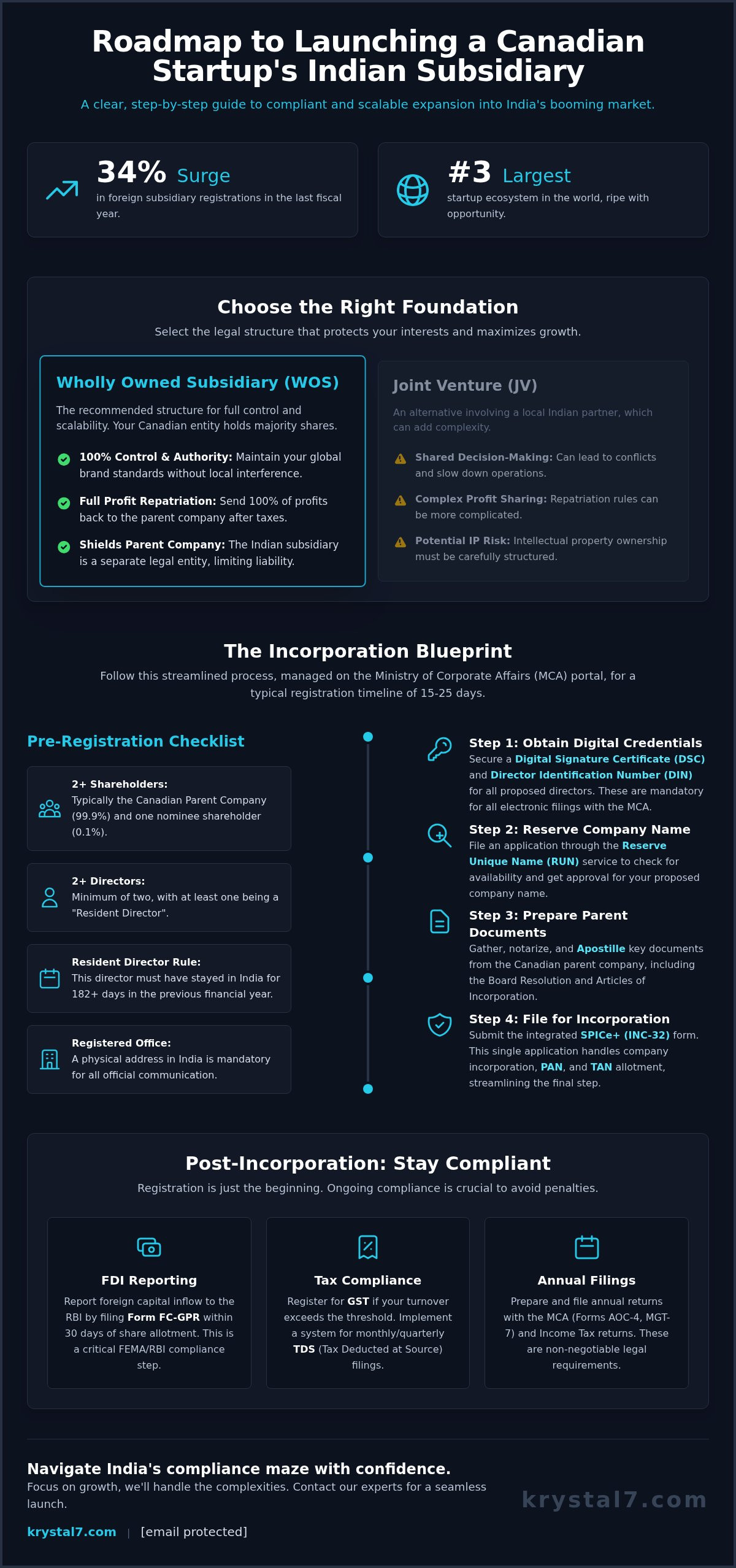
Establishing a Canada startup India subsidiary means creating a distinct legal entity under the Companies Act, 2013. Your Canadian entity acts as the parent company, holding the majority of the share capital. This structure is the most popular choice because it allows for full operational liberty while shielding your Canadian parent company from local liabilities. By choosing the Private Limited Company model, you gain a structure that Indian investors and banks recognize, making it easier to scale your operations locally.
India’s regulatory environment has become significantly more welcoming for international tech firms and innovators. Most sectors now allow for 100% Foreign Direct Investment in India through the automatic route. This means you don’t need prior approval from the Reserve Bank of India (RBI) or the government to start your journey. It cuts through the red tape that used to slow down international expansion, allowing you to move from planning to execution with visual clarity.
Wholly Owned Subsidiary (WOS) vs. Joint Venture
A Wholly Owned Subsidiary gives your Canadian team total control over management and intellectual property. It’s the preferred path for startups that want to maintain their brand’s global standards without local interference. While a Joint Venture provides local market expertise through an Indian partner, it often complicates profit repatriation and decision making. Most Canadian founders choose the WOS model to ensure 100% of the profits can be sent back to the parent entity after paying relevant taxes in India.
Minimum Requirements for Incorporation in 2026
To register your Canada startup India subsidiary, you must meet specific criteria set by the Ministry of Corporate Affairs (MCA). These requirements ensure your business has a transparent and legal foundation from day one.
- Shareholders: You need at least two shareholders. The Canadian parent company usually holds 99.9% of the shares, while a nominee holds the remaining 0.1% to satisfy the legal requirement for two distinct owners.
- Directors: A minimum of two directors is mandatory. One director can be a Canadian citizen, but the law requires at least one “Resident Director.” This person must have stayed in India for at least 182 days during the previous financial year.
- Registered Office: You must provide a physical address within India to serve as your official headquarters. This address is used for all statutory communications and must be verified with a utility bill or a lease agreement during the incorporation process.
Step-by-Step Registration Process for Your Indian Subsidiary
Moving from a structural plan to actual registration requires a methodical approach. To establish your Canada startup India subsidiary, the first technical step involves securing Digital Signature Certificates (DSC) for your directors. These certificates act as electronic signatures for all filings on the Ministry of Corporate Affairs (MCA) portal. Once you’ve secured the DSC, you’ll apply for a Director Identification Number (DIN), a unique eight-digit code required for anyone serving on an Indian board.
The next phase involves the Reserve Unique Name (RUN) service. You’ll submit your preferred company names to the MCA to ensure they don’t conflict with existing trademarks or entities. Accuracy here is vital to avoid delays. Following name approval, you’ll use the SPICe+ (INC-32) form. This integrated digital application is a breakthrough for efficiency; it simultaneously handles your company incorporation, PAN (Permanent Account Number), and TAN (Tax Deduction and Collection Account Number) applications.
Documenting the Canadian Parent Entity
Preparation is your best defense against bureaucratic anxiety. You must gather and notarize specific documents from your Canadian headquarters, including the Articles of Incorporation and a formal Board Resolution authorizing the Indian expansion. Because Canada is a member of the Hague Convention, these documents generally require an Apostille to be legally recognized in India. This step ensures that your investment aligns with the Reserve Bank of India FEMA Guidelines from the very beginning. If you’re feeling overwhelmed by the paperwork, you can explore a company incorporation package to streamline these requirements.
The Role of the MCA and SPICe+ Portal
The SPICe+ portal has transformed the incorporation timeline. In 2026, the standard window for receiving your Certificate of Incorporation (COI) is 15 to 25 business days for sectors under the automatic route. However, minor errors can lead to rejections. Common pitfalls include mismatched addresses between your utility bills and the application or failing to provide a clear description of business activities. Meticulous attention to detail during this stage creates the operational liberty you need to launch without legal hiccups. Our team ensures every document is precisely aligned with current MCA standards to prevent these setbacks.
Cross-Border Compliance: FEMA and RBI Guidelines
Establishing a Canada startup India subsidiary involves more than just incorporation; it requires meticulous adherence to foreign exchange laws. The Foreign Exchange Management Act (FEMA) governs how capital moves from your Canadian bank account into your Indian entity. It’s a framework designed to ensure financial transparency, and the Reserve Bank of India (RBI) acts as the primary watchdog for these transactions. You’ll find that staying ahead of these rules creates a foundation of relief and security for your long term operations.
When your Canadian parent company transfers the initial share capital, the Indian subsidiary must report this inflow to the RBI. This isn’t an optional step. You’ll use the FIRMS portal to file Form FC-GPR (Foreign Collaboration-General Permission Route). This filing must happen within 30 days of the share allotment date. Missing this deadline triggers a Late Submission Fee (LSF), which adds unnecessary cost and administrative friction to your journey. We handle these filings with methodical precision so you don’t have to worry about missing critical windows.
Opening a Capital Account and Current Account
Choosing a banking partner is a strategic decision for your subsidiary. Indian banks perform deep KYC checks on foreign entities, requiring notarized and often apostilled documents from your Canadian headquarters. You’ll set up two distinct types of accounts. A Capital Account receives the subscription money from the parent company, while a Current Account handles your daily operational expenses. Once your business account is live, it’s vital to link it to the GST portal to ensure your tax credits and payments flow without interruption.
Valuation Certificates and Pricing Guidelines
Transparency is the cornerstone of Indian regulatory trust. You can’t simply pick an arbitrary share price; you must follow strict RBI pricing guidelines. A valuation certificate from a Chartered Accountant is mandatory to prove that shares aren’t issued below their fair market value. This process aligns your business with the standards maintained by the Foreign Investment Facilitation Portal (FIFP). By securing a professional valuation report, you protect your startup from future audits and ensure your capital infusion remains fully compliant with the latest 2026 mandates.
Post-Incorporation: GST, TDS, and Annual Compliance
After your Certificate of Incorporation arrives, your Canada startup India subsidiary must begin its tax and regulatory journey. This phase is about maintaining the operational liberty you’ve worked hard to establish. You’ll need to register for Goods and Services Tax (GST) if your turnover exceeds the threshold or if you’re involved in inter-state or cross-border trade. Under the Income Tax Act, your subsidiary must also handle Tax Deducted at Source (TDS) on various payments; professional fees currently carry a 10% rate.
The Companies Act, 2013, mandates a statutory audit for every Private Limited company, regardless of its size or revenue. Your auditor will verify your financial statements before you file them with the Registrar of Companies (ROC). You must also file Form FLA (Foreign Liabilities and Assets) by July 15 every year to report the status of your foreign investment to the RBI. These steps ensure your business remains transparent and secure in the eyes of Indian regulators.
GST Compliance for Tech Startups
If your Indian team provides software development or support to the Canadian parent, you’re likely “exporting services.” You can apply for a Letter of Undertaking (LUT) on the GST portal to export without paying the 18% integrated tax upfront. This preserves your cash flow and simplifies your monthly filing routine. You can learn more about these steps in our guide on GST filing and compliance in India.
The Cost of Non-Compliance: Penalties and Risks
Deadlines in India are rigid. The penalties for missing them can escalate quickly. For the financial year ending March 31, 2026, you must file Form AOC-4 by October 29, 2026, and Form MGT-7 by November 29, 2026. Failing to file these ROC documents results in a daily penalty of ₹100 per form. This cost adds up fast and can impact your company’s standing on the MCA portal.
FEMA compliance is even more critical. New regulations taking effect on October 1, 2026, will replace the 2015 framework for the export and import of services. Delayed reporting of share transfers or capital changes can lead to heavy compounding fees from the RBI. To stay ahead of these requirements, review our annual compliance for private limited company checklist. Our team provides a comprehensive Annual Compliance Package to handle these filings on your behalf, ensuring you never face a late fee or legal notice.
Why Canadian Founders Choose Krystal7 for Indian Expansion
Establishing a Canada startup India subsidiary is a strategic move that requires a dependable partner on the ground. Krystal7 Consultants operates from the heart of Gurugram, India’s premier startup hub. This strategic location gives us a direct pulse on the latest regulatory shifts at the Ministry of Corporate Affairs and the Reserve Bank of India. We act as your local eyes and ears, ensuring your expansion remains compliant and scalable from day one.
Our team specializes in the end to end management of the foreign subsidiary registration process. We understand that as a founder, your primary goal is to capture market share and innovate. By delegating the administrative burden to us, you gain the operational liberty to focus on your product. We handle the meticulous details of MCA filings and RBI reporting, turning a complex bureaucratic journey into a clear and predictable roadmap.
Trust is built through financial openness and visual clarity. We embrace a “Transparency Motif” in every cross border transaction we manage. This means you’ll always have a precise view of your compliance status and filing timelines. Our goal is to alleviate the anxiety of Indian regulations by providing expert guidance that is both professional and approachable.
Our Methodical Approach to Subsidiary Setup
Entering the Indian market shouldn’t feel like navigating a maze. We provide personalized advisory services tailored specifically to the needs of Canadian tech startups and SMEs. Each client is paired with a dedicated compliance manager who oversees long term annual support. This methodical approach ensures that your statutory audits and tax filings are handled with elite precision. For a comprehensive look at the legal landscape, you can explore our guide on private limited company india.
Get Started with Your Indian Subsidiary Today
Your expansion journey begins with an initial consultation focused on structural and tax planning. We help you align your Canadian parent entity’s goals with Indian regulatory requirements like FEMA and the Companies Act. We believe in transparent pricing models for our registration and annual compliance packages. You’ll never encounter hidden fees or unexpected costs as you grow your team in India.
Our advisors combine deep institutional knowledge with a human touch to support your long term success. We are ready to handle the complexity so you can pursue your vision with confidence. Contact Krystal7 Consultants today at business@krystal7.com or visit krystal7.com to begin your journey with a trusted Indian partner.
Secure Your Growth in the Indian Market
Establishing a Canada startup India subsidiary is a transformative step toward global growth. You now have a clear roadmap for navigating the Private Limited structure and securing 100% FDI through the automatic route. Remember that meticulous FEMA reporting and adhering to the 30 day rule for Form FC-GPR are essential to protect your capital. These steps create the operational liberty you need to scale without the weight of bureaucratic anxiety.
Krystal7 Consultants provides the Gurgaon based expertise required to manage these complexities with visual clarity. We specialize in Foreign Subsidiary Registration and provide transparent; deadline driven compliance management for every stage of your journey. Our team handles the meticulous details of MCA filings and statutory audits so your focus remains on innovation. Register your India subsidiary with Krystal7 Consultants today to begin your expansion with confidence. India’s vibrant market is ready for your vision; let’s build your success together.
Frequently Asked Questions
Can a Canadian startup own 100% of an Indian company?
Yes, a Canadian entity can own 100% of its Indian subsidiary under the Wholly Owned Subsidiary (WOS) model. Most sectors like IT, manufacturing, and consulting fall under the automatic route of Foreign Direct Investment. This structure ensures your Canadian parent company maintains total control over operations and intellectual property in India.
What is the minimum capital required to start an India subsidiary?
There’s no statutory minimum capital requirement under the Companies Act, 2013, to incorporate a Private Limited company. You can start with a nominal amount like ₹1,00,000 to cover initial setup and professional fees. It’s best to align your initial capital infusion with your actual business plan and operational needs for the first few months.
How long does the Canada startup India subsidiary registration take?
The registration process for a Canada startup India subsidiary typically takes 15 to 25 business days. This timeline includes obtaining Digital Signature Certificates, securing name approval, and receiving the final Certificate of Incorporation from the MCA. Providing apostilled documents from Canada promptly is the best way to ensure a smooth and predictable setup.
Does a Canadian director need to travel to India for registration?
No, your presence in India isn’t required at any stage of the incorporation process. All applications and filings are handled digitally through the Ministry of Corporate Affairs (MCA) portal. You only need to provide notarized and apostilled copies of your identification and address proof from Canada to your consultants in India.
What are the main tax implications for a subsidiary in India?
Your Indian subsidiary is treated as a domestic company and is subject to corporate tax on its global income. You’ll also need to manage Tax Deducted at Source (TDS) on various payments like rent and professional fees. It’s vital to follow the Income Tax Act meticulously to avoid penalties and ensure your business remains financially transparent.
Is GST registration mandatory for an Indian subsidiary?
GST registration is mandatory if your annual turnover exceeds ₹20 lakhs or if you provide inter-state services. Even if you’re only exporting software services back to Canada, registering for GST is highly recommended. It allows you to use the LUT facility to export services without paying 18% tax upfront, which significantly improves your cash flow.
What is the role of a Resident Director in an Indian subsidiary?
A Resident Director is a person who has stayed in India for at least 182 days during the previous financial year. Indian law requires every company to have at least one such director to ensure local accountability. This director acts as a bridge between your company and Indian regulatory authorities like the ROC and RBI.
How do I repatriate profits from India back to my Canadian parent company?
You can repatriate profits by declaring dividends after paying the required corporate taxes in India. These transfers must comply with the Reserve Bank of India pricing guidelines and FEMA regulations. Leveraging the Double Taxation Avoidance Agreement (DTAA) between Canada and India can help you optimize the tax impact on these cross-border transfers.

Article by
Nihal Srivastava
Nihal Srivastava is the Co-Founder of Krystal7 Consultants, helping Indian entrepreneurs and startups navigate company registration, compliance, trademark protection, and regulatory requirements with clarity and confidence. With 6+ years of hands-on expertise in MCA filings, GST compliance, and corporate structuring, Nihal has guided 1000+ businesses across India through their legal and compliance journeys. He believes every business dream deserves crystal clear foundations, and that no founder should be held back by paperwork or red tape.